
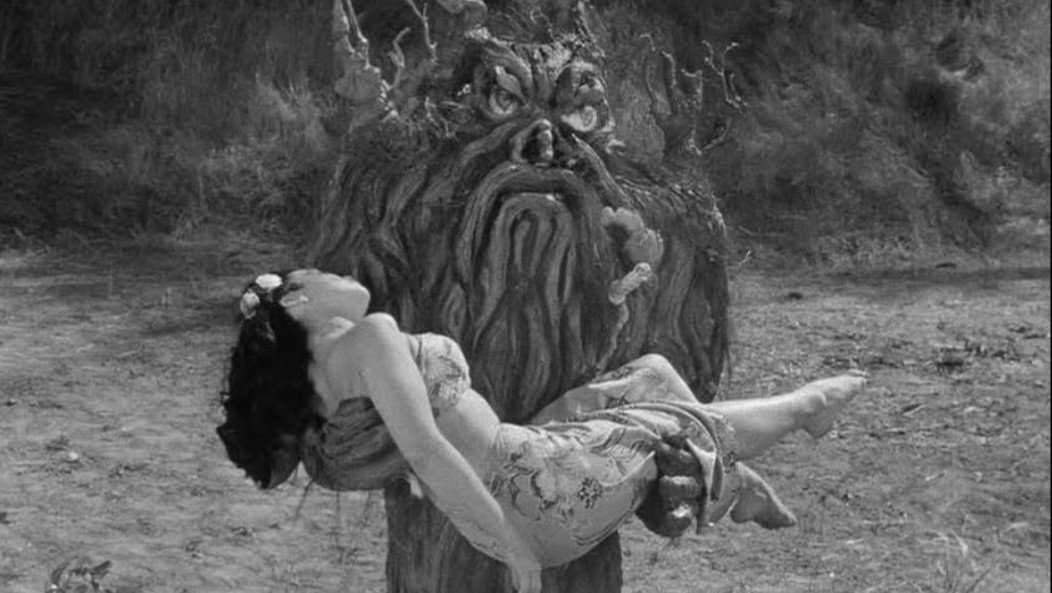
US scientists battle evil natives and a murderous tree stump on a South Pacific island. The killer tree is the saving grace of Dan Milner’s tedious, talky 1957 no-budget cult classic. 2/10
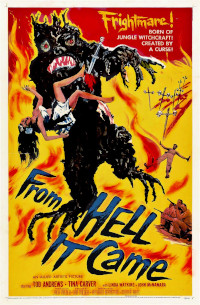
From Hell It Came. 1957, USA. Directed by Dan Milner. Written by Richard Bernstein & Dan Milner. Starring: Tod Andrews, Tina Carver, Linda Watkins, John McNamara, Gregg Palmer, Chester Hayes. Produced by Dan & Jack Milner. IMDb: 3.8/10. Letterboxd: 2.0/10. Rotten Tomatoes: N/A. Metacritic: N/A.
There is a legend that on one island in the South Pacific, there was once a prince who was unjustly killed and buried upright in a tree trunk. He came back as a walking tree to exact justice on those who betrayed him.
At least that is what the opening crawl of Allied Artists’ 1957 cult classic From Hell It Came would have us believe. Yes, this is the movie known as “the one with the walking tree stump”, which is much easier to remember than its generic title. Directed by Dan Milner, this is the second and last production by the Milner Brothers, and it was released in a double bill with another low-budget jungle quickie, Walter Grauman’s The Disembodied (1957).

After the opening crawl, we jump straight into the execution of prince Kimo (Gregg Palmer), accused bringing about the death of his father the chief by allowing the white men to give him bad medicine for a disease caused by the devil dust. This is all a ruse conctocted by medicine man Tano (Robert Swan), the new would-be chief Maranka (Baynes Barron) and Kimo’s double-crossing wife Korey (Suzanne Ridgeway) to seize power. Before he is stabbed to the heart, Kimo vows to return and avenge himself (or as the screenplay puts it, revenge himself). He is then buried standing up in a wooden box (not in a tree trunk, as the opening crawl would suggest).

Meanwhile, on the other side of the island, the white men are bored to death with their job. They are here to investigare nuclear fallout from atom bomb tests, and now the natives blame the tests for making them sick. This, of course, is just nonsense and propaganda, but it turns out that the villagers are actually sick with the plague. This means that the white scientists are now instead tasked with curing the villagers of the plague. This is easier said than done, as medicine man Tano has turned the villagers against the westerners after the death of the chief.
The westerners include William Arnold (Tod Andrews, our male lead), Prof. Clark (John McNamara) and Eddie (Mark Sheeler). There’s also Mrs. Kilgore, who is the proprietor of the local trading post and our comic relief (Linda Watkins). They are soon joined by the beautiful Dr. Terry Mason (Tina Carver, our female lead), whom Arnold has his eyes set upon. But there are problems in paradise, as Mason has decided that she is scientist first, and woman second, and we all know that women in the 50’s could not be both women and scientists.

Around half an hour of exposition and romatic attempts later (and a shower scene), the scientists notice that there is a radioactive tree stump growing out of Kimo’s grave, and Dr. Mason confirms with a stetoscope that it has “a human heartbeat”. They dig up the stump, which has legs, arms and a snarling face, and bring it to the lab, where Mason injects it with her “new serum” in order to keep it alive (apparently this is the same serum that cures the plague, so it is multi-funtional).
But lo and behold, the tree stump does more than live, it gets up and walks out into the jungle. One of the few natives that still keep up with the westerners, Norgu (Lee Rhodes) brings his sick wife (Lenmana Guerin) for check-ups, which the scientists perform by looking at her cheeks, confirming that she is recovering well from the plague. Norgu explains that the walking tree stump is Kimo, returned to life as the tree monster Tabanga. Tabanga has risen once before, and killed not only those who wronged him, but initiated an undiscriminating killing spree.

Meanwhile, medicine man Tano’s wife Naomi (Tani Marsh) defects to the westerners, as she sees that Tano is now favours his co-conspirator Korey over her. This leads to a cat-fight between Korey and Naomi, with Naomi on the losing end, until Tabanga shows up to kill his devious ex-wife, by throwing her into quicksand. Tabanga then proceeds to kill the new cheif and the medicine man, by squeezing them to death. Having run out of baddies, Tabanga turns to Dr. Mason, and this is when the white men get involved. Rather than use their superior western science to kill the fiend, they take Norgu’s advice that the only way to kill the monster is to drive the dagger which killed Kimo, still lodged in the monster’s chest, deeper into the monster’s heart. This they set out to do by shooting the hilt of the dagger, Robin Hood style, with their hand guns.
Background & Analysis

Dan Milner is such an obscure director that he doesn’t have either a Wikipedia entry or a proper IMDb bio. Milner was a respected editor now nearing the end of his carreer, and his brother Jack was a sound and film editor. Dan had directed one little film in the 30’s, but he is best known for his other two movies (his only other movies), Phantom from 10,000 Leagues (1955, review), and From Hell It Came. Both were produced by him and his brother Jack, and the earlier was one of the first films released by American International Pictures, made for $75,000. Despite the rather dismal end result (but still profitable), the Milner brothers were somehow able to convince Allied Artists to let them produce another monster movie, From Hell It Came, in 1957. I haven’t found any budget figures, but it can’t have been more than $100,000.
Just as little is known about the screenwriter Richard Bernstein, who produced and directed a handful of B-films between 1956 and 1963 that have been generously described as “interesting”. Dan Milner and Bernstein are credited for the story of From Hell It Came, and Bernstein with the actual script. If nothing else, one must give Milner and Bernstein credit for coming up with an original idea. I don’t think anyone had thought of making the villain in a film a South Sea prince returned from the dead as a walking tree before. That’s not to say that it was a good idea, but definitely original.
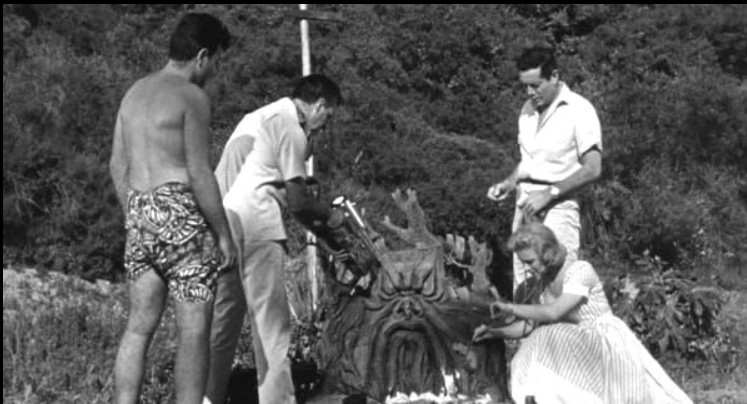
The only other positive thing you can really say about the script is that it is at least somewhat coherent. The plot, such as it is, is a mishmash of popular tropes. South Sea adventure movies had been popular for a long time, but increased in popularity in the mid-forties after US soldiers returned home from having served on the islands during WWII. However, apart from the sarongs and a short hula dance sequence, there is nothing in the portrayal of the natives suggesting a South Sea culture. Rather, they are portrayed very much in the casually racist manner that Hollywood movies portrayed African tribes in the period, complete with voodoo rituals that, of course, have never been native to the Pacific islands. There’s the old colonialist white saviour narrative with western scientists saving superstitious and ignorant natives from themselves, battling evil witch doctors and romancing meek and submissive native girls. The tree monster born out of native magic places this in the fantasy monster movie category, but Bernstein has also wedged in the catch-all trope of the times, radiation, placing this film somewhat loosely on the fringes of science fiction.

This mishmash could easily be forgiven, was the script well-written. Unfortunately, it is not. There is no mystery to be solved, no plot points to unravel, as the opening crawl combined with Kimo’s speech in the beginning, lay out all the plot points and character motivations, which remain unchanged to the end of the film. Thus Bernstein paints himself into a corner in the very first five minutes, as there is now no real plot to be had, other than waiting for the tree monster to arrive and start killing people. Bernstein’s solution is to use around 40 of the film’s 71 minutes on leaden exposition that we don’t need and a pointless romantic subplot that we don’t want.
We already know that Kimo will return as a killer tree. We accept the fact because he says so. No exposition in the world will make it any more plausible. From Kimo’s speech we also know that his father died of the plague, and the medicine man and the usurper chief have poisoned him in order to turn the village against the western scientists. Still Bernstein sees fit to have the white people explain this fact to the audience several times. Kimo also says that it was the plague that made his father sick, not the radioactive fallout. Still, this point is also laboured several times in the westerners’ dialogue. The legend of Tabanga the vengeful tree is laid out in the opening crawl. Still, we have characters explaining what Tabanga is several times in the movie.
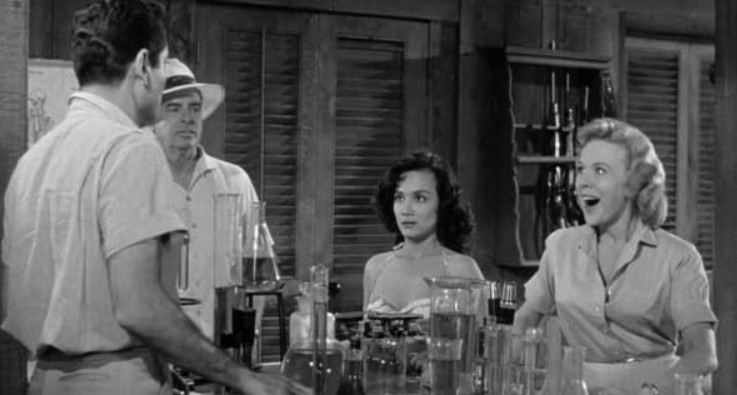
The romance plot is combined with the trite “women can’t be scientists” trope. Of course, by this day and age many women were scientists, some of them famous ones. So the screenwriters in 50’s movies couldn’t claim women couldn’t be scientists because of any lack in intellect. Instead, the trope — that might very well have been established in Rocketship X-M (1950, review) — that 50’s screenwriters fell back on was that you couldn’t be “all woman” and scientist at the same time. That somehow, using your grey matter for solving scientific problems in your work prevented you from having emotions, dating, being feminine, getting married, having children, being happy in your personal life — or really even from having a personal life at all. It is never explained why this doesn’t also apply to men.
But of course, the underlying conflict here is that for a woman to be a scientist, she must have a professional career. This means she can’t be at home ironing her husband’s socks and making him slow-cook dinners all the time, and this arrangement requires the husband to take part in domestic duties, at least to some extent, even if the family hires a maid/nanny. This, of course, isn’t said aloud in these movies, but rather it is presented as the men trying to convince the women to search their own feelings in order to realise that beneath all this “science stuff”, all women really have a yerning for raising children and being the soft, stay-at-home caretakers that god and natured designed them as. And that all this “science stuff” and “caree stuff” goes against their very nature. It is also often oddly suggested that women with a career in science somehow feel that they can’t even have relationships because it would somehow interfere with their careers in science. (Unfortunately this often had some truths to it, as their husbands wouldn’t let women have careers, but wanted them to stay at home and iron their socks and slow-cooking dinners. Just look at all the Hollywood actresses who dropped out of their careers after marrying.)

This is the case in From Hell It Came, where Mason tells Arnold that she’s “nobody’s girl” and can’t give up her life in science for a relationship. Arnold doesn’t take no for an answer and more or less forces himself on her in order to prove a point. But halfway through the movie, this subplot vanishes into thin air, and we never learn if Mason sees the light and becomes a All-American House Wife or not, rendering all the build-up pointless.
I won’t go into all the problems with the script in detail, as that would make for a never-ending post. But the main problem really is that it is so slow-moving and talky that you risk falling asleep before anything starts to happen. It doesn’t help that almost all western characters are wholly unlikable and do nothing but complain from beginning to end. The casual downplaying of the dangers of nuclear fallout doesn’t make them seem any more sympathetic — or indeed scientific. At one point one of the characters says that the fallout isn’t more radioactive than “an ordinary dental x-ray”. Well, there’s a reason that you are shielded with lead plates for the couple of seconds an x-ray takes to get.

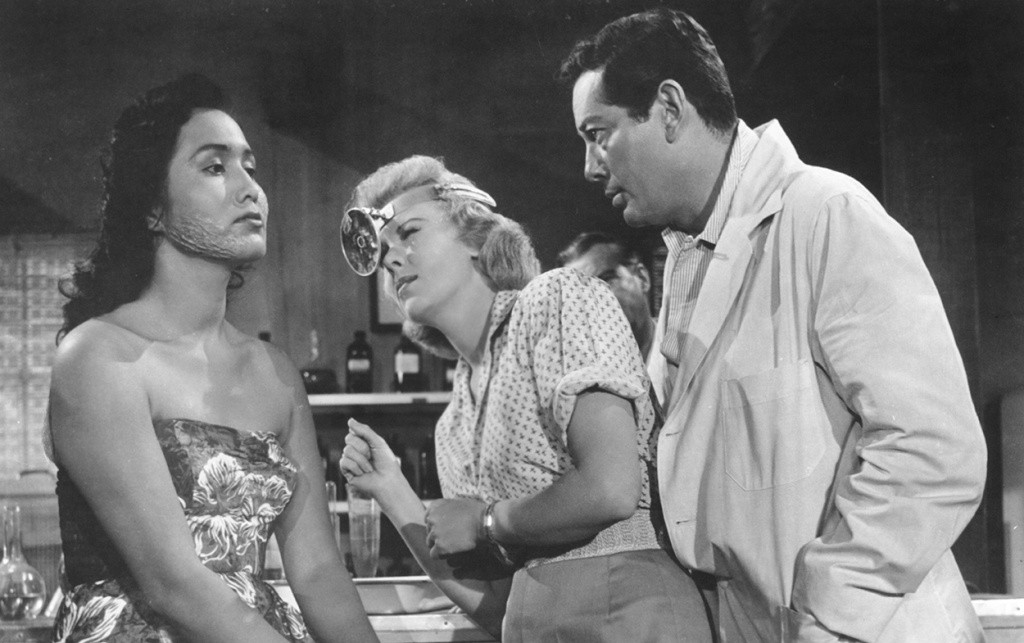
And you really have to suspend your disbelief in order to buy the fact that these are actial scientists. They examine plague victims by simply looking at their cheeks, they take the pulse of a tree with a stetoscope and leave what they have been told is a deadly tree monster unfettered on a hospital bed. Apart from the stetoscope and an IV-drip, there is not a single piece of medical equipment in sight, despite the fact that they have been running a clinic for the whole village out of their bungalow.
There are also way too many characters. Eddie has no function whatsoever. Tano and Maranka could have easily been a single character, in fact Maranka has little to no plot value. Naomi seems to exist only so that she can fight Korey in one scene. Then there’s Orchid (Grace Mathews), the westerner’s mixed-race servant girl who seems to be in the plot only to look pretty. Dori and Norgu only exist to provide exposition, and conveniently turn up at the clinic whenever something needs to be explained.
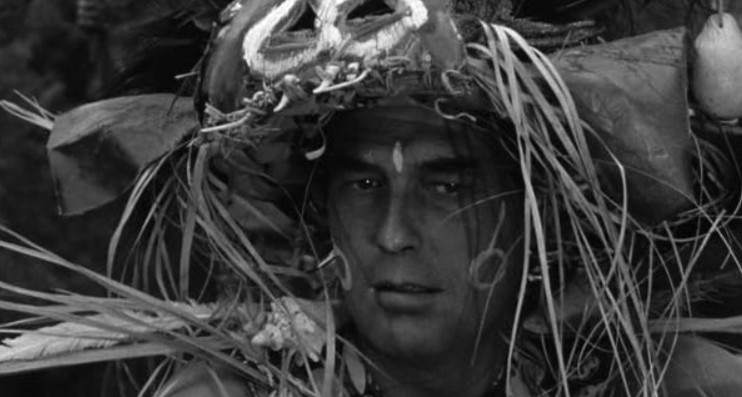
Matters aren’t helped ny the fact that almost all natives are played by white actors sporting wildly inappropriate American dialects. The only non-Caucasian actors in movie, according to IMDb’s credit sheet, are Tani Marsh and Al Kikume, both born on Hawaii. And Kikume is only in a bit-part, and wasn’t even credited on-screen. Speaking of accents, there’s the annyoing comic relief Mrs. Kilgore, played by Boston-born Linda Watkins. A throwaway line seems to suggest that she is supposed to be Australian, but Watkins’ accent sound more like someone took an approximation of Cockney and put it through a blender.
I don’t want to be too hard on the actors. There’s few actors that could have made this script and dialogue work. But they certainly don’t help matters. Tod Andrews makes for both an unsympathetic and flaccid leading man, and John McNamara brings little to the role of Professor Clark, other than a snide grin. Tina Carver struggles bravely with the role of Dr. Mason, but when your character is required to use a stetoscope and an IV drip on a tree while claiming that she can’t date people because that would interfere with her being a scientist, there is only so much you can do. Gregg Palmer gives it his all as Kimo, but unfortunately he is killed off before the film even gets started. Robert Swan looked more at home in a cowboy hat than dressed up as a medicine man. Suzanne Ridgeway hams it up to the max as Koray, and is at least entertaining. Tani Marsh gives the most sincere performance, and one would have liked to see more of her.
We haven’t even gotten to the infamous monster yet. The walking tree stump is the only reason this movie is still remembered today. I long thought that From Hell It Came was produced by American International Pictures, partly because Dan and Jack Milner produced their first SF movie for AIP, but mostly because of the involvement of AIP’s monster maker extraordinaire, Paul Blaisdell. Turns out, Blaisdell’s involvement was much smaller than I had thought. Randy Palmer’s book Paul Blaisdell, Monster Maker states that he was approached by the Milners to do the monster for The Phantom from 10,000 Leagues, but that he declined due to other obligations. For From Hell It Came, Dan Milner once again approached Blaisdell, and once again Blaisdell was busy with other projects. However, he agreed to create a basic design for the tree monster, which eventually turned into two highly detailed design drawings.
The original concept was apparently quite far removed from what appears on film. Blaisdell created a spindly, creepy monster that wasn’t supposed to be played by a man in a suit, but would have had to be done as a stop motion puppet, a rod puppet or a marionette. Blaisdell’s frequent collaborator Bob Burns says that this was perhaps the finest design Blaisdell ever made. However, the Milners realised that they didn’t have the time or the money to create the effects needed for Blaisdell’s vision. Dan Milner decided that the cheapest and fastest way to make the monster was through the tried-and-tested man-in-a-suit solution, and took Blaisdell’s drawings and turned them over to Don Post Studios in order to have them redesign and manufacture the monster according to the Milners’ instructions.

The end result includes Blaisdell’s trademark evil frown, but lacks the spiky, leathery appearance of most of his designs. If one took away the frown, one wouldn’t immediately identify it as a Blaisdell design, which, of course, it wasn’t. When immobile, the monster doesn’t look half bad — it sort of resembles some kind of totem creature carved out of wood. However, as soon as it starts wobbling its way through the jungle, it is prone to induce more laughter than terror. Of course, the concept of a murderous tree stump is laughable in and of itself, and when the end result is clearly a stuntman struggling to move in an awkwardly restrictive rubber suit, you think more of the poor sod stuck inside the thing than about whether the monster is going to kill any of the inconsequential characters of the movie. That poor sod’s name was Chester Hayes, a tall, burly bit-part actor who is only remembered today for this very role.
Blaisdell says in the book about the end product that “the people who built it did a damn good job of reproducing a prop that was a nice concept and certainly an original one, but one that was very awkward”. “Awkward” is the key word. Hayes clearly has very restricted leg movement, and moves with shuffling steps, awkwardly bobbing from side to side when walking. The victims all work very hard to try and convince the audience that they wouldn’t be able to escape the monster at a leisurely strolling pace. The only way the Tabanga is able to catch its victims is when the actors either pretend that tree trunks standing several feet apart are an impenetrable wall against which they are cornered with no way to escape, or when they stand patiently in one place for no obvious reason, allowing the monster to sneak up on them from behind. Also, the Tabanga’s arms begin at the elbows, so its reach is severely limited. As one critic put it, the best way to escape Tabanga would probably be to lie down flat on the ground, as the monster can’t bend forward, nor reach down with its arms.
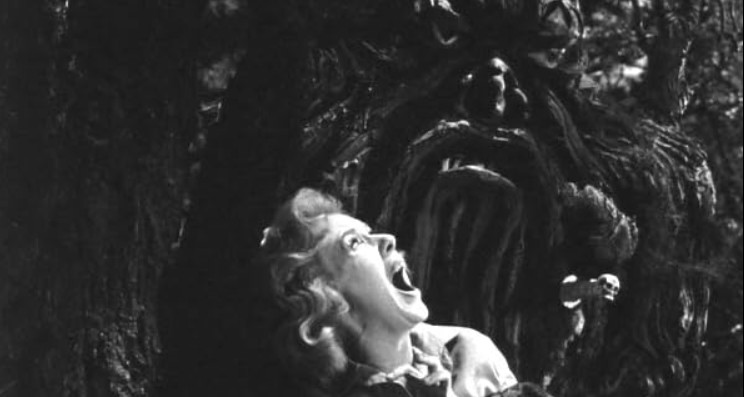
There’s some confusion about the name of the vengeful tree spirit. Literary sources alternatively spell it Tabanga and Tabonga, and some press kits at the time of the film’s release called it Taranga. To further complicate matters, the trailer called the monster Baranga. I think it’s quite clear that the characters in the film call it Tabanga.
Dan Milner was a seasoned editor, so he knew the importance of doing multiple setups, blocking and keeping things fluid (however it was brother Jack who did the actual editing). But it doesn’t matter from how many angles you show people in a room talking if they have nothing interesting to say. Much of the film is shot outdoors, which means most of it is shot in a largely uninteresting light. And indoors, cinematographer Brydon Baker, whose primary experience was from B-westerns, isn’t able to do anything interesting with the lighting in order to build atmosphere. Darrell Calker’s nondescript score, focusing mostly on crashing the audience’s ear drums when something dramatic is supposed to take place, doesn’t offer much help. Set designs are threadbare, and we never see anything of the native village except for the exterior of one hut. There is absolutely no sense of geography in the movie. We are told that the village and the westerner’s outposts are on different sides of the island, but there is no concept of what this means in terms of distance, nor where anything else in the movie takes place in reference to these two landmarks. Low-budget makeup specialist Harry Thomas worked on the film, and says his primary job was to provide the villagers with radiation scars (although the movie explicitly states that radiation is not an issue — on the other hand it states that the radiation made the plague symptoms more severe).
From Hell It Came is a film that fails on almost every account, and that has few redeeming qualities. From a technical point of view, it is more accomplished than many of the no-budget films I have reviewed here, and the actors are all clearly professionals. But this doesn’t help much when the script and dialogue are as bad as they are here, and the quality of the cinematography is secondary if there’s nothing interesting to point the camera at. The main sin of From Hell It Came is that it is just extremely boring and slow-moving with pretty much nothing in the way of a plot. The only way to enjoy it is as an object of derision. And as a so-bad-it’s-good movie, at least the inept and absurd monster will provide you with a few good laughs.
Reception & Legacy

From Hell It Came was released on a double bill with The Disembodied in late August, 1957, following a summer jam-packed with monster movies. Beginning in 1957, low-budget outfit AIP had taught studios that a good poster alone could sell enough tickets to monster films that the actual content didn’t matter much, as long as the budget was kept low. Other studios caught on in 1957, and during the summer months there was a new monster movie premiere every week, and I suspect that none of the films lost money.
By the time that From Hell It Came came out, trade paper critics were already seemingly numb to the often poor quality of these movies. The Motion Picture Exhibitor wrote that it was “no better and no worse” than similar movies. Harrison’s Reports said that it “should make one’s flesh creep, povided, of course, that one takes the doings seriously”. Variety said: “Although somewhat amateurishly turned out, the film does have the necessary horror ingredients for which the teenagers are storming the [box office] just now”. However, the paper also noted that “Dan Milner’s direction […] often leaves much to be desired”. Allegedly one critic at a major newspaper had a one-line review stating something along the lines of: “From Hell It Came … and to Hell it can go right back”.
From Hell It Came has a 3.8/10 audience rating on IMDb, based on around 2,000 votes and a 2.0/5 rating on Letterboxd, based on around 1,000 votes. AllMovie gives it 2/5 stars, with Bruce Eder writing that the monster is the one thing in the film that actually works: “Nothing else does — not the acting, despite the presence of once-promising theater hopeful Tod Andrews in the lead; and certainly not the script, which makes little sense, and is also terminally talkie for a full half-hour (which seems like an hour) following the ridiculous introduction, loading us up with exposition leading nowhere. So the viewer, in theaters in 1957 and at home ever since, takes what they can get, in this case, the Tabonga”. TV Guide calls it “really goofy”.
There are many online reviewers that put up some defence for this film. Mark Cole at Rivets on the Poster opines that its not “as bad as the legends suggest. It’s actually fairly good as low budget Fifties horror/SF goes.” Phil Hubbs at Hubbs Movie Reviews says: “In all honesty, all sideswipes aside at the immensely ludicrous plot this movie isn’t too bad. Lets be frank, if you enjoy corny black and white horror flicks then this will really rock your world.” Glenn Erickson at DVD Savant also seems to enjoy the films “hilariousness”, writing: “On the scale of ludicrous-ity it ranks somewhere near the Great Works of Ed Wood“. Gary Loggins at Cracked Rear Viewer also said that among so-bad-they’re-good movies, From Hell It Came is “right up there with the best of the worst”. Also letting himself be swept up the the “ludicrous-ity” is Kevin Lyons at The EOFFTV Review: “From Hell It Came is indeed dreadful on just about every level but thanks to the eponymous “it”, an inexpressive, scowling possessed tree monster designed by the indefatigable Paul Blaisdell, it is a lot of brainless fun.”
However, everyone’s not amused. Dave Sindelar at Fantastic Movie Musings and Ramblings calls the film a “turkey”, writing: “the story is slow, talky, confusing, and badly acted, and the monster is one of the least spry this side of Kharis”. And Richard Scheib at Moria isn’t swayed by by the unintentional comedy gold, giving the film 0/5 stars: “About the only virtue that From Hell It Came has is as a bad movie classic.”
Cast & Crew
I think I have written all that is even remotely interesting about the director, producer and writer – at least everything I can find from the sparse sources available – above. However, the cast list is a tad more exciting.

Tod Andrews had a second career on stage, which was by all accounts more successful than the one he had in the movies. He entered Hollywood in the early 40’s and enjoyed a brief moment as a B-movie leading man and as a supporting player in A-films after the US entered WWII, and many of Hollywood’s male stars were called into service (at the time, he used the screen name Michael Ames). It was during this era that he played the male lead in two just as hilariously bad SF horror films as From Hell It Came (1957): Monogram’s Bela Lugosi vehicles Return of the Ape Man (1944, review) and Voodoo Man (1944, review). In addition, he had a supporting role in Warner’s SF comedy The Body Disappears (1941, review) and as the ill-fated Skipper in Beneath the Planet of the Apes (1970). He found some fame also on TV in the mid-50’s. In 1954-1955 he had a regular role in almost 400 episodes of the day-time soap opera First Love, and 1957-1958 he payed the titular lead as Confederate cavalry officer John Singleton Mosby in the American Civil War series The Gray Ghost. He appeared sporadically in feature films during the 50’s, 60’s and 70’s, but mainly worked in TV and on stage.
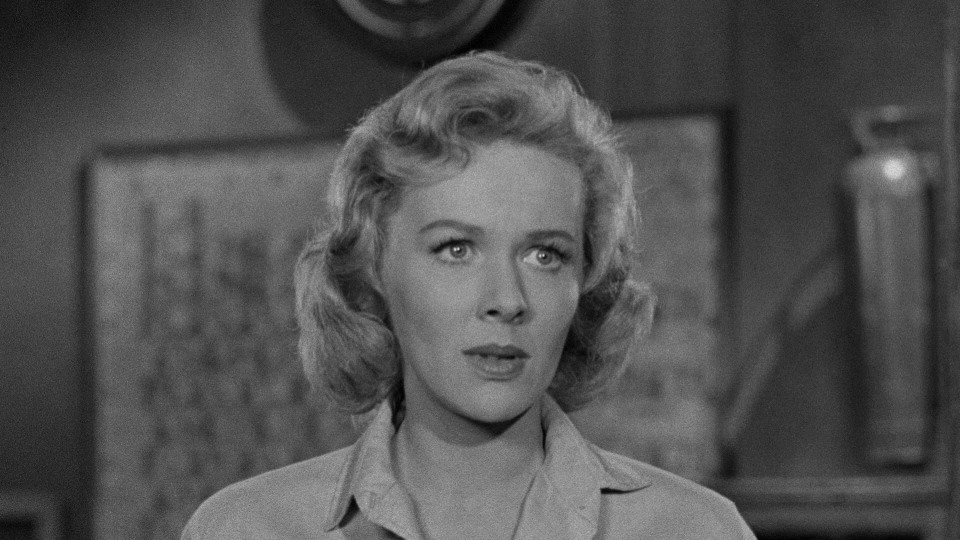
Another stage alumni was Tina Carver, who appeared on the stages of the US entertainment troops in Germany after WWII, having followed her husband’s work to the country. Back in the US in the early 50’s, she worked her way from TV to a Columbia contract and was for a time a hopeful starlet, however her career never took off, and she was confined to leading roles in B-movies and a few supports and bit-parts in A-films. In 1957 she appeared in two SF movies, The Man Who Turned to Stone (review) and From Hell It Came, which remained her last film role. She struggled on as a TV guest star until the early 60’s, when she called it quits.
Linda Watkins was also primarily a stage actress. From Hell It Came claims to “introduce” her to the big screen, despite the fact that she had appeared in half a dozen films in the 30’s, before returning to the stage. She appeared in numerous films and TV shows during the late 50’s, 60’s and 70’s.

Gregg Palmer has a small but memorable role as Kimo in From Hell It Came (1957). Of Norwegian heritage, he started his showbiz career as a radio announcer, and was able to secure a contract as a stock player at Universal in the early 50’s under his own name Palmer Lee. He went freelance in 1954 as Gregg Palmer, and appeared as a guest star in numerous TV shows, but also managed to establish himself as a popular and handsome leading man in B-movies. He co-starred in The Creature Walks Among Us (1956, review), and starred in Zombies of Mora Tau (1957). He tells film historian Tom Weaver that he didn’t want to make From Hell It Came, but that his agent managed to talk him into taking a small role, as monster movies were popular with the kids. His scene took one day to film. He also appeared in a bit-part in The Absent Minded Professor (1961) and in a large supporting role in The Most Dangerous Man Alive (1961). He also had an uncredited bit-part in the Star Trek Episode “Spectre of the Gun”, in which the Enterprise crew are transported to an alien recreation of the Wild West. Palmer appeared in close to 200 films or TV shows between 1953 and 1982, and is perhaps mostly associated with westerns. He was at one point offered to take over the role of Tarzan, but declined.
Prolofic character actor Baynes Barron also co-starred in Space Probe Taurus (1965) and Suzanne Ridgeway had an uncredited bit-part as a barmaid in Mesa of Lost Women (1953, review). Chester Hayes appeared as a caveman in Teenage Caveman (1958, review) and as a Neanderthal in Valley of the Dragons (1961).
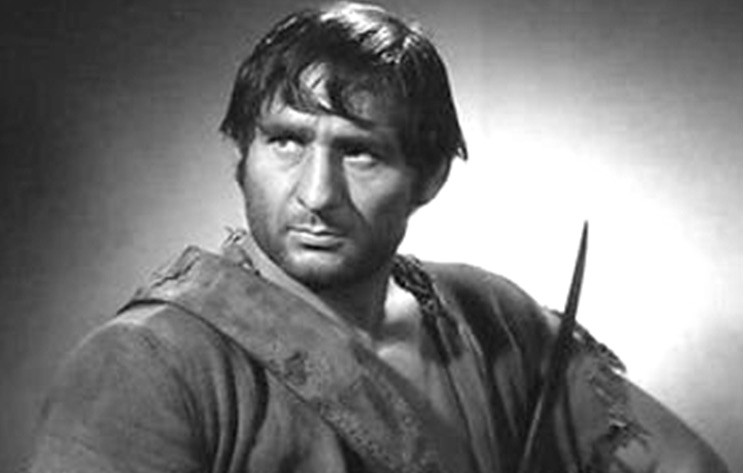
Tani Marsh was born on Hawaii to a Hawaiian mother and Swedish father. She was a hula dancer, teacher and singer who appeared in around a dozen films, often as a native, often as a dancer. While often featured in small roles, she did appear in a number of big films, such as Song of the Island (1942), Big Jim McLain (1951) and Blue Hawaii (1961).

This was one of the last film roles of Hawaiian-born actor Al Kikume. Kikume turned up often in B-movies as island natives and different ethnic roles from the thirties to the late fifties. He can be seen in The Mad Doctor of Market Street (1942, review), the terrible comedy Bela Lugosi Meets a Brooklyn Gorilla (1952, review) and From Hell It Came (1957).
Janne Wass
From Hell It Came. 1957, USA. Directed by Dan Milner. Written by Richard Bernstein & Dan Milner. Starring: Tod Andrews, Tina Carver, Linda Watkins, John McNamara, Gregg Palmer, Robert Swan, Tani Marsh, Suzanne Ridgeway, Lee Rhodes, Grace Mathwews, Baynes Barron, Chester Hayes, Lenmana Guerin, Al Kikume. Music: Darrell Calker. Cinematography: Brydon Baker. Editing: Jack Milner. Art direction: Rudy Feld. Makup: Harry Thomas. Sound: Frank Webster. Special effects: James Donnelly. Produced by Dan & Jack Milner for Milner Brothers Production.
 Scifist.
Leave a comment