
Science fiction has never been averse to the strange and bizarre, but some movies baffle even the most hardened SF fan. The latter part of the 20th century hosts some of the most famous examples, but here we highlight some lesser known gems released before 1950.
10. The Mysterious Island (1929)
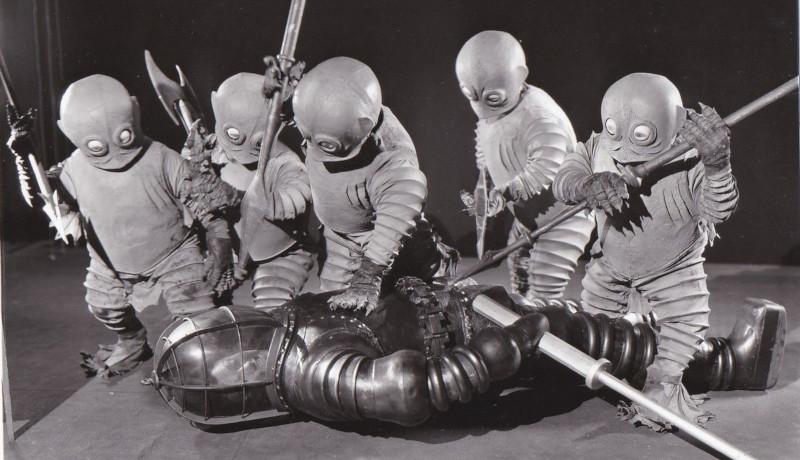
Not so much weird because of its content-matter but due to its bizarre format, this epic was four years in the making, but ended up an epic flop for MGM, discouraging Hollywood from science fiction for two decades. Disaster-prone from the start, the film went into production in 1926 and was released in 1929, bridging the entire transition from silent film to sound. Despite the name, it has little to do with Jules Verne’s novel, other than the fact that it involves an island and a submarine, but borrows a bit here and there from different adventure novels. Scripting dragged, so underwater scenes in Bahamas had to be filmed during hurricane season, causing the underwater filming equipment to break down thrice. Pedantic directors went over budget and schedule, and were replaced twice. By the time the movie was in the can, silent films were dead in the water in Hollywood, so MGM had to reshoot with a crew that had never worked with sound. One of the main actors, Warner Oland, had such a thick Swedish accent that the producers decided to kick him off the project, which meant all his scenes had to be re-shot, sometimes on sets that no longer existed. The result is a fascinating train-wreck, filmed partly in the stylised silent hand-to-forehead technique, and with intertitles, and partly as a talkie, sound comes and goes without logic. Sometimes there’s foley and dialogue, but no ambient sound or effects, sometimes there’s ambient sound and effects but intertitles, sometimes dialogue and nothing else. Sound effects and ambient are often tinny and amateurish, like in a live-broadcast radio play. The cast headed by stars Lionel Barrymore and Lloyd Hughes battle on bravely, but ultimately go down with the Nautilus and take the entire genre of science fiction with them. Full review
9. Boom in the Moon (1946)

There is no doubt that Buster Keaton is one of the greatest movie stars ever to walk the Earth. As a producer, actor and director he made some of the greatest comedies of the 20’s, peaking with masterpieces like The General (1926), Sherlock, Jr. (1928) and Steamboat Bill, Jr. (1928). But a couple of disastrous business choices, an extravagant lifestyle and worsening alcoholism, combined with the coming of sound, drove Keaton into the ground in the thirties and forties, which is how he found himself in Mexico in 1946, starring in this hodgepodge of a movie, of which the majority of the production budget evidently went into the faded star’s salary. It’s original title El moderno Barba Azul translates as “The Modern Bluebeard”, a title which is as descriptive of the film as its US TV title Boom in the Moon. The bewildering story sees Keaton as a US air force pilot shot down during WWII, drifting to Mexico, which he believes is Japan and surrenders, only to be mistaken for a wanted wife-murderer. On death row, he meets fellow inmate Angel Garasa whom he strikes up an uneasy friendship with. A mad scientist comes looking for death row inmates for his experimental rocket to the moon, and is served up Keaton and Garasa. After spending a remarkably long time on a farm where the movie treads water in order to fill out its 90-minute running time, the two dimwits accidentally launch into space along with the scientist’s daughter (Virginia Serret). But the launch is unsuccessful and the rocket lands in Mexico City. Believing they are on the moon, the three “astronauts” don wizard robes and pointy hats (because that’s apparently what you do when landing on the moon), and for the next half of the film screenwriters Jaime Salvador and Victor Trivas try their darndest to convince the audience that three people, of which two are Mexicans, can walk around Mexico City for an entire day, believing they are on the moon. The “Bluebeard” plot of the title has absolutely nothing to do with the rest of the film, and feels like a discarded idea for an entirely different film. Once landing on “the moon”, there is no real plot, only a series of “humorous” incidents. It seems the entire idea of the movie is having Keaton re-heat some of his famous gags from two decades ago – which he does with excellence, but without the pacing and direction to give them any punch. The weirdest thing about this movie is probably that it ever got made. Director Jaime Salvador went on to do at least slightly better SF movies in the 50’s and 60’s. Full review
8. Voodoo Man (1944)

We love this movie, partly because it was Bela Lugosi’s farewell to low-budget studio Monogram after starring in nine films for the company in the early 40’s, known with a mix of love and disgust among Lugosi aficionados as the “Monogram Nine”.What more, here he is joined by two other low-budget horror greats, George Zucco and John Carradine. For such a simple setup, the story is insanely convoluted. The simple version is: Bela Lugosi kidnaps young women in order to transfer their life force into his zombified (dead) wife. Hopeless boyfriend/hero spends most of the film doing nothing. The convoluted version: Bela Lugosi lives in a mansion with an underground lair where he keeps his zombified wife, a Voodoo priest who freelances as a gas station attendant (Zucco) and a stoned henchman with bad posture and a dinner jacket five sizes too large (Carradine). Zucco spots beautiful, lonely women in cars at his gas station, and calls ahead to Lugosi, who has a henchman crew posing as maintenance workers redirect the girls’ cars onto an abandoned road. Here Lugosi uses his “death ray” to cause engine failure in the cars, finally prompting Carradine to fetch the girls from the car, taking them to the Voodoo lair. Here Zucco, wearing yet another wizard’s robe, and adorned with face paint, chants gibberish while waving his hand over a piece of string which ties itself thanks to the magic of stop-motion photography, while John Carradine bangs on bongo drums like his life depended on it, looking like he enjoyed a little bit too much weed at Woodstock. Over all this, Lugosi in his best Dracula manner sits the girl and his zombie wife opposite each other and starts reciting “my mind to your mind, my thoughts to your thoughts” until the girls are drained of their life-force. Full review
7. Life Returns (1935)

If you’re into animal snuff films (which I sincerely hope you’re not), then this is the movie for you. This is an obscure Universal horror melodrama from 1935, coming in at the middle of the studio’s horror heyday. It is strange to think this was released the same year as Bride of Frankenstein, as they are quality-wise worlds apart. The narrative follows a scientist (Onslow Stevens) who works on a method of resuscitating people after clinical death, in other words, after heart failure. As our devoted good-scientists-gone-over-the-edge tend to do, he buries himself in his work, forsaking both his wife and son. His wife leaves and his son becomes a street kid, all while Stevens spirals toward the bottom of his depression. The movie then abruptly shifts tone and focus to the son and his street urchin friends and their adventures, suddenly becoming a Little Rascals movie. One of the main characters here is the kid’s dog, which towards the end of the movie has a fatal accident. The emotional turning-point is when the kid confronts Stevens with the dead dog, begging his father to wake up from his dark depression — and at least try to save the dog. We then cut to what is actual archive footage of real-life mad doctor Robert E. Cornish using his experimental resuscitation technique on a dog, bringing it back to life.
The idea of making a film about the research into cardiopulmonary resuscitation is, as such, not bad, or particularly weird. However, Universal chose to fund this, in essence indie film, as an entry into its horror canon. The credits tout ACTUAL FOOTAGE OF SCIENTISTS BRINGING THE DEAD BACK TO LIFE. The whole movie rests on 10 minutes of footage from the so-called Lazarus Project by Dr. Robert E. Cornish, in which the scientist had six dogs clinically put to death and then tried to resuscitate them. His method wasn’t too far removed from modern CPR, the main difference being that closed-chest cardiac massage had not yet been standardised as a way of keeping the patient’s blood circulating. Instead, Cornish invented a sort of see-saw technique, which rocked the patient’s body back and forth during the procedure, giving the whole thing a very “mad scientist” vibe. The footage in the film actually shows a clinically dead dog being brought back to life by Cornish. But the sweet ending comes with a bitter after-taste when you know the only reason the dog was dead in the first place was that Cornish killed it — and it died again eight hours after the procedure. Full review
6. Strange Holiday (1945)

A factory employee (Claude Rains) is on his way home from a fishing holiday (in his own bi-plane!), bitching to his colleague about work, as one does. Returning to his home city, he finds the streets deserted, shops closed and people acting strangely. Gradually he realises that while he was away fishing, the US has been overtaken by a fascist invasion. Finally, Rains is put in prison, where he gives a long closing monologue in which he admits the error of his former ways. Basically, he has realised that by failing to rise to the level of motivation that his company needs, complaining about unionisation, pay and working hours, he has functioned as a useful idiot, letting fascists infiltrate government and society.
Now, if this sounds more like a right-wing propaganda movie made in order for a company to justify bad working conditions than a Hollywood production, then that it because it is exactly what Strange Holiday is. While it was given a general US release in 1945, it was actually filmed in 1942 as a propaganda short film commissioned by General Motors for their employees. Originally, the film featured the German Nazis. Partly, it may have been a way to placate the critics who pointed out that General Motors was building cars for the Nazis in Germany, but most of all, the film comes across as a completely paranoid anti-union movie. Director was Arch Oboler, one of the great radio pioneers, who had also dabbled in TV by 1942. The movie was loosely based on one of Oboler’s radio plays. Somehow, Oboler and GM managed to reel in movie star Claude Rains for their propaganda effort, but when the film was finally made, it seems that for some reason or the other, GM never screened it for its employees. Perhaps even the company realised how absurd it all came across. Desperate to give the film a general release, Oboler re-edited the movie into 60-minute feature length and filmed a new ending. When he finally got a distribution contract, the war was over and the Nazis defeated. Oboler then had to retouch all the swastikas in the movie and turn them into fictionalised “fascist” symbols. While the film was given a limited release, audiences reeled at the content — the nation had fought a harrowing war, and soldiers returned from the front only to be slapped in the face with an alternate history of the Nazis taking over the US. Unsurprisingly, the movie sank quickly into obscurity. Full review.
5. An Over-Incubated Baby (1901)

There was a lot of weird shit being shown during the first years of the movies, but British Walter R. Booth’s 1901 2-minute short must be one of the oddest, looking at it from today’s perspective. Today the neonatal incubator is a standard hospital equipment, and there’s nobody contesting its life-saving value for prematures. However, in the early 20th century, things were different. The idea of the incubator was championed by a small number of physicians in the late 19th century, and in 1901 it was still highly controversial. Cue The Over-Incubated Baby, a short film in which a mother brings her scrawny baby to “Dr. Bakem’s Incubator”, which promises an infant to grow at a rate of 12 months in only one hour. However, and accident causes the incubator to overheat, and lo and behold: during half a minute the toddler has grown a whopping two feet, and has acquired a comely beard. The End.
Walter Booth was one of the primary movie pioneers of the UK, and made a number of SF-themed short films. Many of the movies made at the time commented on current affairs and not least some of the odder material found in the press. The neonatal incubator was one of such themes. Of course, the idea of the incubator is that it keeps a prematurely born baby warm when it still can’t produce its own body heat, and has nothing to do with the speed of a baby’s growth. However, despite clear positive results in tests and early experiments, most of the medical field viewed the incubator as pseudo-scientific, and the closest analogy for a layman was the heated chicken coupe, which newspaper satirists naturally took full advantage of. The case wasn’t necessarily helped by the fact that early promoters of the incubator displayed their invention, babies and all, at the 1896 World’s Fair, where visitors would stumble upon it, perhaps between visiting the Congo Village and the Alpine Yodellers. Labelled “Couney’s Child Hatchery”, the exhibition was once again on the road in 1901, receiving huge amounts of press. This may explain the background of the movie. Full review
4. The Phantom Empire (1935)

Here are a few things that were extremely popular in 1935: Singing Cowboys. Science fiction comics. Western serials. Stories of ancient, underground civilisations. Airplanes. Radio shows. Comedy films starring plucky kids. Cliffhangers. And somebody over at Mascot Pictures apparently thought that if you put all these together into a 12-part film serial, there was no way you could lose. That someone was absolutely right, as The Phantom Empire (sometimes titled Radio Ranch) was a resounding hit and launched the spectacular movie career of singing cowboy Gene Autry, who at the time of his death in 1998 was still the 10th highest grossing western star of all time.
The result is a brilliantly delirious mishmash combining wild west adventure, lost Atlantis-type fantasy, Flash Gordon tropes and country singing. There is a frame story in which Gene Autry plays a fictionalised version of himself as a singing cowboy on a ranch, where he and his merry men record a daily radio show in which the fictionalised Gene Autrey plays a fictionalised version of himself as the leader of the “Thunder Riders”, a gang of riding marauders whose adventures are played out in each of the episodes complete with gunfights and stunts (disregarding that it is supposed to be a radio show). As if all this wasn’t enough, one day three villains arrive in the valley, having discovered radium and possibly the lost civilisation of Mu under a nearby mountain. But to get to it with their bulldozers, they need to get rid of the Radio Ranch, so they frame Autry for murder, before discovering the actual lost civilisation of Mu, which, just so happens, is guarded by the REAL mythical Thunder Riders. So now Autry not only has to battle the murderous villains of his radio show, but also the three actual murderous villains, the local sheriff AND the Flash Gordon-styled army of the REAL Thunder Riders. But the real clincher of each episode is whether Autry is going to escape his killers, save the damsels in distress and restore peace to Mu in time to perform his two-o’clock song for the radio show. The show also featured the trick riding of 14-year old rodeo star Betsy King Ross and former child superstar and stunt actor Frankie Darro, as well as the comedic relief of Smiley Burnette. Full review
3. Just Imagine! (1930)

The Phantom Empire was not the first US movie to mix the musical with science fiction. In 1930 major studio Fox also thought they had a winning concept on their hands, when they set out to mix musical revue with the fast growing science fiction genre. But whereas The Phantom Empire drew inspiration from the early SF comics of the thirties, Just Imagine! instead attempted a spoof at science fiction pulp literature. And because this was Fox, it was done with all the resources of a major studio. The film is set in the future of 1980, where citizens with call numbers rather than names fly their private planes over the art deco skyline of New York, stopping to complain about the totalitarian bureaucracy of the day, where career points determines whom you get to marry. And this is the MacGuffin. Our hero takes it on himself to fly the first experimental rocket to the moon in order to win the hand of his beloved. Along for the ride is his best friend and a comic relief character from the year 1930, who has just been thawed out of his cryochamber after being killed in his former life. This character is played by the infamous El Brendel, an Irish-German American who made a stellar career in vaudeville with his faux-Swedish character. After having marvelled at the world of 1980 for a while (babies from vending machines, vodka in pill form, etc), El Brendel and our two heroes set off for the moon, which eventually becomes Mars. Here they are greeted by a Martian Princess in fish scales and her burly captain of the guard, as well as their evils twins who kidnap them.
The tone of the film is absolutely insane. It is set in an authoritarian future, but based on the light-hearted musical revue that was so hugely popular in the late 20’s. The music and songs (which perforate the entire film and have little to do with the plot) are written by Hollywood’s hottest musical revue team, Lew Brown, Buddy G. DeSylva and Ray Henderson, who had a massive hit with the 1929 film Sunny Side Up, a brainless flirtation comedy with a dance number in which scantily clad women tickle bananas that grow and stiffen. The same sort of Pre-Code silliness permeates this film, with a burly, gay Martian captain who likes his nipples pinched. It sort of tries to mimic a social satire, but does it with bizarrely tone deaf moments like one of the protagonists longing to the “old days” by singing he “likes his girls like his grandmother used to be”. El Brendel’s tired vaudeville jokes fall like lead weights on the studio floor. Here’s an example: “We’re going to Mars”, says the protagonist. “Take me with you, I’d like to meet your mother”, replies Brendel. Yes I know, try not to split your sides. Then there’s, with no connection to anything, “The Fly Swatting Song”. And it is exactly what the title says. And the oddest thing of all it that it feels like a spoof on a Flash Gordon-type film serial, but no such film serials had yet been made. In fact, Flash Gordon hadn’t even been published as a comic yet. Alas, by 1930, US audiences were getting tired of brainless musicals and El Brendel’s jokes, and the film bombed. Together with the failure of MGM’s The Mysterious Island, Just Imagine! led to a 20-year gap in Hollywood SF production, as major studios didn’t dare touch the genre with a stick. Full review
2. Charleston Parade (1927)
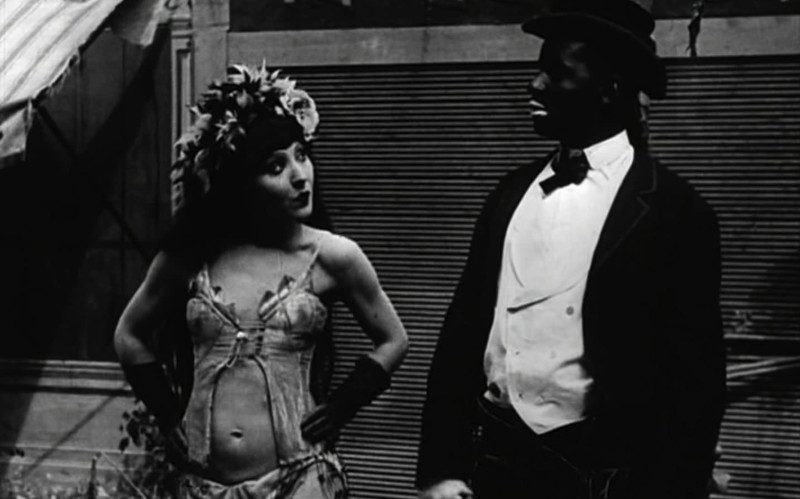
This is our second short subject and our only “art film” on the list, and it comes from famed French director Jean Renoir. The 17-minute piece is set in a post-apocalyptic, jungle-overgrown Paris in the year 2028. The ruins are inhabited by the scantily clad native girl Catherine Hessling and her pet gorilla. From the civilised continent of Africa arrives black explorer Johnny Hudgins, complete in minstrel show outfit and blackface painted on his black skin, in a shining UFO-like craft, to explore the “terra incognita” of lost Europe. He is fascinated by the alluring native girl, who offers to teach him the tribal dance, the Charleston. Amused, the explorer asks for a phone whereby the native goes into her column (her home) and draws a phone on the wall, which then materialises. She calls up the heavenly operator, and gets a bunch of angels (including Renoir) on the line. The explorer informs the angels that he has rediscovered the ancient custom of the Charleston, and would very much like to learn it. The angels give him permission. This then leads to 10 minutes of footage, a lot of it in slow motion, of the native and the explorer dancing the Charleston, until the exhausted explorer can take it no longer and heads back to the spacecraft. He is delighted when the girl agrees to come along back to Africa. But first she calls upon her attires of civilisation, a fur coat and an umbrella, who eagerly come crawling out of a storm drain and take their places on her body. She blows a kiss to the crying ape, and off they go to civilised Africa. The End.
This is a fascinating little exploration of colonialism and exoticism, in which Renoir turns the prevailing stereotypes on their heads. The sarcastic tone is enhanced by the fact that Hudgins performs in blackface, even though the minstrel shows were more or less extinct by 1927, due to their perceived racism. But over half the movie is simply an exploration of human movement and the way in which it can be highlighted by the art of cinema. It is a truly bizarre film, but in the best of ways. Full review.
1. El hombre bestia (1934)
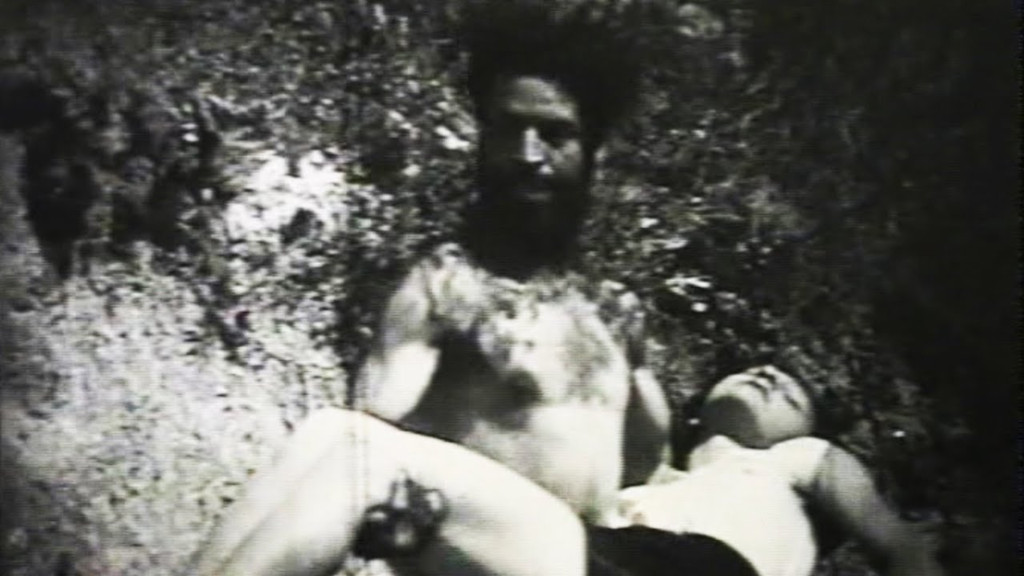
This is here is something you have to see for yourself. Argentina’s first science fiction horror, monster and science fiction movie was a super-low-budget independent effort by producer-writer-director Camilo Zaccaria Soprani. The plot is too confused to properly do justice, but in short it concerns aviation ace Captain Richards who crashes in a forest, where he then lives for 12 years, becoming a hirsute Tarzan character. But this is just the prelude, as he is found and taken to civilisation, only to become the test subject for a mad doctor who injects both his pecs with a “diabolical conconction”, which turns him into a super-sexed beast man with superhuman powers, who starts kidnapping local women, dragging them to a cave. The girls’ families hire an Italian detective, inexplicably called Jackson, who spends all of the film speaking Italian, which is incomprehensible to all the other characters of the movie, as well as for most of the film’s Spanish-speaking audience. He conveniently stumbles upon a group of sailors brawling on a beach, whom he hires as muscle, and go on the hunt for the beast man.
The story is absolutely ludicrous. It’s like Soprani had three different ideas on the backstory of his beast man and couldn’t decide on which one to choose, so he just used all three of them. Then there’s the filming. Scenes are often filmed in a single take and you get the feeling that most of it is filmed in and around a single building. There’s no sense of geography, and I don’t know if the Beast Man’s cave is located 500 or 5,000 metres from the town — if it is a town, I’m not sure, as we never really see beyond the front yard where most of all conversations take place. The editing is disjointed and often cuts randomly between one scene and another. The soundtrack is absolutely mad. The film is partly sound, partly silent. Sometimes the exposition is laid out in overlay titles, as if for a silent film. The most egregious part of the soundtrack is the musical score. I have never heard music used in a film as badly as this. It is insane! The film starts out with booming military march music for the scenes of the aviator and the aerial battle, but when the film shifts gears, the music stays the same. So we get pieces akin to Wagner’s Flight of the Valkyries whenever the Beast Man takes a stroll in the forest. The worst thing is that the music never seems to be synced to the dialogue and the rest of the soundtrack (of which there is little). Neither, does it seem, did Soprani have the technology of a volume button. The music may simply be cut off in the middle of a crescendo, because the film cuts to a dialogue scene, which has no background music. Then it snaps back to whatever was happening before — continuing the musical score from the same place it left off. This makes the movie absolutely maddening to watch! It’s almost as if the editor first cut the individual scenes and laid a musical score on of those that should have such a thing, and then started editing the these scenes together with each other, without paying any regards to what happened with the score. The story is absolutely bonkers, it has every single Hollywood horror movie cliché rolled up in one, super-crammed into a little more than an hour. The clumsy editing and bizarre mix of silent and sound techniques gives it the feel of an art film, which it absolutely is not, and the maddening use of music is the last straw, sending this movie into a whole new realm of weirdness of its own. This is a magnificent train wreck of a film that has to be seen! It doesn’t help that the only surviving copy is a grainy VHS transfer. Full review
All films on the list are available on Youtube and/or archive.com, except Strange Holiday, which can be found at specialty DVD dealers.
Janne Wass


 Scifist.
Leave a reply to Janne Wass Cancel reply