

Between romantic rivalries, scientists conjure forth a monstrous woman from the year 5200. AIP’s 1958 curio is cheaply made and poorly directed, but does have a quirky originality and some intreresting ideas. 4/10

Terror from the Year 5000. USA, 1958. Written & directed by Robert Gurney, Jr. Inspired by Henry Slesar’s short story. Starring: Ward Costello, Joyce Holden, Frederic Downs, John Stratton, Salome Jens. Procuced by Robert Gurney, Jr. IMDb: 2.9/10. Letterboxd: 2.7/5. Rotten Tomatoes: N/A. Metacritic: N/A.
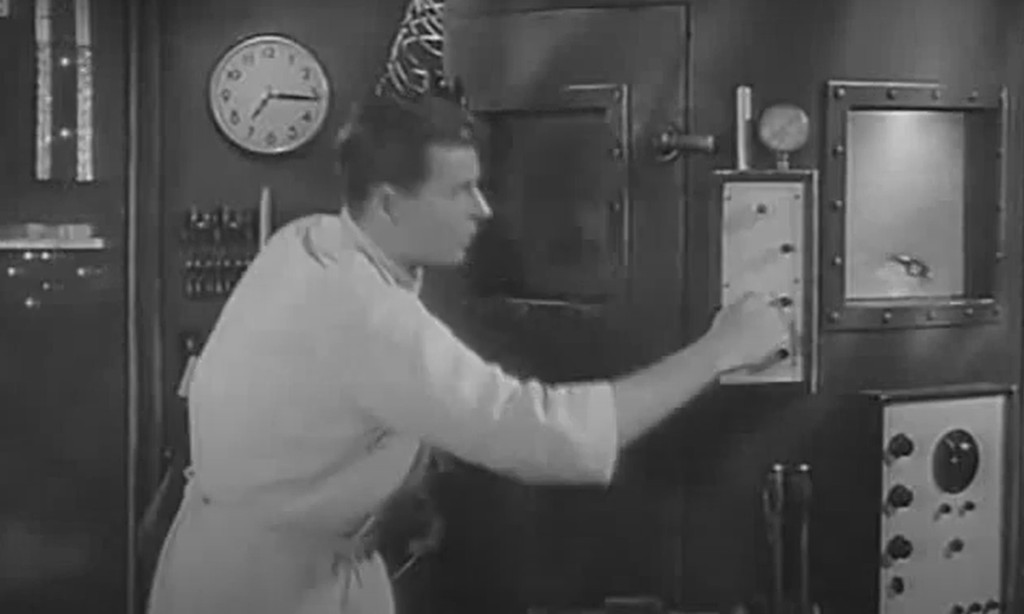
After being sent a radioactive miniature statue that seems to date from the 5200 AD — 3000 years in the future — Dr. Robert Hegdes (Ward Costello) visits its apparent sender, Professor Howard Erling (Frederic Downs) in his mansion/lab on an island. Here Erling and his assistant/financer Victor (John Stratton), are carrying out experiments to “breach the time barrier”. They have deviced a machine into which they put objects and send them into the future, and get back corresponding objects from the year 5200. As Howard puts it, doing “barter trade” with a future civilisation.
It turns out that neither Howard nor Victor sent the statue to Robert, rather it was done by Howard’s daughter and Victor’s fiancée, Claire (Joyce Holden), who wanted to get someone out to the island to verify her father’s experiments and get him re-instated into the scientific field he had been expelled from. Meanwhile, there’s tension between Howard and Victor, with the older scientists wanting to proceed carefully, and Victor wanting to push their experiments — and their machine — to their limits. When Robert arrives, he catches Victor using the machine secretly at night, conducting his own experiments. One night he sees Victor throwing suitcases into the sea. The next day, he takes Claire for a swim, and investigates the suitcases. The audience doesn’t see what’s inside, but we know Victor is up to no good. Also, we know that Claire is getting tired of Victor’s bad behaviour, and that she and Robert are falling in love. The next night, Victor cranks up the power on the machine, and — something — grabs and tears his shoulder, before he is able to push it back into the machine. This someting is the Terror from the Year 5000.
Terror from the Year 5000 is a 1958 low-budget effort, independently written, produced and directed by Robert Gurney, Jr. under the wings of American International Pictures, the foremost low-budget outfit of the 50s in Hollywood, home of producers like Roger Corman, Alex Gordon and Herman Cohen. The film is very, very loosely inspired by Henry Slesar’s short story Bottle Baby. It was released as a double bill with The Screaming Skull.
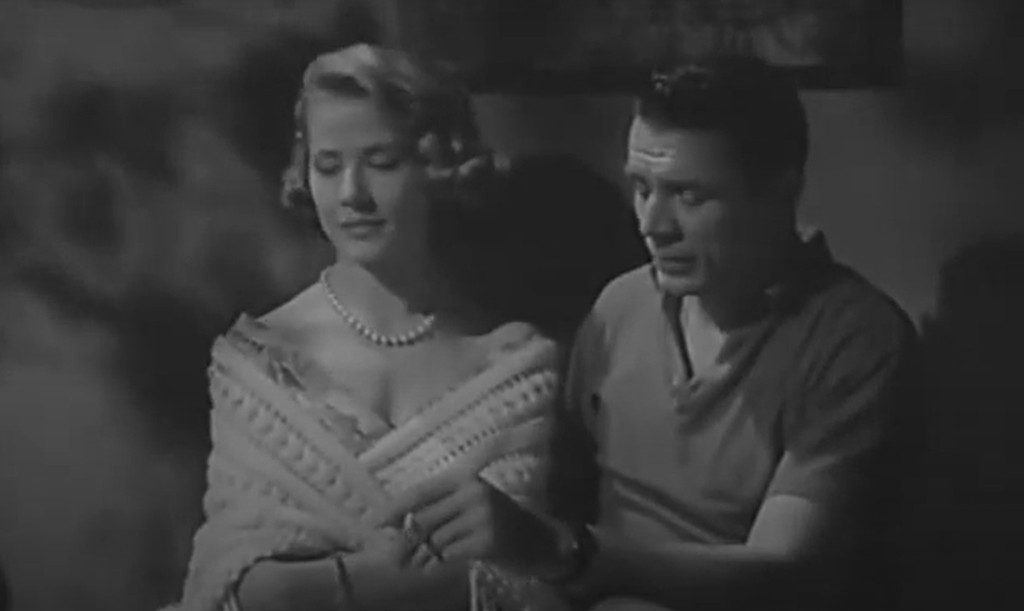
Henry is rushed to the hospital on the mainland ro have his radiation burns checked out, and once admitted, Robert, Howard and Claire go to have dinner, only to realise that Victor has escaped and returned to the mainland. Now Victor cranks up the machine to the max, and from it emerges a female figured seemingly dressed in black, glittering tights, who attacks Victor and flees into the woods. When the trio return to the island, they find Victor in bad shape, rambling about something horrible that has escaped.
The Future Woman, as she is billed in the credits, kills the island’s caretaker Angelo (Fred Herrick). Howards sends for a nurse to take care of Victor (Salome Jens), and when she arrives she is also attacked by the Future Woman. The Future Woman then takes out a featureless face mask from a container, and places it on the nurse’s face. It takes on the feature of the nurse, instead leaving her featureless. Future Woman then applies the mask to herself, and dresses in the dead nurse’s clothes, whereafter she arrives at the mansion to take care of Victor.

But instead, she hypnotises Victor by wiggling her silvery nails, and tells him her story. In the year 5200, the Earth’s atmosphere is so polluted with radiation that one in five children are born as hideous mutants. She now needs Victor to transfer himself into the future so that he can inject fresh and healthy genes into the gene pool. They both enter the lab and Future Woman changes back into her glittery catsuit, which, she explains, shields her from radiation, and has Victor put on his own protective suit, as he prepares to travel into the future. However, Joyce discovers them and realises that Victor is under hypnosis. She attacks the Future Woman, and tears her mask revealing her deformed face — realising that the Future Woman is one of the mutants she has spoken of. After a struggle, Robert and Howard arrive and manage to kill future woman. Robert, struck by the plight of the people of the future, volunteers to go through the machine and help them with their nuclear-scarred world. But in a solemn closing monologue, Howard reminds us that the best way to save the future is to change our present.
Oh, and Victor conveniently dies, so that Robert and Claire can have each other.
Background & Analysis

The fact that American International Pictures bought the rights to Henry Slesar’s short story Bottle Baby, published in Fantastic Science Fiction in April, 1957, has led to the misconception that the film is based on the story. This is not the case: after adaptation and rewriting, the final script bears no resemblence to the story, and Slesar asked not to be given a screen credit.
Slesar’s story is a cheeky, humorous little tale clearly aimed at the male readership of US pulp magazines. It concerns a small, well-endowed, nude alien woman who one day appears in the vacuum bottle of a flabbergasted scientist. Having won a trip to Earth as a prize in a beauty pageant, she is particularly interested in experienceing Earth sex — for which purposes she can momentarily change her size and become a human-sized well-endowed nude alien woman. Much of the story concerns the scientist’s struggles in getting the woman into some clothes, which he only has some minor success with. In the end, he uses her size-changing abilities and nudity to get revenge on a competing scientist.

If you squint mentally, you can make out some similarities between the story and the film. Both do concern a woman arriving from another “dimension”, who is interested in mating with the people on our end, and both involve scientists at odds with each other. But that’s pretty much it.
In 1958 American International Pictures had grown from a small production/distribution company catering to science fiction-hungry kids to a – still small – pioneer of sorts, leading the way in providing movies for the new teenage audience. The studio churned out dirt cheap exploitation movies, and had been the first studio specialise in so-called teen and juvenile delinquency films, often with lurid titles drawing the crowd to see fairly timid melodramas starring teenagers against the background noise of car engines and rock and roll. However, among its biggest hits were still the good old SF and monster movies. And, besides, AIP was not in business to produce quality hits, but to make cheap movies that filled enough seats to earn a profit.

AIP was, in essence, James Nicholson and Sam Arkoff. Nicholson was primarily the ideas and marketing man, while Arkoff handled the money and legal matters. AIP’s formula was that the company didn’t directly employ any filmmaking staff, rather they made contracts with producers on a film-to-film basis, and the producers often had their own ragtag teams of directors, actors and crew that they collaborated with – with some overlapping. This is how Robert Gurney, Jr. came into the picture. Gurney started collaborating with AIP on the SF spoof Invasion of the Saucer Men (1957, review), which he wrote and produced. The film was a hit, so AIP was happy to employ him again for Terror from the Year 5000 (and they also let him direct it because he was able to loan the camera equipment for free).
The film had a bigger-than-usual budget for AIP: $144,000, when the usual AIP film rarely cost more than $100,000. This made possible, among other things, some decent lab sets, including the “time machine”, as well as location shooting in Florida. In no way, however, does the film feel more expensive than AIP’s usual output, in fact the the opposite is the case. The entire film seems cramped and restricted, confined as it is to an island setting with a small number of tiny sets and a few forest and beach locations.

Watching Terror from the Year 5000 is an odd experience. One the one hand, this is one of the clunkiest movies that that AIP released in the 50s. Despite the larger budget, Gurney’s direction is ham-fisted, the acting for the most part atrocious, the script treads water for a long time, and is repetitive (the characters keep running back and forth to the suitcases in the water, instead of just taking them out of there), the “monster” is of the cheapest bargain-bin variety and the dialogue is dreadful. But on the other hand, the further the movie progresses, it starts growing on you. The basic idea is novel – nothing like this had been seen in SF movies at this time, and the between all the madcap science, the clunky romantic triangle and the overall badness, the film hits you with little nuggets of brilliance. Such as the creepy, taxidermied four-eyed cat found in one of the cuitcases, the idea that the Future Woman thinks the people of our time speek Greek because they have transferred a college ring with Greek letters on it, and not least the creepy mask. And the idea of hypnotic fingernails is so bizarre, it’s impossible to say whether it is moronic or brilliant.
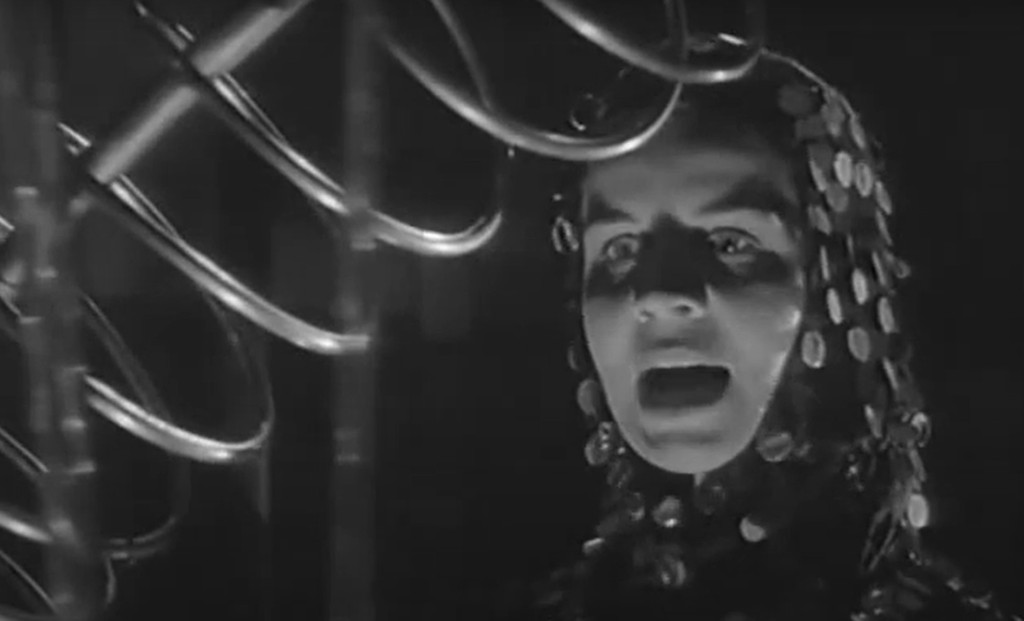
Toward the end, the movie picks up intensity and interest, not just because things finally start to happen, but also because once Salome Jens is introduced into the movie as Future Woman, she absolutely commands the screen. It’s clear that when Future Woman is first introduced, she is played by another, uncredited, actress, one who seems both taller, thinner and more nimble, leaping across the screen in her glittering leotard – we never see her face properly. Jens arrives to the island as the nurse, but after Future Woman steals her face, Jens takes over the titular role, and plays it with an eerie, otherwordly authority and charisma.
Once we see Future Woman’s real face, it’s not as terrifying as the build-up would have us imagine: she has a few buck teeth and a deformed nose, but considering the kind of mangled monsters that AIP kept serving up, she is almost a beauty. Gurney claims that Salome Jens was almost in tears over having to wear the make-up, but eventually relented.

With a better screenwriter and a shorter running time, this would have been an excellent episode of The Twilight Zone. The theme and in-your-face conclusion just scream Rod Serling. It offers up a horror story of the future, landing squarely in the troubles of our times, throwing the ball to the viewer: it is up to YOU to decide the future. Unfortunately, while he might have had the ideas, Robert Gurney, Jr. did not have the craftsmanship of Rod Serling. But to be fair, his script is still better than the short story it was inspired by, which was mainly concerned with naked lady parts.
The film has a good sense of mystery, starting with Robert trying to unravel the mystery of the statue seemingly made in the future, and continuing with Victor doing his secret experiments in the lab. But there are also less good ideas. Too much time is taken up by Robert trying to investigare whether Howard has tried to murder him by sending him a radioactive statue, making it feel like padding, and the love triangle between Victor, Robert and Claire feels severely tacked-on. There’s also the comings and goings of caretaker Victor, who seems to have a thing for Claire, and who is set up as a red herring. He seems to be in the picture only so Future Woman has someone to kill, instead of killing any of the main characters.

When Future Woman first shows up, she moves around in a sort of silly marching patterns, with straight arms and legs. Not that you see much of her. Gurney deliberately keeps her obscure in the shadows, or by one of the film’s few optical effects, a sort of mist of white patches floating around her – perhaps some sort of camouflage when she is trying to hide from the caretaker. Gurney probably kept her obscured partly to retain som mystery, but also because he realised that she looked not so much like a monster from the future, but rather a woman dressed up in black tights with glitter on them.
Apparently, Gurney and editor Dede Allen, who went on to three Oscar nominations, cut the film too long for AIP’s taste. After seeing the film, Allen, whose first credited job as an editor this was, was apparently in tears, as AIP randomly cut ut 30 second chunks here and there to get the film down to desired length. According to Gurney, she wanted her credit taken off the picture, but he convinced her to keep it. Gurney had been promised 20 percent of the profits, as the film’s producer. However, as soon as the theatrical run of the movie was over, AIP sold the rights to the film to a TV distributor. In the words of Sam Arkoff, as AIP didn’t own the picture, they also couldn’t pay any profits from it. Gurney then marched up to James Nicholson and told him he would never work for AIP again, a promise he kept.

Terror from the Year 5000 has some refreshingly original ideas for the time of its making, or at least halfway original, and it is a film that grows on you as you watch it. Unfortunately Robert Gurney, Jr. directs in such a static manner, and it takes ages for the story to go into gear, that the viewer risks snoozing off before we get to the better parts. The flaccid acting, trite romantic triangle and clunky script further offset what is at heart a rather interesting little film.
Reception & Legacy

Terror from the Year 5000 was released in January, 1958. Whit in Variety said: “Overall unfoldment is so clothed in confusion […] that it’s a weakie even for the small exploitation field”. The Monthly Film Bulletin wrote: “The woman from the future is an unimaginative creation and whatever horrific possibilities she has are soon expended […] The film is crudely photographed with no noticeable interest in continuity and little attempt at convincing settings.” However, Walter Greene at the Hollywood Reporter said the film was “highly imaginative”.
Today, Terror from the Year 5000 has a lowly 2.9/10 rating on IMDb, based on 1,500 votes (thanks to its inclusion on MST3K, which always lowers a film’s IMDb score) and a 2.7/5 rating on Letterboxd, based on 500 votes.

In his book Keep Watching the Skies!, Bill Warren writes: “Terror from the Year 5000’s production values are only adequate; a few of the actors do fairly good work; the whole picture has a hangdog air. Most audiences probably found it of little interest, but I don’t think it deserves to be completely overlooked. It has some imagination in its conception and enterprise in its execution. It is not a good film, but I am not sorry it was made.” Bryan Senn writes in his book Twice the Thrills! Twice the Chills!: “Like an AIP percentage check, the anticipated excitement fails to materialize in the end”.
Kevin Lyons at EOFFTV Reviews writes: “Had [Gurney] stuck to the genre elements and not bothered with the swimming expeditions, leering shots of Joyce Holden getting undressed and bickering between jealous lovers we might have had a better film […] And yet at the same time, Gurney is capable of isolated moments of real atmosphere and suspense.”
Bryan Senn claims that Terror from the Year 5000 is the first movie to feature a time machine. Nothing could be farther from the truth. A time machine was featured as early as 1942 in no less than two films: Hungarian Sziriusz (review) and French Croisères sidérales (review), and again in 1944 in the British movie Time Flies (review). However, Terror from the Year 5000 was the first American film to feature a time machine.
Cast & Crew

There is little information available on the life and career of producer Robert Gurney Jr. Invasion of the Saucer Men (1957) was his first production credit, and he co-wrote and produced three more films for AIP in 1957 and 1958, including the infamous Terror from the Year 5000 (1958). After AIP re-cut the film without his consent and screwed him over on his promised 20 percent share of the profits, he refused to work for AIP again. In 1964 he wrote, produced and directed the comedy The Parisienne and the Prudes, which was supposedly a satire on McCarthyism set at a nudist colony. It only ever played at Cannes.
Henry Slesar, whose short story Terror from the Year 5000 is “inspired” by, was a prolific and respected author and teleplay writer, mostly writing detective mysteries, science fiction, and for TV, soap operas. Although he wrote relatively few screenplays, his stories have served as basis for around a dozen films – however, no SF movies beside Terror from the Year 5000. Two of his stories were adapted for the original run of The Twilight Zone. He won an Emmy during his longtime job as head writer on the daytime mystery/soap opera The Edge of Night, for which he wrote almost 3000 episodes. Before his career as a TV writer Slesar had a successful career in advertising, and is said to have popularised the term “coffee break”.

Dede Allen was one of Hollywwod’s top editors for decades between the 60s and 00s. She worked as a sound cutter and assistant editor before getting her first editor credit with Terror from the Year 5000. She was nominated for three Oscars without ever winning, but won a BAFTA for her work on The Hustler (1961). Seven of the films she worked on were nominated for Best Picture at the Oscars, including The Hustler, Bonnie & Clyde (1967) and Dog Day Afternoon. She also edited the SF movies Slaughterhouse-Five (1972) and The Final Cut (2004).
Robert Gurney’s wife Beatrice Furdeaux worked as art director and production supervisor on Terror from the Year 5000.

Terror from the Year 5000 probably provided Ward Costello with his only lead. A former news editor, Costello got bitten by the acting bug in the early 50s, and appeared in around 50 films or TV shows between 1951 and 1989, mostly doing guest spots on TV or appearing in small supporting roles in films. Between 1954 and 1955 he was part of the principal cast on the short-lived daytime medical soap opera The Greatest Gift. Costello appeared in the SF movies The Terror from the Year 5000 (1958), Return from Witch Mountain (1978), Goldengirl (1979) and Project X (1987).
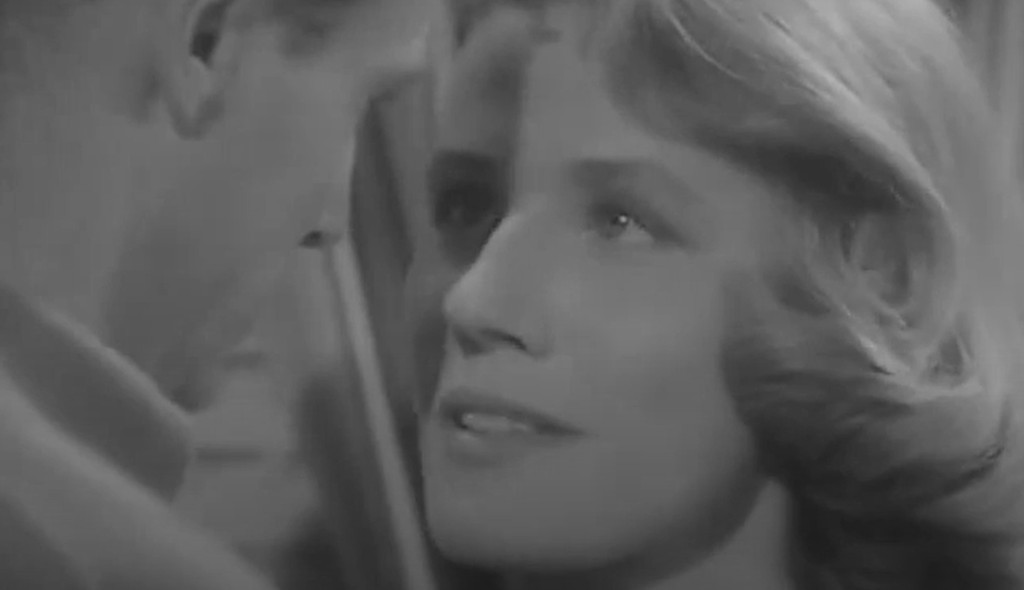
Joyce Holden was put on the showbiz track by her mother, who started her performing by the age of 3. The family eventually made their way to Hollywood, where Holden studied acting, worked on stage and won beauty pageants until she was signed by Universal in 1950. She showed a talent for comedy, which she later regretted, as it narrowed the roles she was being offered. She starred in decent-sized supporting roles in bigger films and leads in B-movies, before being dropped by the studio in 1953. After this, she only did four more movies, a crime film and a slapstick for Allied Artists, The Werewolf (1956, review) for Columbia and Terror from the Year 5000 (1958) for AIP. She soldiered on for a while, doing guest spots on TV, but retired in 1958, seeing the writing on the wall.
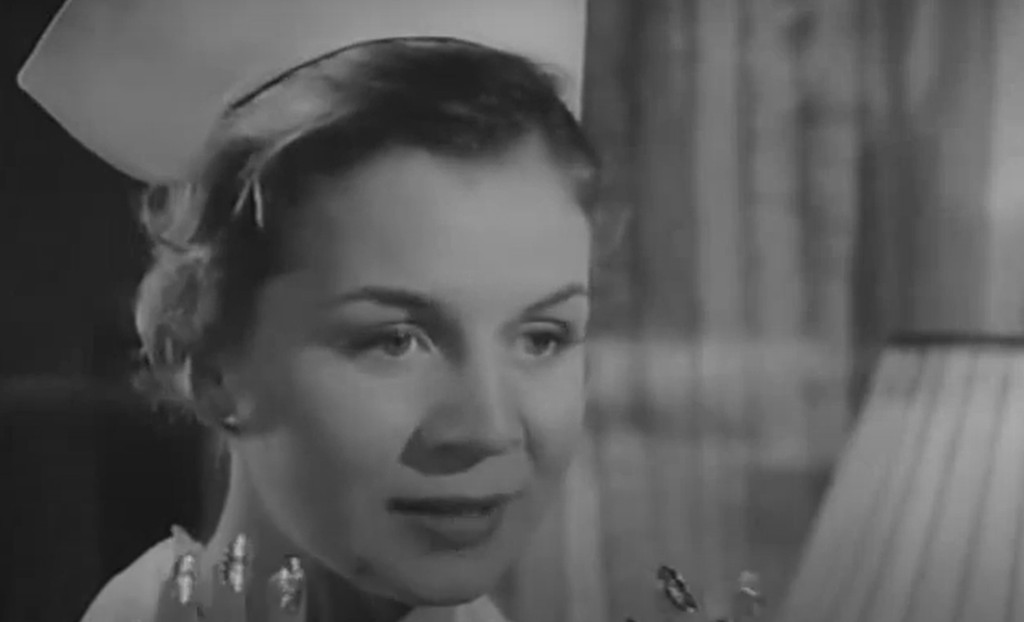
Multi-talented Salome Jens (b. 1935) grew up in Milwaukee and early on showed a talent for for music and performing. She played the piano and studied dancing in New York, before deciding on a career in acting, studying under Stella Adler and Lee Strasberg. She made her Broadway debut in 1956, and forged a very successful stage career both on and off Broadway, which was to remain her main focus in the decades to come. Stage highlights included a memorable turn as Josie the thief in the New York premiere of Jean Genet’s The Balcony (1962), Eugene O’Neill’s A Moon for the Misbegotten in the late 60s, the title role of Mary Stuart in 1971 and Antony and Cleopatra in 1972. Jens also taught acting at UCLA.
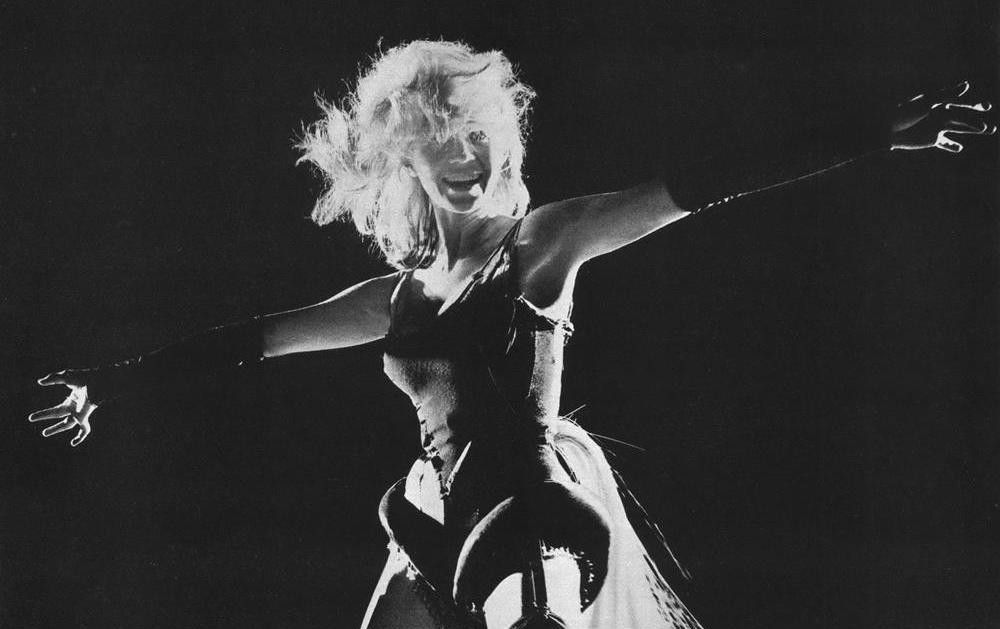
But Jens also found time between stage work and teaching to carve out a small but memorable career in film and TV, often playing off-beat characters in supporting or starring roles. She debuted as the Future Woman in the low-budget SF movie Terror from the Year 5000 (1958). Her movie highlights include the mysterious title role in Angel Baby (1961), Burt Reynolds’ screen debut and Rock Hudson’s love interest in the tense psychological science fiction film Seconds (1966). Around half of her film and TV credits are for SF productions. She is perhaps best known to a mainstream audience for her recurring role in Star Trek: Deep Space Nine (1994-1999) as the Female Changeling, the villainous leader of the Dominion, and a foil for her countryman Odo. Jens also voiced the Female Guardian in Green Lantern (2011). As of March, 2024, Jens is still in the books of the living.
Terror from the Year 5000 was co-lead John Stratton’s only movie appearance.
EDIT: March 23, 2024: Corrected the plot synopsis with regards to the ending: the future woman is killed, and does not return to her own time, as I misremembered the ending when writing. Thanks for the catch, Steven!
Janne Wass
Terror from the Year 5000. USA, 1958. Written & directed by Robert Gurney, Jr. Inspired by Henry Slesar’s short story Bottle Baby. Starring: Ward Costello, Joyce Holden, Frederic Downs, John Stratton, Salome Jens, Fred Herrick, Beatrice Furdeaux, Jack Diamond, Fred Taylor, Bill Downs, Willial Cost. Music: Richard Dupage. Cinematography: Arthur Florman. Editing: Dede Allen. Art direction: Beatrice Furdeaux, Bill Hoffman. Makeup: Rudolph Lizst. Sound: Robert Hathaway. Procuced by Robert Gurney, Jr. for La Jolla Productions and American International Pictures.


 Scifist.
Leave a reply to Janne Wass Cancel reply