

A scientist feeds women to a woman-eating tree, which gives him a serum that can bring back the dead. This British 1958 quota quickie is plodding and illogical, but kept afloat, barely, by its silly premise and decent acting. 2/10.
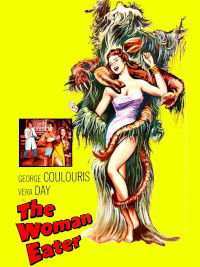
Womaneater. 1958, UK. Directed by Charles Saunders. Written by Brandon Fleming. Starring: George Coulouris, Vera Day, Peter Forbes-Robertson, Joyce Gregg, Jimmy Vaughn. Produced by Guido Coen. IMDb: 4.6/10. Letterboxd: 2.9/5. Rotten Tomatoes: N/A. Metacritic: N/A.
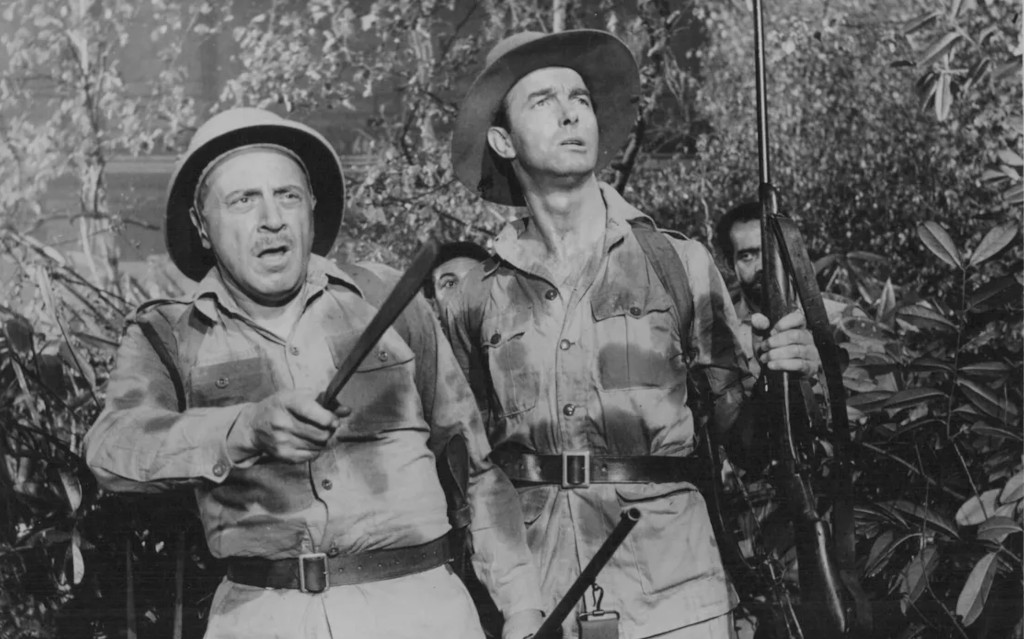
Eccentric British scientist Dr. Moran (George Coulouris) and Lewis Carling (Robert MacKenzie) head off from London to South America in order to find the lost Inca tribe whose juju can bring the dead back to life. After hacking their way through a jungle set, they find the lost tribe, that seems to consist of Africans rather than Native Americans, in the middle of a ceremony. Drummer Tanga (Jimmy Vaughn) is drumming a woman (Marpessa Dawn) into a trance, after which she is fed to a monstrous three with what looks like three pairs of arms and two tentacles with mouths. Lewis tries to resque the woman, but is killed. Cut to civilisation, when Moran wakes up with jungle fever and swears he must get his hands on the Juju.
That’s the intro to the British 1958 quota quickie Womaneater, a film with a double entendre in the title that can’t have gone unnoticed by the teen audiences of the time. The film stars George Coulouris, a respected character actor in both British and Hollywood films, and blonde bombshell Vera Day, who was not a bad actor either. A throwback to the mad scientist films of the 40s, the movie has few points of interest beside its silly central premise, a murderous tree to rival Tabanga.
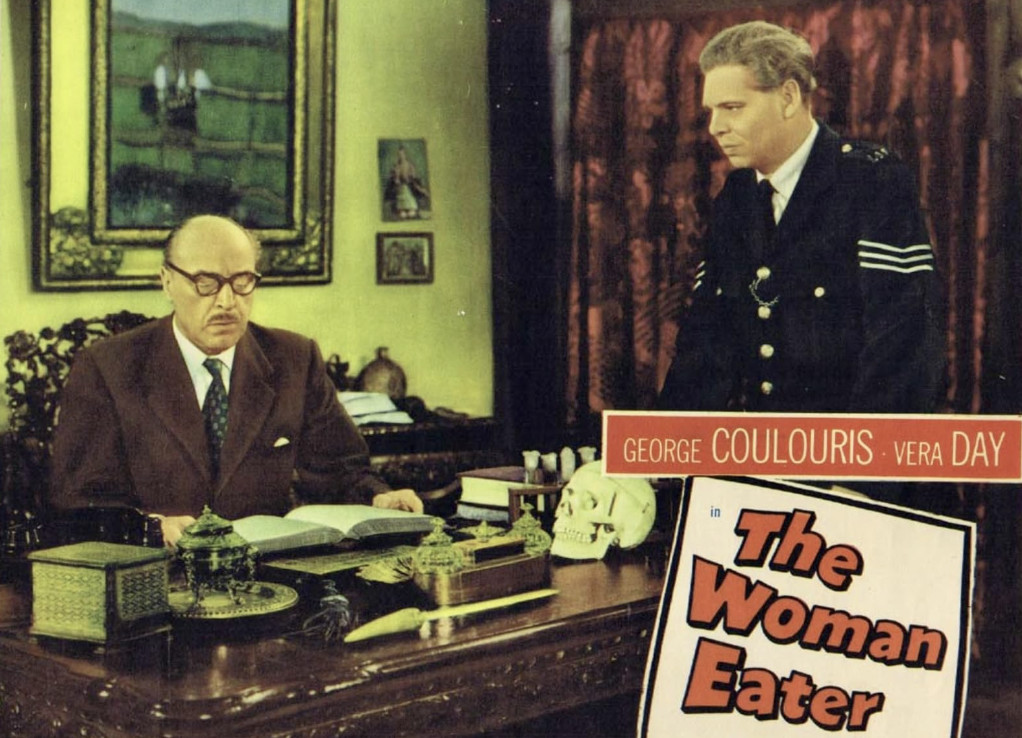
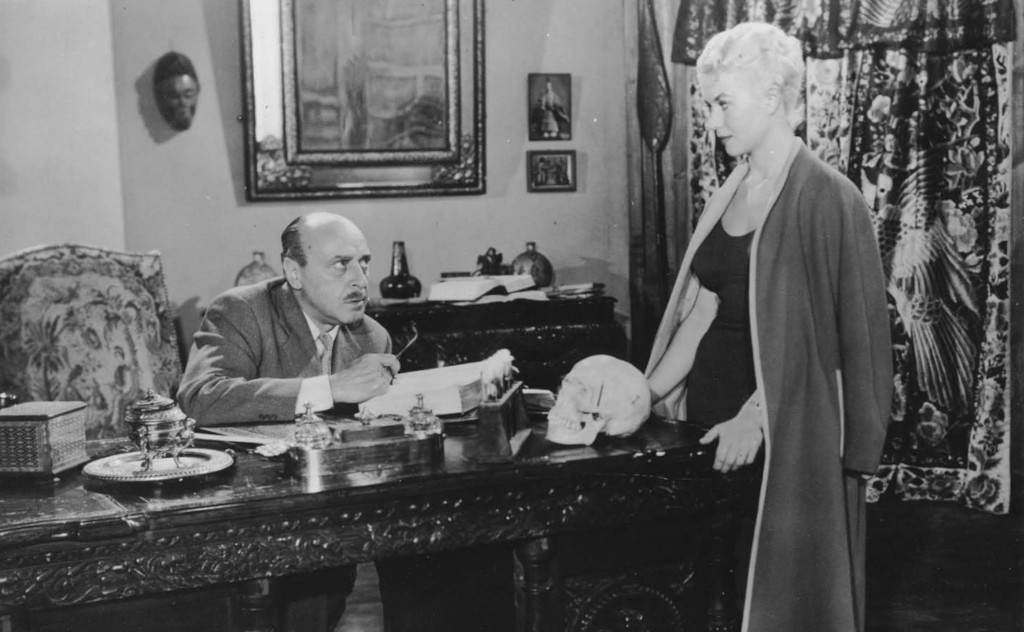
Cut now to London, five years later, and Dr. Moran’s secluded mansion, where he and drummer boy Tanga keep the tree, dubbed Juju, in the dungeon-like basement, where Tanga drums more innocent young women into trance and feed them to the Juju. Moran then extracts a serum from the tree, which he hopes that, with the enhancements of modern science, represented by a mass of bubbling beakers, will help him bring the dead back to life. For the moment, he is experienting on a gigantic heart in a vat, with dubious success.
Enter Sally Norton (Vera Day), who works as a hula dancer at a fun fair, and car mechanic Jack Venner (Peter Forbes-Robertson), who looks at hula dancers at the fun fair. When Sally’s barker talks not very nicely to her, Jack slugs him, which gets Sally fired. Jack suggests she see if Dr. Moran is hiring help, which Sally does. And it just so happens that Dr. Morans housekeeper and former lover Margaret (Joyce Gregg) is not only overworked, but also a little bit too inquisitive about what goes on in the basement. Sally is hired as help.

Sally goes back to Jack’s car shop where he asks her to help him fix a car. He admires her boobs and asks Sally to marry him, and then goes on complaining when she doesn’t know how to fix a car. For some inexplicable reason, she agrees to marry him. Meanwhile, Dr. Moran hunts down another young woman at a bar (Joy Webster), whom he takes home and feeds to the tree. When Margaret gets too incquisitive about what goes on in the basement, he fires her. When she talks back he strangles her in a fit of rage and accidentally kills her. And, hey presto, now he has a body to test his serum on. Also meanwhile, Sally suddenly becomes terrified of Dr. Moran for no discernable reason and tells Moran she wants to quit her job. But Moran has now decided that Sally is to become his wife and will stand beside him when he reveals his wondrous new discovery to the world, and forces her to come down to the lab and see what’s on the slab, in this case: Margaret.

The local police, however, have been investigating a string of women that have gone mysteriously missing around Dr. Moran’s mansion, but have been blockheaded enough never to investigate Moran. Not until the finale of the film, when they finally decide to check out what’s in his basement. That’s when our hero Jack gets suspicious when Sally is not back from work at the appointed time, and point the police in the direction of the Moran residence, which is where they are already headed.
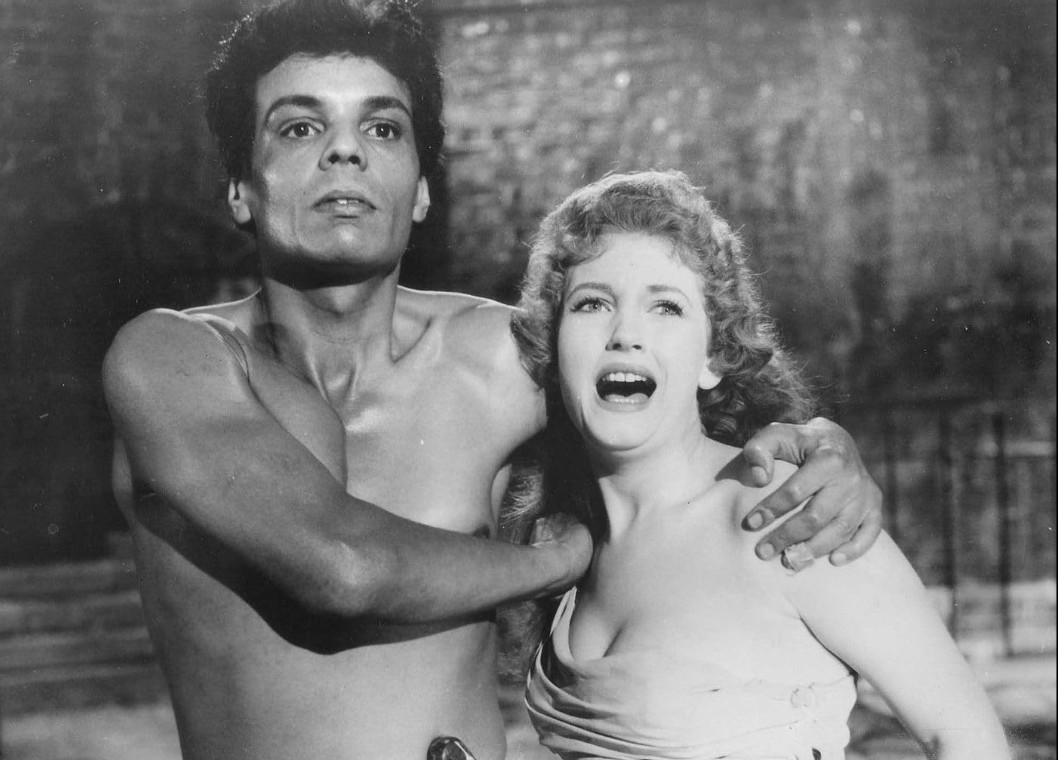
In the basement, Moran injects dead Margaret with the serum. In a classic Frankenstein reveal, Margaret returns from the dead, but stares blankly in front of her and grasps for Sally, before she collapses and dies again. Moran realises that the serum is only half the old Inca secret, and Sally returned without a mind. Tanga laughs and says that the other half of the secret is reserved for the Inca, and will never be revealed to Moran. Then Tanga wants to feed Sally to the tree, but Moran saves her and sets the tree on fire. This is when our hero Jack arrives. Moran shouts at him to take Sally to safety, and Jack then shows Sally how to walk up the stairs to the exit, which she apparently didn’t manage herself. Moran escapes after them, but Tanga throws a dagger at him, killing him. Tanga then kneels before the burning idol, presumably going up in flames with it. The end. Oh yes, and the police also arrive.
Background & Analysis
Womaneater was the second science fiction film by Italian-born producer Guido Coen. The first was the odd 1957 movie The Man Without a Body (review), in which a scientist revives the brain of Nostradamus which he plans to transplant into his own head. Like Womaneater, the movie starred George Coulouris as the mad scientist. That movie was directed by American low-budget SF legend W. Lee Wilder, and officially co-directed by Charles Saunders, who also directed Womaneater. But reportedly, Saunders was only credited on The Man Whithout a Body, as the film needed to have a British director in order to qualify for the quota grant from the British government.
Coen was clearly trying to ride the coattails of the sudden success of British horror and SF movies with the Quatermass films and The Curse of Frankenstein (1957, review), but seems to have had a somewhat feeble grasp on what the kids were into, as his movies seem to emulate the low-budget output of Poverty Row Studios like PRC and Monogram in the 40s, rather than anything made in the 50s. The script of Womaneater was put together by veteran all-round writer Brandon Fleming, who must have had either very little time or interest, as the script only barely holds together. The movie was filmed in and around Twickenham Studios, where Coen would soon wind up working, with some night shoots seemingly done in downtown London with a hidden camera, as film historian Bill Warren points out that Coulouris seems to be walking among real people looking for his next victim.

From a standpoint of logic the film is a mess. Things are off from the first minutes, as the old Inca tribe is played by actors of African rather than American descent. We never get any explanation as to how Moran is able to get the Juju, or Tanga, with him to London. The “voodoo” ritual that Tanga performs on his bongo drums seem to put the women in a trance, so that they can be easily fed to the tree, but they all struggle and scream anyway, which renders the who excercise moot. As British critic Robin Bailes at Dark Corners points out, Moran says that the sacrifices the women make are small in comparison to the benefits he will bring the world. But as far as we see, he must kill one person for every person he brings back alive, again, rendering the excercise moot. The ending, in particular, is hard to swallow. Tanga reveals that he has been cheating Moran all along, concealing the second half of the secret of resurrecting the dead. The question arises why on Earth Tanga has been helping Moran, both as a lab assistant and as a bongo drummer, for five whole years, killing seemingly a woman a week, if he has known it was all for nothing.
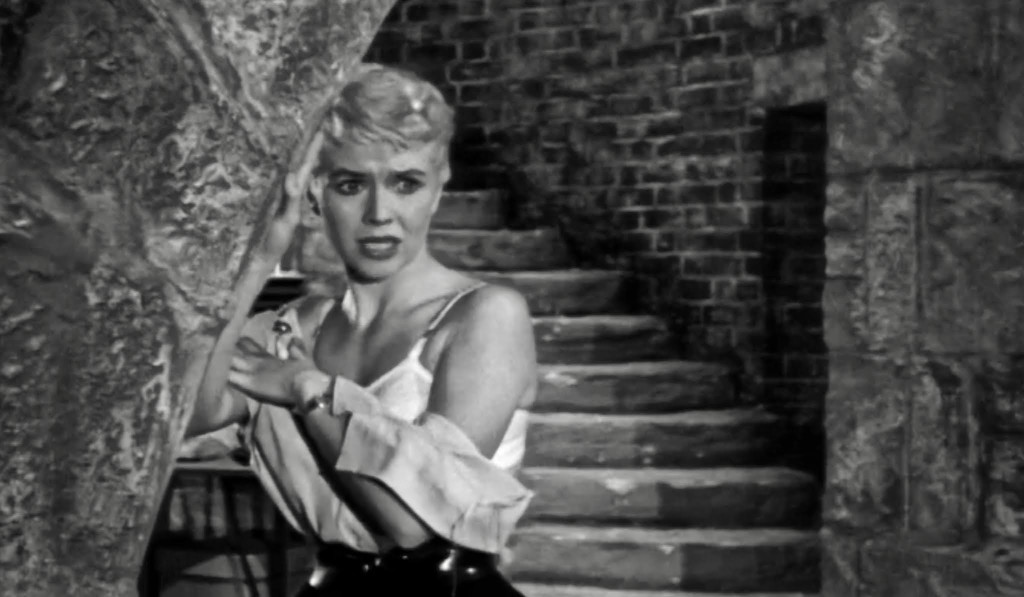
Furthermore, if women have gone missing for years around Moran’s lab, why is the police just now starting to put two and two together? And the biggest question of all: how is it possible that Sally actually falls in love with Jack, who seems to be a dick of gargantuan proportions? I have seen many an ineffective hero in B-movies, but Jack must be one of the least heroic leading men of all time. He practically shoves Sally into the arms of the mad scientist by first getting her fired and then pointing her to Moran. He then spends the whole film talking down to her, and when he finally enters hero mode, he doesn’t spring to her aid, but goes to the police – who are already – FINALLY – on their way to the Moran residence anyway. In the end, he doesn’t even confront Moran; in fact, in a rare turn of events, it is actually the villain himself that saves Sally. All that Jack does is point Sally to the stairs – which she is standing next to, while the villain destroys the monster and the henchman kills the villain, and them himself, doing all the hero work for Jack. If it wasn’t for Jack being a dick, Sally would have been in no trouble whatsoever.

Wonky logic is not something alien from science fiction and horror B-movies, and isn’t necessarily fatal, if the film is entertaining and well-made enough. However, Womaneater has little else going for it. Fleming’s badly structured script treads water from the 10-minute mark to the 65-minute mark of the 70-minute movie. From the moment Sally walks through the door of Moran, we all know what’s going to happen. From that point on, the film offers no new information, and the plot never advances until the very final scene, which offers up one of the lamest climaxes seen in these movies, when the zombie we have all been waiting for dies of natural causes before it even has a chance to attack anyone.
Charles Saunders’ direction is plodding and offers up little tension or atmosphere, although he is partly able to hide the film’s cheapness through good use of rural locations. The dungeon set by art director Herbert Smith is also quite well realised, nodding back to the gothic horrors of the 30s and 40s. Less well realised is the bizarrely cheap-looking monster tree, which looks like a papier-maché trunk with three handlers hiding behind, waving their arms around. In defence of the effects crew, allegedly the original Juju burned up in an accidental fire when shooting was about to begin, and the props department scrambled to get something on screen. This does have the ring of someone making an excuse for shoddy work, but on the other hand, as demonstrated by the final scene, they needed to make something that was extremely flammable.

The only thing, really, holding the film together are the actors. George Coulouris had shown in The Man Without a Body that he could elevate a batty script with his integrity and energy, and he does the same with Womaneater, even if he has far less to work with in this movie. Coulouris brings a jumpy, frantic energy to the driven, paranoid Moran, dashing and rushing to and fro, as if he knew the film needed a boost. He gets good support from Vera Day who chirps her way through her role in a competent manner, given her airheaded character. The rest of the cast is decent enough, given the circumstances. Peter Forbes-Robertson (billed as Peter Wayn) is fine in the “romantic” lead, considering his impossible role, and there’s nothing wrong with Joyce Gregg as Margaret either. Jimmy Vaughn, whose only credited film role this was, was probably cast for his “exotic” looks rather than any previous acting experience. He is not particularly good, but his role is such a stereotype that he is able to bring it home thanks to a sincere effort.

Womaneater is interesting perhaps only for its rarity – it is one of the few mad scientist films in the classic Poverty Row mold made in the UK – albeit 10, 15 years too late. Friends of batty so-bad-they’re-good low-budget monsters may also get a kick out of Juju the woman-eating tree stump. For all other intents and purposes, Womaneater is a plodding, bewildering movie. It’s not badly made per se, director Charles Saunders knows how to point a camera and the actors all do a decent job, but there’s just nothing particularly good about it, and the script is absolutely terrible.
Reception & Legacy

Womaneater premiered in the UK in April, 1958, on a double bill with the Swedish crime drama Blonde in Bondage. In the US, Columbia released it in 1959 as The Woman Eater, on a double bill with Japanese import The H-Man (review).
Womaneater garnered few accolades in the trade press. Hollywood Reporter called it “a slow-paced entry that ineffectually tries to generate more than moderate suspense”. Variety said the movie featured an “old-hat plot carelessly put together”. The Film Bulletin called it “third-rate right down the line”. Harrison’s Reports said that “even the undiscriminating horror fans probably will look upon it as a lesser picture of its kind, for little imagination has gone into its moss-covered story […] Not much can be said for either the direction or the acting.” The Motion Picture Exhibitor wrote: “Direction is sluggish, as is much of the acting, with Coulouris doing his best in an implausible role. The special effects are not much, and the killer tree seems destined to evoke as many chuckles as chills.”

Bill Warren in his book Keep Watching the Skies! called the movie “one of the dullest science fiction-horror thriller ever made”. Warren also opined that the film was unusually misogynist, starting with the tree that seems to have a preference only for pretty, young ladies (something which is never explained), and notes that Sally isn’t even able to walk up the stairs that are right in front of her to escape the dungeon without the help of a man; “Women are beauty objects or things to be used and discarded, such as Margaret and the tree’s victims. Even the title itself, even if taken as a reference to cunnilingus […], reduces a woman to an object.”
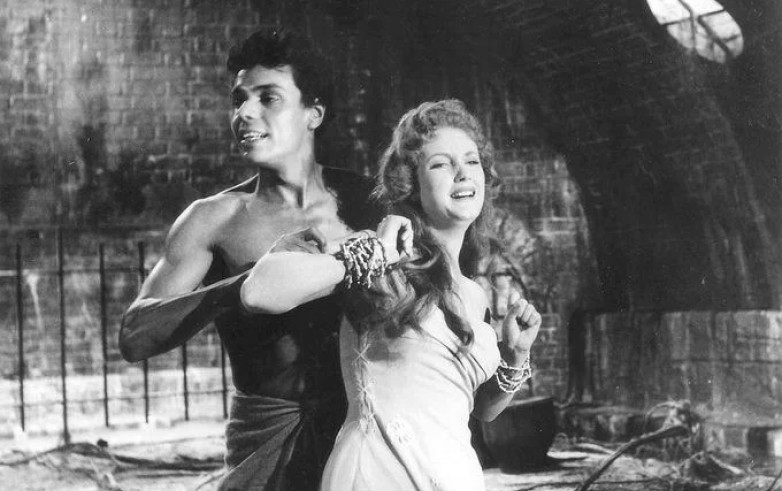
British critic Phil Hardy wrote in The Encyclopedia of Science Fiction Movies that “the direction, acting and scripting are all questionable and totally lack the silliness required to get away with such a motif”. Bryan Senn in Twice the Thrills! Twice the Chills! was more positive, citing Saunders’ good use of location shooting in the countryside and the dungeon set, creating “an atmosphere of ominous menace”. Senn goes as far as calling the tree monster “fairly impressive”.
Today Womaneater has a 4.6/10 audience rating on IMDb, based on 700 votes and a 2.9/5 rating on Letterboxd, based on 300 ratings.
Cast & Crew
Director Charles Saunders was a former editor born in London in 1904, who made the transition to directing in 1944 with Tawny Pipit, a rather well-received little wartime drama on the home front, about an injured WWI soldier and his nurse protecting a pair of endangered birds in a small English town during the war. Generally seen as Saunders’ best film, it eclipses everything he did since, despite him directing 30 more fims between 1948 and 1962 – almost all of them quota quickies. He was credited for direction on The Man Without a Body (1957, review), but only because the film needed to have a British director in order to receive the government quota grant. Reportedly, Saunders showed up on set every day, even if it was American W. Lee Wilder who did all the directing. He got his shot at directing an SF movie of his own the next year with Womaneater (1958).
Italian-born producer Guido Coen came to England in 1929, and soon found work at the production company Two Cities, a long time as a film subtitler, and later as an assistant producer. In 1949 he set up his own production compay, specialised in quota quickies. In 1959 he joined Twickenham Studios in London, first at lower positions, but eventually as executive director. He oversaw extensive development of the site, on which numerous classic films were shot, from Alfie (1969) to Blade Runner (1982).
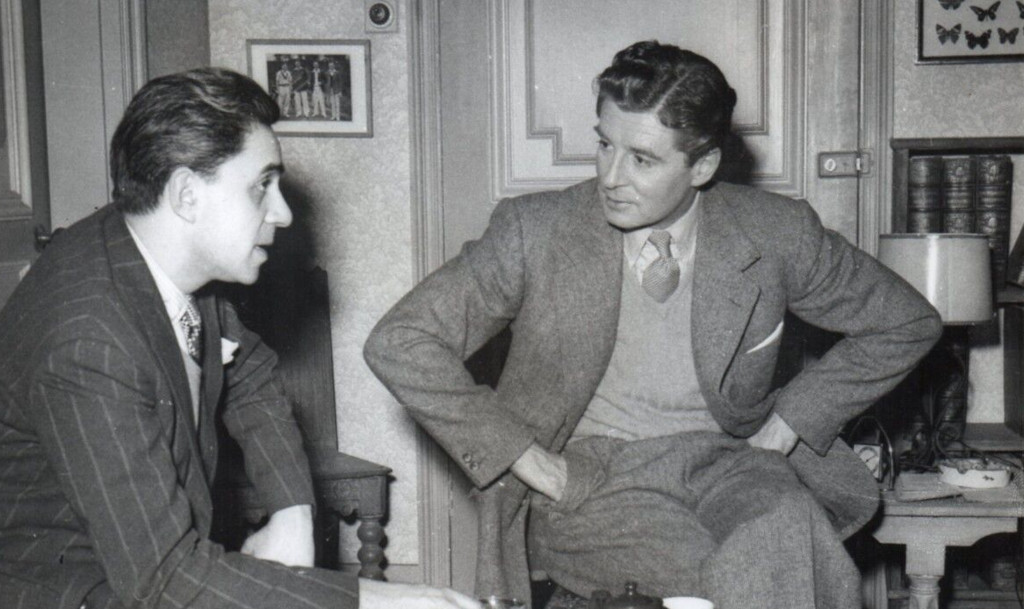
Screenwriter Brandon Fleming was born in 1889, and worked as a writer in many capacities over his long career, including as a journalist, author playwright and screenwriter. He wrote several dozen short stories published in British pulp magazines, but doesn’t seem to have had much dealings with science fiction, according to an excellent article on Tellers of Weird Tales. IMDb lists two different Brandon Flemings, one with 9 screenplay credits and one with 13. However, they both seem to have written for two different productions called The Flaw, one in 1933 and one in 1955, and I suspect that they are one and the same person.

The music ofWomaneater was composed by one of Britain’s most prolific and iconic TV composers of the fifties and sixties, working on TV series like The Adventures of Robin Hood, Ivanhoe and The Saint – Edwin Astley. He also provided music for a number of both A and B movies, best known perhaps for the Peter Sellers/Jack Arnold collaboration The Mouse that Roared (1959). Astley occasionally dabbled in science fiction, scoring films like Devil Girls from Mars (1954, review), Womaneater (1958), Behemoth the Sea Monster (1959, review), Kadoyng (1972) and Digby, the Biggest Dog in the World (1973), as well as the TV series The Champions and Department S.
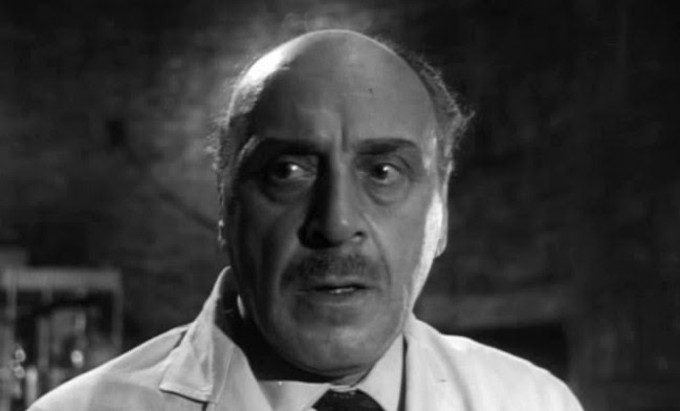
George Coulouris was a celebrated stage actor who began his career in London, but made the move to New York in 1929. Here he regularly appeared on Broadway, and was a longtime member of Orson Welles’ Mercury Theatre. He also worked extensively in radio, and was the first actor to voice the extremely popular agent Bulldog Drummond on the air. He made his film debut in 1933, and established himself as a major film actor in 1941, when he played the Kane family lawyer in Citizen Kane (1941). During his Hollywood heyday Coulouris appeared in such films as For Whom the Bell Tolls (1943), Watch on the Rhine (1943) and Mr. Skeffington (1944). He returned to the UK in the early fifties, where he divided his time between prestigious stage roles and rather mundane film roles. He appeared in the science fiction movies The Man Without a Body (1957, review), Womaneater (1958) and Peter Fonda’s nihilistic post-apocalypse film No Blade of Grass (1970), as well as A Clockwork Orange (1971). His last SF work was in the odd The Final Programme (1973).

Vera Day was a hair model who got hired as a stage showgirl in the mid-50’s after auditioning in the smallest bikini she could find. She was spotted by Val Guest at one of the shows, and was brought into the film business. Here she made a modest career as a blonde bombshell in both serious and comedic films. She is perhaps best remembered for appearing as the chirpy barmaid in Quatermass 2 (1957, review), the crime drama Hell Drivers (1957), the horror film Womaneater (a rare lead, 1958), the Boris Karloff vehicle Grip of the Strangler (1958) and the crime comedy Too Many Crooks (1959). Day dropped out of acting in the early 60’s but made a surprise return in 1998 in Guy Ritchie’s likewise surpsise hit movie Lock, Stock and Two Smoking Barrels. She had a small but memorable role as a croupier explaining the rules of a poker game, and said in an interview she was extremely happy to have “the only female role in the film with lines and her clothes on”. She accepted occasional roles in the years to come, most notably in the straight-to-video release The Riddle (2007). Her latest film appearance was in the short film Bad Friday in 2017.
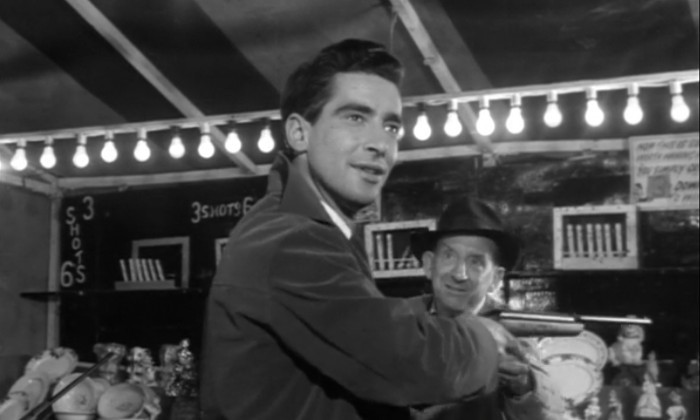
Womaneater provided a rare lead for Peter Forbes-Robertson, appearing under the stage name Peter Wayn. He appeared in around a dozen films and around 40 TV shows between 1949 and 1986, one can assume mainly as a way to supplement an income from stage work. In movies he primarily held small bit-parts, sometimes even uncredited. In 1966 he appeared as a doctor in Terence Fisher’s Island of Terror, and he may be best known for appearing in seven episodes Dr. Who between 1966 and 1972.

The native girl sacrificed to the Juju in the beginning of Womaneater (1958) was Marpessa Dawn, star of the Oscar-winning movie Black Orpheus (1959). Born in Pittsburg, she emigrated to England in her teens, and reportedly did some TV work there, although IMDb has no record of this. Aged 19, she relocated to France in 1953, where she worked various jobs at nightclubs, including singing and dancing, and appeared in a couple of minor film roles. She did a short comeback in Britain in 1958, appearing in Womaneater and a TV episode, before getting cast by Marcel Camus (whom she was briefly married to) as the female lead in Black Orpheus (1959), which won both the Palm d’Or at the Cannes Film Festival and the Oscar for Best Foreign Language Film. This, however, remained her only high-profile film role. She had another lead in the low-budget French-Spanish adventure film El secreto de los hombres azules opposite another US emigrée, Lex Barker, in 1961, but apart from that she mainly had small supporting roles in films and guest spots on TV during the 60s and 70s. Dawn had more success on stage in the 60s, but in the mid-70s offers began thinning out.

Well-endowed Marie Deveraux plays one of the prostitutes that Dr. Moran passes on his hunt for a new victim in Womaneater (1958). Deveraux, real name Patricia Sutcliffe, was a nude model with acting ambitions, who appeared in a TV show in 1958, and made her big-screen debut in Womaneater. Deveraux appeared in around two dozen films in the UK, almost exclusively in bit-parts, often uncredited, cast more on the strength of her physical attributes than her acting abilities. She appeared in three Hammer films, including The Brides of Dracula (1960), in which she played one of the titular creatures. A high point, of sorts, was when she got the chance to travel to Italy to participate in the classic Cleopatra (1963). In addition to having a tiny part as a baccanal guest, she was also Liz Taylor’s body double. After this, she relocated to Hollywood, whe she had to small parts in Samuel Fuller’s cult movies Shock Corridor (1963) and The Naked Kiss (1964). After this she married and had kids, and dropped out of acting.
Janne Wass
Womaneater. 1958, UK. Directed by Charles Saunders. Written by Brandon Fleming. Starring: George Coulouris, Vera Day, Peter Forbes-Robertson, Joyce Gregg, Jimmy Vaughn, Joy Webster, Robert MacKenzie, Norman Claridge, Marpessa Dawn, Sara Leighton, Edward Higgins, Maxwell Foster, Peter Lewiston, Shief Ashanti, Marie Deveraux. Music: Edwin Astley. Cinematography: Ernest Palmer. Editing: Seymour Logie. Art direction: Herbert Smith. Makeup: Terry Terrington. Produced by Guido Coen for Fortress Film Productions & Eros Film.


 Scifist.
Leave a comment