

A love-lorn weakling acquires superpowers from “ant milk” and becomes a lucha libre sensation in order to impress the woman of his dreams. An uncredited re-imagining of the Hollywood comedy “The Gladiator”, this Mexican 1959 film is derivative and marred by a low budget, but well acted and enjoyable. 4/10
El superflaco. 1959, Mexico. Directed by Miguel Delgado. Written by Gunther Gerszo, Carlos Orellana. Starring: Pompín Iglesias, Evangelina Elizondo, Wolf Ruvinskis, Daniel “Chino” Herrera, Santanon. Produced by Fidel Pizarro. IMDb: 6.2/10. Letterboxd: N/A. Rotten Tomatoes: N/A. Metacritic: N/A.
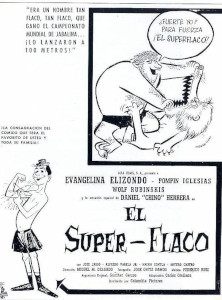
Pompis (Alfonso “Pompín” Iglesias) is a scrawny anemic who wants to get strong so he can impress on his idol, beautiful singer Brigida Loyo (Evangelina Elizondo). He sees his chance to impress on her while she is having a fight with her buff boyfriend Rudy (Wolf Ruvinskis). However, Brigida will not be courted by an annoying fan, and a weakling at that, and has Rudy throw out Pompis like a rag doll. However, Pompis’ neighbour, mad scientist Professor Nicasio (Daniel Herrera) and his assistant (Santanón) may have a remedy…
So begins the Mexican 1958/59 (depending on the source) comedy El superflaco (sometimes written as El super-flaco or El super flaco), directed by Miguel M. Delgado and starring second-tier comedy star Pompín Iglesias. The movie seems to have been inspired by the 1938 Hollywood comedy The Gladiator (review) starring Joe E. Brown.
Back in his poor neighbourhood, Pompis dreams of Brigida, oblivious to the longing looks he is being sent by his neighbour and co-worker at a gym store, the mousy Rebeca (also Evangelina Elizondo), who loves Pompis for who he is, and needs neither muscles nor diamond rings. On the other hand, Professor Nicasio is trying to coax Pompis to try his new serum, derived from the milk of ants, that he tells Pompis will make him super-strong. But seeing as Nicasio’s previous experiment has turned his assistant into small person, Pompis is not keen to try whatever the mad scientist has cooked up. That doesn’t stop Nicasio, who secretly injects Pompis when he is asleep.
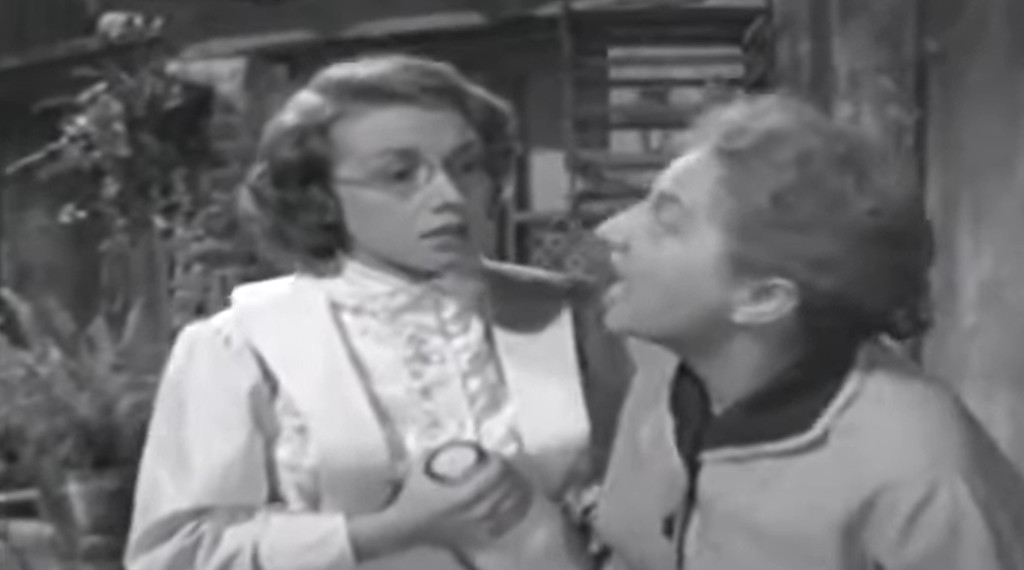
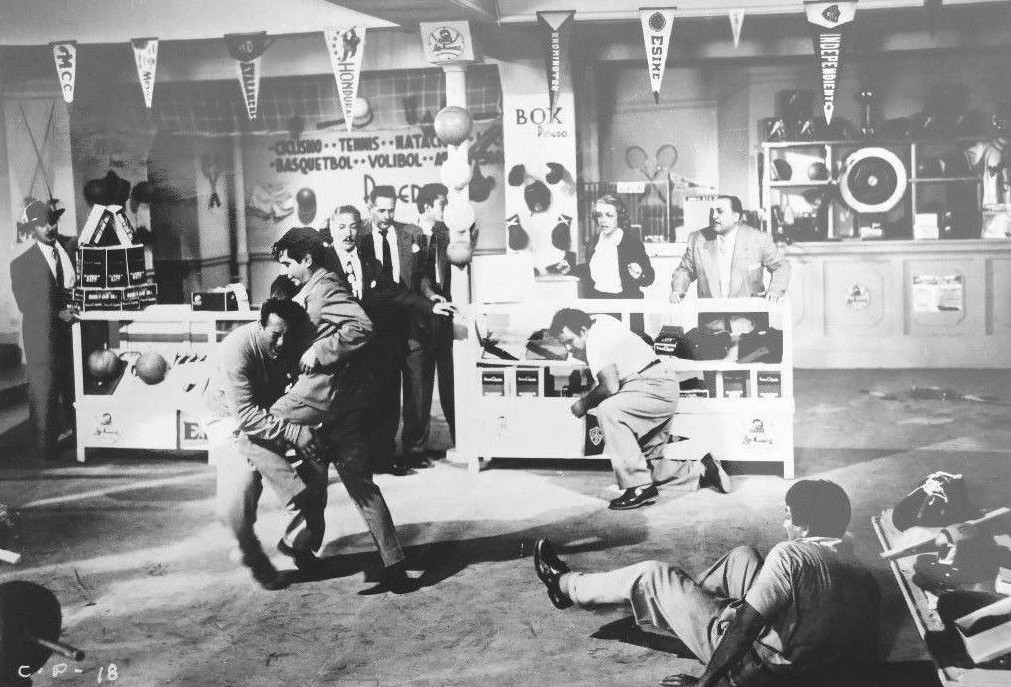
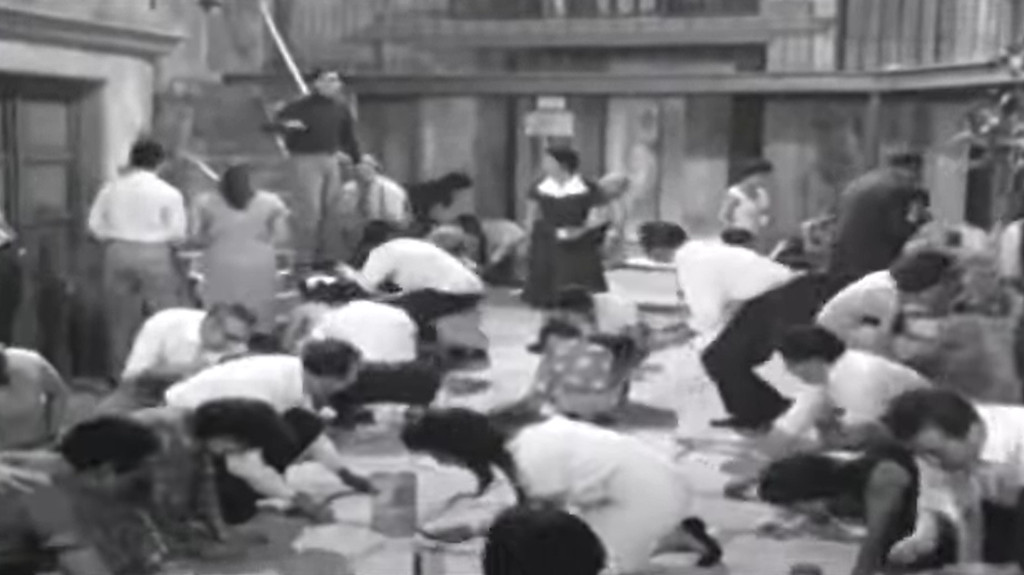
The next morning, Pompis discovers his super-strength when taking out a whole group of pro wrestlers that get in his face at the gym store, and after a trip to the police station, he gets hired by a lucha libre promoter (Alfredo Varela). Branded as “The Bull”, Pompis becomes a national sensation in the lucha ring, and as he gains fortune and fame, he also gets the interest of the materialistic Brigida Loyo. However, Brigida’s boyfriend Rudy challenges Pompis to a lucha libre match – a match Pompis should win easily. But – alas! – just hours before the bout, the serum wears off. While not knowing that the serum is the cause of his strength, Pompis remembers Nicasio and his crazy experiments, and seeks him out. However, Nicasio has run out of ants, so the whole block is called out to an ant hunt. Still, when the bout begins, Pompis has still not received his serum – and gets thrashed by Rudy. The film has no last-minute intervention: Pompis loses both the fight and the hand of Brigida. Back home, Pompis is moping, when Brigida shows up at his doorstep, ready to take him back. Only – it is not Brigida, but Rebeca, who has gotten rid of her glasses and been styled by Brigida. Pompis realises that has been blind to what has been right in front of him the whole time.
Background & Analysis
Very little information is available about the production of El superflaco – which translates as “the super-skinny”. This speaks to the film’s nature as a quickly produced programmer made without any major artistic or even commercial ambitions. It was probably shot over a week or two on a modest budget.
The picture is primarily studio-bound. It was most likely shot at the Churubusco Studios in Mexico City. This was Mexico’s largest and most well-equipped movie studio, and was generally used for shooting these kind of mid-budget comedies. In fact, I can identify the front yard/street sets used for the neighbourhood in which Pompis, Rebeca and Professor Nicasia all live as the exact same set used in El castillo de los monstruos (1958, review), shot the same year as El superflaco, and which is confirmed as being shot at Churubusco. In that film it was used as the neighbourhood where comedian Clavillazo lives – and where he rents out his apartment to – whom else? – Evangelina Elizondo, the female lead of El superflaco. Both films even place the lab of the mad scientist atop the stairs on the left-hand side of the set. The stairs are also used for slapstick in both movies. In El Castillo there’s a running gag with Clavillazo falling down the stairs, and in El superflaco Pompín Iglesias accidentally pulls the railing loose before discovering he has become super strong. It would make sense that a relatively cash-strapped (compared to Hollywood) film industry such as Mexico’s in the 50s would have had their major studio equipped with generic standing sets that could be used by different producers. The wrestling scenes are almost certainly filmed at Arena México, the country’s largest and most modern wrestling arena, which was featured in numerous films.
As far as the story goes, as mentioned, the movie closely resembles David Loew’s 1938 comedy The Gladiator (review), directed by Edward Sedgwick and starring comedian Joe E. Brown. Both films concern a weakling who is bullied around and wishes he was strong, in order to impress a woman. In both films, we have a scientist creating a serum from ants, which they inject the protagonist with while they are sleeping. Both protagonists then become sport stars – Brown in American football and Iglesias in wrestling. Both films also feature as their climax a wrestling match where the super-strength serum wears off at the crucial moment. The similarities are simply too many for them to be coincidences, and it seems clear that someone on the writing team – Gunther Greszo or Carlos Orellana – or possibly director Delgado himself – decided to make a Mexican version of The Gladiator.

Superhuman figures with fantastic strength or other superpowers naturally goes back to our oldest mythologies and religions, from Gilgamesh and Hanuman to Hercules, David and Thor. However, one of the most important prototypes for the trope was Hugo Danner, the protagonist of science fiction writer Philip Wylie’s 1930 novel Gladiator, in which a scientists injects his still unborn son with a serum that gives him supernatural strength. The film The Gladiator was a very loose comedic interpretation of Wylie’s novel – the protagonist’s name is even Hugo Danner. However, in the Mexican version the over-arching theme of both the novel and the US film – basically that with great power comes great responsibility – has been lost. Instead, this is more of an ode to the underdog. The resolution that you don’t need to be rich or strong to be loved and respected is very much in line with the traditional themes of Mexican comedies, whose protagonists always tended to come from the lower social classes. Very often these protagonists would ascend on the social ladder through the films, only to realise in the end that money, success and social status is not all that it’s cut out to be, and that it is what’s in one’s heart that matters. This is also the case in El superflaco, and having by now watched a number of these Mexican comedies, it makes the film rather predictable, an issue that isn’t lessened by the fact that it so closely follows the beats of The Gladiator.
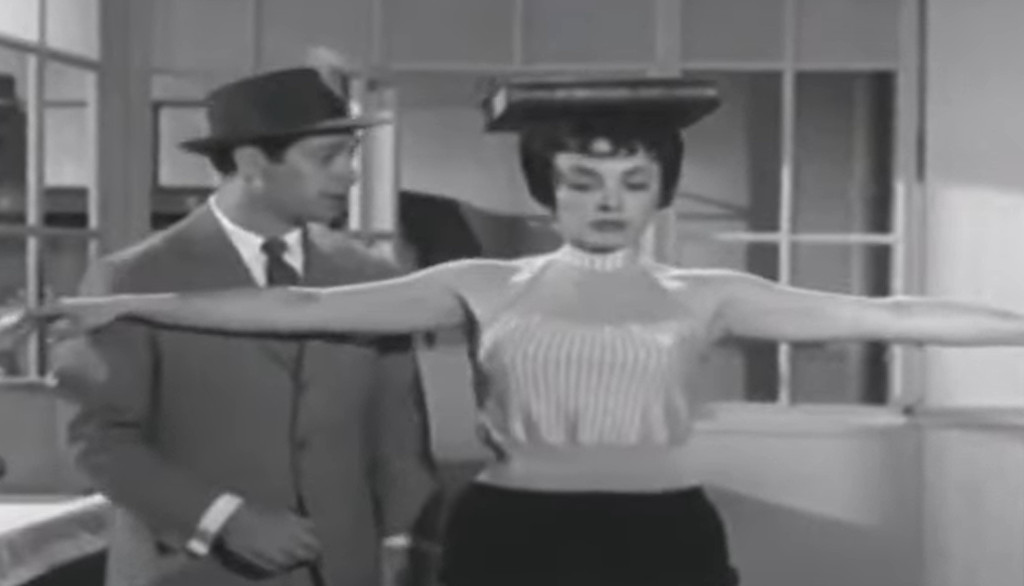
A weakling receiving superhuman powers was also a popular theme in Mexican comedies of the 50s. Resortes starred in two such films in 1952: El beisbolista fenomeno and El luchador fenomeno. In the first one, the spirit of a baseball player possesses Resortes, and in the second he receives his power from both divine and satanic intervention. In Una movida chueca (1956, review) Clavillazo drinks a serum which allows him to see the future. El superflaco was followed up in 1960 by El supermacho, which also involves scientific experiments.
In the defense of El superflaco, it is a film that is plot-driven, rather than one that mainly serves as a vehicle for the trademark shenanigans of which ever comedian appears at the top of the bill – which is often the case in these kind of comedies. The scenes presented on screen are generally logical extensions of the previous one, there is a clear dramatic arc that runs through the entire film, and most characters actually serve a dramatic purpose. This might sound like faint praise, but I’ve seen enough 50s sci-fi comedies by now in which the plot merely seems to be an afterthought that I appreciate even the most basal dramatic construction. Be it as it may that the plot of El superflaco is derivative, predictable and almost entirely lifted from another, better, movie.
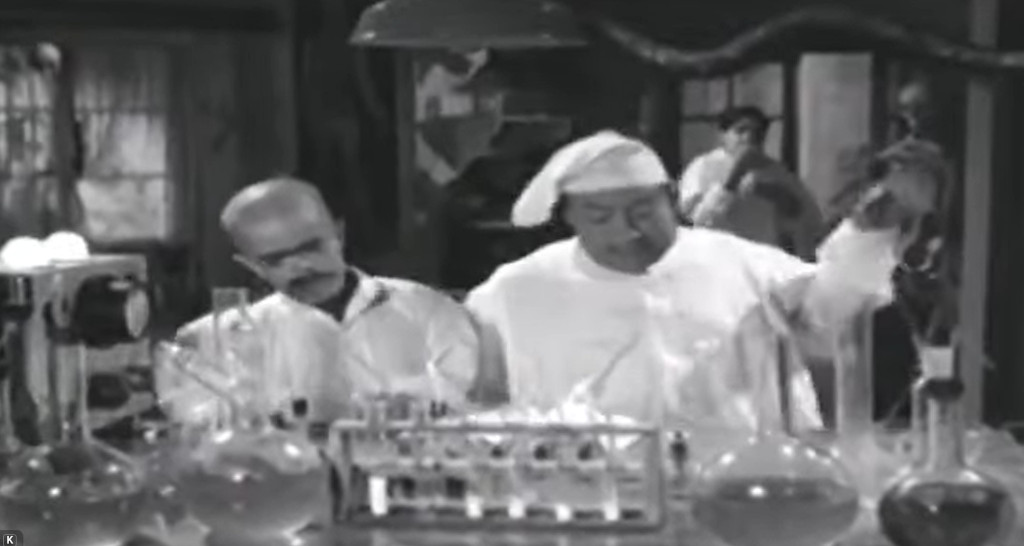
I do like the fact that Evangelia Elizondo gets some pretty good characters to play with. The character of Rebeca is written, and beatifully played by Elizondo, as a feisty firecracker under her meek veneer, passionate in her defense of Pompis, not afraid to get in a physical fight to defend him.
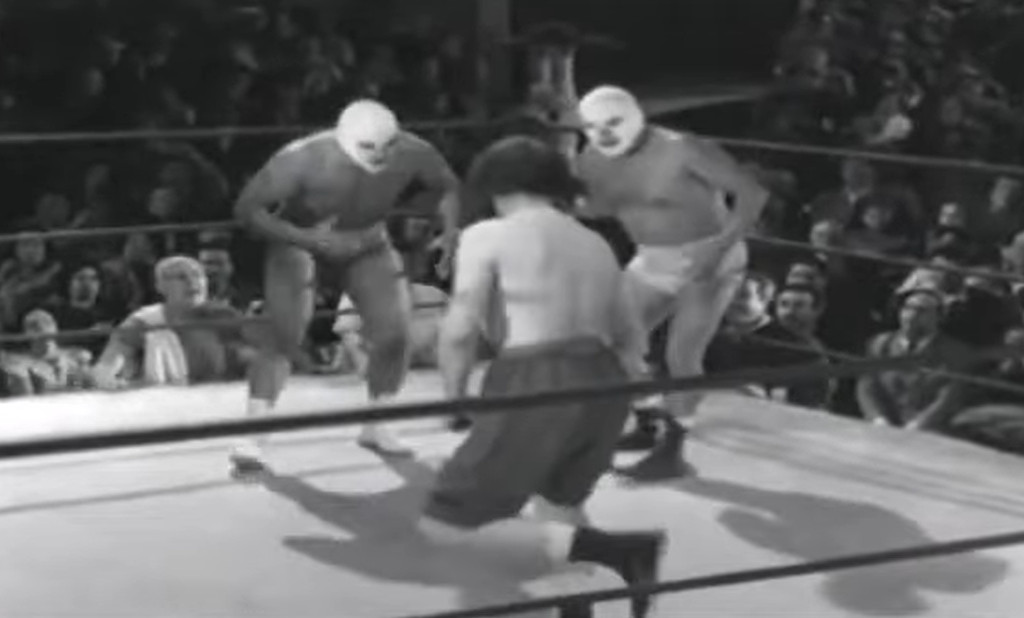
Screenwriters Gunther Gerszo (who primarily worked as a production designer) and Carlos Orellana (a sci-fi veteran by this time) fail to do anything interesting with Pompis’ superpowers – largely, one suspects, because of budgetary restraints. His most spectacular feat is holding on to a bus, preventing it from leaving. Pompín was not a physical comedian, so the wrestling scenes where he is supposed to have super-strength are unimpressive, as no special effects are used to enhance the them, and they mostly consist of other luchadors falling to the ground at the mere touch of Pompis. And if the special effects are few and unimpressive, there is nothing in the way of visual effects in the movie.
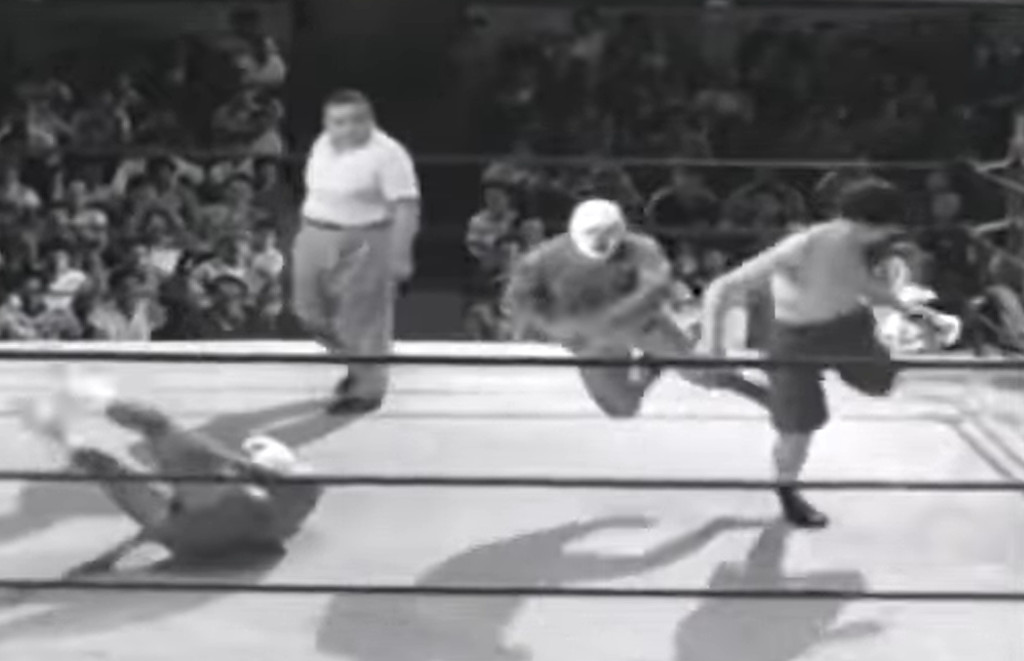
Miguel Delgado’s direction is professional but workmanlike, consisting mostly of dull setups, wide and medium shots, and often scenes are filmed only from a single angle. Gunther Gerszo was nominated for several Ariel awards for his production design, but here he is severely hampered by the budget – the scenography is uniformly uninteresting and drab.
The movie includes two or three choreographed song numbers, all involving Evangelina Elizondo as Brigido Loyo. Elizondo was a trained and successful singer, and the song numbers are not bad as such, but they are poorly integrated into the plot, and are present only because comedies of this ilk were often expected to have musical numbers. In this case, however, it is forgivable, as Elizondo actually plays a singer. There’s one song about the yo-yo, which was perhaps at the height of its popularity at this time, which is a fun little period marker.
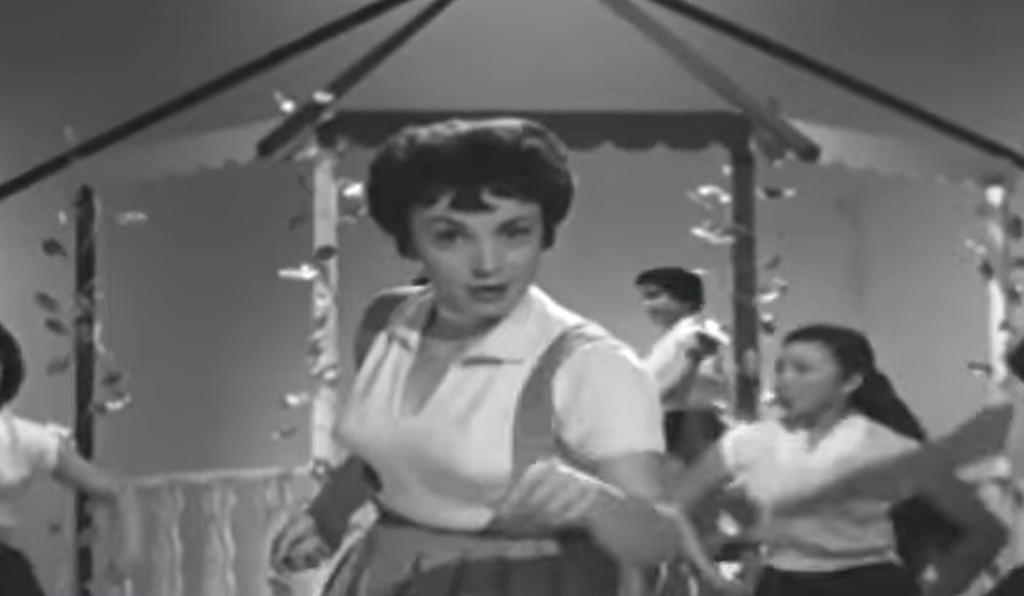
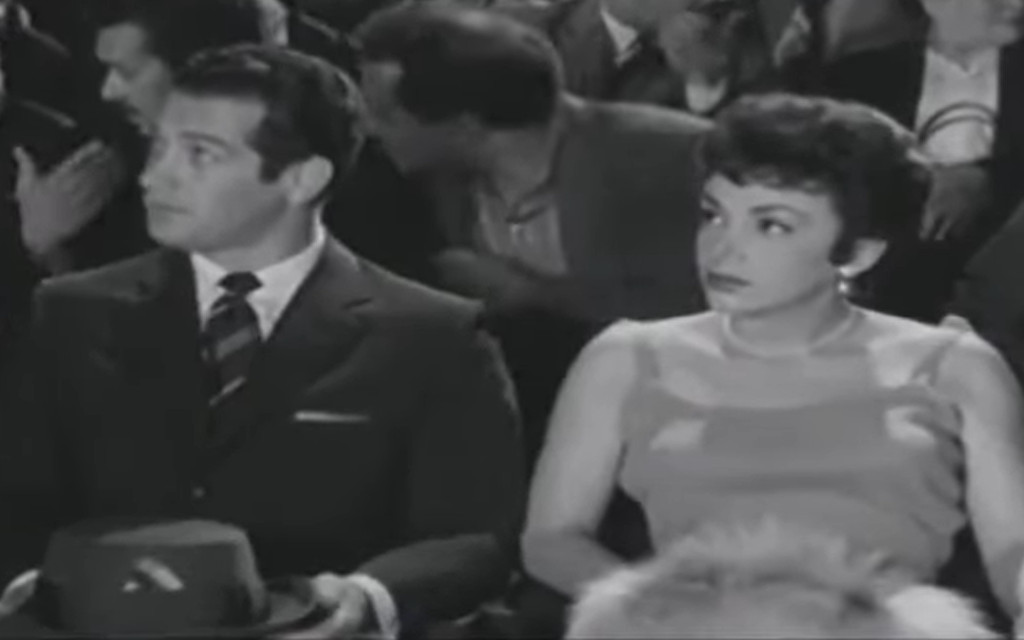
El superflaco doesn’t suffer from a lack of talented actors. Granted, Pompín Iglesias was not among the country’s top tier of comedic actors – he thrived on his boyish energy and hapless charm. His performance works for the role, but is not particularly memorable. Evangelina Elizondo was one of Mexico’s top leading ladies and has been good in everything I have seen her in this far, and her work in El superflaco is no exception. In fact, her dual role as Rebeca/Brigida is quite impressive. I hadn’t looked at the IMDb credits before I watched the movie, and actually didn’t realise she played both roles before I started reading up for this article. Of course, much of this is up to hair and make-up: Brigida is a glamorous brunette while Rebeca is a mousy blonde in glasses – but still, Elizondo is able to give the two characters very distinct personalities and physicality, enough to fool me anyway.
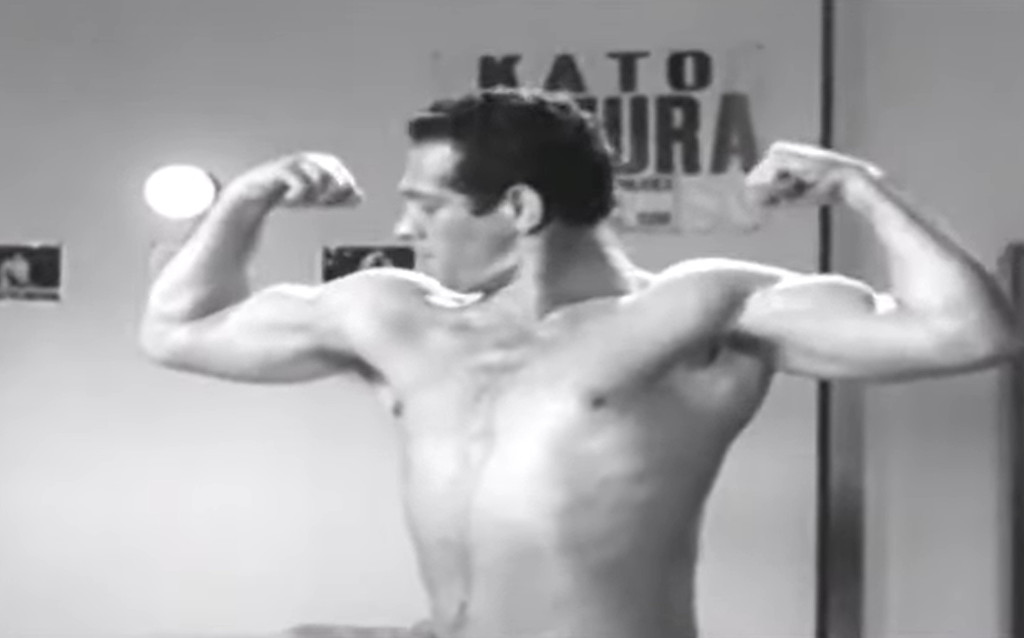
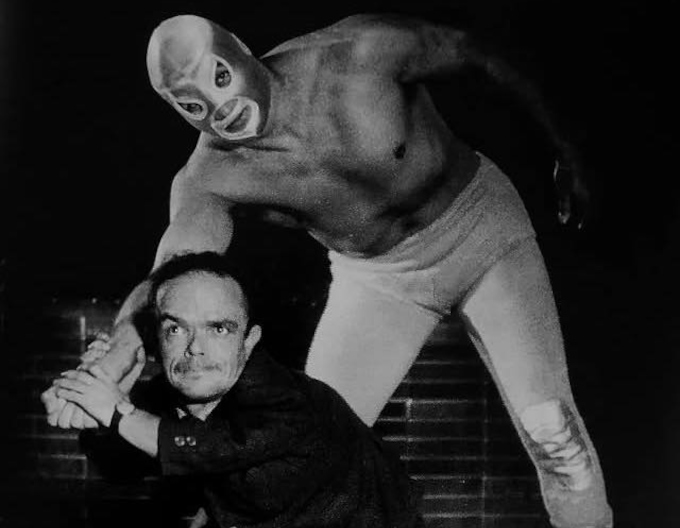
Wolf Ruvinskis gives another solid performance as Brigida’s boyfriend Rudy. Ruvinskis had a short but promising wrestling career before injuries forced him to give up the sport, and he instead focused on acting – and proved to be a fairly good actor, at that. Character actor Daniel “Chino” Herrera is amusing as the mad doctor, but it is his memorable assistant that steals the scenes he is in. Oddly enough, the actor of little stature that has quite a prominent role in the film isn’t credited on screen or even in IMDb’s credits. However, my research leads me to the conclusion that the actor in question is Rafael Muñoz Aldrete, better known under the pseudonym El Enano Santanon, or simply Santanon, one of the top little people actors in Mexico. For some reason, the screenwriters haven’t given him any lines – he only grunts – but his intense acting, coupled with a rather humorous mustache, makes him unforgettable.
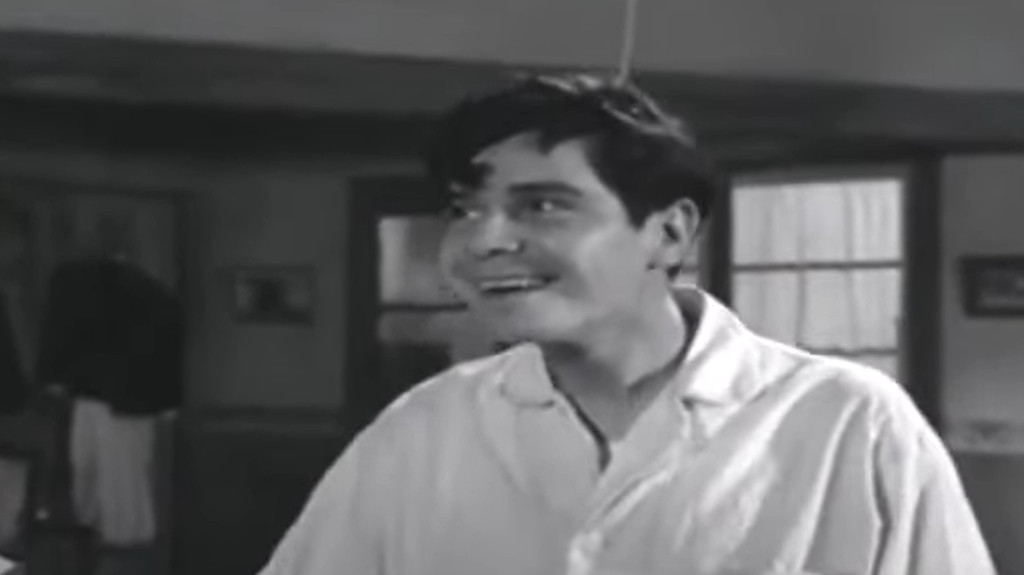
Despite its derivative and programmatic nature, El superflaco is a pretty enjoyable film, if you don’t come in with particularly high expectations. It is also more accessible to non-Spanish speakers than a lot of the comedies with actors like Resortes, Clavillazo and Tin Tan, as these often place the emphasis on the verbal equilibristics of said comedians, whereas El superflaco is a situation comedy. As I often state here on Scifist, it is for completists only, but as such it is one of the more entertaining Mexican comedies I have viewed. If nothing else, it is worth watching for Evangelina Elizondo’s performances.
Reception & Legacy
The release date of El superflaco is uncertain, some sources put it at the end of 1958, others at the beginning of 1959, it’s one of those films that flop back and forth between years on IMDb. Since it is listed as having premiered in 1959 at the time of writing this article, that’s what I’m going with. The film was released at least in Mexico and Chile, and some sources also claim Colombia.
I have found no contemporary reviews of El superflaco. However, there are a few write-ups in some later publications. In the film journal Cuadernos de cine Colombiano 19/2013 Roberto Fiesco writes that film is jam-packed with great comedy talent, but, “the excellence of the cast […] could not hide the weakness of the plot by the brilliant set designer Gunther Gerszo, who became a writer by through who knows what impulse”. David Wilt in The Mexican Film Bulletin 5/2015 calls the film “a rather bland, mediocre film overall”, citing undestinguished art direction and a lack of special effects as some of the failings of the picture. However, in a later issue of the magazine (2021) he compares it favourably to El supermacho (1960), which he categorieses as “a real mess”.
The only review I have found in English, apart from David Wilt’s, comes, unsurprisingly, from Dave Sindelar at Fantastic Movie Musings and Ramblings. Once again, Sindelar has watched the film without subtitles: “However, it was very easy to follow, and much of the humor was visual. Still, one of the reasons it was so easy to follow was that the story itself is very familiar; I’m sure I’ve seen several variations of it by this time, and though I was a bit surprised by some events near the end of the movie, in general it was very predictable and mostly lacking in surprises. […] From what I can tell, it’s passable and mildly entertaining, but unless the verbal jokes are really good, it’s no more than that.”
Cast & Crew

Alonso “Pompín” Iglesias Soto was a minor comedian star of Mexican cinema and TV, who is probably best remembered by Mexicans today for his role in the long-running TV series Mi secretaria (1975–1985), in which he was associated with the catchphrase “Qué bonita familia, qué bonita familia!”. Little information is available about Pompín’s life and career online, but he was born in Colombia in 1926, and presumably moved to Mexico in order to get into the movie business. Wikipedia lists a film credit from 1943, but his movie career proper began in 1950, primarily in uncredited bit-parts. For most of his career he played comic sidekicks and other supporting roles. There was a short-lived push in the late 50s, with films like Maratón de baile (1958) and El superflaco (1959) to make him a top-billed comedy actor in the vein of Cantinflas and Tin Tan, able to carry films on his reputation alone, but nothing really came of that. It seems Iglesias simply didn’t didn’t have that special something that would have made him star quality. He did continue to act, though, up until 2002, and appeared in some 70 films in his career. In 1985 he received an award for best comedic actor at the Premios TVyNovelas gala.

Lead actress Evangelina Elizondo was a remarkable woman. At a young age she excelled as a painter and got degrees in both art and theology, and had a keen interest in singing and dancing. She started her film career as the Spanish voice of Disney’s Cinderella in 1950, when she won a contest during her studies at the university, according to an interview in the book Screen Sirens Scream! by Paul Parla and Charles P. Mitchell. This opened the door for her for both stage work and later movies — she specialized in comedy and musicals, as she says her real passion was singing and dancing, and she wasn’t that interested in dramatic roles. In Screen Sirens Scream! she lists all her three SF movies; Los platillos voladores (“an excellent picture”), El castillo de los monstruos (1958, with Clavillazo) and El superflaco (1959). During the 70’s and 80’s Elizondo partly retired from film work, but made a bit of a comeback in TV in the late eighties — first co-starring with Resortes in El abuelo y yo (1992), and then making a splash as Doña Emilia in the telenovela Mirada de mujer, which led to more featured telenovela work in the 2000’s. Furthermore, Elizondo has recorded several music albums, was a respected artist and published a book on art and a book on philosophy. She passed away in 2017.
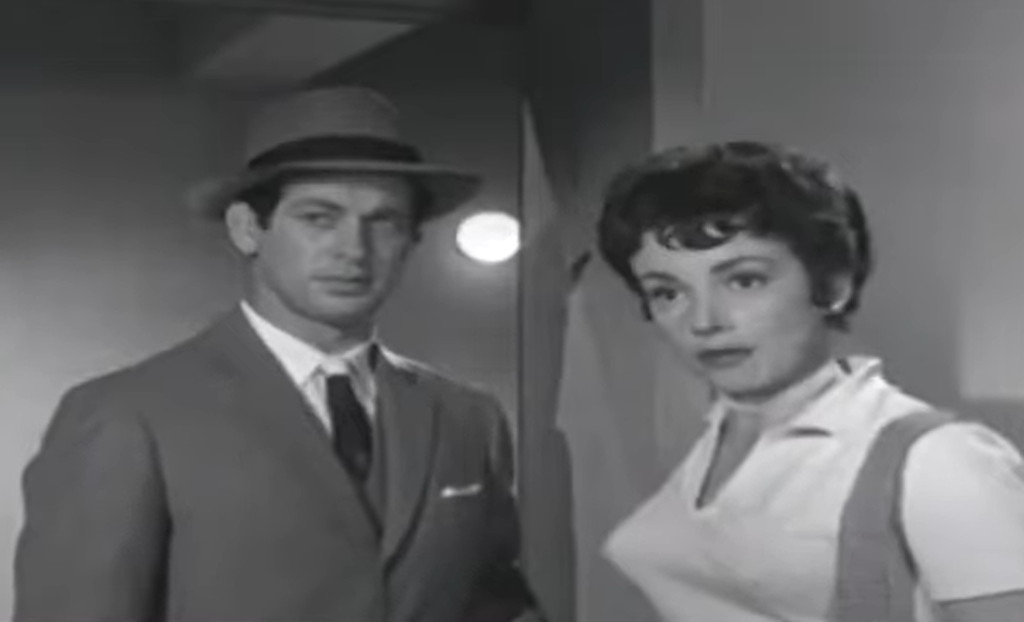
Wolf Ruvinskis Manevics was born in Riga, Latvia, in 1921, and his Jewish family fled prosecution by the Nazis to Argentina in the 30s. At the age of 19 he became a luchador, which brought him to Mexico. As The Latvian Wolf, he played a bad guy in the ring, facing off against all the top stars of Mexican show wrestling, until accumulated injuries forced him into partial retirement in the early 50s, allowing him to focus on his other passion, acting. A fixture in B-movies in the early 50’s, like Crox Alvarado, Ruvinksis got his breakthrough in The Magnificent Beast (1952). He often played secondary characters, and The Body Snatcher (1957, review) was his first bona fide leading role, even if he was third-billed below Columba Dominguez and Alvarado. In 1960, he followed in the footsteps of Santo, and got his own masked superhero luchador character in Neutrón, el enmascarado negro. He played Neutron in a handful of films between 1960 and 1965, movies that have become his most lasting legacy. His SF output include: The Body Snatcher (1957), El superflaco (1959), Neutrón, el enmascarado negro (1960), Neutron vs. the Death Robots (1962), Neutron vs. the Amazing Dr. Caronte (1963), Neutron vs. the Maniac (1964), Neutron Battles the Karate Assassins (1965) and Santo vs. the Martian Invasion (1967). Ruvinskis kept on acting until his death in 1999, and appeared in over 120 movies. He was also a stage magician, an accomplished tango dancer and in later years opened a restaurant.

Daniel “Chino” Herrera was a renowned Mexican comedian who received his nickname because of his supposed Asian-looking features. In film, he ususally appeared in comic relief capacity or in supporting roles. He later found steady work in TV, and functioned as host for several TV shows. He appeared in two science fiction movies: El superflaco (1959) and Los invisibles (1963).
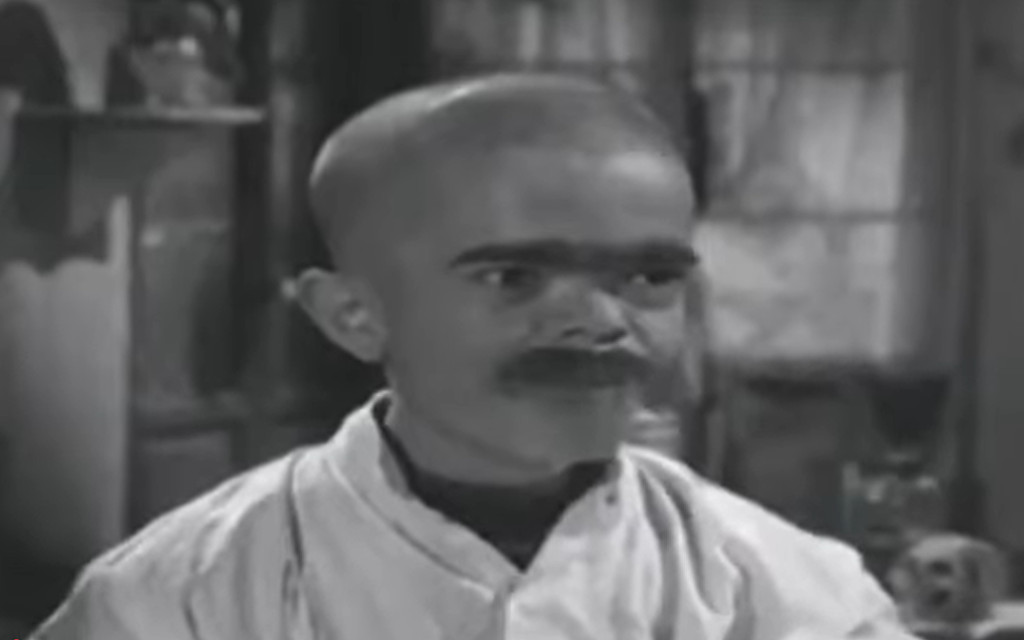
As stated earlier, the short actor who plays the scientist’s assistant isn’t credited, nor does he appear in IMDb’s credits for the movie, despite his prominent role. However, it is undoubtedly Rafael Muñoz Aldrete, better known as “El Enano Santanon” (“the dwarf Santanon“), or simply Santanon. Santanon was considered one of Mexico’s greatest diminutive actors, and he is best known for his suit role as “The Stinky Skunk”, added to the story of Little Red Riding Hood in the children’s film El caperucita roja (1960), and its three popular sequels. He also played the lead as Puss in Boots in another popular children’s film, El cato en botas (1961). He was dubbed by other actors for these movies.
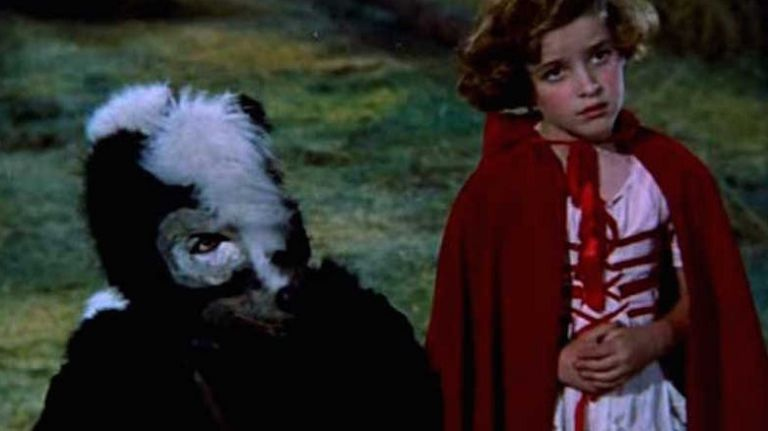
Like many of Mexico’s comedians, Santanon got his start in the vaudeville/circus environments of the so-called “carpa cultural”, the many performance tents that littered Mexico between the 30s and 50s, when he was still a pre-teen. This was presumably where he took of was given his stage name. He made his film debut in 1944, and presumably appeared in several movies uncredited, even when he had substantial roles, as in El superflaco. IMDb lists only 29 film appearances, but a Mexican obituary claims that the total number is at least 84, probably more. Internationally he is probably best known for his involvement in a handful of luchador films, two starring Santo and one starring John Carradine and Mil Mascaras. Santo and Blue Demon vs. the Monsters (1970) is the most widely known of these. He also appeared in the Boris Karloff movies Fear Chamber (1968) and Isle of the Snake People (1971).
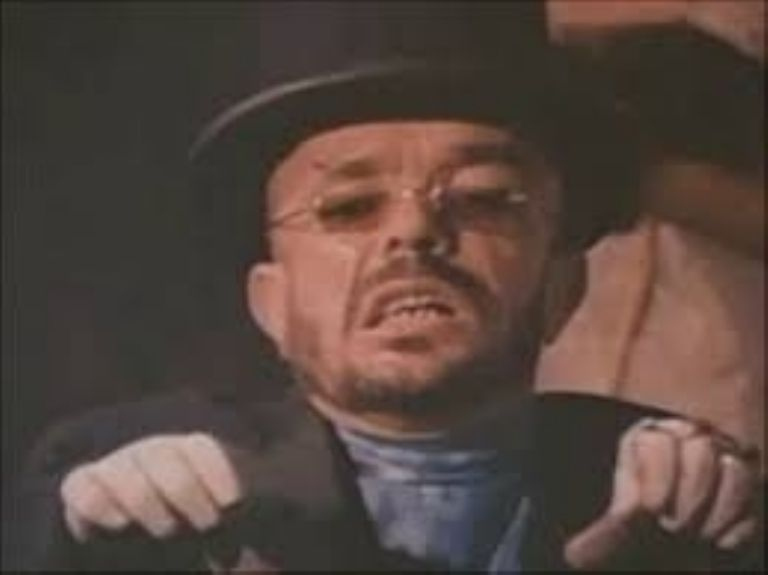
Santanon retired from acting in the early 1980s, only 52 years of age. He lived his four last years in a nursing home and passed away in 2002.
Director Miguel M. Delgado was a comedy specialist, best known for his close working relationship with comedy superstar Cantinflas. Delgado directed Cantinflas in 33 movies. He travelled to Hollywood in 1928, as one of his close relatives was film star Lupe Vélez, who at the time was the boyfriend of Gary Cooper. Vélez was able to convince Cooper to hire Delgado as his personal assistant, and legend has it that Cooper in turn was able to get him a job as up-and-coming director Henry Hathaway’s assistant director. However, Hathaway himself only worked as an assistant director up until 1932, and Delgado left Hollywood in 1931. Delgado doesn’t have any credits on IMDb for work in Hollywood, so one can assume that if he indeed worked for Hathaway he was rather the assistant to the assistant director. What is clear though, is that he did work at Paramount in some capacity, and during his three years in Los Angeles he got to witness the shift from silent films to talkies, and thus returned to Mexico with valuable knowledge to a Mexican film industry that was soon to enter its golden years.
In Mexico he worked as an assistant director up until 1941, when he teamed up with Cantinflas for their first mutual film. In 1942 they first tried to reach an international audience with Los Tres Mosqueteros, a very loose adaptation of Alexandre Dumas’ famous book. It was screened at the Cannes Film Festival in 1946, but was universally panned by critics. Critics thought Delgado and Cantinflas resorted to jokes and gags where they should instead have been trying to parody the story itself. Miguel Delgado directed some of Cantinflas’ most successful films, but unfortunately in most cases the actor himself outshone the actual end product, and Delgado never rose to the top ranks of Mexican directors. He did, however, work as assistant director on the Mexican-US co-production The Mad Empress (1939). He also has a credit as ”associate director” (presumably because of the language barrier) on the 1948 film Tarzan and the Mermaids, which was filmed in Mexico. It starred Johnny Weissmuller, who had at one time been married to above mentioned Lupe Vélez, which may be how Delgado got the gig.
Co-writer Carlos Orellana was a revered veteran in the Mexican film industry – as a screenwriter, director and actor, and as a mentor to many young people in the movie industry. Orellana appeared in Mexico’s first sound film, Santa (1932), in which he played the piano and sang, and appeared with all of Mexico’s comedy stars: from Cantinflas in his first movie to Resortes, Tin Tan, Clavillazo, Piporro and Evangelina Elizondo. As a screenwriter Orellana had his greatest success writing drama and comedy for director Ismael Rodríguez and movie star and singer Pedro Infante in the 40s and 50s. As an actor, he primarily did character parts, remembered particularly from the horror classic La llorona (1932) and the horror comedies El signa de la muerte (1939, with Cantinflas) and El castillo de los monstruos (1958, with Clavillazo). He co-wrote four SF comedies: Una movida chueca (1956, review), Los platillos voladores (1956, review), El castillo de los monstruos (1958, review) and El superflaco (1959). Orellana was nominated for an Ariel Award for best screenplay in 1955.
Orellana co-wrote El superflaco with Gunther Gerszo, who was primarily a production designer. Gerszo won a heap of awards and worked with directors like Buñuel and Roberto Galvadon, and his last film was John Huston’s Under the Volcano (1984), filmed in Mexico.
Janne Wass
El superflaco. 1959, Mexico. Directed by Miguel Delgado. Written by Gunther Gerszo, Carlos Orellana. Starring: Pompín Iglesias, Evangelina Elizondo, Wolf Ruvinskis, Daniel “Chino” Herrera, Santanon, José Jasso, Alfredo Varela, Nacho Contla, Arturo Castro “Bigotón”, Luis Manuel Pelayo. Music: Federico Ruiz. Cinematography: José Ortiz Ramos. Editing: Jorge Bustos. Set decoration: Gunther Gerszo. Makeup: Evangelina Garibay. Special effects: Juan Muñoz. Produced by Fidel Pizarro for Alfa Films.
 Scifist.
Leave a comment