
The world’s first film featuring a robot, made in 1897, is not one of Georges Méliès’ masterpieces, and primarily interesting for its science fiction pedigree. 5/10
Gugusse and the Automaton (Gugusse et l’Automate) 1897, France. Directed and produced by Georges Méliès. IMDb: 6.6/10. Letterboxd: 3.7/5. Rotten Tomatoes: N/A. Metacritic: N/A.
THIS ARTICLE HAS BEEN UPDATED (28.09.2026) FOLLOWING THE DISCOVERY OF THE FILM IN 2025.
Gugusse and the Automaton (Gugusse et l’Automate) was one of French film pioneer Georges Méliès’ earliest fictional films, made in 1897, when he had started to experiment with trick films, inspired by his day job as the owner and star of a magic theatre. For more on Méliès, see my post about the pioneers of science fiction films. Méliès made his first films in 1896, and very quickly started pioneering special effects, such as jump cuts, double exposures, split-screen photography, latent image matting and black screen photography. His films, like most at the time, ran for the lengths of one reel, or somewhere around a minute or slightly less. Méliès early trick films often involved people appearing and disappearing in thin air, or changing appearance as through magic – beautiful ladies turning into witches or demons turning into bats or skeletons. Inanimate objects came to life through wires, rods, black screen photography and stop trick animation.

Gugusse and the Automaton was long a white whale for film buffs, as it was thought lost since WWI. Almost all of Méliès’ negatives were either melted down for silver and celluloid (for army boot heels) during WWI, or burned by Méliès himself after the war, when he was all but forgotten. Fortunately even the earliest of his films were so popular that several copies have remained, and today nearly 300 of his movies have been recovered. When this article was originally written in 2018, Gugusse and the Automaton was deemed lost forever. However, in 2025, it was rediscovered at the Library of Congress in the US, in pile of 10 short reels donated to the library by a man whose great-grandfather had been a travelling showman in the late 19th century, and had been showing the films as part of his show. The man who donated the reels had no idea what was on them.
Back in 2018, I had this to say about what was presumed to be on the 45-second reel:
“The only description we have of the film […] is that […] Gugusse the clown is reacts with amazement at the actions of an automaton – the old word for what we would call a robot today.
But since Méliès’ films were so widely imitated, some of the later films on the subject may shed some light on the movie. Ed Stephens writes at Zedfest that American Selig Polyscope Company released a film in 1903 called The Clown and the Automaton, and that the Selig catalogue describes the film thusly: ‘A magician produces before the audience a small automaton figure of a clown, which he places upon a pedestal, whereupon the figure begins to grow, as he passes his hand in front of it, until it is full life size; when it at once comes to life and endeavors to quarrel with the magician. He, however, with the aid of a heavy sledge hammer, gradually reduces the figure to its original size. One of the most interesting films ever presented.’ […]
We can surmise that Gugusse and the Automaton was probably a film that relied on stop trick photography and possible some sort of physical effects. The automaton was probably played by an actor or it could have been some sort of a rod-and-wire-controlled puppet. My money is on the first. In all fairness, it was probably a pretty basic Méliès slapstick movie. […]
One of the reasons that so many of Georges Méliès’ films have survived is that they were so popular that numerous copies were made, and Thomas Edison made it a habit to make illegally pirated copies to leech off Méliès’ success in the US. That no copies of Gugusse and the Automaton have turned up would suggest – a bit disappointingly perhaps – that it was a rather unremarkable slapstick film.”
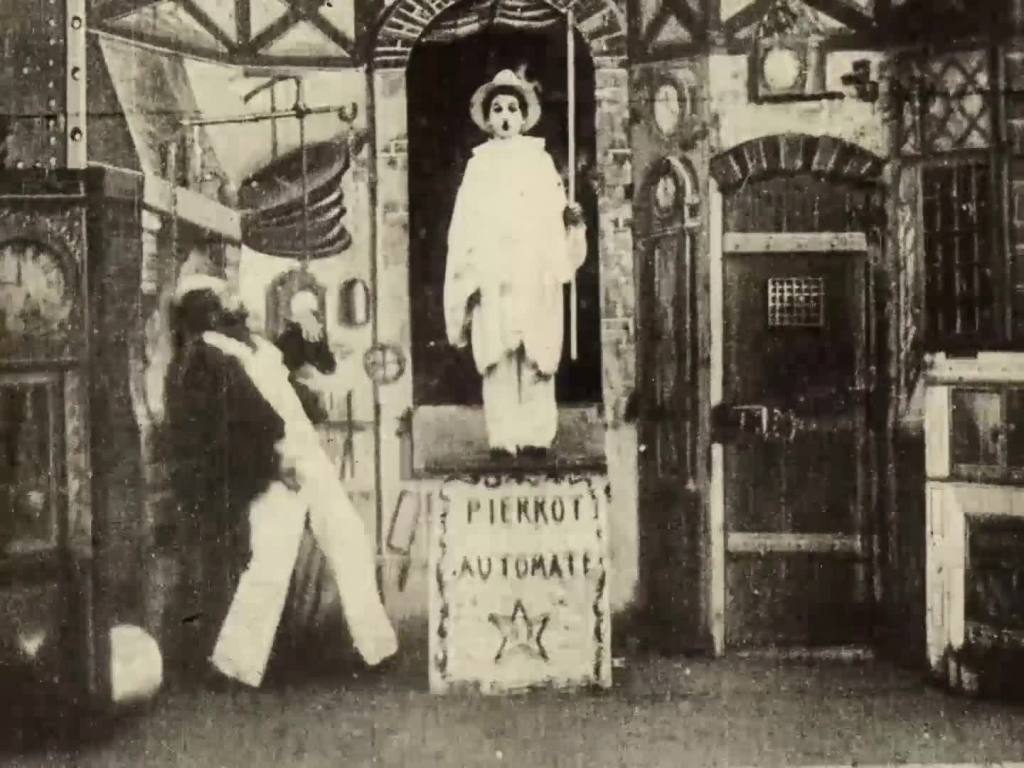
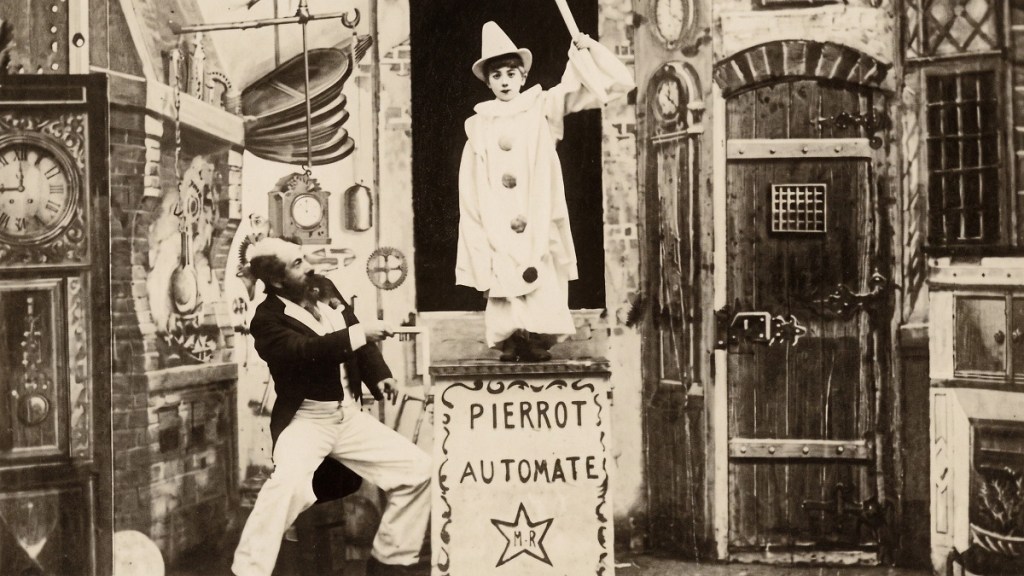
And, as it turns out, The Clown and the Automaton was indeed a carbon copy of Gugusse and the Automaton. In Méliès’ film we see a magician (Georges Méliès himself) standing next to a pedestal with a crank on it, and on the pedestal is written “Pierrot Automate”, and on it stands a young version of the clown Pierrot (based on the classic pantomime and commedia dell’arte character Pierrot). As the magician (presumably named Gugusse) cranks the automaton, it grows taller and older, an effect achieved with simple stop/start jump cuts. Pierrot the automaton keeps hitting Gugusse with a stick. When he is “fully grown”, he steps off the pedestal and continues whacking Gugusse, and in gaining independent motion, takes the step from being an automaton to becoming a robot. However, Gugusse picks up a mallet and starts bashing Pierre, each time reducing his size, until he beats the robot into oblivion.
All in all, the film is indeed a pretty basic Méliès slapstick movie, the type of which he would probably have filmed in a day, as opposed to his more ambitious work to come. It’s a short gag reel compressed into reel of film, which would have been shown at sideshows and screenings among other similar movies. The design is not particularly interesting: there is nothing about the automaton suggesting that it is mechanical, apart from its somewhat stiff movements – it’s just actors in clown outfits. The special effects are also quite crude and obvious in comparison to what Méliès would do just a year later, with films like The Astronomer’s Dream (review) and The Four Troublesome Heads. Gugusse is played by Georges Méliès himself, but we have no information about the three actors that play the automaton in its different stages.
Méliès is best known today for his trick films, but in 1896 when he bought his first camera he was primarily a theatre owner and stage performer. Of his first 250 film clips only a small handful were trick films or indeed fictional films at all. Méliès did just what Lumière, Gaumont and Pathé did, and got his hands on a projector as soon as he could, and started to organise screenings at his Theatre Robert-Houdin. When he first started making films, he wasn’t thinking about trick films – the moving pictures themselves were tricks, just as good as any trick that he had performed at the theatre. Films were just another trick added to his repertoire. Why would he need to show magic tricks on film, when he had his own theatre in which to do then live?

However, thanks to a film reel that stuck in the camera while he was filming a street scene one day, he had a revelation. The film temporarily stuck mid-film, but after fighting for a moment with the crank, he got it going again. However, when he viewed the shot, he found that during the interval a carriage filled with living people had transformed into a hearse carrying a corpse, and thanks to the jump cut it seemed to happen right in front of the viewers’ eyes. It was after this that he made his first film using the stop trick. The first stop trick film, called The Vanishing Lady (1896) is simple and crude, and basically involves the re-enactment of one of Méliès’ regular stage tricks. He has his assistant, actress (and later wife) Jehanne d’Alcy sit down on a chair at the stage of Theatre Robert-Houdin, and covers her with a drape. When he removes the drape, she is gone. A number he had probably performed hundreds of time on stage, with the help of a rigged chair and a trapdoor, only this time didn’t need any rigs or traps, just the magic of editing. But the fact remains that he could just as well have performed it onstage, which leads one to believe that the film was made primarily as a dry run.
And Méliès soon stepped up his game, so that in around the turn of the new year 1897 he released Le manoir du diable, which has been cited as the first horror film, with multiple characters, a devil, witches on brooms, a dancing skeleton, multiple jump-cuts, etc. He also started using more and more effects like smoke, fire and explosions in his films, as well as ever more elaborate sets. But still most of his visual effects still relied on jump cuts, wire work and various stage tricks. Up to the point when he made Gugusse and the Automaton, he had not yet started playing around with double exposure and black screen tricks. He used black screens in a couple of films in 1897, but then simply as a way to hide parts of the actors’ bodies in a single shot, not in a double exposure.

We do know, however, that Méliès did use black screen photography when he multiplied his own head at the very end of 1897 in the movie The Four Troublesome Heads. As Stephens writes, it may or may not be a coincidence that the magazine Scientific American released a book in 1897 containing the secrets to over 400 magic tricks – including trick still photography with black screens and multiple exposures – and that Méliès started using both techniques in his films at the end of that year.
When we read automaton or robot today, our minds might go to something like C3PO, or perhaps the automaton shown in Martin Scorsese’s Mèliès biopic Hugo (2011). And in fact, automata looked pretty much like that one – on the inside. Automata were no sci-fi concept in the late 19th century, in fact they had been around since the 15th century (in some forms since ancient Greek), when Leonardo da Vinci designed an elaborate wind-up toy for adults. Because that’s basically what automata were. They were mainly designed by clockmakers, who would use the same sort of cogs, wheels and levers they used in clocks to propel dummies. Some of them were hugely impressive pieces of machinery. One of the most impressive ones was made by Henri Maillardet in the 18th century. It was a machine that – with a pen – could write three different poems, and draw four highly detailed drawings, and served as the inspiration for the one in Hugo. Many stage magicians used automata in their acts. Some where impressive enough to be used as such, other times the number involved some illusion with assistants controlling and/or voicing a dummy from behind the stage. In some cases real automata were enhanced by the use of some trick or illusion. Such was the case with history’s most famous automaton, Wolfgang van Kempelen’s The Turk, a chess-playing automaton who went up against some of the best minds of the day, including Benjamin Franklin and emperor Napoleon Bonaparte – and won. It even got mad at Napoleon when he cheated. It did, however, very rarely, but occasionally lose when pitted against actual chess masters … There are currently two replicas in use, one in the US and one in China, and it’s such a beautiful illusion that I don’t want to spoil it, but if you’re interested in how it works, you can google it.

In the second half of the 18th century, Paris was the capital of automatons, partly thanks to the work done by clock maker turned magician, Jean Eugène Robert-Houdin, the same Robert-Houdin whose theatre Georges Méliès bought from his widow in the 1870’s. Robert-Houdin bought numerous automata, and built many himself, including a wonderful little acrobat that could perform a full trapeze number on stage. We know that at least one of Robert-Houdin’s automata was found among the props and machines at the theatre after Méliès had bought it, so perhaps Gugusse and the Automaton was Méliès’ homage to his big hero Robert-Houdin.

Méliès would of course go on to change the history of cinema, not only with his advances in cinematic trickery, but with his pioneering of elaborate, imaginative and costly narrative movies, from Cinderella (1899), Joan of Arc (1900), and Bluebeard (1901) to his most famous movie A Trip to the Moon (1902, review). He continued to champion Jules Verne with his science fiction films The Impossible Journey (1904, review), Under the Seas (1907, review) and The Conquest of the Pole (1912), making him early cinema’s most prolific science fiction director, alongside Walter R. Booth.
Janne Wass
Gugusse and the Automaton (Gugusse et l’Automate) 1897, France. Directed and produced by Georges Méliès.


Leave a Reply