

Scientists cure a dying woman with an experimental serum, which also turns her into a soulless killer. Kurt Neumann’s misogynistic 1957 SF melodrama is handsomely filmed, but predictable and dull. 4/10
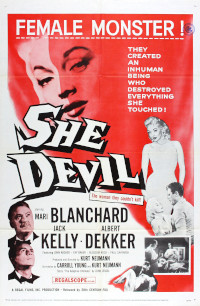
She Devil. 1957, USA. Directed by Kurt Neumann. Written by Carroll Young & Kurt Neumann. Based on short story by Stanley G. Weinbaum. Starring: Mari Blanchard, Jack Kelly, Albert Dekker. Produced by Kurt Neumann. IMDb: 5.7/10. Rotten Tomatoes: N/A. Metacritic: N/A.
Experimenting with fruit flies, Dr. Dan Scott (Jack Kelly) has come up with a new serum, which he hopes will be a cure-all for all disease, utilising every organism’s capacity to self-heal (“like a lizard shedding its tail and growing a new one, or a chameleon changing its colours in self-defence”). His friend, Dr. Richard Bach (Albert Dekker), the head of Grand Mercy Hospital, is sceptical about letting him conduct human experiments on his patients, but relents when he admits Ms. Kyra Zelas (Mari Blanchard), a young woman dying from incurable tuberculosis. Ms. Zelas, a woman apparently with a past in the shadier walks of life, receives the serum, and is immediately cured. Not only that, but she also becomes practically invulnerable, as her wounds heal instantaneously. Scott and Bach set her up at the two bachelors’ lavish mansion in order to keep her under observation. But on her way to his place, she visits a dress shop, slugs a man with a vase and steals his money to buy herself a new wardrobe. In order to evade the police, she uses her new powers to change her hair from black to blonde, and then goes on a shopping spree. When Scott and Bach find out, they suspect that the serum has caused Zelas to also undergo a personality change — that Scott has not saved a life, but instead created a new life, the life of something inhuman.

Thus begins She Devil, director Kurt Neumann’s 1957 SF/noir melodrama, released by 20th Century-Fox as a double bill with Neumann’s own Kronos (1957, review). The film is based on Stanley G. Weinbaum’s lauded 1935 short story The Adaptive Ultimate, which had by this time been adapted into radio plays at least twice and into television episodes at least thrice. The screenplay was written by Neumann himself together with Carroll Young, whom Neumann had worked with on his two Johnny Weissmuller Tarzan movies. A somewhat forgotten little SF movie, this one has stood in the shadow of its better known double bill partner, and, while it has some class, not necessarily undeservingly.

The continuation of the plot is hardly surprising. It isn’t long before our She Devil graduates from mugging to murder, killing the wife of of a millionaire (John Archer), and subsequently marrying him — and killing him in a car “accident”, inheriting his fortune. Zelas seems to have no remorse, openly admitting to her two doctors her crimes, knowing that they can’t tie her to them. Scott and Bach realise that they must do something. However, there is one hitch: Scott has fallen in love with Zelas.
Background & analysis

Stanley G. Weinbaum is one of those tragic fates that makes one wonder what might have been, had he not died of lung cancer in 1935, only 33 years old. The author was immortalised almost immediately after publishing his first science fiction story in John Campbell’s pulp magazine Astounding in in 1934. The Martian Odyssey is considered by many critics as one of the best, or at least most groundbreaking, SF stories ever written. What made it special was the way in which it described its alien, as a being that, according to Campbell, “thought as well, if not better, than a man, but not like a man”. The story was the start of a nine-part “planetary” series published in Astounding between 1934 and 1935.
Many of Weinbaum’s stories included “strong” female characters, and also often dealt with themes of character motivation and the pursuit of dreams – with his characters often finding metaphorical gold turning to dust and vice versa. Several of his stories explored intelligent beings following different logic than humans, unacquainted with human morals and ideals. As such, Ms. Kyra Zelas in The Adaptive Ultimate can be seen as a continuation of Weinbaum’s exploration of alien minds.

The plot of the film follows the well-known story quite closely, with a few minor alteration – such as fleshing out the romantic angle and Scott’s ambivalence regarding Zelas. In the film, she causes her rich husband’s car to crash with both her and him inside, miraculously surviving unscathed, while her husband perishes. In the original story she steals a car and runs over a child, with no moral misgivings of her actions. The death of her rich husband helps give the film a “cleaner” ending, without having the two protagonists attempting to kill someone’s wife, and at least metaphorically “giving back” Zelas to Dr. Scott without moral implications of cheating.
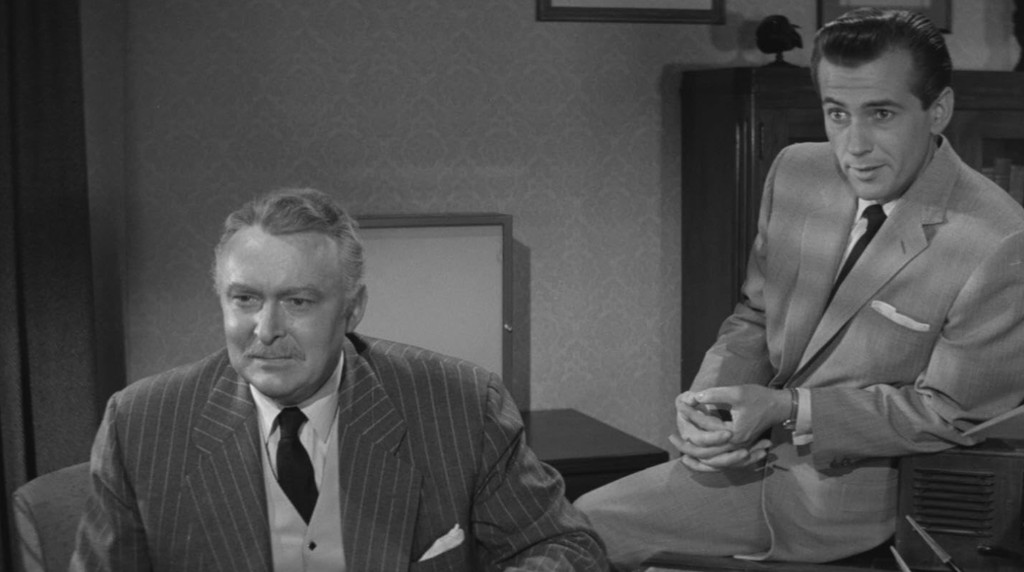
The short story is actually very short, laying out most of it as conversations between Scott and Bach, and we often learn of the actions of Zelas through these conversations. This leaves a lot of the subtextual content open to interpretation, something which is partly lost in the more conventional narrative structure of the film. Oddly enough, while not deviating very much from the original story, the script manages to put a conservative 50’s spin on the tale, in a way turning it on its head. Unfortunately the script adaptation brings the story closer to the turgid misogyny of the many works in the Alraune tradition – which depict the independent and sexually assertive woman as soulless and evil creature. The story makes it clear that the mutated Zelas is an ambitious creature – by marrying the director of the US treasury, she is not only out for money, but for power and influence. She uses her sexual power, her newfound beauty and fortune in order to gain influence and agency. In the film, she is portrayed as a frivolous and impulsive brat, who plays the game only for riches and indulgence. In a way, Weinbaum’s story releases Zelas from the female attributes often repeated in pulp fiction of the era, and instead gives her the same ambition and guile often reserved for male antagonists. The movie script instead strengthens the typical “female” attributes of vanity, indulgence, self-centrism and short-sightedness.

Of course, the underlying inspiration here is George Bernard Shaw’s 1913 play Pygmalion, in which a working-class girl is taken in by a rich member of the upper-class, and is “transformed” into a socialite lady. Kyra Zelas is a sort of reverse Eliza Doolittle. Shaw railed against the Victorian and Edwardian notions that poverty sprang out of weak morals, showing that Doolittle’s morals remained intact, whether rich or poor. Conversely, one can read an opposite message into the film: with Zela’s newfound status, her poor morals are only amplified. The ending, while rehashing the old “there are things Man should not tamper with” trope, can also be read as a comment on class – that the poor cannot be “reformed”.
We have reviewed a very similar film here on Scifist, Hammer’s 1952 SF melodrama Stolen Face (review), in which a scarred woman from the criminal underworld gets a new face from a (male) plactic surgeon who hopes to transform her into a lady. Like in She Devil, the woman takes advantage of her newfound beauty in order to merely indulge herself in vices and immorality. One wonders if the screenwriters hadn’t perhaps read Weinbaum’s story.

Aside from the problematic class aspect of She Devil, the level of misogyny on display here is appalling, even by 50’s standards. I don’t think it was intended to come across as blatantly, but rather that this was a case of hurried filmmakers not entirely thinking through the material they were working with.
The film rehashes old themes from German author Hanns Heinrich Ewers‘ “scandalous” 1911 novel Alraune, about an artificially created woman without a soul or conscience but with a lot of ambition and sex drive. The novel was a hugely popular source for movie adaptations. At least two early silent versions were made, but best remembered are the two versions starring Brigitte Helm, one silent (1928, review) and one in sound (1930, review), neither of them particularly good. The story was adapted for a fifth time in 1952, starring Hildegard Knef (review). Ewers rode the moral outcry around the fairly new technique of artificial insemination (still only carried out with animals at the time), however it is unclear if She Devil is making any actual point. There is an idea here about the exploration of human morals, that would have been interesting, had it been fleshed out. But instead, Neumann, goes for the old “boundaries of human knowledge” platitude from mad scientist films if yore. However, the science here is so vague, and the discussions about research ethics almost completely absent, that it feels as if the filmmakers have just cobbled together a number of tropes from old mad scientist and noir movies without stopping to think if there was something they actually wanted to say with the film.

The “science” behind the film is, of course, ridiculous. Fruit flies don’t mutate, they evolve, and the reason they are used for study is not any unique adaptability, but their short life span. Scientists do look into the regenerative abilities of lizards and samalanders in order to figure out exactly how the process works, but even if the process could be used in medicine, it would hardly be a cure-all, or make us invulnerable. Or able to change the colour of our hair, for that matter.
One of the problems with She Devil, however, is that it is so utterly predictable. We have seen this story played out several times before. This is partly the case with Weinbaum’s original story as well, which hasn’t aged as well as many other SF stories of the era. At heart, this is a pulpy femme fatale story we’d expect to see in a 40’s horror melodrama. The writing in the script isn’t terrible, but it isn’t better than any of the other mad scientist B-movies of the era — which is clear from the get-go, when Kelly and Dekker start off the film with exchanging a barrage of awkward exposition lines.

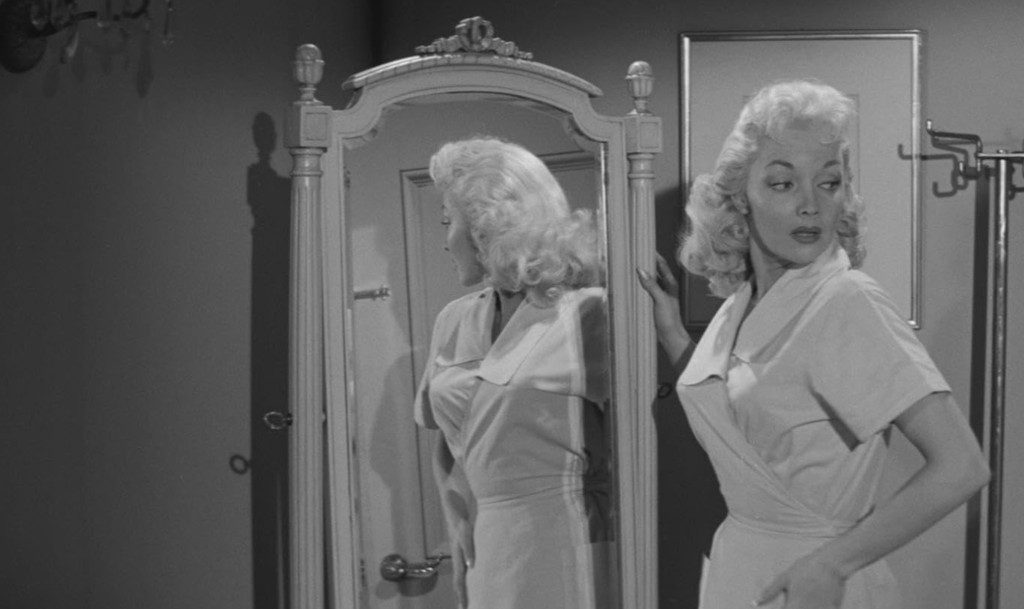
The special effects are few and far between, but well executed, depsite the film having no credited special effects crew. The famous scene of Zelas changing her hair colour is quite startling, as it is actually her hair changing colour before our eyes. Here cinematographer Karl Struss used the same technique he had used in Dr. Jekyll and Mr. Hyde (1931, review). Mari Blanchard was probably wearing a coloured wig in the scene, and by adding and substracting filters with corresponding colours, the effect shows up on black-and-white film as changing from dark to light, from raven-haired to blonde. There car crash scene is spectacular, but it is lifted from another Fox movie.
Acting-wise the film neither disappoint nor impresses. Jack Kelly is rather bland in the lead, but he is written that way. Albert Dekker, best known for playing the titular mad doctor in Dr. Cyclops (1940, review), does well in this more benign role, as a sort of big-brother figure to Kelly. Mari Blanchard is, of course, the center of the film, and carries it well, however, without being especially memorable.
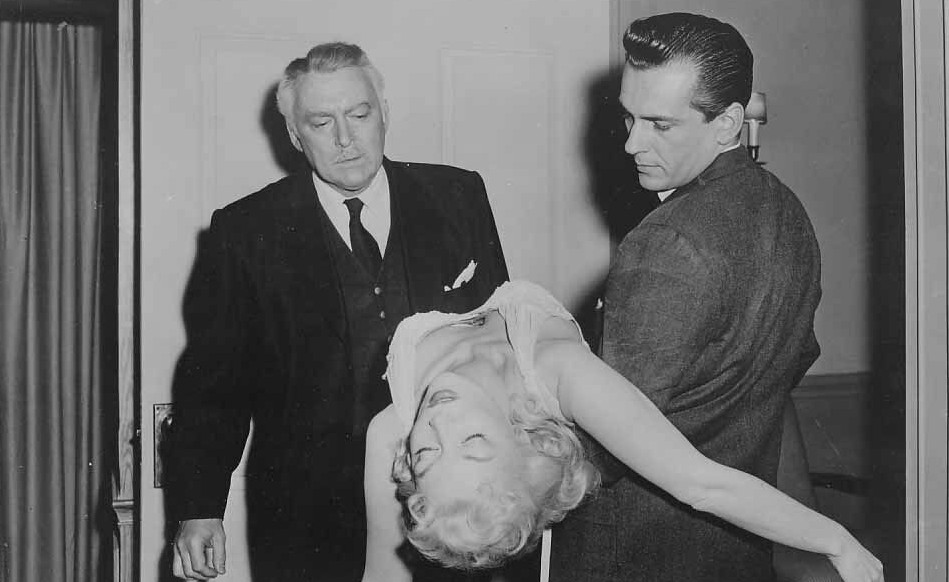
Karl Struss’ classy photography and the wide Regalscope format makes She Devil feel like more of a prestige picture than it is. Neumann’s direction is nondescript. It is a good-looking film, but not in the slightest original from a visual or artistic point of view. At around 80 minutes, the movie, like its counterpart Kronos, is a bit too long for its own good. Both pictures would have benefited from being reduced to the standard B-movie length of around 60-65 minutes. Not particularly good, not awful, She Devil is mainly quite dull.
The film has no connection to the 1989 movie She-Devil.
Reception & Legacy

She Devil received mainly negative reviews upon its release. The Los Angeles Times wrote: “It can be said that the film has a legitimate and honest theme that it pursues to the bitter end. The entire cast suffers from an overdose of cliches and poor dialogue.” The paper also thought “Blanchard is cast beyond her present capability”. The Monthly Film Bulletin called it “fairly tame stuff with too much talk, not enough action and too unrealistic”. And Variety said Neumann “fails to generate much of a chiller atmosphere for the melodramatics and the screenplay is rather talky”. In his 1984 book The Encyclopedia of Science Fiction Movies, Phil Hardy writes: “She Devil is the worst of [Neumann’s science fiction] work because lack of suspense combined with poor characterization renders an already ludicrous plot and far too talkative screenplay unworkable”.
She Devil currently has a 5.6/10 audience rating on IMDb based a little less than 500 votes, and not enough entries for a Rotten Tomatoes critic consensus. AllMovie gives it 2/5 stars, with Hal Erickson writing: “Even back in 1957, no one took this one seriously”.
In a great write-up at DVD Savant, Glenn Erickson attacks the film’s “impressively undiluted sexism”, so “engagingly misogynist”, that it has become a parody of itself. Erickson writes: “So, the film’s “monster” is simply a gal that won’t submit to patriarchal authority or play a submissive role. Richard and Dan instinctively understand that this is social heresy, that Kyra must be destroyed. We the audiences are meant to agree. […] Compounding its sexist bias, the script now has the doctors plot a “moral” killing.” Kevin Lyons at EOFFTV writes: “Like so many of Neumann’s genre films, there’s a better idea at work here than he can do justice to”.
Cast & Crew

Director Kurt Neumann was born in Germany in 1908. He worked briefly in the German film industry in the late twenties, and had only directed one short movie before he was brought to Hollywood to direct German-language versions of Hollywood movies. This was during the short-lived era at the beginning of sound films that studios would make the same movie in different languages, often with different actors and directors. However, Neumann quickly mastered English and established himself as a director in his own right, and made a couple of well-regarded films for Universal in the early 30’s. These included The Big Cage (1932), a circus movie which included several scenes with lions and tigers being handled by lion tamer Clyde Beatty, that were famously re-used in the SF/horror film Captive Wild Woman (1943, review). He freelanced for almost all major studios, before being picked up by RKO to direct a string of Johnny Weissmuller Tarzan films in the early 30’s. Neumann worked primarily on B-movies for major studios, but also freelanced for smaller outfits like Monogram and Allied Artists.
In 1950 crafty freelance producer Robert Lippert took advantage of the media hubbub around George Pal’s upcoming Destination Moon (1950, review), and hurried out the low-budget movie Rocketship X-M (review) a few weeks prior to Pal’s humdrum moon adventure. As director, he hired Neumann, and as cinematographer Karl Struss, and the duo was able to make a surprisingly competent space movie on a short schedule and little money. Neumann has since been labelled as a “science fiction specialist”, but in truth he didn’t make that many SF movies – which is a shame, as he clearly had a knack for the genre. Along with Struss as his cameraman, he directed Kronos, She Devil and perhaps most famously, The Fly (1959, review).
Karl Struss was favourite of Neumann’s and they worked together on many films in the 40’s and 50’s. But in his earlier career, the New Yorker was, as mentioned above, one of the hottest cinematographers in Hollywood, with credits F.W. Murnau’s Sunrise: A Song of Two Humans (1927), Dr. Jekyll and Mr. Hyde (1931, review), Cecil B. DeMille’s The SIgn of the Cross (1932) and Charlie Chaplin’s The Great Dictator (1940). He also shot one of the best sci-fi films of the thirties, Island of Lost Souls (1932, review). He also, bizarrely, filmed the turkey Mesa of Lost Women (1953, review) and The Alligator People (1959).

Lead actress Mari Blanchard was the daughter of an oil tycoon who dropped out of law school and pursued a career in modelling and acting. She had a string of uncredited bit-parts in the early 50’s before being signed by Universal in 1953. Despite a couple of B-movie leads, her career didn’t thrive with the studio, and she is best known for her role as the Venusian queen in Abbott and Costello Go to Mars (1953). Dropped by Universal in 1954, Blanchard soldiered on in B-movies, sometimes in leads, sometimes supporting roles, until her work started drying out in the 60’s. She passed away in 1970 from cancer, only 47 years of age.

Lead actor Jack Kelly was a former child model and actor who studied law at UCLA and worked on stage and in radio before entering the movie business in 1949. Through alternating between film, TV and radio work, he kept busy throughout a career that lasted until the early 90’s, mostly with little fanfare. He is best known for his recurring role as Bart Maverick in the 1957-1962 TV show Maverick, a role he reprised in later TV movies and spinoffs. SF aficionados will recognise Kelly as Lt. Farman in Forbidden Planet (1956), the crewman who gets scalded by Leslie Nielsen for taking too much of an interest in Anne Francis. His voice can be heard as a radio announcer in the low-budget film Spawn of the Slithis (1978).
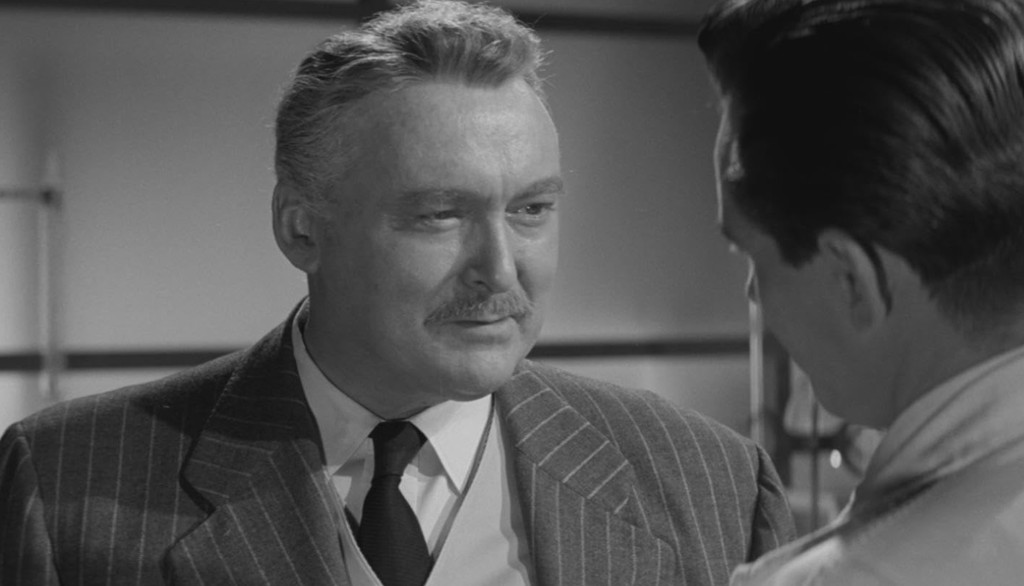
Apart from his role as the villain in Dr. Cyclops, Albert Dekker is perhaps best known for his bizarre death. He was a respected character actor throughout the thirties and forties, and got his start on Broadway rather than in films. Today he is perhaps best reme,bered for his roles in the Burt Lancaster and Ava Gardner film The Killers (1946), the James Dean vehicle East of Eden (1955), and for his last role as detective Harrigan in the classic The Wild Bunch (1969). He also played the secretary of defence in Gammera the Invincible (1966). Dekker had quite an eventful life, including the tragic death of his son, who accidentally shot himself while working on a silencer for his rifle. Dekker was also a Democratic politician who held a chair at the California State Assembly. He was an outspoken critic of McCarthyism, which had him blacklisted in Hollywood between 1952 and and 1955, during which time he worked on Broadway. His death was the object of a slight scandal, when in 1968 he was found kneeling, bound, gagged and asphyxiated in his bathtub with two dermatological needles inserted into his arm and lewd lipstick-writing all over his body. It was ruled that he had apparently accidentally strangled himself during some bizarre autoerotic ritual.
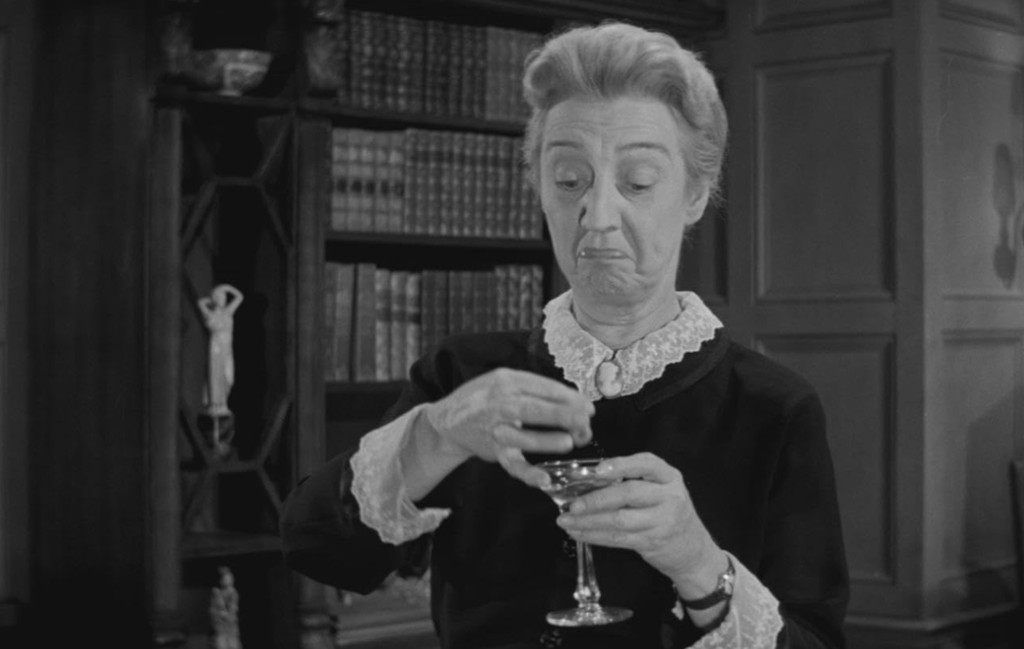
There’s a fun breakout character in the film, the housekeeper Hannah, who isn’t above gulping down leftover drinks and shakes mutters beneath her breath at the silliness going on in the two scientists’ house. She is played by character actress Marie Blake, immortalised as Grandmama Addams on The Addams Family (1964–1966). There’s also a bit-part by Paul Cavanagh, who appeared in The Man in Half Moon Street (1945, review) and did a standout performance in The Man Who Turned to Stone (1957, review). There’s a small role by an actor whose most intriguing feature is his name, X Brands. Born Jay X Brands, he was of German ancestry. The story goes, that in his ancestor’s small German hometown, there were two men called Jan Brands, and one of them added an X to his name to differentiate the two, and became known as X Brands. The unusual name became a family tradition. Brands was a prolific TV guest star, best know for his co-starring role as native American Pahoo-Ka-Ta-Wah in Yancy Derringer (1958-59). In 1958, Tod Griffin palyed the lead in another SF movie called She Demons (review).
Janne Wass
She Devil. 1957, USA. Directed by Kurt Neumann. Written by Carroll Young & Kurt Neumann. Based on the short story “The Adaptive Ultimate” by Stanley G. Weinbaum. Starring: Mari Blanchard, Jack Kelly, Albert Dekker, John Archer, Fay Baker, Marie Blake, Paul Cavanagh, George Baxter, Helen Jay, Joan Bradshaw, X Brands, Tod Griffin. Music: Paul Sawtell, Bert Shefter, Cinematography: Karl Struss. Editing: Carl Pierson. Production design: Theobold Holsopple. Makeup: Louis Hippe. Sound: Eugene Grossman. Produced by Kurt Neumann for Regal Films and 20th-Century Fox.
 Scifist.
Leave a comment