

A mystery woman unwittingly spreads a flesh-eating fungus spore from Mars across the US, and G-men race to stop her. This 1958 Dragnet-styled thriller is a competent low-budget potboiler, but fails because the plot needs the smart heroes to act like idiots. Plus the relentless narration. 4/10

Space Master X-7. 1958, USA. Directed by Edward Bernds. Written by George Worthing Yates, Daniel Mainwaring, Edward Bernds. Starring: Bill Williams, Robert Ellis, Lyn Thomas, Paul Frees, Moe Howard. Produced by Bernard Glasser. IMDb: 5.2/10. Letteboxd: N/A. Rotten Tomatoes: N/A. Metacritic: N/A.
When the “satellite” X7 712 returns from its Mars orbit to New Mexico, Earth, it brings with it a red fungi, which Dr. Charles Pommer (Paul Frees) examines in his home lab. However, he is distracted by his ex-lover, Laura Greeling (Lyn Thomas), who wants custody over their illegitimate son (now sent off to a boarding school). After some dramatics, Greeling leaves Pommer to his work, on her way to her husband in Hawaii. Meanwhile, Pommer comes to the conclusion that the red fungi from Mars is a protein-eating organism (or a “flesh eater”, as Pommer spells it out) which grows exponentially the more it devours, and he labels it “Blood Rust”. Unfortunately, the fungi escapes from its petri dish and starts devouring Pommer himself. He makes a panicked phone call to his security officer John Hand (Bill Williams), instructing him to torch Pommer’s house. Hand and Pvt. Rattigan (Robert Ellis) find Pommer’s lab overrun by a pulsating mass, that is in the process of dining on the remains of Pommer. They torch the place, but not before snatching Pommer’s audio notes from his dictaphone. After getting a thourough decontamination, Hand and Rattigan get confirmation from Professor West (Thomas Browne Henry) that the whole area around Pommer’s house has been decontaminated, and that no-one has come in contact with either the house or with Pommer since he started on the fungi analysis – the danger should be over. That is, until they listen to Pommer’s notes, and hear him argue with an unknown woman, who is now in the wind.

The beginning of 1958’s Space Master X-7 promises an American ripoff of The Quatermass Xperiment (1955, review), but although that film is clearly an inspiration, the movie soon veers off in a sligthly different direction. It was based on a heavily re-written script by George Worthing Yates and Daniel Mainwaring, who between them had credits for films like Them! (1954, review), Earth vs. the Flying Saucers (1956, review) and Invasion of the Body Snatchers (1956, review). The movie was produced by Robert Lippert’s Regal Films for 20th Century-Fox, and directed by Three Stooges veteran Edward Bernds.
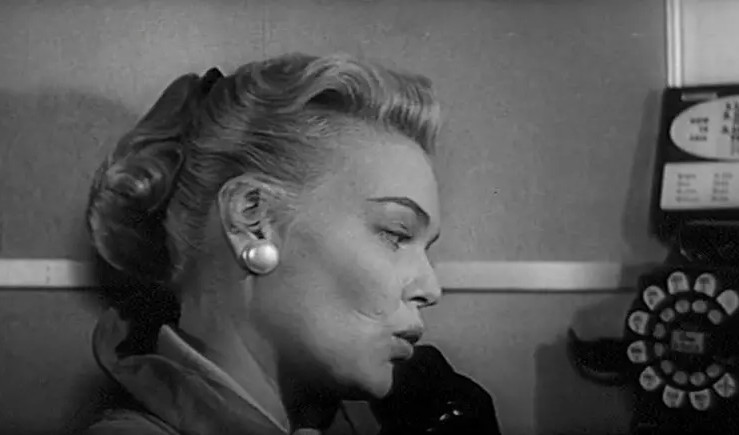
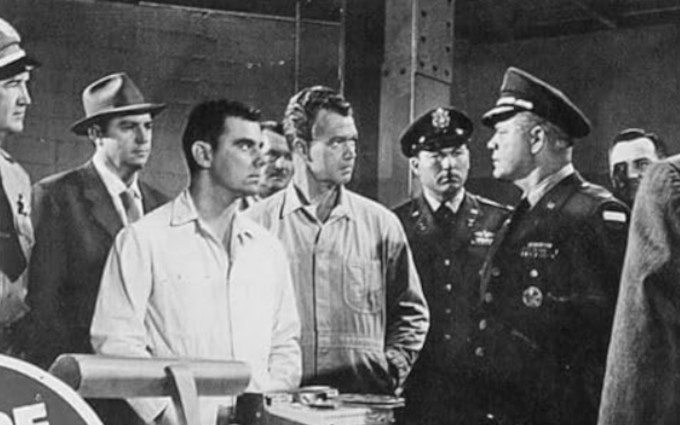
As the mystery woman might be a carrier of the deadly fungus, Hand and Rattigan immediately launch an operation to find her, as outlined by the persistant and ever-present narrator voice-over that permeates the film, Dragnet-style. In a classic Hollywood move, they decide not to inform the public about the fungus (panic, etc), and instead announce that Dr. Pommer died in a house fire, and that they are looking for a woman in conjunction with his death. Lacking any further information, Laura Greeling, of course, thinks that the police believe she burned down Pommer’s house, and trying to avoid a scandal (remember she is married to another man and has an illigitimate son), she now starts running, first from New Mexico to Los Angeles by train, planning on taking a plane to Honolulu from there.
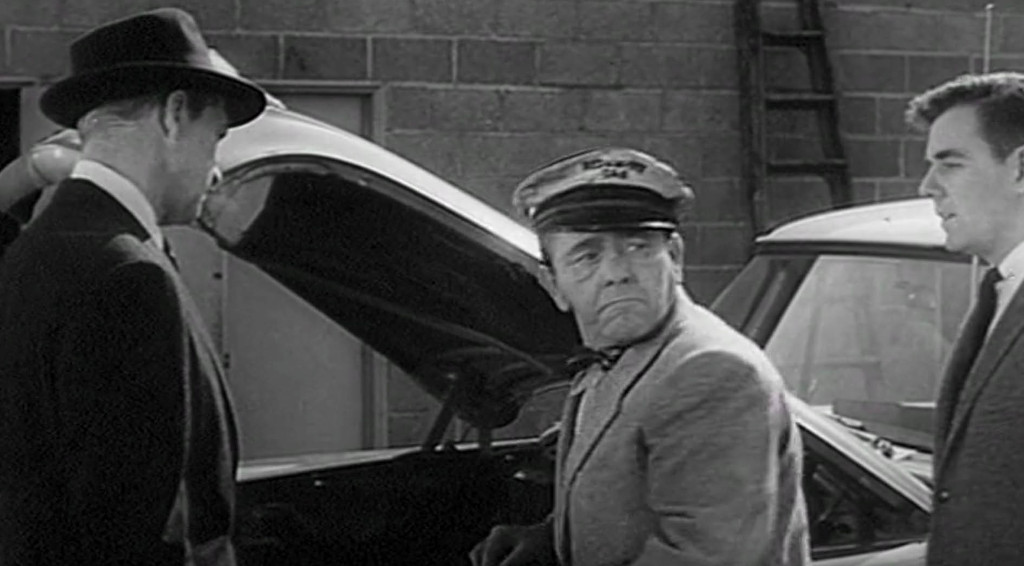
Meanwhile, Hand and Rattigan find the cab driver who drove Greeling from Pommer’s house (Moe Howard), find out she is headed to Los Angeles and get her discription, which soon starts appearing in WANTED-bulletins on TV, further prompting Greeling to go underground. In Los Angeles, Hand and Rattigan confiscate the luggage car from the train from New Mexico, which has now been overrun by the Blood Rust, and with the help of haz-mat personnel and flame throwers, are able to exctract her luggage, where they find her ticket to Honolulu. Meanwhile, she checks into a hotel under a false name, sends for new clothes and dyes her hair from blonde to brown. Hand and Rattigan are on her trail, but show up to the hotel moments after she leaves, and find out she is a brunette now wearing a tweed jacket. While Hand tries to discover what else she is wearing, Rattigan sets off to the airport.
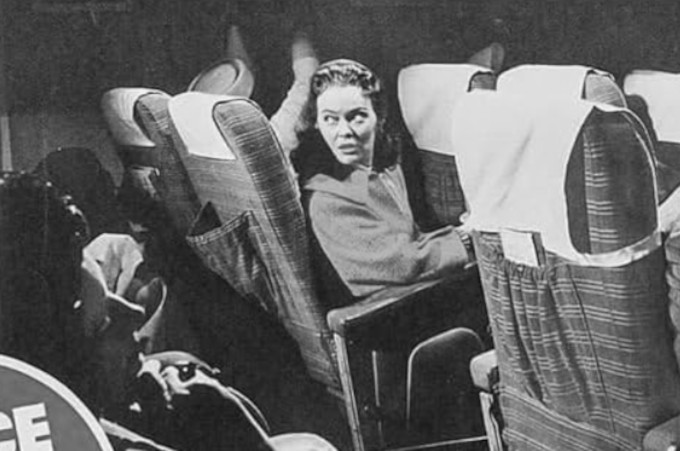
At the airport, Rattigan is informed that three brunettes wearing tweed jackets are on board the next flight to Honolulu. Rattigan boards at the last minute, and begin interrogating the three women as the plane takes off. However, it takes him ages to tell them exactly why he is looking for a certain woman, so Greeling thinks she is still wanted for murder, and lies. That is, until Rattigan finally spills the beans and she fesses up to the truth. Only now, when he has identified the woman, can Rattigan order the pilot to turn the plane around and head back to Los Angeles. But there is a problem: the Blood Rust has now infested in the whole luggage compartment, and starts entering the cabin and breaking out of the plane. The pilot is forced to make an emergency landing, while Rattigan and the cabin crew do their best to keep the deadly fungus at bay, amidst panicked passengers, leading to an action-filled climax.
Background & Analysis
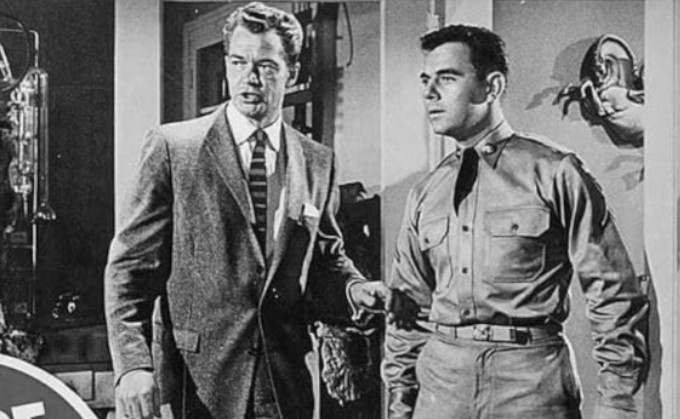
Space Master X-7 entered production thanks to a proposed western, Escape from Red Rock, that director Edward Bernds wanted to make for 20th Century-Fox. However, Fox declined. Some time later, in 1956, Fox entered a partnership with low-budget producer Robert Lippert, outsourcing the production of many of their B-movies to Lippert’s Regal Films, a company created solely for this purpose. For legal reasons, Lippert being a movie theatre owner, his name did not appear in any of Regal’s movie credits, but it was Lippert who ran the show. Fox then pointed Bernds to Lippert with his western. Lippert agreed to make the film, on the condition that he and producer Bernard Glasser also make a science fiction movie for Regal.
The duo purchased a script that George Worthing Yates and Daniel Mainwaring were shopping around, originally titled, according to Bernds, “Doomsday-something-or-other”. Bernds and Glasser liked the script, but realised it had to be reworked, as it was originally intended as an A-movie, and couldn’t be filmed on the $90,000 budget that they had available. In an interview with film historian Tom Weaver, Bernds says that he did an extensive re-write on the film, as he usually did with his films (without ever taking credit), adding for example the Dragnet-style narration and changing the final train scene to a plane scene for economical reasons. According to Bernds, Mainwaring was livid when he heard that Bernds changed the script, but according to Bernds, they couldn’t even have afforded to hire Mainwaring for the rewrite, as he was “probably a “$750-a-week writer”.

It is unclear how the film ended up with the title Space Master X-7. The shooting title was “Missile Into Space”, but probably someone at Regal realised that this was too much of a misnomer for audiences expecting a space rocket story. Not that Space Master X-7 was much less misleading, as the entirety of the film is Earth-bound and really has nothing to do with space, apart from the fact that the fungus is from Mars. The poster depicted a space rocket in flight, and the taglines “Satellite Terror Strikes the Earth”, “Boundless Adventure from Limitless Space”, as well as “… Piercing New Worlds of Terror” – indicating that the poster art was probably done before the title change. There is no such thing as a “Space Master X-7” in the film, but the title alludes to the film’s “satellite” (the technical term would probably be “probe”) X7 712. The film was released on the heels of the launch of Sputnik and Explorer I, so anything moving through space, regardless of whether it was a probe, a UFO or a rocket, was now a “satellite” in Hollywood’s vocabulary.
The fungus among us trope was popularised by The Quatermass Xperiment in 1954, but the trope of a single, unwitting person threatening to cause an epidemic goes back to the tragic case of “Typhoid Mary” in the early 20th century. Mary Mallon, an Irish-born cook, may have infected more than a hundred people in New York with typhoid fever without ever showing symptoms herself. The trope probably entered the movies, or was at least popularised, with Elia Kazan’s 1950 picture Panic in the Streets.

Both writers George Worthing Yates and Daniel Mainwaring had some experience with science fiction, and you can see ideas from their previous movies carried through in Space Master X-7. Perhaps to a less extent from Yates, as he tended to be only one of several writers, and did films in all conceivable genres. Them! (1954) was his fiest science fiction film, and from there on, he specialised almost exclusively in the genre. And while Yates did contribute to a few great SF movies, almost invariably as he was solely responsible for the scripts, they were of lesser quality, a low point boing The Flame Barrier (1958, review). Yates and Mainwaring had written scripts together before, the melodrama This Woman is Dangerous (1952) and the western musical Those Redheads from Seattle (1953). Mainwaring, on the other hand, specialised in crime dramas and war films from the early 40s onward, and many of his films dealt with people running against the clock, chasing or being chased. The theme is prevalent in the script for Invasion of the Body Snatchers, in particular in the dramatic final scenes, when Kevin McCarthy and Dana Wynter run from the pod people, at the same time racing against time and their own sleepiness, knowing that falling asleep will turn them into pod people themselves. Mainwaring’s scripts also often centered around trains as modes of transportation, as did the original script for Space Master X-7.
The script for Space Master X-7 shows Yates’ pencheant for scientific details in his SF movies, sometimes wholly made up, but still. It’s possible that the movies of Ivan Tors served as an inspiration for the script, as Tors prided himself on making SF movies that would be genuinely educational as well as exciting. The Magnetic Monster (1953), with its hunt for the carrier of dangerous radioactive material that threatens to destroy the planet shares many similarities with Space Master X-7. In both films, a sort of “Typhoid Mary” is picked up on a plane. It is refreshing to see a 50s movie whetre hazardous material is being handled in a somewhat realistic fashion, adding to the film’s documentary feel. However, the endless techno-babble spouted by the narrator does also feel a bit like padding, and unfortunately works to slow the action and plotting down. It is also clear that Bernds has made significant changes to the script, replacing dialogue with narration for budgetary reasons. The feeling of realism is enhanced by shooting in real Los Angeles locations, such as a train station, but the film team doesn’t seem to have had time or money for post-production dubbing, so many of these scenes are relayed entirely by the narrator. Sometimes it becomes downright silly, as in a scene in which Greeling is attempting to check out her luggage from the counter at the train station, only to be told that she has to wait a while, as the luggage has not yet been delivered from the train yard (because Hand and Rattigan are torching it). The scene wouldn’t need any narration, just a short two-sentence dialogue exchange, but instead we see Greeling walking toward the counter, having a conversation with the clerk, and walking away, all which is vigorously narrated by the voice-over, giving the impression of an Ed Wood movie.
Speaking of the location shooting, in some of these dialogue-free scenes, it feels as if the sound editor has overcompensated for the lack of dialogue by bringing up the background noise. In the train station scene, for example, there’s a deafening roar of background noise, as if Greeling was walking through some sort of heavy industry hall.
Overall, the story does move you along with a good amount of interest, despite it being held up every now and again by long-winded science explanations, and despite the fact that the hard-boiled narration drags you out of the story from time to time, as you as a viewer get annoyed at the voice over over-explaining events that we can a) see on the screen and b) could have been done more effectively with a short dialogue.

My main problem with the script, a problem I seem to share with at least some other critics, though not nearly all, is that you need to put credulity aside in a number of instances in order for the plot to work. Two plot twists are particularly egregious. First of all, I find it very hard to believe that, faced with an existential threat to the nation and the world, the US authorities would not be able to come up with a bulletin that a) does not cause widespread panic, but at the same time b) gets the point across to Greeling that she is not suspected of murder and that it is extremely important that she make herself known to the authorities. Coming out of WWII just over a decade earlier, the US authorities should have a rather well-oiled machinery in place to deal with just this kind of public commication.
My second peeve with the film is that in order for the finale to work, the screenwriters need to get Rattigan on the plane and the plane in the air. The thing, however, that all viewers are screaming at the screen, is: why doesn’t Rattigan just ground the plane? We see that he has the authority to turn the plane around, which means he would surely also have had the authority to stop it from taking off. This means that for some reason, he chooses to conduct his investigation in the air. Why? The final scene shows all the airplane passengers and crew driven off in double-decker buses to decontamination. Why not just load them all into the buses before the plane takes off? The entire tirade on the plane could have been avoided, and the result would have been exactly the same. Plus: why all the cloak-and-dagger business with the women he interviews? They are already all on the plane with a flesh-eating monster on board. Why not just tell them: we are not after you for murder, but you may be carrying a flesh-eating fungus that will devour the world – including you – if we don’t get you to decontamination? Effectively, that’s all that’s needed for Greeling to immediately announce herself to Rattigan. Again: the whole movie could have been avoided if the US authorities wouldn’t have been dumb enough to trick Greeling into believing she was wanted for murder in the first place.

Plus: a bit of scientific nitpicking. The Blood Rust devours Pommer’s lab – and Pommer – in a matter of hours. It completely invades both the luggage car of the train and the luggage compartment of the plane in an even shorter time, just from residue from Greeling’s luggage. Why is Greeling not affected? Time is a bit hazy in the movie, but she seems to be on the run for at least 24 hours. According to Pommer, the fungus eats protein, and the bigger the protein supply, the faster and larger it grows, and the more it eats. So why does it grow so much faster on luggage than on a fleshy human being? Greeling should have been lunch long before her luggage.
Of course, logic isn’t necessarily a requisite for a good science fiction movie. But the idea of a prehistoric, radioactive dinosaur being dislogded from the ocean floor by nuclear tests is already so far into the realm of fairy-tale that you just go with it, and much more important to the credibility of the film is whether the characters in the movie react to the fairy-tale circumstances in a believable way. Likewise, we buy into the idea of a flesh-eating fungus from Mars (despite the fact that it’s hard to explain how a flesh-eating fungus would have survived on a planet devoid of flesh. Maybe it ate suitcases.), but when the film’s premise relies on the supposedly genius heroes constantly making amateurishly dumb and completely illogical decisions, you have a credibility problem.
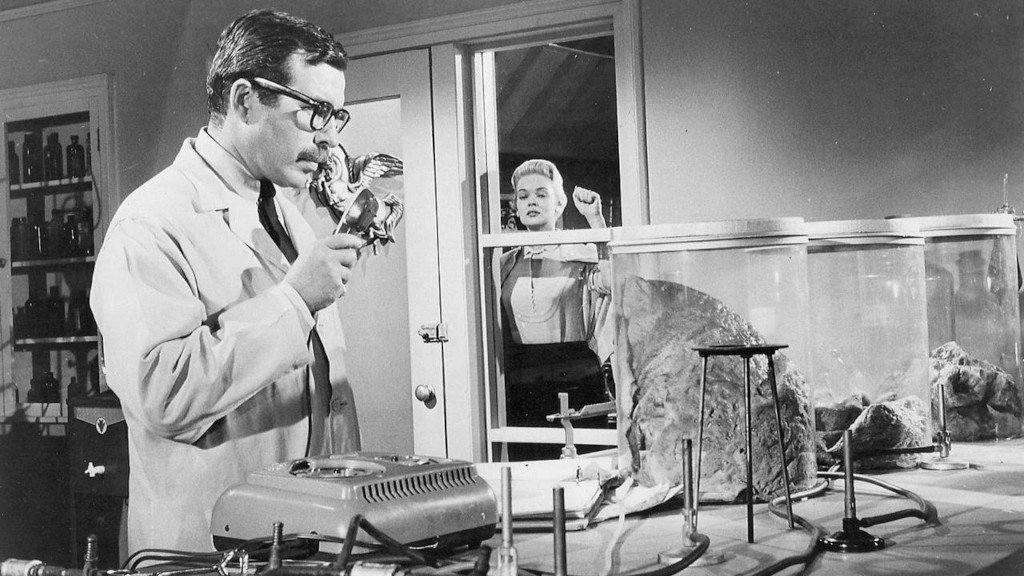
Acting-wise, the movie does OK. Minor B-movie and TV star Bill Williams and former child actor Robert Ellis are both fine in the male leads, but don’t have much to work with in terms of characterisation. Lyn Thomas, a busy B-lead whose career was on the slide, is credible in the role as the hunted woman. I didn’t recognise Paul Frees as Dr. Pommer with a mustache, but I just about jumped out of my chair when I heard that FANTASTIC voice. The amazing voice actor didn’t do that much work in front of the camera, but he was a good dramatic actor as well, and is one of the highlights of the movie. Another one is Moe Howard of the Three Stooges fame, who surprisingly turns up in a rather small but important role as the cab driver. Howard ditches all of his Stooges schtick and does a very good dramatic performace, even if he is a bit of a comic relief.
The background to Howard’s involvement was that Edward Bernds was primarily known for having directed a large amount of Three Stooges shorts before moving into feature films. Space Master X-7 was made in the short interim between Columbia shutting down their comedy shorts unit in 1957 and the Stooges’ revival on TV in 1959, and Howard was out of work. According to Bernds, he didn’t need the money, but just wanted to work. A happy circumstance of Bernds signing on Moe Howard was that Moe essentially brought along with him the film’s special effects creator, his son-in-law Norman Maurer. According to Bernds, Howard told him that Maurer wanted to get involved in movie production, and asked Bernds and Glasser if they would take him on as a production assistant. Bernds told Tom Weaver that he knew Maurer was a professional artist, and was happy to take him on, as “an artist can be a great asset to a movie production”.

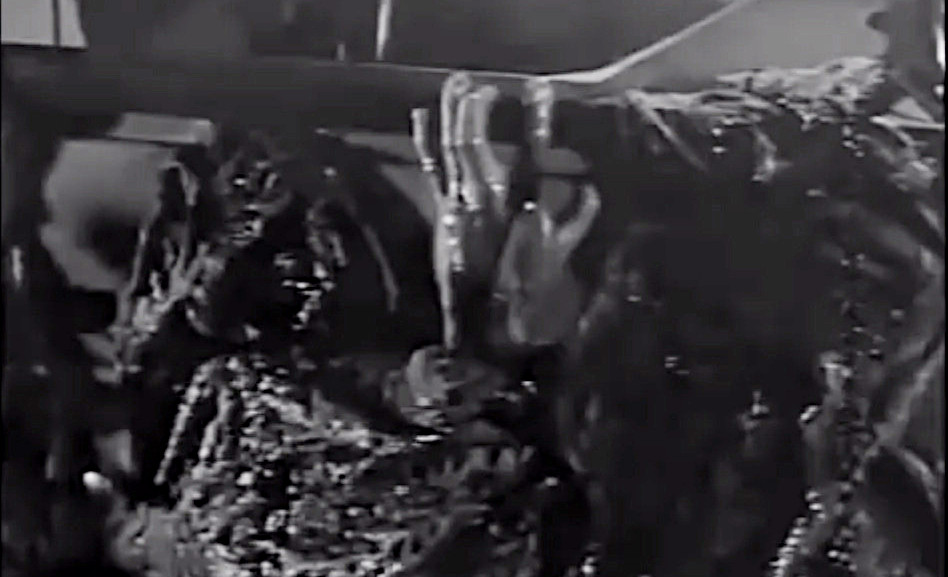
Maurer ended up designing the Blood Rust, which was basically foam rubber mats that were made to undulate by blowing compressed air underneath them. The mats were manufactured at Don Post’s latex factory – Post being the man behind many of the popular latex face masks at the time, and later. The film can’t hide that the Blood Rust is simply sheets of foam rubber, but with the added action of fire, flame throwers and fire extinguishers, the effect works reasonably well.
Bernds’ direction is solid, on the whole, with both weaker and stronger moments. The quick shooting schedule is apparent, with several scenes done with a minimum amounts of setups, leading to a somewhat static feel in certain parts. Other scenes are quite dynamic, in particular the climax in the airplane, which has a real sense of urgency and chaos as Rattigan and one of the pilots battling it out against the fungus trying to break through the floor hatch from the luggage compartment, and dangling outside the airplane window. The action makes you forget the fact that the production apparently only had the budget for 12 or so airplane seats, and that at one point it looks as if the cabin is over 10 feet in height.
I can’t remember what the music in the film sounded like, now a few days after watching it, which at least should mean that it didn’t bother me. The film had no composer, and the soundtrack was put together from stock music.

Space Master X-7 is a mixed bag. It is competently made, and manages to stir up some tension with its race against the clock. However, its low budget shows, and it is hampered by the long stretches of techno babble and the ever-present narration that often seems entirely superfluous, and added more as a budgetary solution that anything else. The many entirely illogical and counterproductive choices made by the heroes in order to make the plot works also eats away at the picture’s credibility. Bernds says to Tom Weaver that Regal always prided themselves on delivering the best possible products that could be made on the budget available. At least in the science fiction department, the results I have seen have been mixed. The ambitous Kronos (1957, review) benefited greatly from an original story by Irving Block, Kurt Neumann’s tight direction and the film’s impressive low-budget effects by Block, Kurt Neumann’s and Louis DeWitt. But like Neumann’s She Devil (1957, review) and Charles Marquis Warren’s The Unknown Terror (1957, review), the visuals were not the problem, or even the original idea, but a weakly written script. The visuals and the effects are often impressive in the studio’s films, given that Regal worked with the same kind of budgets that AIP did, and their effects were made by Paul Blaisdell sitting in a shed with pieces of latex and glue. But Regal always seemed to stumble in the script department, often dropping the ball on poentially good ideas. Such is the case with Space Master X-7 as well.
Reception & Legacy

Space Master X-7 was released by Fox on a double bill with Kurt Neumann’s The Fly (review) in June, 1958, and it’s not difficult to guess which if the movies caused a greater stir.
The film got fair reviews in the trade press upon its realease. Jack Moffitt at the Hollywood Reporter called it “a better than avegare second feature” and “better than many films of this calibre”. The Monthly Film Bulletin said that as a location thriller “it is quite gripping in an elementary sort of way”, but thought the science fiction trimmings were “ridiculous” and that the fungus was “rather insipid, resembling large quantities of omelet mixture”. Harrison’s Reports opined it was a “fairly good program picture” with “expert direction and good performances”. Powe in Variety called it “a competent science fiction tale”, but also noted that it “runs out of story before it runs out of film”.
Perhaps because it got left in the shadow of The Fly, Space Master X-7 fell into obscurity after its release, and was very seldom shown on TV in later years. It was never released on home video, and for years the only copies available seem to have been VHS recordings from TV. Fox also has also never released an official DVD or Blu-ray. For this reason, the movie was a bit of a white whale for many science fiction aficionados, and may be the reason why there are not tons of online reviews of it today. In 2017, a German company apparently was able to license the movie and put out a good-quality DVD. The German company now seems to have folded and the movie is currently in the public domain worldwide. However, the only online version is a badly degraded one, which is how I watched it. But those who are willing to pay up can find legal copies of the German print (with English dialogue) by specialty vendors.

Before the age of the internet, the go-to bible for science fiction movies was Phil Hardy’s Encyclopedia of Science Fiction Movies. Hardy’s Encyclopedia is impressively comprehensive, covering a multitude of non-American films, early, now lost short films and many curiosities that have seldom been seen by anyone, and is still something of a treasure trove for researchers like me. Unfortunately, it is sometimes painfully obvious that Hardy hasn’t seen the films he’s covering either, and Space Master X-7 is a case in point, as Hardy describes how the fungus turns Mrs. Greeling into some kind of monster, and Hand inventing an antidote for her condition, none of which is, obviously, in the film.
Modern assessments of Space Master X-7 is wildly varied, with some considering it a lost classic, other as a bottom-of-the-barrel programmer. The film has a 5.2/10 rating on IMDb, based on over 400 votes, but doesn’t have enough ratings even for a Letterboxd consensus.
On his channel Atomic Snack Bar, R.S. Sterling gives the movie 4/5 stars, calling it “a great example of just how good 50s sci-fi can be: well acted, well written, just ‘pulsaty’ enough”.
Others way between the pros and cons, such as Dave Sindelar at Fantastic Movie Musings and Ramblings: “The realistic style contributes quite a bit to making this cheap little movie a lot more effective than it might otherwise have been, though it doesn’t quite compensate for some glaring logic errors”. Likewise Marty McKee at Johnny LaRue’s Crane Shot says: Besides the dumb plotting to make Laura think she’s a murder suspect, Space Master X-7 is an intelligent thriller, if not always an exciting one. […] Scenes of men in fireproof suits spraying a train Laura was traveling in with fire, then spraying themselves to kill the fungus, are believable and interesting. The special effects fare less well. The blood rust is merely thin foam rubber with compressed air blown into it to make it pulsate, and a shot of a miniature Jeep burning is one of the least convincing models ever filmed.”
Thomas Hortian at German blog The Home of Horn writes: “The film itself works well as a crime thriller, but some inconsistencies make the story seem rather trashy at times, as the script has a few stumbling blocks.” Richard Scheib at Moria is not amused, however, and gives the movie a measly 1/5 stars: “Unfortunately, Spacemaster X-7 is not very good. The direction […] is pedestrian and dull. The film looks cheap”.
Cast & Crew

Director Edward Bernds had a somewhat unusual path to becoming a movie director. Born in 1905, he became a ham radio operator in his teens, and was able to get a commercial broadcasting license in the early twenties. In 1923 he found employment as chief operator on one of the many radio stations that were popping up, and when the talking movies arrived, he was one of many radio operators who moved to Hollywood to work as sound technicians on movies in 1928. At Columbia he worked as a sound engineer until 1944, until he asked for the chance to direct — his first commission was a 1944 edutainment short for the war service, and his first entertainment films were short films featuring comedian El Brendel and The Three Stooges in 1945. He considered his second Three Stooges short The Bird in the Head (1946) his true crash course in directing. It was filmed shortly after Curly had his stroke, and Bernds quickly realised that the former star was in no shape to perform his old gags, so he had to think on his feet and rewrite the movie so it covered up Curly’s disability while still keeping him the main character. Apart from the dozens of short films he made with The Three Stooges, he also directed three feature films with them between 1951 and 1962.
In 1948 Edward Bernds got his first shot at directing a feature film, when he was contracted to take over the direction of Columbia’s hugely popular Blondie comedy film series about the Bumstead family. Between 1948 and 1950 he directed the five last films in the series. He was also commissioned to direct another comedy film series based on a comic strip, Gasoline Alley, which ended up being only two movies long. Moving to Allied Artists in 1953, he took over another hit series, The Bowery Boys, with whom he made eight movies with over three years, including the horror comedy cult classic The Bowery Boys Meet the Monsters (1955). At AA, he also branched out from comedy to other genres — straight westerns, melodramas, action thrillers, even a hockey movie. Apparently his contract with AA wasn’t exclusive, and on the side he branched out into TV and worked with other low-budget companies, particularly Regal Pictures and API, for whom he made a string of teensploitation movies. 1955–1960 was a mishmash of low-budget movies: comedies, teensploitation, crime dramas, action films and a couple of science fiction movies. In 1958 he directed Space Master X-7 for Regal and Queen of Outer Space (review), starring Zsa Zsa Gabor, for AA. He is probably best known to genre fans as the director of the sequel Return of the Fly (1958), with Vincent Price returning as the co-lead. And in 1961 he directed the cult movie Valley of the Dragons for Al Zimbalist. Another milestone, or perhaps more a gravestone, for his career, was that he wrote the script for Elvis’ 1965 movie Tickle Me, which was his last official screen credit.

Born in 1901, screenwriter George Worthing Yates seems to have been writing short stories and treatments as early as the twenties, when his one of his westerns were adapted into film. From 1938 to 1954 he contributed to about a dozen screenplays, mostly B westerns, but also crime dramas and adventure films. In the thirties and forties he released a handful of mystery novels, sometimes working under pseudonym with another author. He found his stride with the first draft of the giant ant film Them! (1954, review), and after that worked almost exclusively in science fiction. He did a draft for George Pal’s and Byron Haskin’s semi-flop Conquest of Space (1955, review), but not much more than a few basic ideas of his were used for the finished film. He then contributed to such films as It Came from Beneath the Sea (1955, review) and Earth vs. the Flying Saucers (1956), The Amazing Colossal Man (1957, review), Attack of the Puppet People (1958), The Flame Barrier (1958), War of the Colossal Beast (1958), Space Master X-7 (1958), Frankenstein 1970 (1958, review) and Earth vs. the Spider (1958, review), making him perhaps the most prolific sci-fi screenwriter of the late fifties.
Co-writer Daniel Mainwaring was of the same generation of Yates, and like Yates, also published mystery novels, although Mainwaring was slightly more successful in this than his friend and collaborator. Left-leaning Mainwaring’s first novel, One Against the Earth (1932), was a proletarian novel, and the only one he published under his own name. During the rest of the 30s and the first half of the 40s, he made a bit of a name for himself with a string of hard-boiled mystery novels under the pseudonum Geoffrey Homes, culminating in Build My Gallows High (1946), which was his last novel, and generally considered his best. In the following year, he adapted the novel into the screenplay for the film noir classic Out of the Past, starring Robert Mitchum, Jane Greer and Kirk Douglas.
Several of Mainwaring’s books and stories were turned into movies, and from the early 40s onward, he also wrote original screenplays, almost exclusively crime and mystery films, as well as westerns. By the time Out of the Past premiered, he was already focusing exclusively on screenwriting. This Woman Is Dangerous, a rare drama film about a female gangster going blind, was his firs collaboration with George Worthing Yates, with whom he wrote a handful of movies. An interesting project was The Hitch-Hiker (1953), about a serial killer who kidnaps two friends on fishing trip, forces them to drive over the Mexican boarder and tells them he is going to kill them when they reach their destination. The movie was based on the real-life case of serial killer Billy Cook, and the film was notable as the first film noir directed by a woman – movie star, producer, writer and director Ida Lupino.
Beside Out of the Past, Mainwaring’s best known film is Don Siegel’s SF classic Invasion of the Body Snatchers (1956, based on Jack Finney’s novel and co-written with Richard Collins. He continued to write for the screen until the late 60s, when he retired. His work consisted mainly of B-movies, the crime thrillers and westerns that were his bread and butter, and in the 60s he wrote primarily for TV. But he also contributed to the SF movie Space Master X-7 (1958, with Yates), the fantasy/peplum film The Minotaur, the Wild Beast of Crete (1960), George Pal’s SF/fantasy film Atlantis: The Lost Continent (1961) and the horror thriller Catacombs 1965.
Mainwaring was a leftist sympathiser, and it is sometimes claimed that he was blacklisted at one point during McCarthyism, but his wife has denied this. Rather, she said, he provided his name as a “front” for blacklisted screenwriters.

Norman Maurer was a comic book artist and writer who married the daughter of Moe Howard, of the Three Stooges fame, in 1947. He consequently produced several Stooges comic books, as well as the first 3D comic book, about Mighty Mouse, in the late 40s and early 50s. Interested in movie production, he got his chance when Moe Howard, during a break in Stooges production, took on a small role in the low-budget SF movie Space Master X-7 (1958), and convinced the producer to take Maurer on as a production assistant. Maurer’s background as an artist served the film well, as he designed the film’s menace, the “Blood Rust”, a flesh-eating fungus from Mars. The next year, he got the chance to co-produce (with Sidney Pink) Ib Melchior’s cult classic The Angry Red Planet. Along with Pink, he developed what they dubbed “the CineMagic process”, which involved processing the photographic black-and-white negative through solarisation, making parts of it appear as positives, and then tinting the film red. This was done with all the scenes depicting the Martian landscape. The process had several cost-cutting advantages for the low-budget production. While the rest of the film was made in colour, all Martian scenes could be filmed in black-and-white, plus, there was no need to make a photographic positive.

Much of Maurer’s later career as a producer and writer was connected to the Three Stooges, as he managed the group along with Moe Howard after their contract with Columbia was terminated in 1957. After the final demise of the Stooges in 1970, he began working as a writer for Hanna-Barbera, writing scripts for a number of the studio’s animated series, including Scoobie-Doo and Richie Rich.

The biggest star name in Space Master X-7 is Bill Williams, born Henry August William Katt in New York. Born in 1915, he trained as a professional swimmer and worked in underwater shows before getting into film acting in 1944. His swimmer’s physique and wholesome vibe made him a good cut for B-movie “nice guy” leads and co-leads, and his career culminated between 1951 and 1955 when he played the popular titular hero in the TV Show The Adventures of Kit Karson. He continued his TV career as Betty White’s husband in the short-lived domestic comedy A Date With the Angels (1957-1958). After the show was cancelled, James Buxbaum approached Williams to star in a new series centered around a scuba diver. Williams declined, as he didn’t think an underwater show would work on TV. The role instead went to Lloyd Bridges, who turned Sea Hunt (1958-1961) into a nationwide hit. The show inspired a small cottage industry of underwater shows, and Williams managed to get the lead in one of them, Assignment Underwater, but it only ran for one season in 1960. Most of the 60s and 70s was spent as a guest star on TV, including several episodes of Perry Mason, where his wife Barbara Hale had a recurring role. Movie-wise, Williams occasionally turned up in smaller supporting roles in feature films, most notably in Howard Hawks‘ John Wayne vehicle Rio Lobo (1970). He retired in 1981.
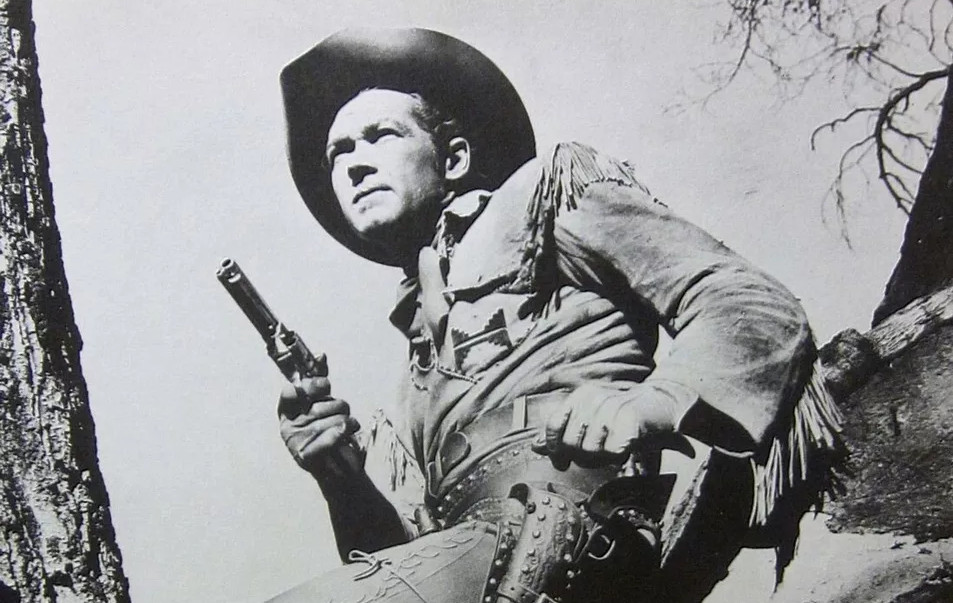
Williams did also a have a decent science fiction track record. He appeared in five episodes of Ivan Tors’ TV show Science Fiction Theatre (1955-1957) and was a guest star on Men Into Space (1959-1960). He played the lead in two science fiction movies produced by Robert Lippert, Space Master X-7 (1958) and Spaceflight IC-1: An Adventure in Space (1965). He had a bit-part in the TV movie A Fire in the Sky, and a large supporting part in the low-budget film The Giant Spider Invasion (1975), starring his wife Barbara Hale. His last film role was a cameo in Joel M. Reed‘s no-budget film Night of the Zombies II (1981).
Williams’ son, William Katt, went on to a successful acting career, starring in the SF TV series The Greatest American Hero (1981-1983) and appearing in leads or large roles in a number of hit movies, such as Carrie (1976), House (1985) and The Man from Earth (2007). He also appeared in a number of other SF projects, for example first-billed in the dinosaur pic Baby: Secret of the Lost Legend (1985), Snake Island (2002), the notoriously bad straight-to-video picture AVH: Alien vs. Hunter (2007), and co-starred in the low-budget films Deadland (2009) and Earthling (2010).

Bill Williams’ co-star in Space Master X-7 was Robert Ellis, who started his career as a child actor in the 40s, and appeared in around 60 films or TV shows before he retired at the age of 28 in 1961 – and instead started producing educational films. He debuted in April Showers (1948) at the age of 5. The same year he played Babe Ruth as a boy in The Babe Ruth Story. He achieved some manner of fame in adulthood after appearing in the recurring role as Ralph Grainger in The George Burns and Gracie Allen Show in 1956-1958, which was probably the strength on which with he was hired for Space Master X-7 (1958). He then went on to play the role of Hot Shot in Gidget (1959), after which his acting career teetered out. He died in 1973, only 40 years of age.

Lyn Thomas‘ film and TV career also spanned precisely between 1948 and 1961, although she entered it a little bit older than Ellis. She played female leads in no-budget westerns for Republic and Monogram in the early 50s, and after that spent most of the decade in guest spots on TV. Space Master X-7 (1958) brought her back to the big screen, and in the next couple of years she starred in half a dozen low-budget films, mostly westerns again, opposite actors like Steve Brodie, John Agar, and even reunited with Bill Williams in Alaska Passage (1959). She abandoned acting when she married in 1961.

Paul Frees, a renowned voice actor (who also has face for film), composer and sound editor who not only acted in or provided voices for over 300 films or TV series, but also worked as one of those well-kept secret actors in Hollywood who would do overdubs in post-production whenever extras needed voicing or a film star’s lines needed changing and the star couldn’t make it to the sound studio. So adept was Frees at doing voices and accents, that in some instances on dubbed films or animations, he wound up having a four-way conversation with himself. The War of the Worlds (1953, review) is his best known role where he’s actually seen. He or his voice also appeared in The Thing from Another World, When Worlds Collide, a number of Godzilla dubs, Earth vs. the Flying Saucers (1956, review), The Cyclops (1957, review), The Mysterians (1957, review) dub, Beginning of the End (1957), The 27th Day, The Monolith Monsters, The H-Man (1958, review) dub, Space Master X-7 (1958), The Time Machine (1960), The Last War (1961) dub, Atlantis, the Lost Continent (1961), The Absent-Minded Professor (1961), Gorath (1962) dub, Dimension 5 (1966), King Kong Escapes (1967) dub, Colossus: The Forbin Project (1970), Beneath the Planet of the Apes (1970), The Milpitas Monster (1976) and Nothing Lasts Forever (1984).
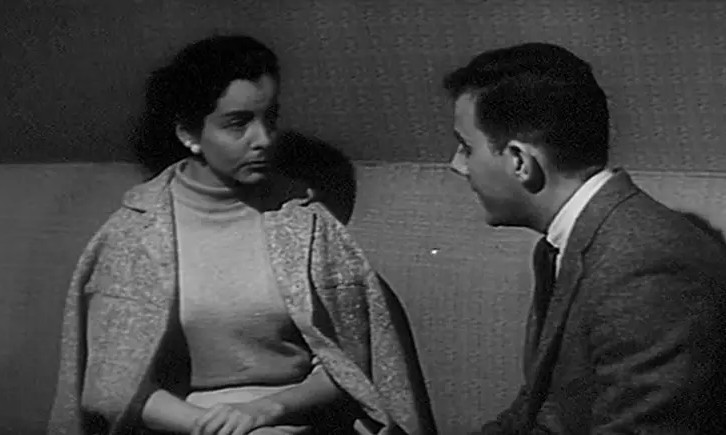
There’s a large role as Elaine Frohman in Space Master X-7, played by an actress called Carol Varga. IMDb lists her as appearing in over 100 films, primarily made in the Philippines, but offers no bio. However, after reading up on the matter, I suspect that IMDb is confusing two different Carol Vargas. One was a Filipino character actress in the 50s and 60s, who won several accolades for her femme fatale portrayals in Filipino film, but no biographies of her mention that she ever acted in Hollywood (even though she moved to the States after retiring from acting in the late 60s). However, there are also credits for Carol Varga turning up in bit-parts or small supporting roles in Hollywood movies throughout the 50s, most notably in a minor part in the Cary Grant film People Will Talk (1951) and a larger part in Curt Siodmak’s Bride of the Gorilla (1951). I think this is a different, Hollywood-based Carol Varga, and that this is the one that appears in Space Master X-7. However, there are also two English-language films produced in the Philippines, in which a Carol Varga appears, which I suspect is the other, Philippines-based Varga; Eddie Romero’s Man on the Run (1958), starring Burgess Meredith, and George Montgomery’s Hell of Borneo (1964). I may be wrong, and might have been only one Carol Varga, a movie star in her home country, who made frequent trips to Hollywood to appear as dancing girls or native women in no-budget productions, but I highly doubt it – and anyway, one might think that it would have appeared in her biohraphies.
B-movie stalwart Thomas Browne Henry shows up briefly as a scientist. Henry was an actor whom B-movie audiences of the late 50’s almost expected tos how up dressed in army fatigues. Sometimes in SF movies like Earth vs. the Flying Saucers (1956, review), Beginning of the End (1957, review), 20 Million Miles to Earth (1957), The Brain from Planet Arous (1957, review), Space Master X-7 (1958) and How to Make a Monster (1958, review).
There’s also a short appearance by Judd Holdren, who would have been familiar to all kids in the US growing up on science fiction in the early 50s. He played the titular role in Captain Video, Master of the Stratosphere (1951), based on the popular TV show Captain Video and His Video Rangers (1949, review). He later played the lead in Zombies of the Stratosphere (1952) and Commando Cody: Sky Marshal of the Universe (1953), as well as The Lost Planet (1953-1955) and appeared in Rocky Jones, Space Ranger (1954). His career plummeted fast, though, and he wound up having uncredited bit-parts in films like The Amazing Colossal Man (1957) and Space Master X-7 (1958).

Likewise plummeted from fame into obscurity was ubiquituous bit-part player Lane Chandler. Chandler, born 1899, grew up on a ranch, which served him well when moving to Los Angeles, and got him small parts in silent westerns. His good looks quickly got him cast in romantic leads opposite many of the silent era’s biggest female stars, such as Esther Ralston in Love and Learn (1928) and Fay Wray in Legion of the Damned (1928). But as the talkies arrived, his stock at Paramount began to fall, and he found himself gradually slipping from second leads to supporting parts, and by the end of the 30s he had become a bit-part player, often for independent studios. But Chandler cracked on, and performed in over 400 films or TV shows in a long career that ended in 1971. Other recognisable faces among the bit-part actors in Space Master X-7 are Hank Mann, Fred Sherman and Robert Bice, all who appeared in hundreds of films.
Janne Wass
Space Master X-7. 1958, USA. Directed by Edward Bernds. Written by George Worthing Yates, Daniel Mainwaring, Edward Bernds. Starring: Bill Williams, Robert Ellis, Lyn Thomas, Paul Frees, Rhoda Williams, Joan Barry, Carol Varga, Thomas Browne Henry, Thomas Wilde, Fred Sherman, Gregg Martell, Jess Kirkpatrick, Court Shepard, Moe Howard, Al Baffert. Cinematography: Brydon Baker. Editing: John Link, Sr. Set decoration: Harry Reif. Makeup: Robert Littlefield. Sound: Victor Appel. Special effects: Norman Maurer, Don Post. Produced by Bernard Glasser for Regal Films & 20th Century Fox.
 Scifist.
Leave a comment