
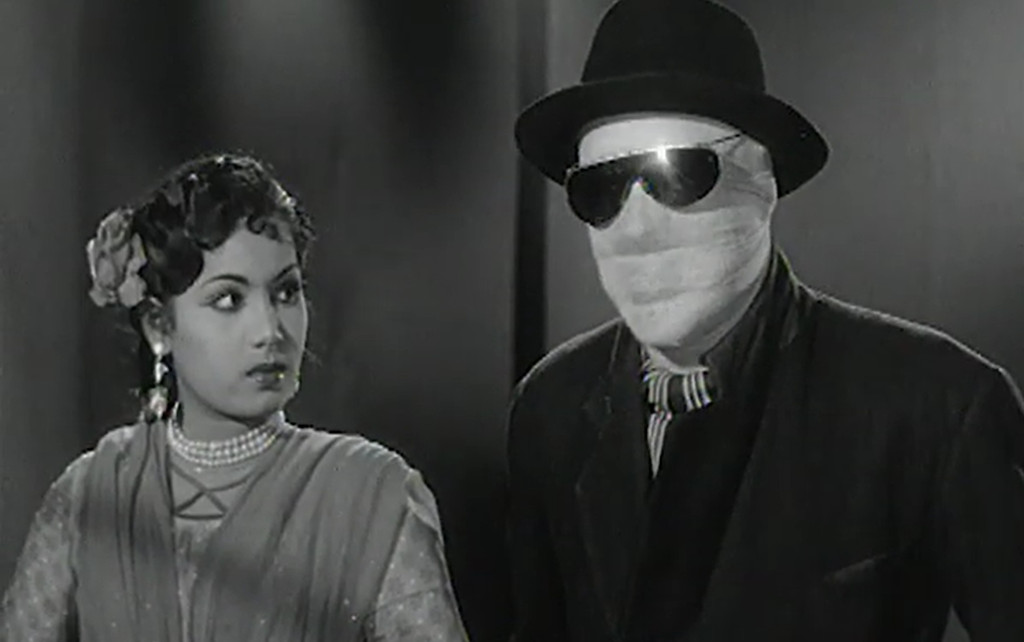
A real rarity: one of India’s first science fiction movies from 1958. A young man drinks an invisibility potion in order to take revenge on a crime boss to the melody of Tamil folk music. It is too long and talky, but is well filmed and acted, and has some great action in its second half. 5/10
Maya Manithan. 1958, India. Produced & directed by T.R. Sundaram. Written by A.S. Muthu. Starring: Sriram, S.A. Ashokan, Chandrakanta, Kaka Radakrishnan, T.P. Muthulakshmi. IMDb, Letterboxd & Metacritic: N/A.
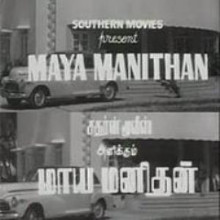
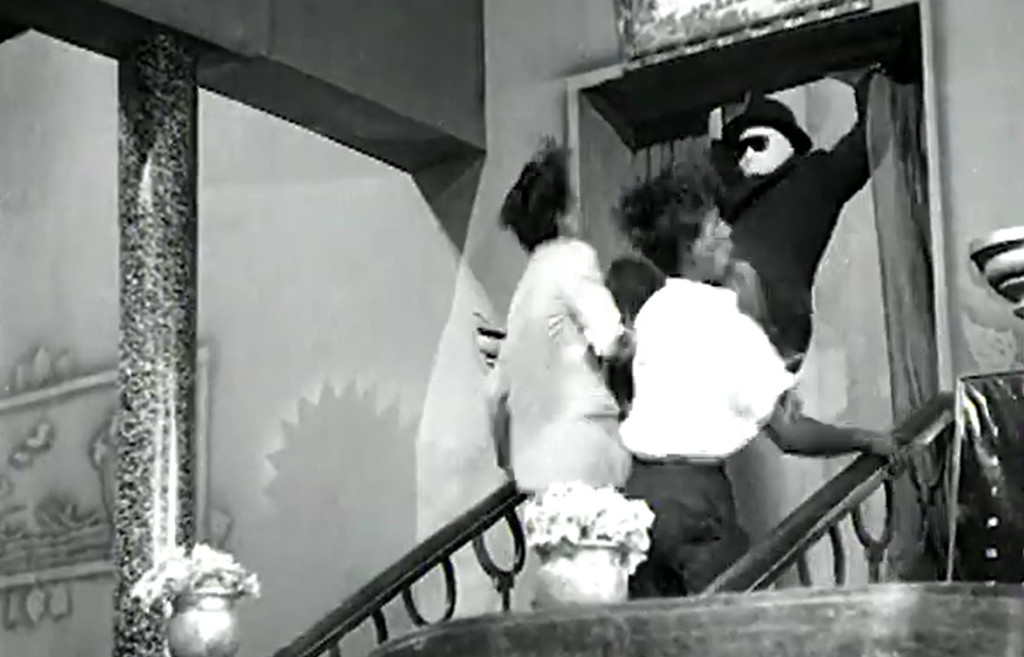
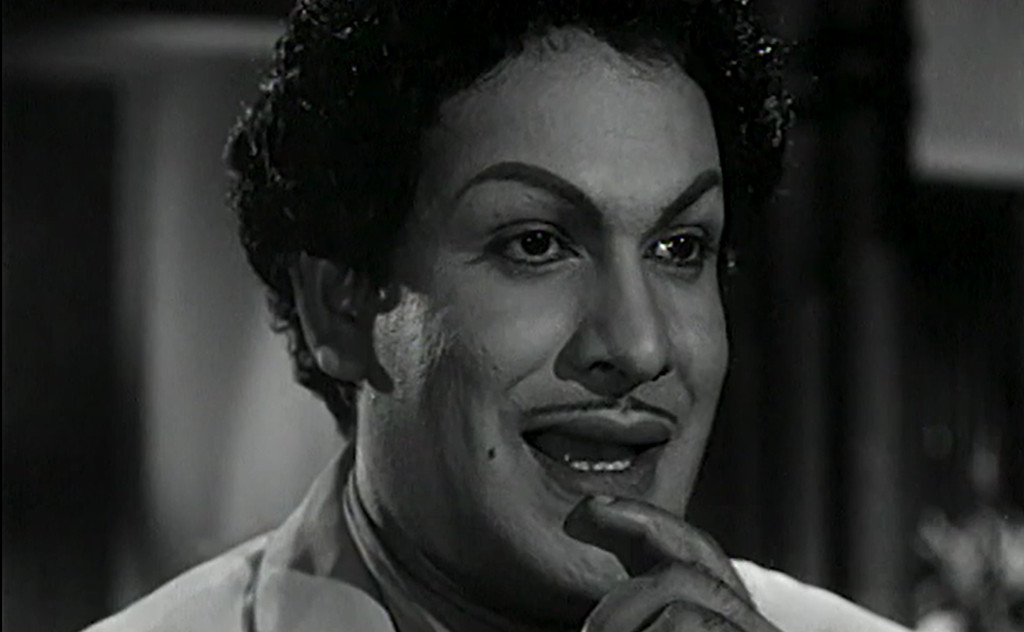
Maya Manithan or “Magic Man” from 1958 is not India’s first science fiction film, but it is one of the earliest that seems to be available online or otherwise. But it is the first science fiction movie in which the primary language is Tamil. As you can see from the screenshot above, Maya Manithan takes its cue from Universal’s The Invisible Man (1933, review), and the “magic man” is really the invisible man.
This is one of those films that I both love and loath to review. It is throroughly obscure, made in a language I understand nothing of, and I watched it without subtitles or even a single decent plot synopsis to help me through it. There is pretty much no information about it online, not even a decent cast list telling me who plays who. It is 150(!) minutes long, in black-and-white, and contains 30 minutes of musical numbers.
With that in mind, here is my very unreliable take on what I could make of the plot.
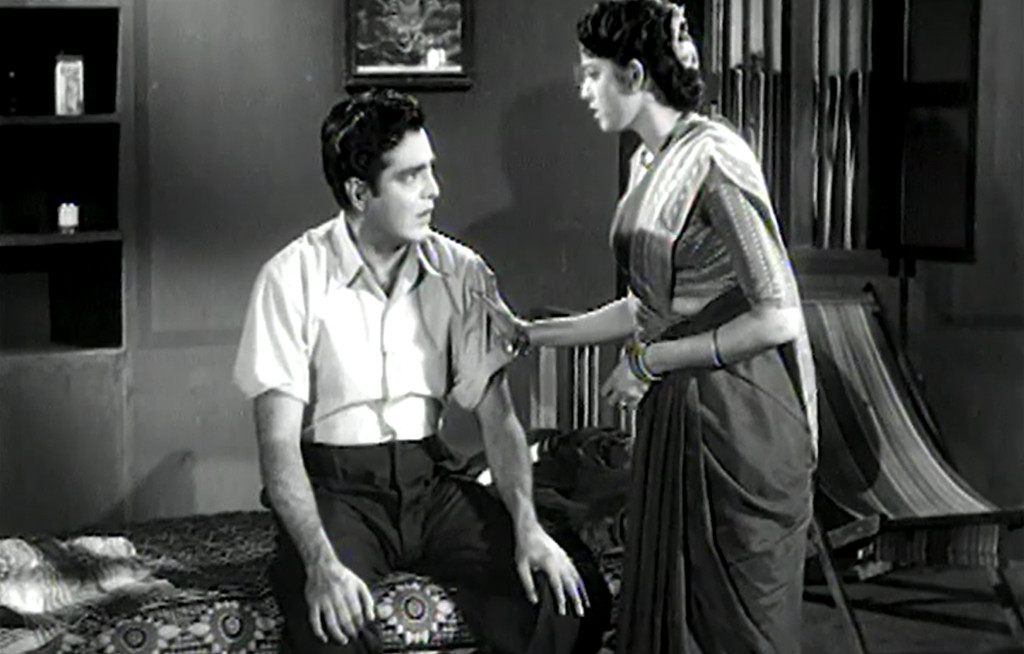
As the film opens, it establishes a feud or conflict between the film’s two main characters, young man from the working class (Sriram), our hero, and an obnoxious rich man (S.A. Ashokan), our villain, who is most certainly a crime lord of some sort. Because of the language barrier, I can’t make out what the schism is about, but it involves Sriram trying to impress Ashokan, and being mocked.
We then see Ashokan take out a bottle from a cabinet, helpfully with a label reading POISON in English. We then cut to what I assume to be Sriram’s home, where we see a woman, who I presume may be Sriram’s sister, lying sick in bed with a doctor hovering over her. A few scenes later she dies, and Sriram is devastated.
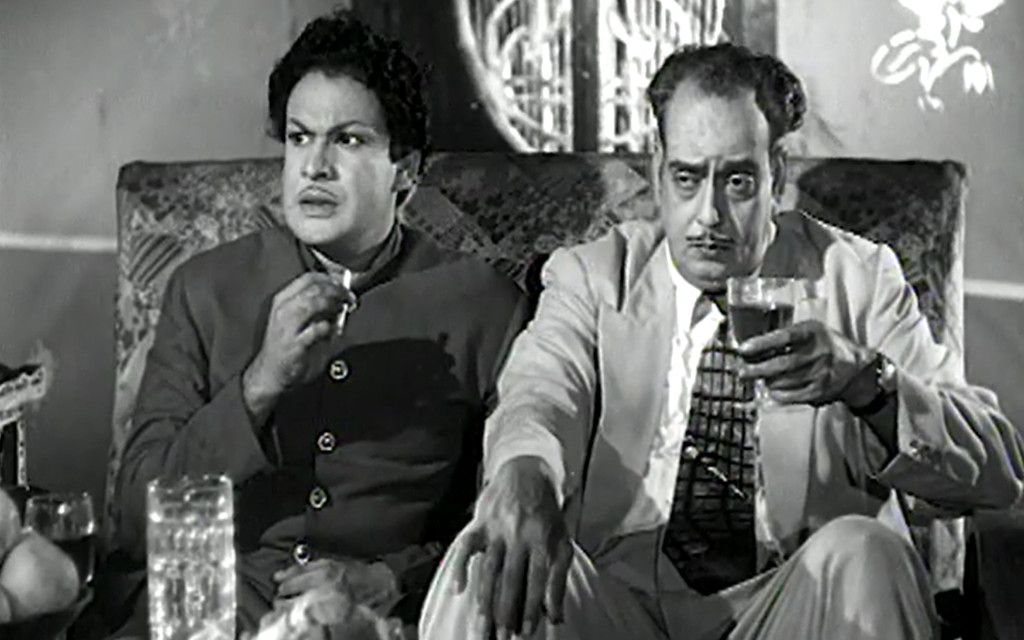
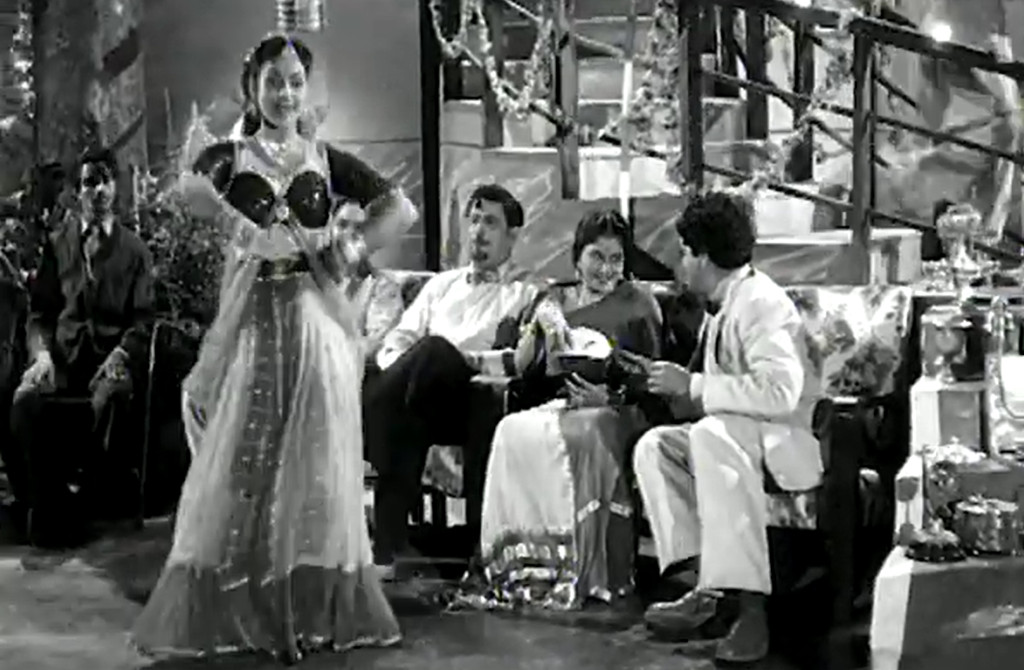
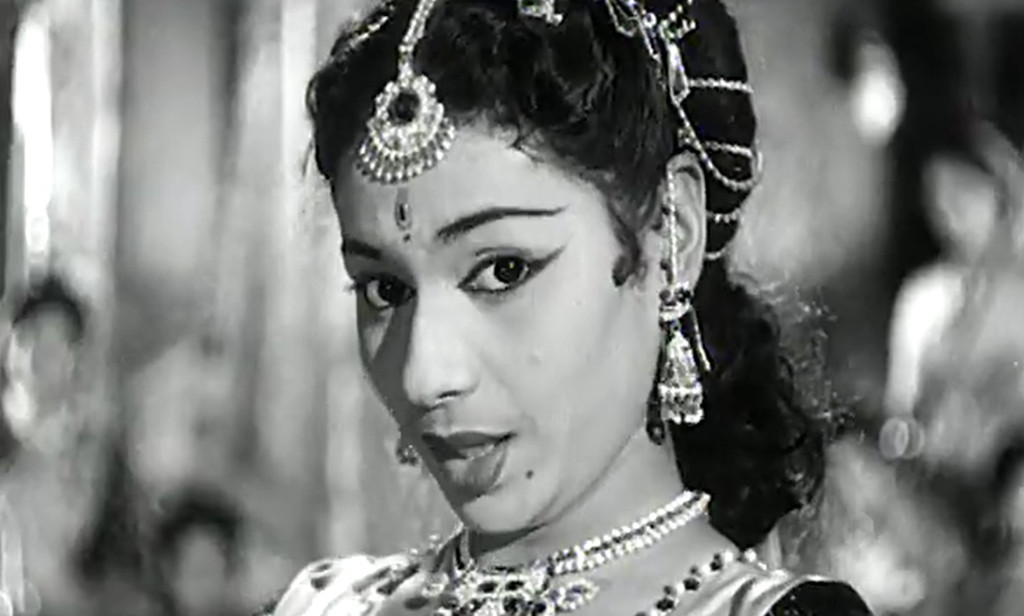
Later, while watching a dance and song performance by the fabulous T.P. Muthulakshmi, Ashokan pours poison into the wine glass of a man he has invited to his house, and then bribes Muthulakshmi into coercing Sriram to enter the room with the dead man. Ashokan has her call the police in order to frame Sriram for murder. But Sriram tricks Ashokan into opening the door, and a fistfight ensues. The police arrive and Sriram escapes into the streets of, presumably, Salem. He sneaks into a house and realises he has entered the abode of the local mad doctor, who hovers over a table full of beakers and bubbling fluids. He produces a potion which he feeds to his dog — making the dog invisible! When the doctor and his assistant exit the lab, Sriram sees his chance for revenge, and gulps down the invisibility potion — and it works!
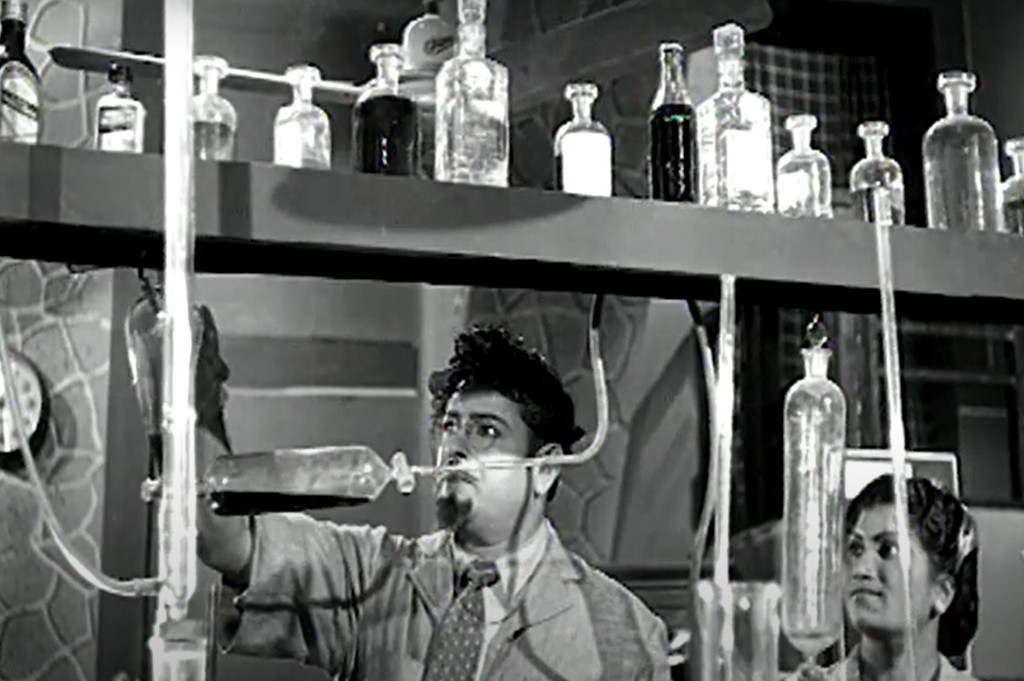
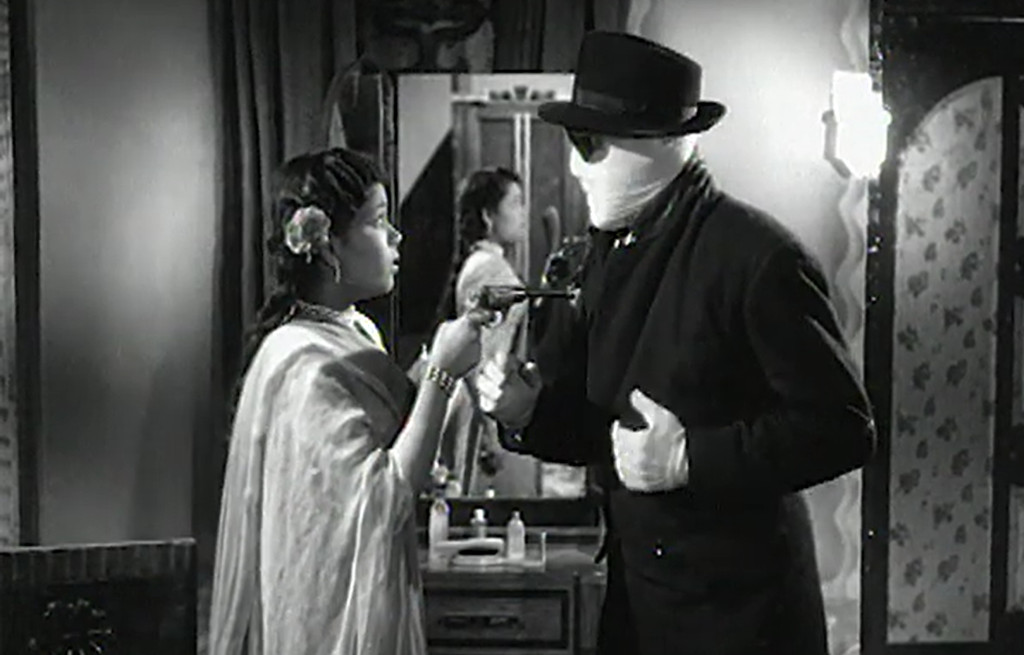
The rest of the plot is quite confusing for me, as there’s a lot of talk, different characters apparently double-crossing each other and fighting it out, and I can’t really make out who is who and what the underpinnings of the conflicts are. The main theme, however, is that after making himself invisible, Sriram dons the classic Claude Rains look of a bandaged head, sunglasses and a fedora, and this is how we will see him for most of the rest of the movie. He at one point visits Ashokan, with what purpose I do not know, but they have a brief discussion, and Sriram finds a confidante in a young woman (Chandrakantha), who seems to be a part of the Ashokan household. She is the leading lady of the movie, who hooks up with Sriram in the end. Eavesdropping on them, Ashokan learns that the bandaged man is really Sriram. In order to get him in trouble, Ashokan and a couple of henchmen dress up in the same way as Sriram and execute a number of robberies across town, and now the police are looking for a man looking like Claude Rains in The Invisible Man.
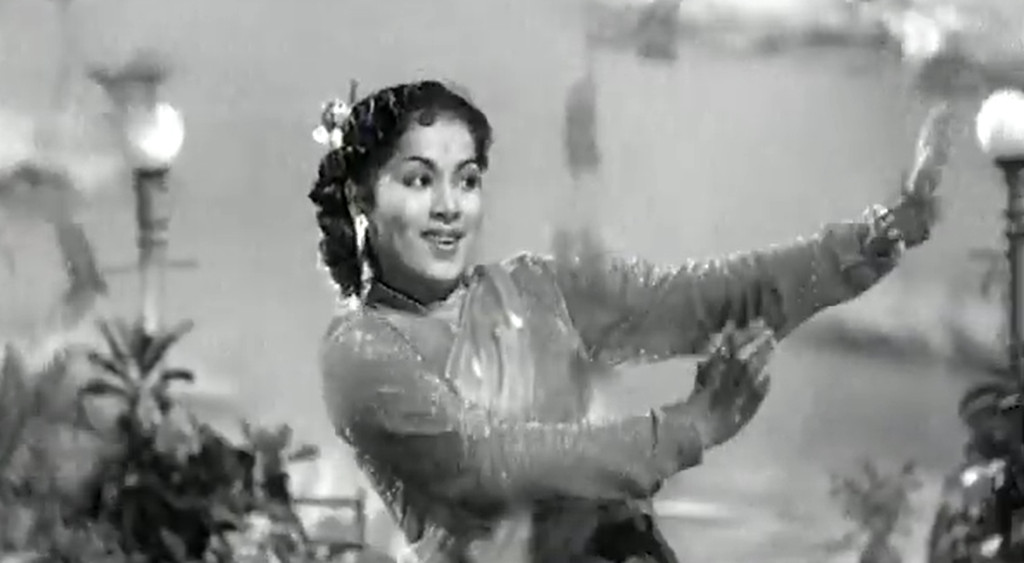
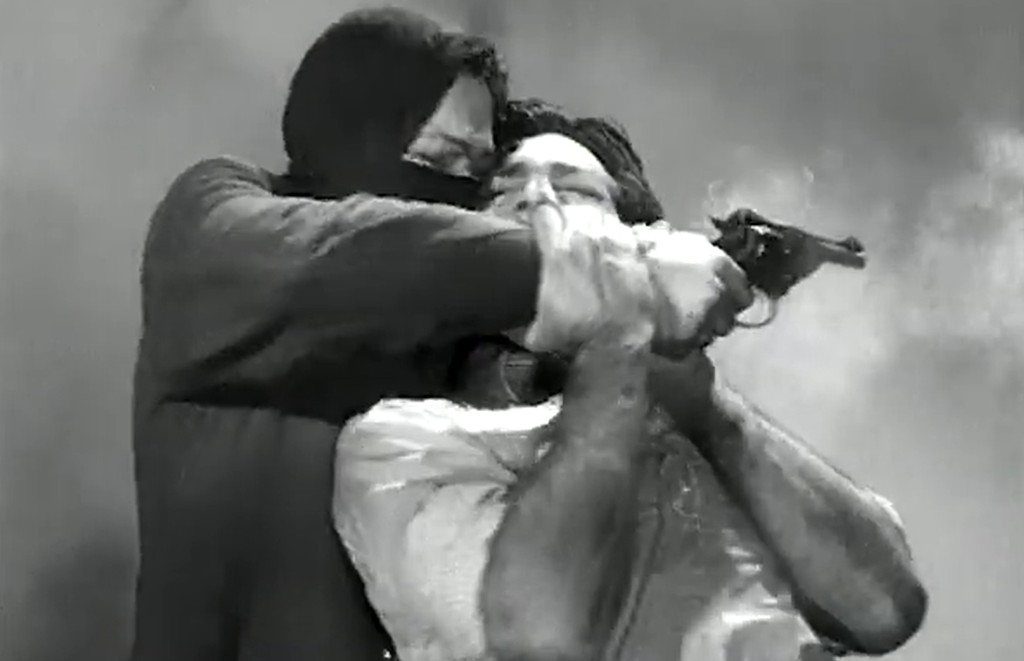
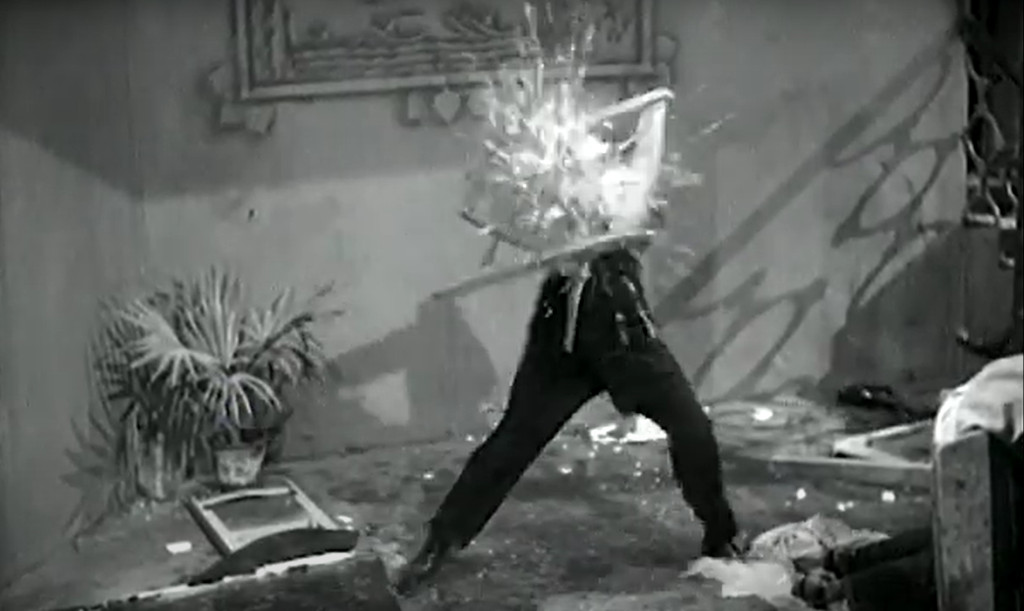
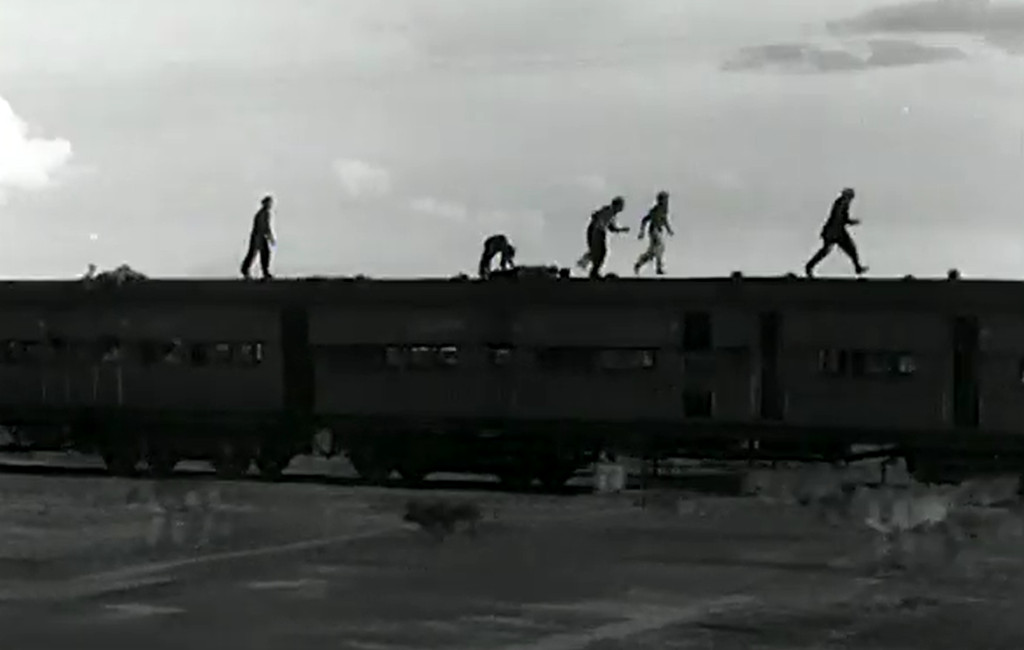
After this, the film picks up steam considerably, and even if I don’t quite understand what is going on, I am very entertained by the well-staged and often well-shot action and fight scenes. A second villain (G.M. Basheer) is introduced, but how he figures into things I have no idea. There are three major fighy scenes, in which Sriram, in bandages and fedora, takes on multiple henchmen at a time. The most impressive one is perhaps one in which the pugilists demolish an entire restaurant, with Sriram front-flipping over tables, throwing baddies through windows and engaging in all sorts of acrobatics. Another one, toward the end, has him fighting henchmen on the roof of a moving train. Finally, he confronts Ashokan in a fight in a mountainous landscape, when Ashokan is accidentally shot by one of his own henchmen. With his dying breath, he seems to confess to the police, and the mad scientist kindly shows up with an antidote to the invisibility potion so that Sriram and Chandrakantha can live happily ever after.
Background & Analysis
Films like these are fun for me to review, as they give me a chance to delve into a geographical genre of films that I know very little about. I am painfully oblivious about Bollywood movies (Hindi movies), and this is its sister genre Kollywood, derived from the name of Kodambakkam, a neighbourhood in Tamil Nadu’s capital Chennai, which has traditionally been the hub of the Tamil movie industry.
First the basics: Tamil is a language spoken by the Tamil people, primarily in the southern parts of India (Tamil Nadu and neighbouring states), parts of Sri Lanka and Singapore. Tamil Nadu is home to over 80 million people, and is home to one of India’s most thriving movie scenes, primarily based in the state capital of Chennai, itself a city of 8 million people. Films have been made in India since 1913, but as the British rule favoured the promotion of British films in their colonies rather than building up the local movie industry, development was slow. Finally, in 1936 the country got its own films studio, and immediately started producing musicals, which has, of course, remained the emblematic genre of the country’s movie industry. Tamil cinema in South India was on board early, and today Kollywood is the third largest producer of films in the country after the Hindi Bollywood and Telegu Tollywood cinemas. On the whole, India is the biggest movie producing country in the world today.
The 50s marked what is often referred to as the Golden Age of Indian cinema, which also accounted for Tamil cinema. Movies made in Tamil Nadu were noted for the influence of the politics of the ruling social democratic Dravidian movement, which led to an increase in pictures dealing with social themes, and a growing emphasis on the dialogue – leading in some cases to extremely talky movies. Another development in Tamil cinema was the rise of superstars like M.G. Ramachandran and Sivaji Ganesan, and in the 50s commercially successful movies became ever more centered on these superstars, while the influence of the director diminished. But of course, Indian cinema would not be Indian cinema without song, dance and spectacle, and the musical entertainment movies also thrived in Tamil cinema, an example of which is the film at hand, Maya Manithan.
Maya Manitham was produced and directed by T.R. Sundaram, an influential figure in Tamil cinema, the founder of the first fully equipped modern film studio in Tamil Nadu, Modern Theatres, and the producer of the first Tamil feature film in colour, Alibabavum 40 Thirudargalum (1956, “Ali Baba and the 40 Thieves”), starring superstars M.G. Ramachandran and P. Bhanumathi. Sundaram’s studio was not based in Chennai, but in the city of Salem, another of Tamil Madu’s movie hubs.
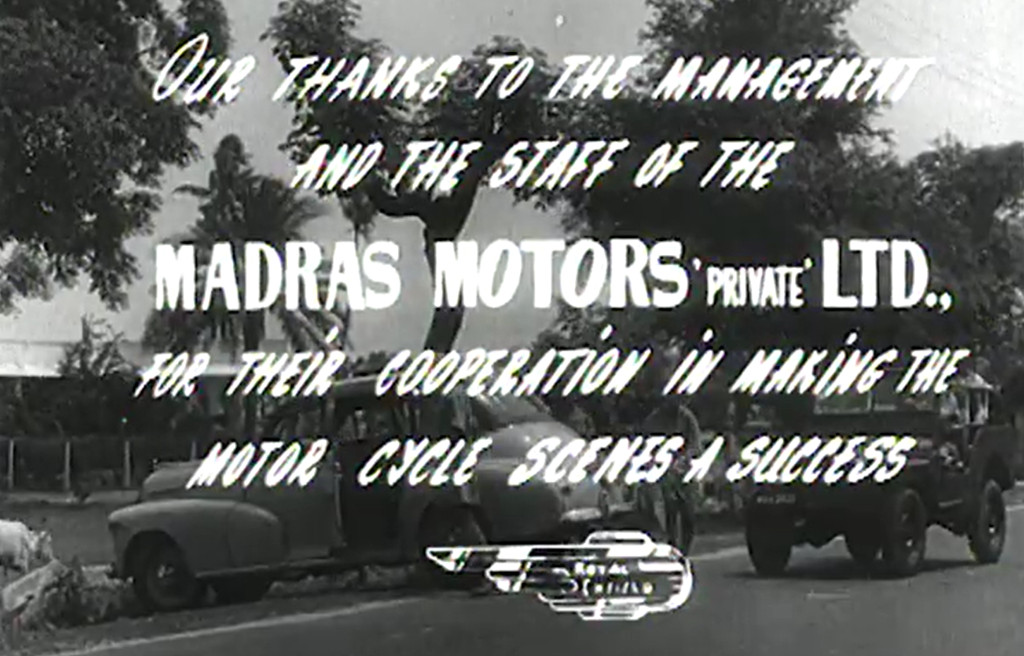
The 1950s was a period when science fiction movies were not only the big thing in Hollywood, but were also starting to appear in countries that previously had little history with the genre. Invisibility was a trope that had appeared in movies previously here and there, often in the form of invisibility cloaks or hats, or other forms of magic. With the onset of the science fiction craze, however, many looked to H.G. Wells‘ 1897 classic The Invisible Man. Not that the films that were borne out of this era had much resemblence with Wells’ novel, rather, they tended to draw their inspirations from Universal’s 1932 movie adaptation, and in particular the iconic look of lead actor Claude Rains and the groundbreaking effects by John P. Fulton. For example, 1952 saw the release of Egypt’s first science fiction movie Min aina laka haza (review) and in 1955 the Turksploitation movie Görünmeyen adam Istanbul’da (“The Invisible Man in Istanbul”) – a film I would love to review, but which does not seem to be available anywhere.
Without having much experience with Tamil or Indian film in general, I can’t say to what extent Maya Manithan follows or subverts the tropes and trends of Kollywood cinema at the time, but the story, curiously, is very similar to that of the Egyptian invisible man film Min aina laka haza? A young man from the working class courts a lady who is also in some way involved with a ruthless, rich crime lord by means of an invisibility potion, and in the process becomes a foil for the villain’s villainous schemes. While Min aina laka haza? had a stronger emphasis on slapstick and buffoonery, Maya manithan plays it straighter, but with a clear comedic undertone.
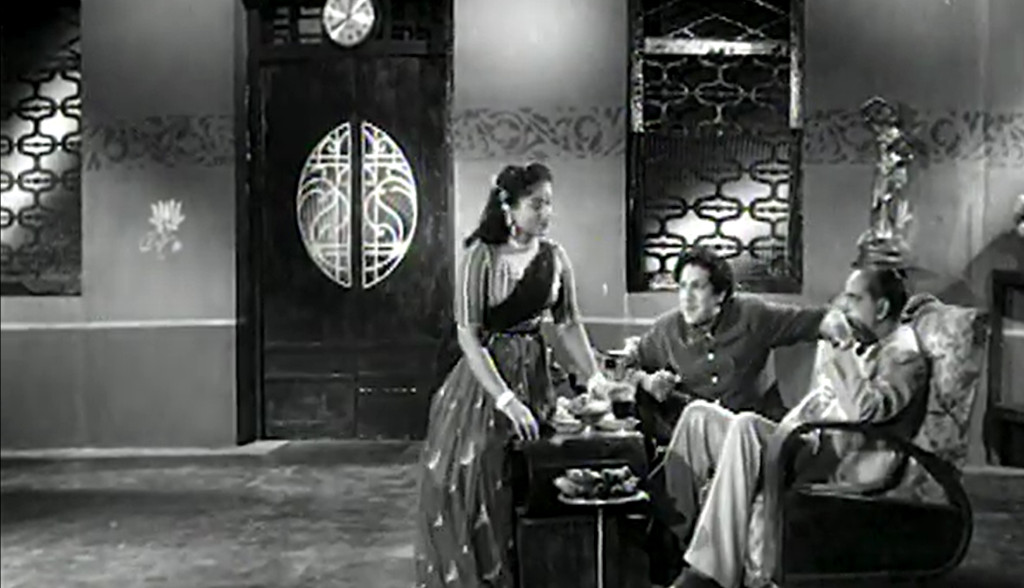
The script by A.S. Muthu, I suspect, is probably far more emblematic for the Kollywood light entertainment film of the period than its science fictional inspirations. The SF angle is treaded lightly, and the fact that Sriram becomes invisible barely even plays into the plot. For most of the film, Sriram is fully dressed in black suit and fedora, and the story plays him more as a masked vigilante from a Hollywood serial than as an invisible man. There’s more The Shadow or The Green Hornet than Jack Griffin about Sriram. In fact, so much that it becomes detrimental to the film. The whole point of Sriram drinking the invisibility potion is so that he can have his revenge on Ashokan – without being seen. But he then doesn’t utilise his invisibility for (almost) anything, but instead remains not only fully visible but instantly recogniseable throughout most of the movie. As a viewer one asks if it would not be easier to fight off half a dozen henchmen if Sriram simply took his clothes off. That is the point, anyway, of making oneself invisible.
At 150 minutes, this is a very long film for what is basically a plot that could have fitted in a 30-minute serial episode. Granted, there are 30 minutes of song and dance in here as well, but as far as I can tell, the plot of this movie is not particularly involved. Granted, also, that much of it is taken up by talk that I understand nothing of, so there might be more to this than I realise. But it was something of a chore for me at least to get through the first half of the movie – it picked up steam in the second half when it became more focused on the action. The reason for the film’s length is that 150–180 minutes was the standard length for Indian movies of the day.
What I will say about this film is that I was struck by how good it looks, and how well it is filmed – with caveats. Director/producer Sundaram was adamant that the crew at his studio should be on par with the best in the business internationally, so one of the first things he did when he founded Modern Theatres was that he hired two seasoned cinematographers from Germany to teach his Indian photographers the tricks of the trade. The cinematoghraphy of Maya Manithan is at times gorgeous, particularly in the song and dance scenes, which were naturally the highlights of the film for an Indian audience. But even in mundane scenes consisting of two people talking, Sundaram and cinematographer M. Krishnasamy manage to keep things interesting by keeping the camera in motion with zooms and tracking shots. Most scenes are shot from multiple angles, and editor G.D. Joshi always has a library of close and medium shots, and often insert details to choose from in order to keep the viewer interested and engaged.
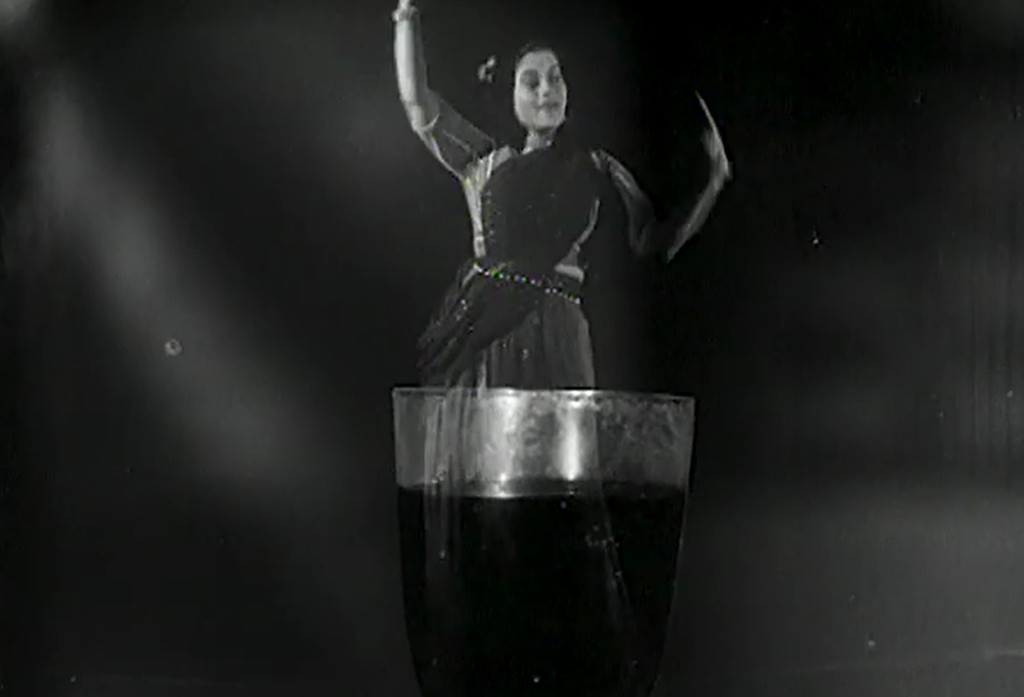
The multitude of angles and setups available for almost any scene of choice gives the impression that the film had a decent budget and a sufficiently long schedule for Sundaram to prepare and shoot multiple setups. Car chases are filmed from inside chased cars, from inside chasing cars, from static street level, from rooftops, cranes and even wide landscape shots with the camera set up at a mountain, overlooking the tiny cars racing along far below. Choreographed dance and song scenes have evidently been filmed many times over, providing the editor with a variety of alternatives to play with in setting up artful music videos. One song number even employs a little bit of visual effects, such as the singer appearing out of a wine glass.
The fight scenes are very well photographed, with the masked hero in particular impressing with his actrobatics. It is clear that it is not lead actor Sriram who appears in these shots, but rather an uncredited stuntman with a leaner and more athletic build. One element that does become a bit distracting is the number of wholly superfluous frontflips the stuntman does, as Sriram’s character doesn’t give the impression of someone who would spontaneously do a frontflip after having bashed in the head of an opponent.
The lighting of the film is quite flat, and there are moments where the otherwise competent cinematography fails. In the car chase scenes some of the footage shot from cars is so shaky that it can’t be intentional. There are some outdoor shots that are severely overexposed, and here and there the shots are out of focus. The chase and fight scene filmed at the top of a car is occasionally underexposed and there are severe focus issues. These are minor issues but nevertheless proof that Kollywood pictures – or at least those done by Modern Theatres – were not quite up to Hollywood standard in technical terms at this point in history.
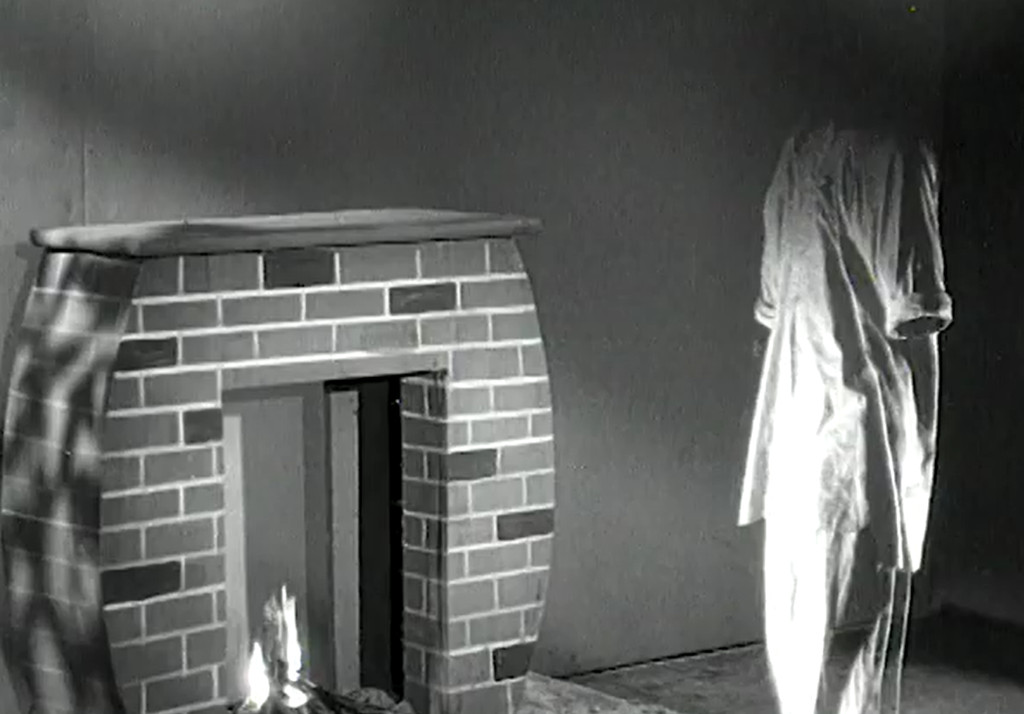
The special effects also leave a lot to be desired. We see very little of Sriram’s invisibility during the very long film, and those shots we do get range from mediocre to terrible. A few shots are made as composits, with Sriram shot against a black background, wearing a black body suit under his clothes, and composited into a background image. These effects are rather poorly done, and it looks as if his head in particular has been artificially darkened in post-production, resulting in the fact that not only is his head invisible, but in some cases parts of the top of his shirt seem to become translucent or even wholly transparent. In other shots, Sundaram has cheated completely, and simply put Sriram in a black balaclava against a black background in live-action shots, with the black hood above his shoulders clearly visible. One shot of Sriram with a towel around his waist, holding a newspaper, is the only invisibility shot in the film that really works the way it should. Then there are of course the obligatory shots of the invisible man opening doors and speaking on the telephone. These are generally well executed, but never spectacular.
The upbeat music of the Maya Manithan is composed by respected film composer G. Govindarajulu Naidu, and also exists of some traditional Tamil folk music. The movie contains 10 song numbers, primarily performed by solo performers, as well as a couple of duets. The music is pleasant and often catchy, even if few songs stand out as individual compositions. One that I found myself liking very much is “Kaana Venum Kaana Venum Endru”, which is extremely catchy and has a very seductive chorus. The song is one of three songs in the movie performed by legendary film singer Sistla Janaki, dubbed “Nightingale of South India”. It was the rule rather than the exception that the actors in Indian movies did not sing, but rather mimed and danced to songs performed by other singers. Likewise it tended to be the rule that the singers themselves didn’t appear in the movies.
Someone looking for the classic glamour and opulence of bigger-budgeted Indian musical films will be disappointed by Maya Manathan. There are no large choreographies or crowd scenes with glitter and confetti, buy mostly just one actor doing a choreography in a single space, like a garden or a room with a balcony, which gives the impression that Maya Manathan was not a prestige film for Modern Theatres.
Acting-wise it is always a bit tricky evaluating performances in a language you do not understand. However, most actors in Maya Manathan are competent and engaging. Sriram in the lead is a handsome tragic hero with velvety puppy eyes, reminding me somewhat of a young Lon Chaney Jr. S.A. Ashokan is the biggest name in the cast, although he was still fairly early in his career when he was cast as the villain in the movie, foreboding his typecasting. Ashokan is a suitably charaismatic and unpleasant villain, with no qualms about hamming it up when necessary. Renowned character actor Kaka Radakrishnan also makes good appearance as a tailor and friend/brother(?) of Sriram, although I’m afraid I don’t have a clue as to what any subplots related to his character are about. Of the female actors, the one that impresses me the most with her charisma and panache is T.P. Muthulakshmi, an in-demand character actor during the 50s and 60s. Unfortunately lead actress Chandrakantha doesn’t make much of an impression on me in her dramatic moments, but that may be due to the way her character is written. She is a very good and expressive dancer, though. I also do like that she gets the opportunity to take part in the action during the final fight scene.
A mention must also go to the great sound design of the movie.
Indian cinema had flirted with science fiction previously, and produced a handful of movies that, like Maya Manithan, can only very generously be considered part of the genre. Two of them, Professor Waman, M. Sc. (1938) and Flying Prince (1946) involve an evil scientist concocting devious potions, and as far as I can tell from titles and taglines, Jadui Bandhan (1941) and Aaj Aur Kal (1947) seem to deal with some sort of time travel or perhaps seeing into the future or something alike, but I really can’t tell, since I can’t find any information on them online. The afore-mentioned The Jungle (1952) barely scrapes by into SF territory with its overwintered woolly mammoths. Maya Manithan is also very low on science and rather high on drama, and the invisibility potion seems more a gag than anything the film revolves around. In fact, it would not have been difficult to write out the invisibility altogether and to have come out with pretty much the same film in the end.
Maya Manithan is, if nothing else, interesting for a non-Indian viewer for its pedigree, especially if you, like me, are fairly unfamiliar with Indian cinema in general. If you are a fan of Indian musicals, it will probably not prove particularly impressive, with production values far removed from the costly prestige song-and-dance films of the era. For a fan of 40s and 50s action films in the Hollywood mold, the movie, at two and a half hours, is far too long and talky, even when livened up with lots of musical numbers. If you come to it looking for interesting science fiction content, there really is none to be had. If, however, you have the patience to sit through a whole lot of talking heads (which, probably, you won’t understand unless you speak Tamil), you will be rewarded with a well-filmed, well-acted and entertaining action spectacle with good fight choerography and nice practical effects, as well as a handful of daring stunts. For a fan of 50s SF/action movies this is an interesting opportunity to explore beyond the familiar.
Reception & Legacy
Maya Manithan was released in August, 1958 in India, and probably had a release in other Tamil terrotories as well. To my knowledge it has never been released outside of South Asia. The film is available as a decent copy on Youtube, as of writing.
I have no information on the success of the movie, neither with critics or the audience.
As far as I can tell, mine is the first actual review of the film published online, in English, Tamil or any other language. Despite the fact that the film has been available for free online for at least five years, at the time of writing it has not a single audience vote on IMDb.
Cast & Crew
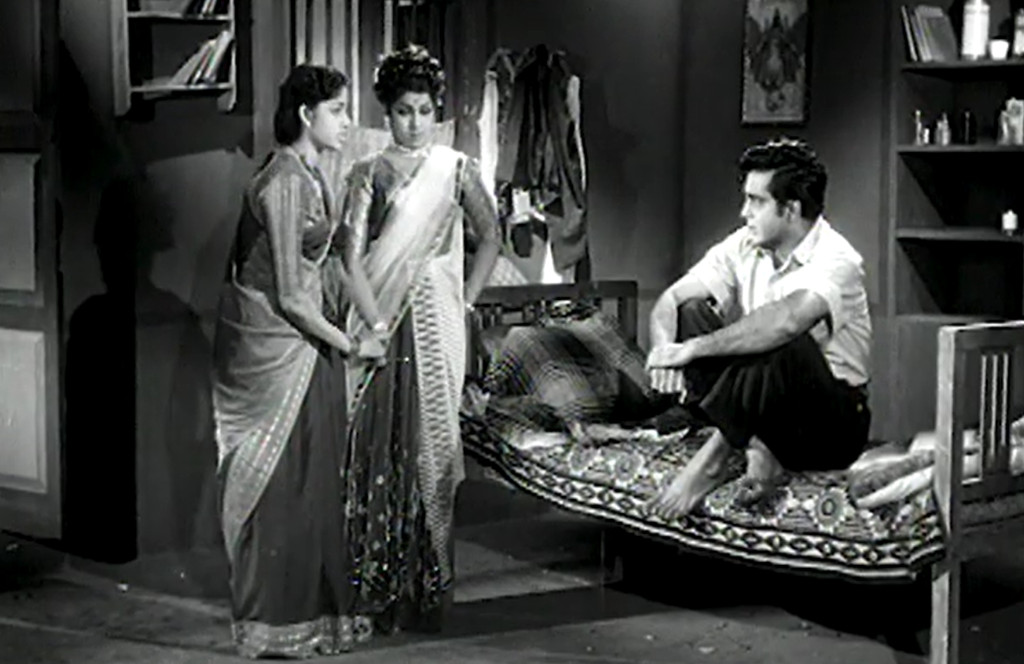
Assessing the careers of the film’s cast and crew is tricky. The IMDb credits, even for such notables as T.R. Sundaram, are woefully incomplete and often erraneous, and because of issues with transcribing, many of the artists and technicians involved are listed on the platform as several different people. Tamil-language Wikipedia, unfortunately, is no more reliable.
IMDb lists the director and producer of Maya Manithan as “T.P. Sundaram”, when in fact his name was T.R. Sundaram, or Tiruchengodu Ramalingam Sundaram Mudaliar. He was born in 1909 in a small city outside of Salem, around 400 kilometers from Tamil Nadu’s capital Chennai. Hailing from a wealthy and prominent family (his brother later became mayor of his hometown), he obtained a bachelor’s degree in present-day Chennai and then studied textile engineering in Leeds, preparing to go into the family business. However, England changed his perspective on life. Here he met his future wife Gladys, and it was also here he took an interest in the film industry. Returning to Salem in 1933, Sundaram got a job at as a producer at the newly founded Angel Films, before founding his own company, Modern Theatres, in 1935.

For his company, Sundaram built the first studio in South India with all facilities needed to produce a movie, such as a backlot, a music recording and dubbing studio, a large studio hall and a screening theatre. Striving to become the most technically proficient studio on South India, Modern Theatres early on brought over two experienced German cinematographers to work for the studio, who also acted as mentors for the young directors, gaffers and cinematographers from India. Under Sundaram, Modern Theatres produced the first South Indian colour feature film, the first double bill movie and the first movies in the languages of Sinhalese (spoken in Sri Lanka) and Malaylam (spoken primarily in Kerala). At its height, the studio employed around 250 people.
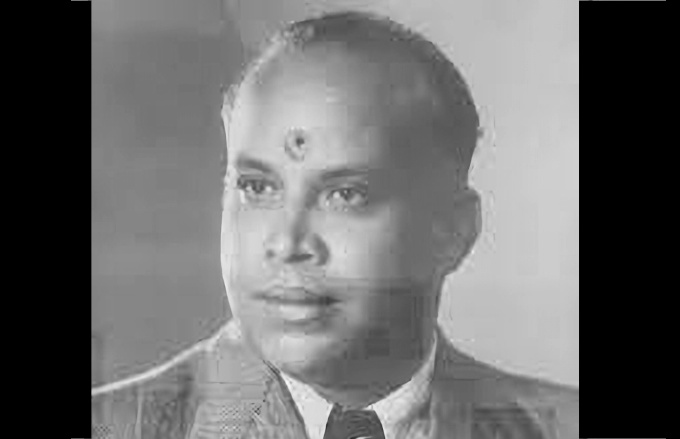
T.R. Sundaram produced over 100 films, even though IMDb lists only 20, and directed many of them himself. Among his best known work is Balan (1938), the first Malayam-language talkie, the fantasy movie 1000 Thalaivangi Apoorva Chintamani (1947), the historical adventure movies Manthiri Kumari (1950) and Sarvadhikari (1951), which were instrumental in establishing M.G. Ramachandran as a superstar, as well as Alibabavum 40 Thirudargalum (1956), the first Tamil colour movie. He also co-produced the US/Indian B-movie The Jungle (1952), an SF/jungle adventure movie starring Marie Windsor, Rod Cameron and Cesar Romero, co-produced with Lippert Pictures, a film which I will be reviewing shortly. This was the first English-language feature film made in South India, by an Indian movie company. He also produced and directed the science fiction comedy movie Trip to Moon (1967). Sundaram served twice as the chairman of South Indian Film Chamber of Commerce. He is commemorated with two statues and in 2013 got his face on a postal stamp.
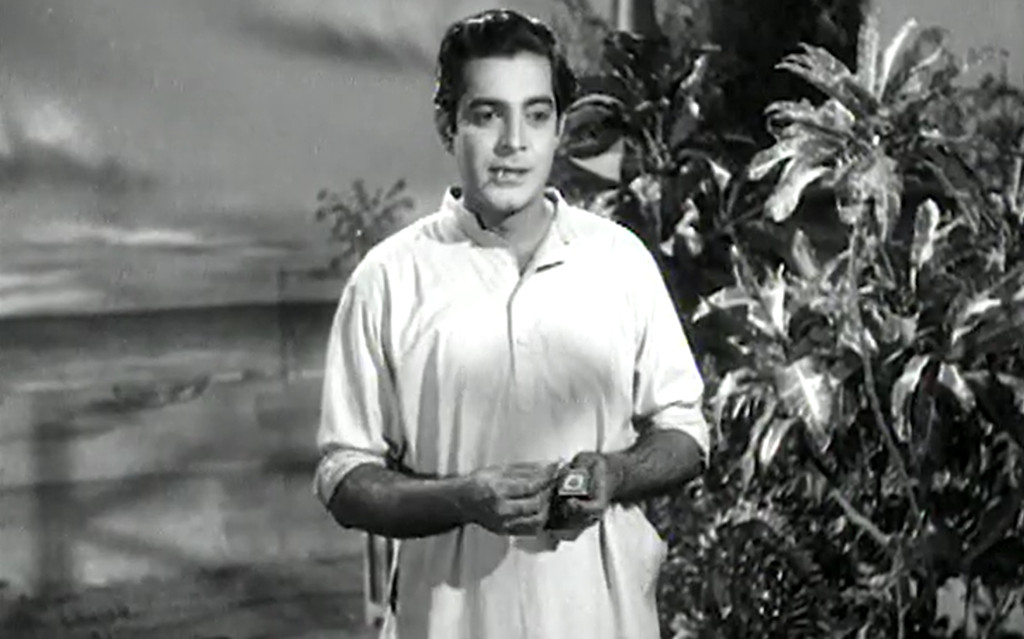
Lead actor Sriram was never among the brightest stars of Tamil cinema, but commanded a good number of leads in lesser films. He is perhaps best known for playing a central character in the Tamil remake of the Hindi blockbuster Samsaram in 1951. Tamil Wikipedia claims his film career ended in 1956, but Maya Manithan is proof the the contrary, and IMDb lists film apperances up to the late 60s.
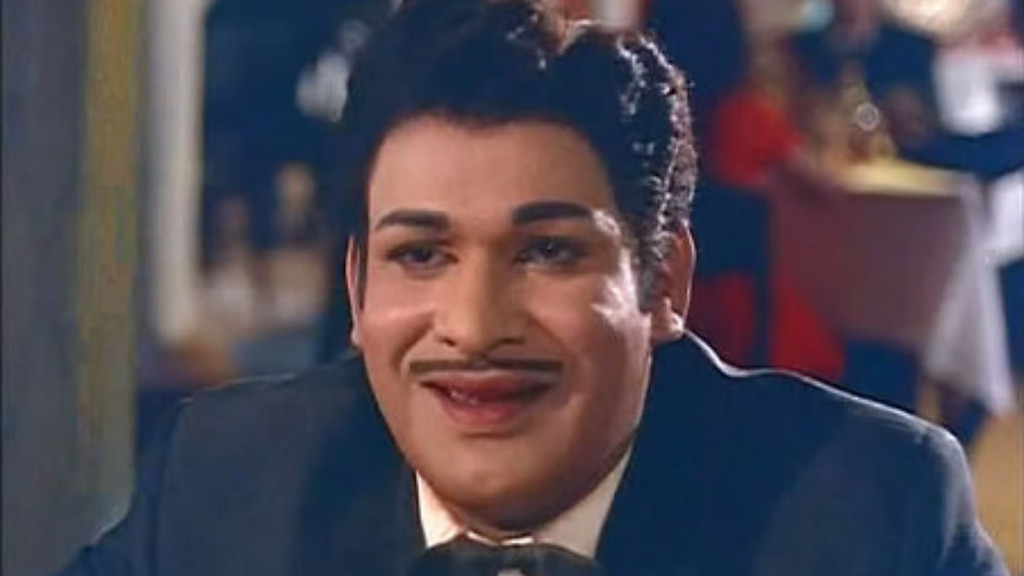
Tamil Wikipedia claims S.A. Ashokan made his film debut in 1961, and once again Maya Manithan is proof that this is not the case. IMDb places his first film appearance in 1954, and in a rare write-up at Kalyanamalai Magazine, he is quoted as saying he did his first movie appearance in 1953. Whatever the case, S.A. Ashokan rose to prominance in the early 60s as one of India’s most popular movie villains, probably appearing in over 200 films, in many of them acting as a foil to hero M.G. Ramachandran or “the James Bond of South India”, Jaishankar. His expressive (read: hammy) acting, his high-pitched voice and his comical sensibilities made him hugely popular with audiences, and also gave proof of his serious acting talents in several memorable heroic and drama roles, but it was his evil antics that sold tickets. he died in 1982, only 53 years old. His son Vincent Ashokan has continued his acting legacy, also specialising in villains.
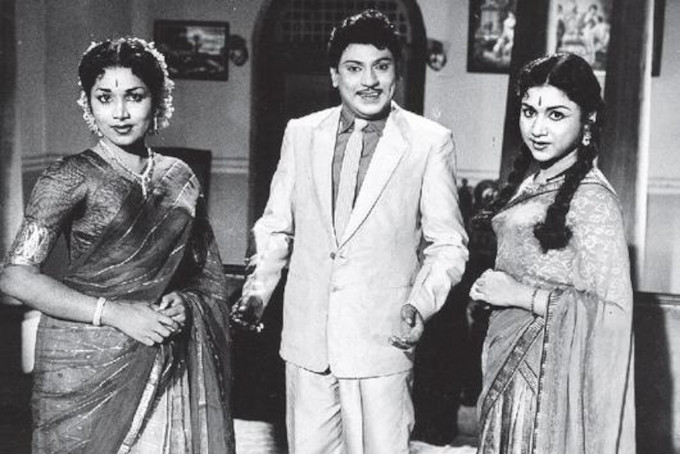
Maya Manithan was the first lead role for actress Chandrakantha. IMDb has only three movie credits listed for her, but Wikipedia claims she appeared in over 30 films, and a write-up in the Hindu Tamil newspaper names her as a popular lead actress in the 60s, especially well known for her expert dancing and her dramatic abilities. According to the article, the pinnacle of her career was the movie Idhu Sathyam (1963), in which Chandrakanta mimed the song “Saravana Poikaiyil” (sung by the playback legend P Susheela), which became a huge hit.
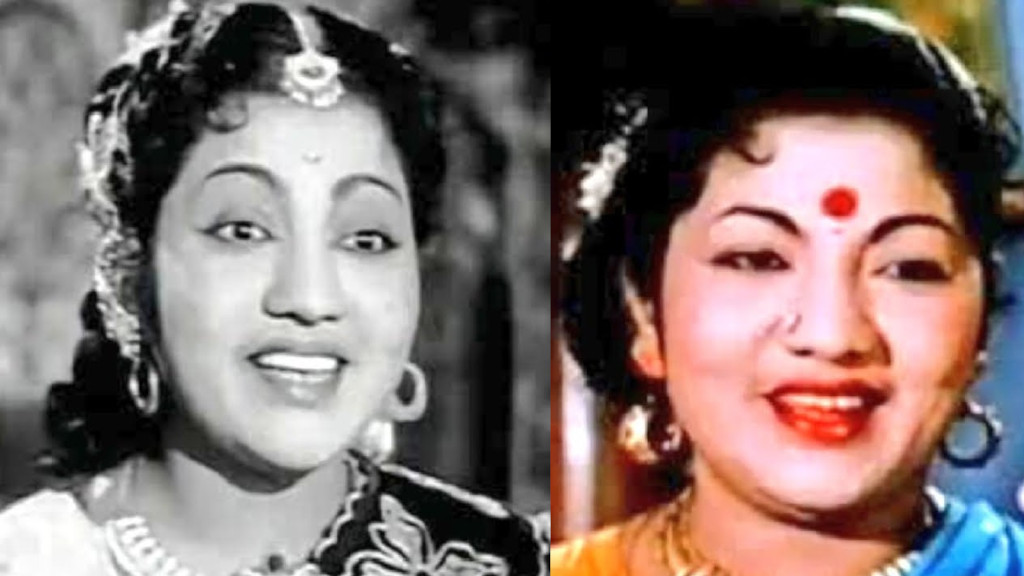
Also in the cast is character actor Kaka Radakrishnan who in his career appeared in over 400 films (according to some sources 600) – IMDb lists 39, and remained a beloved comedic actor will into the 90s. T.P. Muthulakshmi was a popular dancer and comedienne who appeared in around 350 Tamil films from the late 40s to the late 60s, often in supporting roles, but also occasional leads. According to the Indian Film Heritage Foundation, Muthulakshmi was “known for her vivacious presence on screen as well as her superb comic timing”.
Janne Wass
Maya Manithan. 1958, India. Produced & directed by T.R. Sundaram. Written by A.S. Muthu. Starring: Sriram, S.A. Ashokan, Chandrakanta, Kaka Radakrishnan, T.P. Muthulakshmi, C.D. Vanaja, Maithili, G.M. Basheer, K. Kannan, Kandhala Devi. Music: G. Govindarajulu Naidu. Cinematography: M. Krishnasamy. Editing: G.D. Joshi. Produced for Southern Movies.

 Scifist.
Leave a comment