
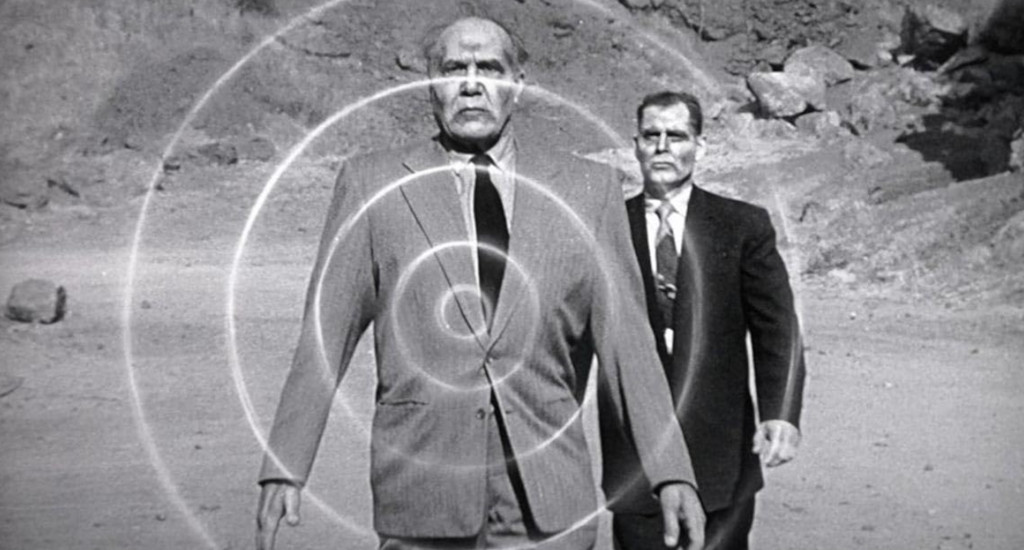
John Carradine explodes and comes back as an alien-controlled zombie intent on taking over the world. But he doesn’t reckon with sci-fi stalwart John Agar. Eddie Cahn’s final SF movie from 1959 has a few good ideas, but is ultimately a forgettable cheapo programmer. 3/10
Invisible Invaders. 1959, USA. Directed by Edward Cahn. Written by Samuel Newman. Starring: John Agar, Jean Byron, Philip Tonge, Robert Hutton, John Carradine. Produced by Robert Kent. 4/10
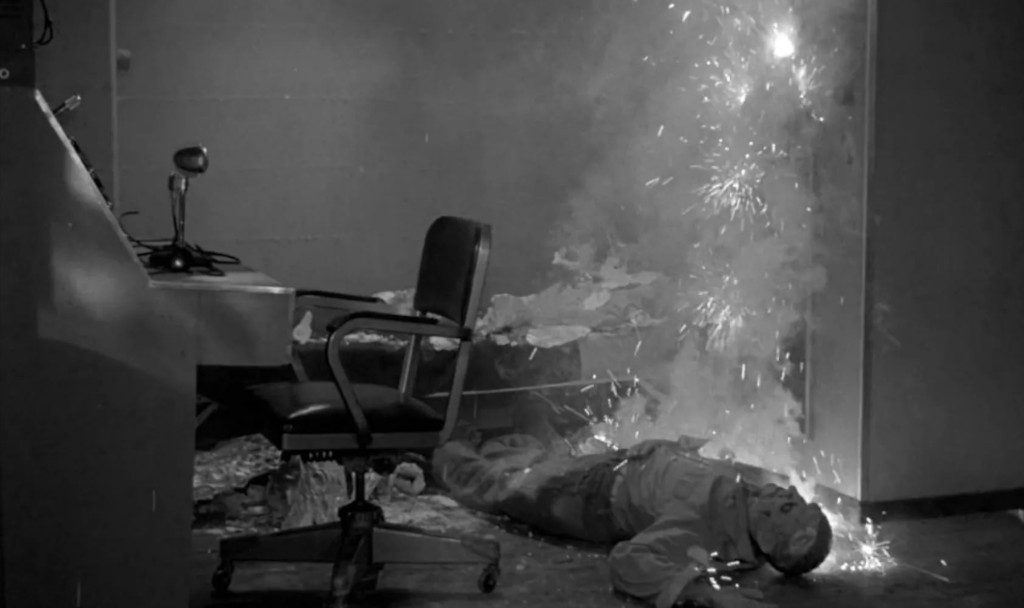
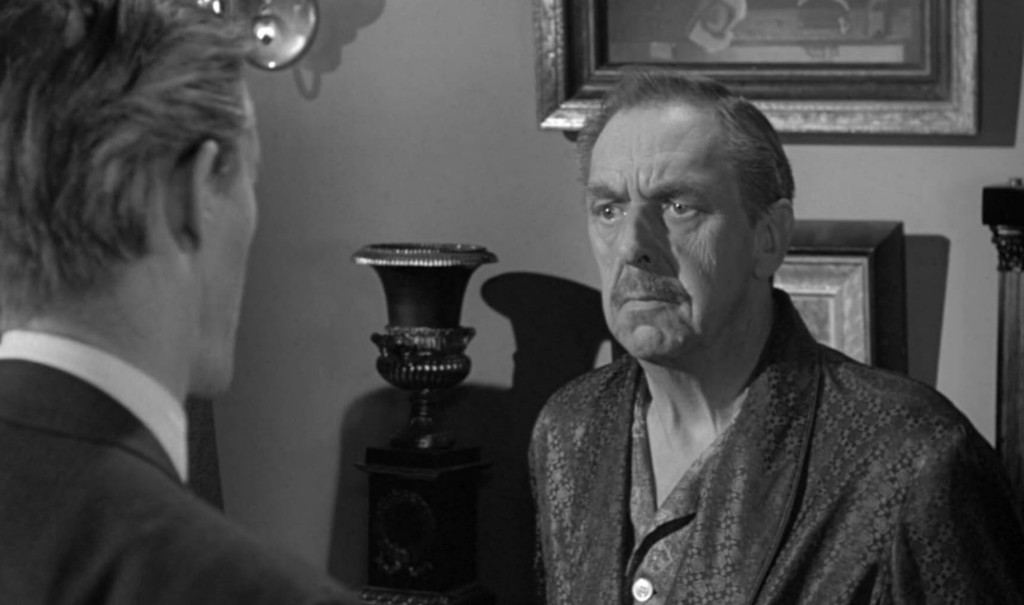
Over a shot of a nuclear test, a narrator (John Dehner) who will be with us for large swathes of the rest of the movie, reminds us that the nuclear arms race is in full swing. The camera then zooms in on one of the scientists working on these weapons, Karol Noymann (John Carradine), and then Carradine explodes. Cut to two of our main characters, Gen. Stone (Paul Langton) and Dr. Adam Penner (Philip Tonge). Penner, a friend of Noymann’s, explains the dangers of nuclear fallout and gives it as the reason he is resigning from the US nuclear commission. He then flies to Noymann’s funeral, where he gives a speech about the matter. After returning home, he gets a knock on his door. Outside stands a zombified Carradine.
That’s the intro for producer Robert Kent’s and director Edward Cahn’s 1959 cheapo programmer Invisible Invaders, a movie that is primarily remembered today for its similarities with George Romero’s zombie classic Night of the Living Dead (1968). Shot on a shoestring budget, it is the only movie in which two sci-fi luminaries appear together: John Carradine and John Agar.
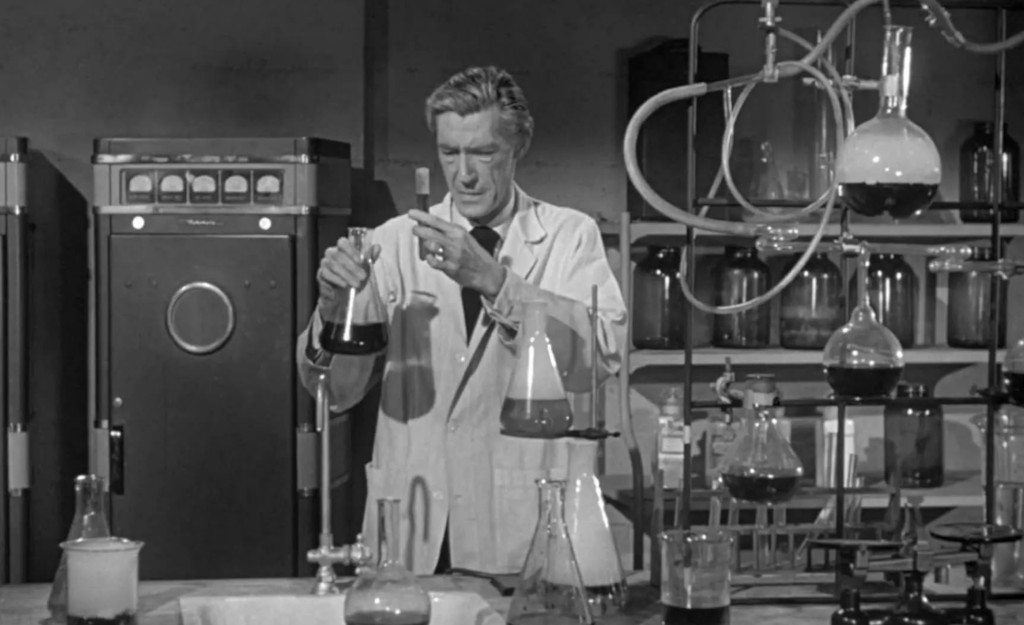
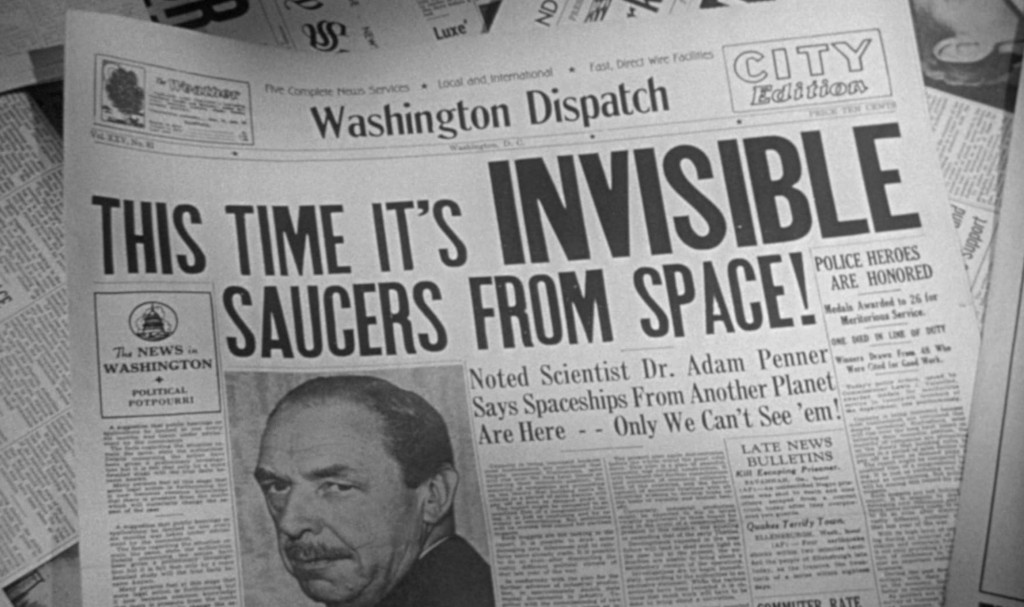
Zombie Noymann explains to Dr. Penner that he is an alien using Noymann’s body as a meat suit. The aliens have inhabited the moon for thousands of years, and have monitored Earth for as long (presumably they have learned our languages by monitoring our radio broadcasts). As long as humans have been dumb, they have paid no notice, but now as we have started dabbling in nuclear weapons and rockets, we have their attention. Now they have sought out Dr. Penner, because he is a voice of peace on Earth. They would have him deliver a word of warning to the leaders of the world: unless all nations surrender to the aliens within 24 hours, the aliens will invade. Zombie Noymann explains that they will possess the dead whom they will use as an army to kill all living humans. Resistance is futile, as the aliens and all their spaceships and technology are invisible.
Enter Penner’s daughter Phyllis (Jean Byron) and her not-boyfriend, nuclear scientist John Lamont (Robert Hutton). While sceptic, Lamont agrees to fly to Washington to deliver Penner’s story and warning. Unsurprisingly, the world laughs at Penner and his silly invisible invaders. Penner takes Phyllis and John out to the cemetery in hopes of talking to the invaders and grant him more time. He’s in luck, as the aliens seem to be hanging out among the tombstones, and leave grooves in the dirt from where their invisible feet are dragging. They agree to give two more warnings before the invasion begins. Twice they warn humanity by knocking out the announcers at sports event (one’s a hockey game), and speak to the crowds via the speaker system. Now the world is listening, but no-one is keen on surrendering, so the invasion begins, via stock footage of demolitions, fires, plane crashes and floods.
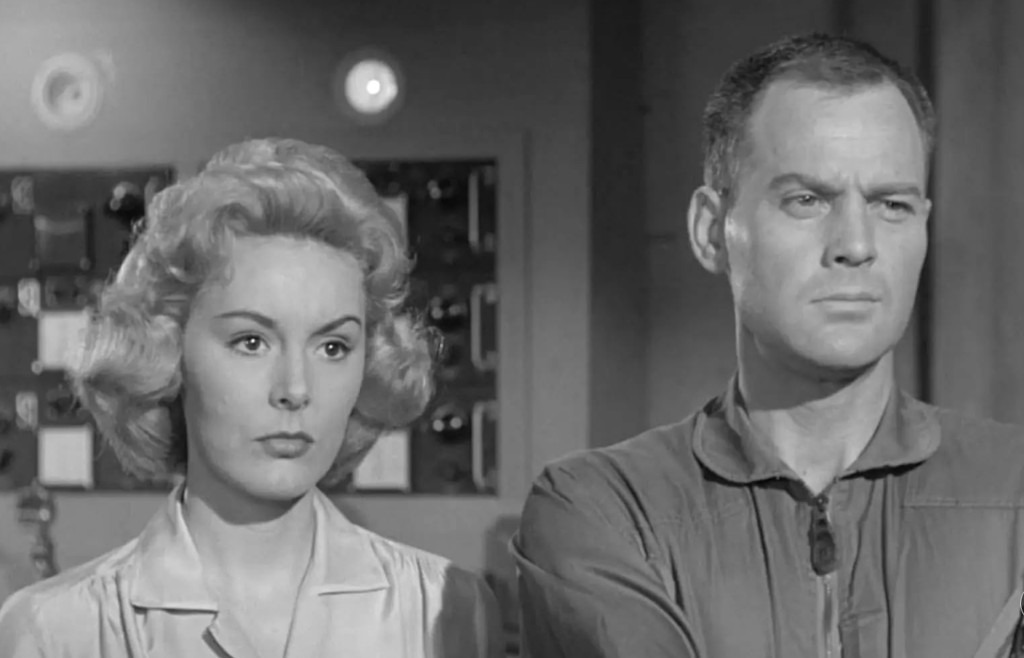
As the world goes to hell in a handbasket, we’re introduced to top-billed hero Maj. Bruce Jay (John Agar), the commander of a secret nuclear bunker, to which Penner, his daughter Phyllis and her not-boyfriend Lamont are whisked away. Via radio General Stone (whom we met in the beginning) informs our four heroes that most of the world’s defences are now beat, and that the four people in their bunker now remain humanity’s last hope.
Working day and night, the four try to figure out some way to defeat the aliens. When all hope seems lost, Dr. Penner realises that the aliens are all using human bodies and our own Earth weapons against us. Therefore, their own weapons and materials must be useless in Earth’s atmosphere. And therefore, their only real strength is their invisibility. And therefore, if they can be made visible, they will lose. And if she weighs as much as a duck, she floats, and therefore she is made out of wood, and therefore she is a witch!
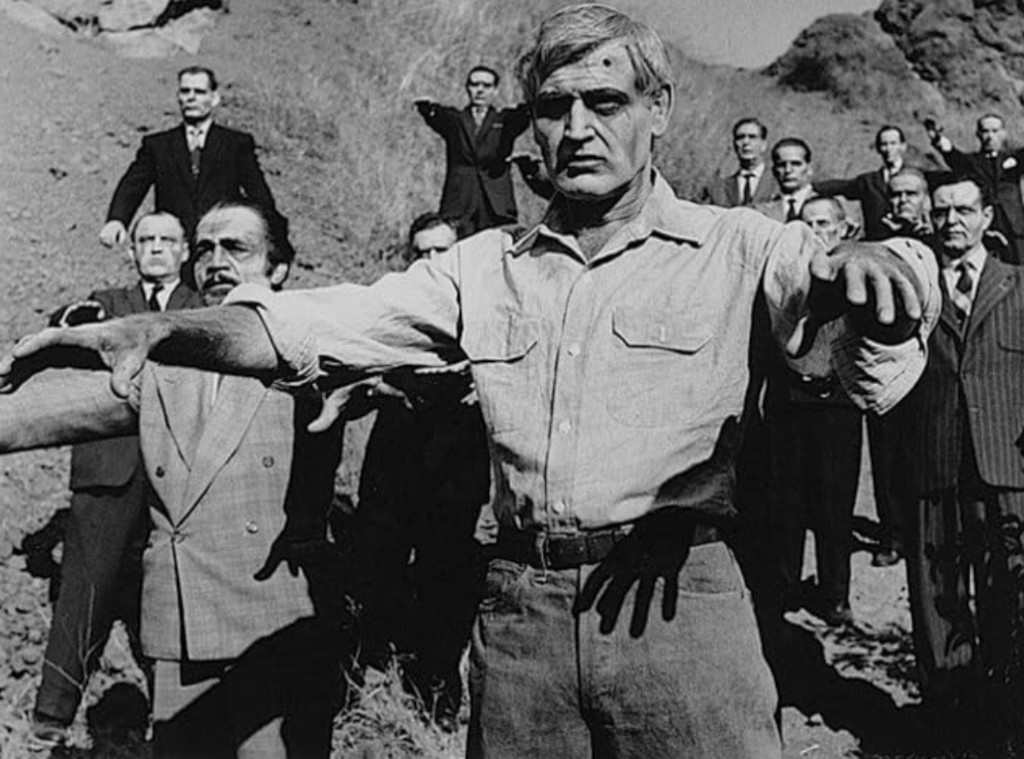
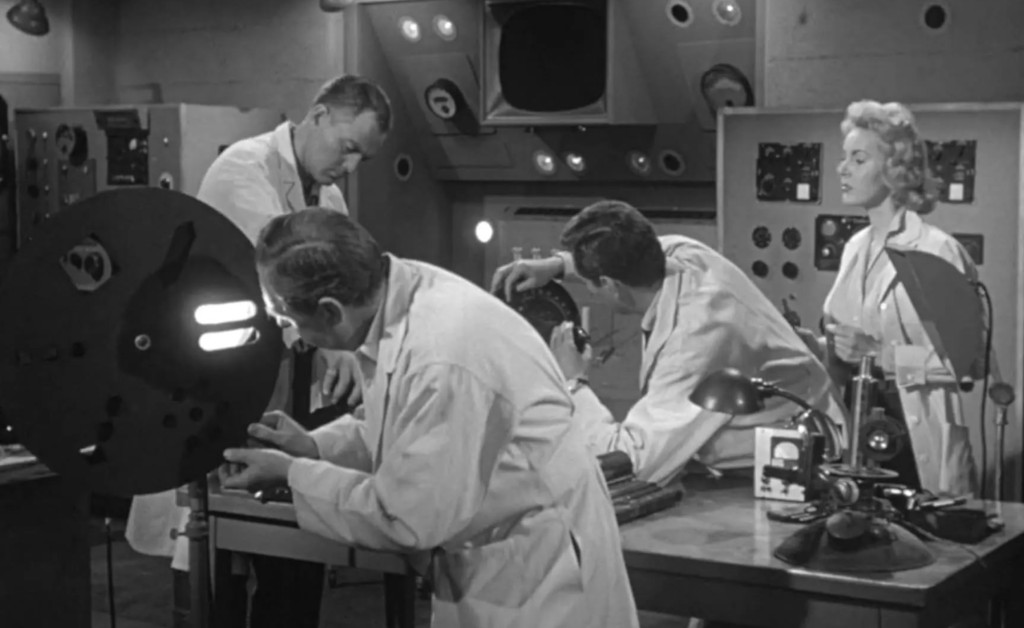
After much talk and stock footage, the film finally springs into action, as the four try to capture and alien for study, by capturing a zombie and sealing the alien into the dead body by covering it in resin. They then imprison it, crack the resin and start figuring it out how to make it visible, all while it taunts them with John Carradine’s voice. All the while, Phyllis and Major Bruce start flirting and not-boyfriend Lamont plays the inevitable role of the scientist that cracks, thinks we should surrender and tries to sabotage the lab and release the prisoner. This leads to a loud alarm going off, which seems to affect the alien. Dr. Penner realises that sound waves (or “sound beams” are the key to destroying the aliens – and builds a sound gun. But will it work, and can they get out word of it to the rest of the world in time?
Background & Analysis
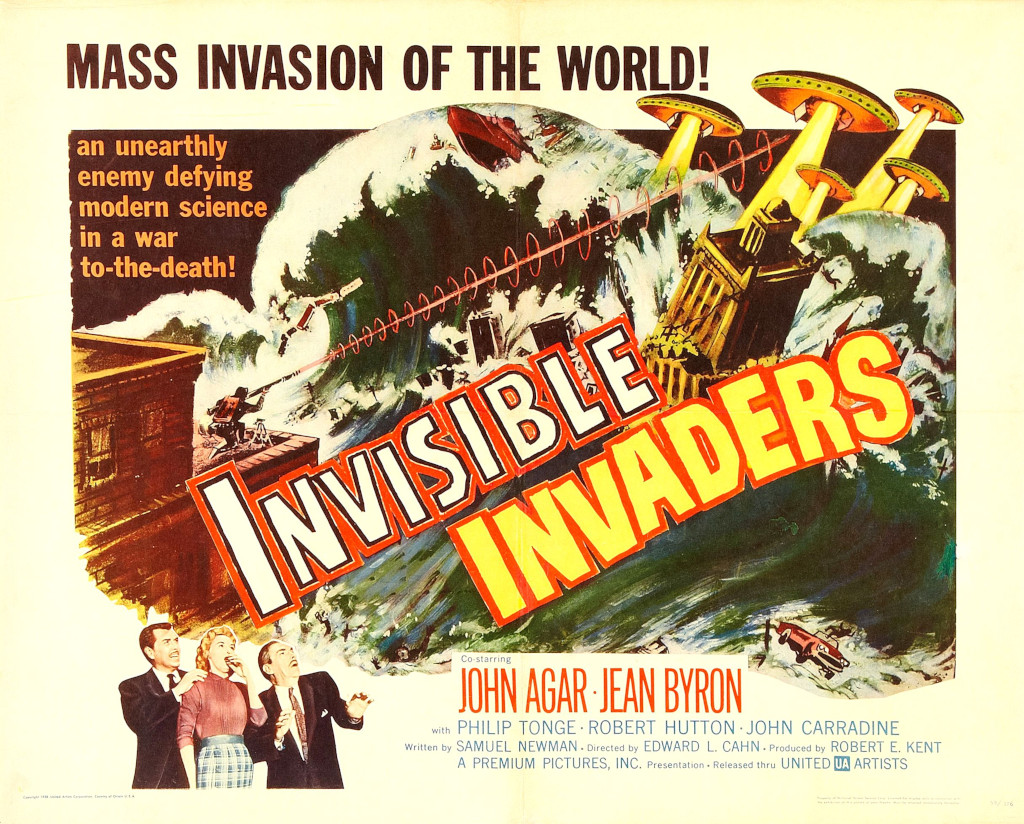
The year is 1959 and science fiction in the movies has been relegated permanently to cheapo B-movie and drive-in fodder. Especially mid-tier studios like Allied Artists and United Artists try their best to compete with the minuscule but wily American International Pictures by turning out low-budget programmers featuring monsters, space rockets and aliens. Many turn to independent producers in order to save on overhead costs. In the case of United Artists, this often meant Robert E. Kent, a veteran screenwriter who turned to producing in 1957. Not a science fiction specialist per se – he primarily worked in the crime and western genres – Kent nonetheless wrote and/or produced seven SF movies between 1941 and 1963, the vast majority in the late 50s and early 60s. Kent had a good track record with UA, having produced the successful It! The Terror from Beyond Space (1958, review), that despite its unweildy monster is considered among the better of the late 50s SF programmers.
Kent, in turn, often turned to veteran cheapo director Edward L. Cahn, a director who, like Roger Corman, prided himself in his ability to shoot coherent movies at a lightning pace. From the beginning of 1959 to the end of 1960 he directed a whopping 16 pictures. From 1955 to 1959 he directed six science fiction films and a number of horrors for different companies, including It! The Terror from Beyond Space.
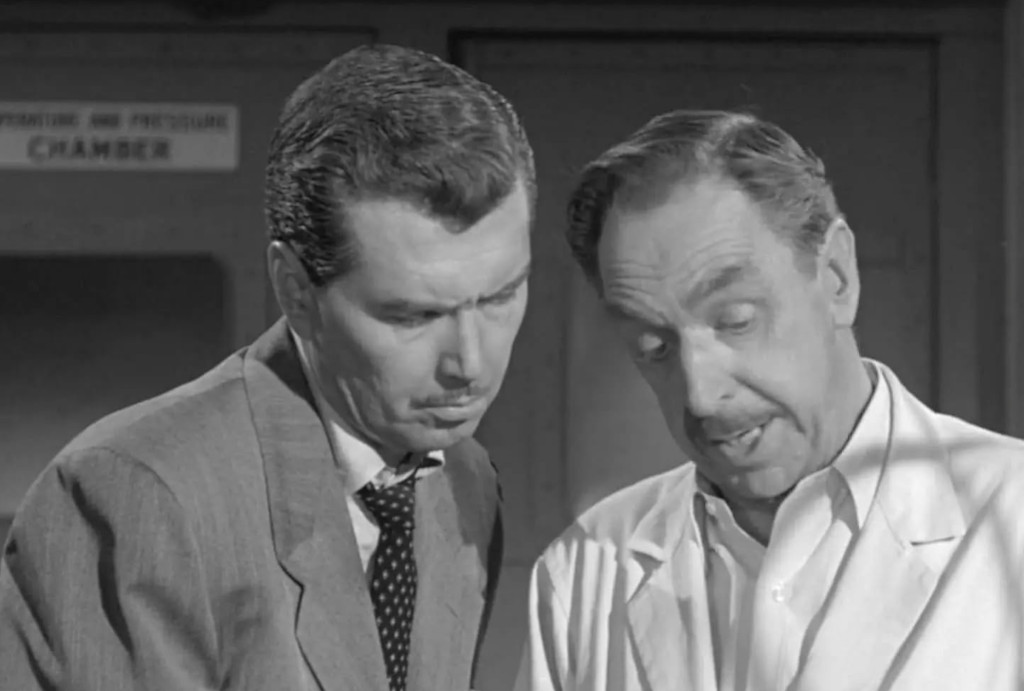
I have found no information on where the idea for Invisible Invaders came, whether it was cooked up by Kent himself or if it was screenwriter Samuel Newman who presented it. Naturally, the idea of invisible antagonists from outer space was one that would have appealed to Kent for budgetary reasons: it circumvented the need for elaborate alien costumes, hardware and special effects. The invisibility itself plays little role for the plot. The MacGuffin of the film is the heroes coming up with a weapon to defeat the aliens – it’s telling that the sound guns that make the aliens visible also, by pure coincidence, happens to kill them. It’s the old trope of humanity going up against seemingly invincible alien invaders, and defeat them through a collaboration of science and military courage. In fact, when the aliens attack they are not even invisible, as they use the bodies of the dead as their weapons, rather stupidly throwing away their only real advantage. When the aliens are shot by the sound gun, it seems they are forced out of their host bodies, and show up as white, fuzzy double exposures, then they collapse and turn into what looks like soap suds as they die. When they are “visible” they seem vaguely reptilian, and sharp-eyed science fiction fans will recognise them as the monster suit worn by Crash Corrigan in It! The Terror from Beyond Space. The suit was designed by AIP monster maker Paul Blaisdell, and he received no renumeration for the re-use of his suit.
It has been speculated that Invisible Invaders was an inspiration for George Romero’s classic Night of the Living Dead, although Romero himself has never named it as such. And it is true that there are similarities, in particular the storyline of a small group of survivors trying to defend themselves in a final stronghold with hordes of zombies banging on the door. The zombies’ slow movement patterns, dead stares and makeup design are also similar to Romero’s film. However, whenever a game-changing film becomes a classic, there’s a torrent of theories from film scholars, critics, fans and detractors claiming this work or another as an “inspiration”. 2001: A Space Odyssey (1968), Night of the Living Dead, Star Wars (1977) and Alien (1979) are among the most frequent targets for this kind of speculation.
It is possible that Romero had watched Invisible Invaders, but the plots are different enough and the tropes well-worn enough that there’s nothing in particular in Invisible Invaders that Romero couldn’t have gotten from somewhere else. Not to mention that Invisible Invaders itself borrows and lifts most of its contents from film history. Invisible monsters had been seen often enough in sci-fi movies by 1959, and back in 1953, W. Lee Wilder featured an invisible alien in Phantom from Space (review). Incidentally, this is the second time in 1959 that John Carradine turns up as an invisible alien – he did so in The Cosmic Man (1959, review) as well. The nerve-wracking trope of a small band of heroes barricading themselves against a seemingly overwhelming enemy is almost as old as cinema itself. In fact, Kent and Cahn had a small group of heroes defending themselves in a small room against an army of zombies in a previous movie of theirs, Creature with the Atom Brain (1955, review) – with the exception that the zombies in that movie had computer brains invented by a Nazi scientist. As is often pointed out, the idea of invading aliens resurrecting the dead and using them as soldiers against humanity harks back to Ed Wood’s Plan 9 from Outer Space (1957, review). As stated, by 1959 humanity had already scienced up super-weapons to fend off aliens and monsters by the truckload. In fact, screenwriter Samuel Newman had done it previously in The Giant Claw (1957, review). However, the situation in Invisible Invaders seems mostly inspired by that in Earth vs. the Flying Saucers (1956, review), in which Hugh Marlowe and John Zaremba hole up in a lab and conjure forth a sonar cannon capable of destroying the invading saucers.
Other tropes are just as familiar. There’s the anti-nuclear proliferation message used so often in 50s SF movies, with aliens forcibly threatening mankind into making peace with each other, as instigated by The Day the Earth Stood Still (1951, review) and carried on by numerous imitators, sometimes with very fuzzy logic, as in The 27th Day (1957, review), where “peace on Earth” means genocide of all leftists. In Invisible Invaders, it is also quite unclear what the aliens actually want. At one time, Carradine brings up nuclear weapons and rockets as the reason for their invasion, and initially their calls for “surrender” has a similar ring to it as Klaatu’s final speech in The Day the Earth Stood Still: stop your fighting and we will leave you alone, otherwise you will be destroyed. But as the story progresses, this angle is unceremoniously dropped, and it is made clear that the alien’s aim is the same as in Earth vs. the Flying Saucers: to invade and strip the Earth of resources. And while the Dr. Penner keeps up his anti-nuclear and wobbly pacifist stance throughout the movie, the message, if any was intended, is garbled throughout the plot. If anything, the movie slides into the old “kill the commies” trope that was so prevalent throughout the era. While the movie on the one hand talks about international cooperation, it on the other hand touts the red scare invasion rhetoric upheld by so many Hollywood science fiction films. It’s hard to make anything out of all this in terms of theme or message.
All this said: one thing all of the Kent/Cahn science fiction movies have in common is that they are all based on ideas that are in and of themselves potentially interesting. There is mileage in the basic building blocks of Invisible Invaders, and occasionally screenwriter Newman and director Cahn is able to build up a bit of suspense in the bunker scenes. The basic plot of the movie is sound, albeit hastily and sloppily scripted.
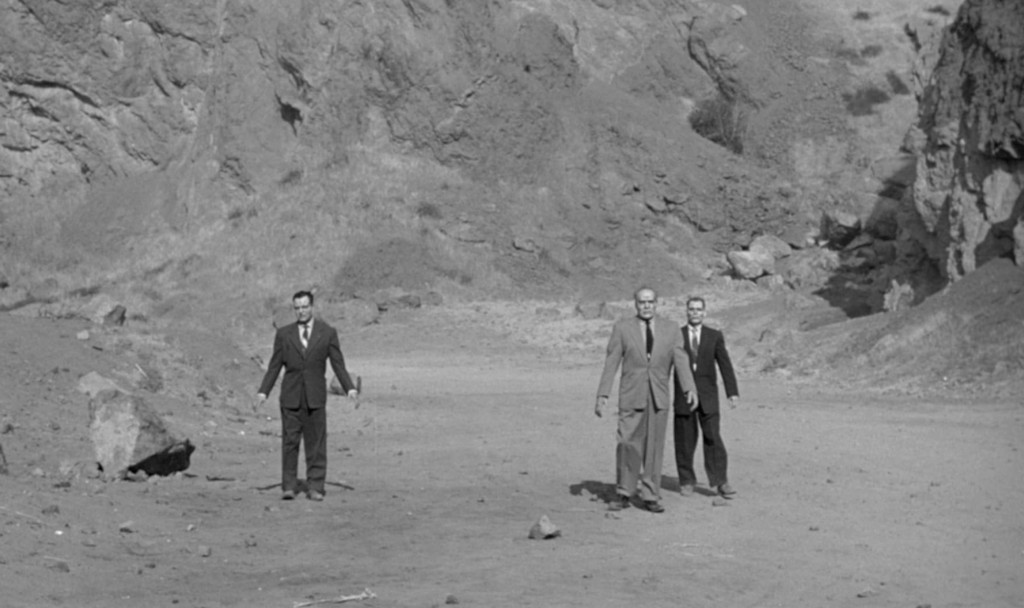
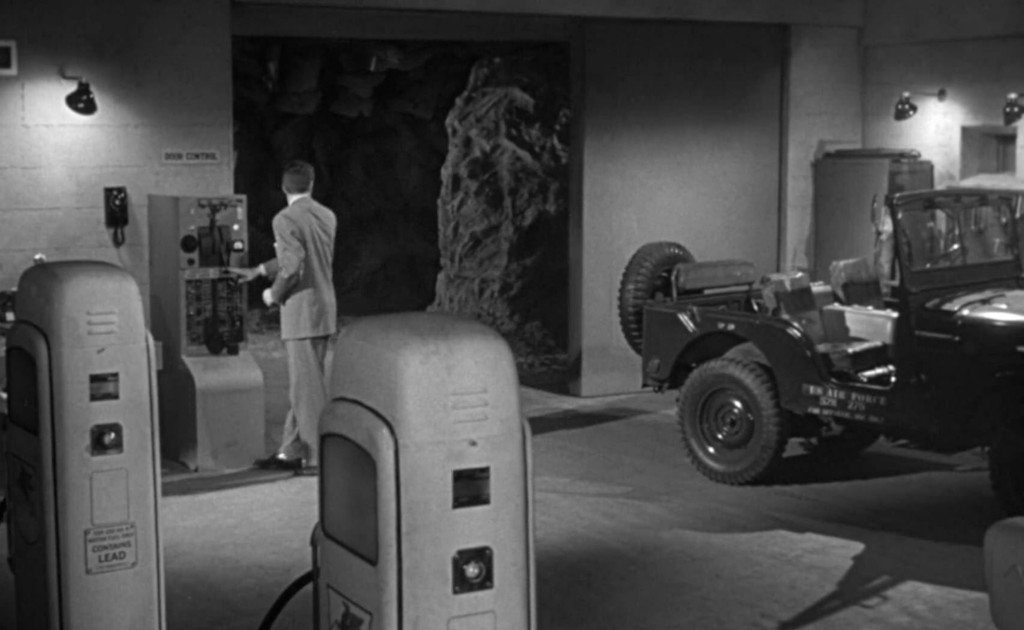
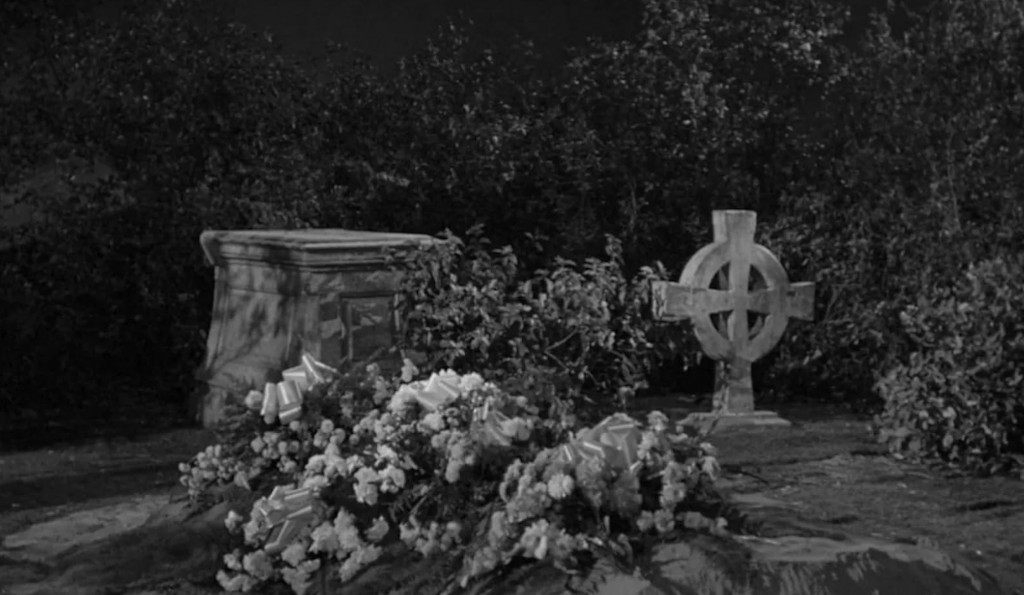
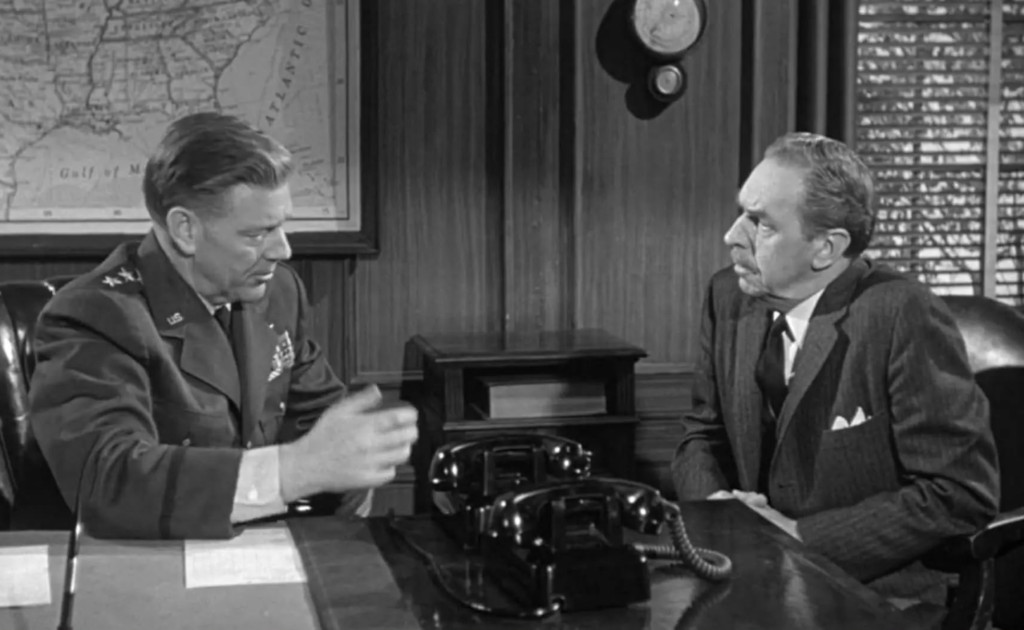
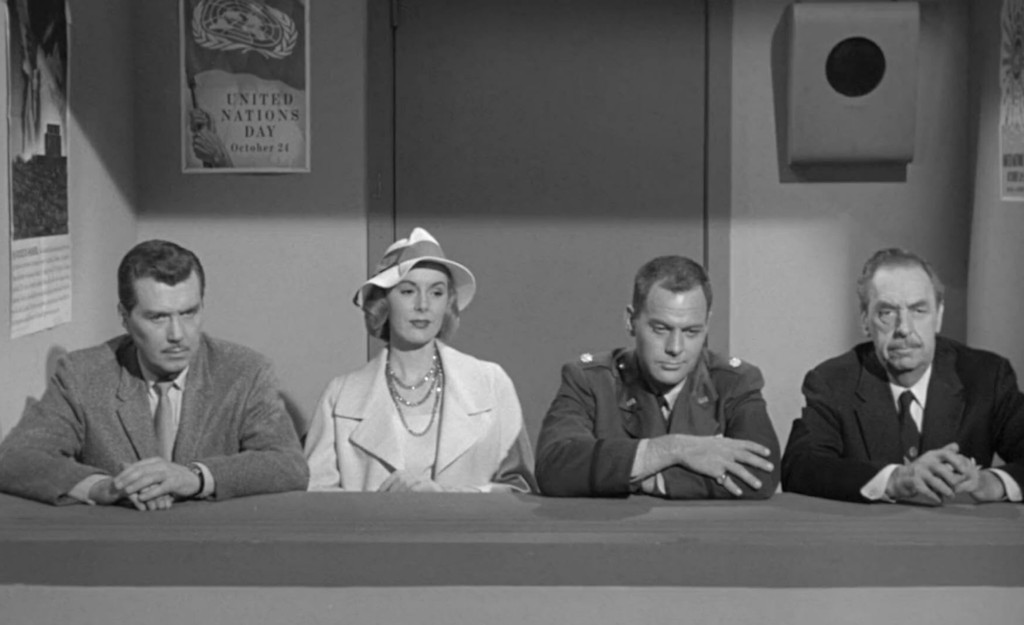
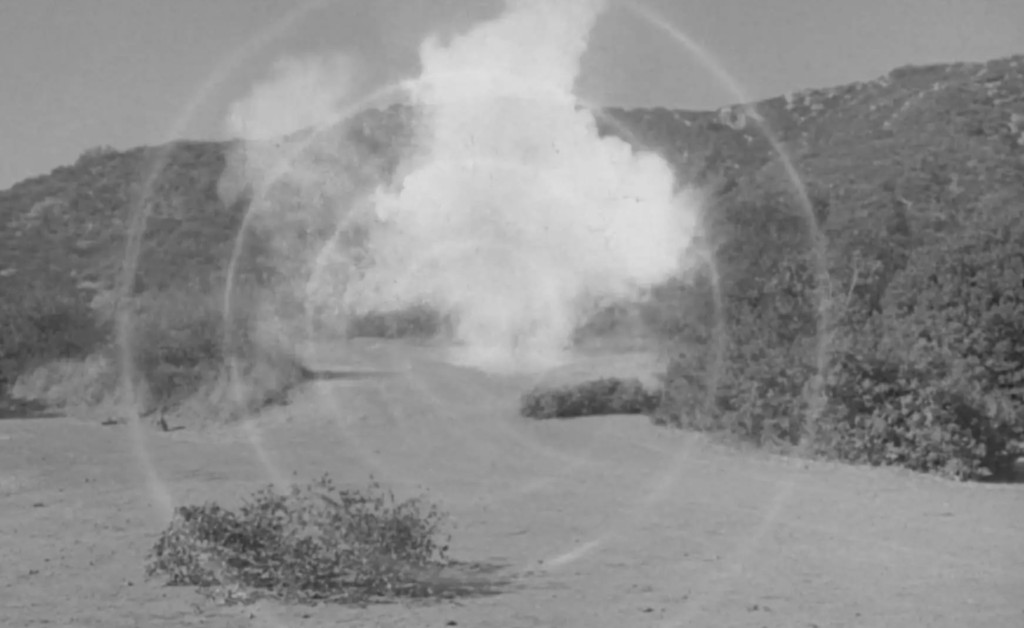
One assumes the movie was shot in a week. There are as few setups as necessary in order to make the film work and the action and the actors are generally set up in a way that would minimize the need for multiple takes. The film is shot either on location in Bronson Canyon/Griffith Park or in front of crammed studio sets. Dr. Penner’s home consists of a sofa and a door. The cemetery is one grave surrounded by a thin backdrop of potted shrubbery. The set first seen as the announcer’s booth at the hockey game is used for two other locations in the movie. The most elaborate set of the film is the bunker, which looks more or less like a garage with a few gadgets inside. The entrance is, unsurprisingly, one of the oft used entrances to the Bronson Caverns. General Stone is perpetually bound to a table in front of a window, sometimes with a radio in front of him, sometimes not. Many of the numerous scenes featuring the invading zombie army is the same shot of ten extras walking down a hill used over and over again. The only visual effects are the double exposures of the aliens becoming visible and a spiral indicating the use of the sound gun. Editor Grant Whytock has to re-use several shots multiple times – not only the approaching zombies, but also the shots of invisible feet dragging dirt and strings pulling brushes aside as the invisible aliens come and go.
The weak script is accompanied by the ever-present voice-over narration that on the one hand keeps us informed of the full-scale invasion and the response of both the US and all the other countries of the world, that, naturally, the film hasn’t got the budget to show, and on the other hand explains things that we can already see on the screen, or things that could easily enough have been explained in the dialogue. And accompanying the voice-over is a constant barrage of stock footage of houses being demolished, fires, collapsing bridges, explosions, etc. Sometimes it gets silly, as when we see a plane crashing into a hill with a huge X clearly pained on the crash site. As with the garbled and ever-changing intent of the invaders, and the fact that the sound guns just so happen to kill the invaders when this was never their intent, one often gets the feeling that Newman just can’t be bothered with the script. The romance between Agar and Byron is so badly and superficially written that it’s obvious for anyone to see that it has just been tacked on for the sake of it being “required” to be in the movie. Newman doesn’t even bother to write the triangle drama that he sets up by having Lamont as Phyllis’ not-boyfriend. Lamont’s turn as “villanous scientist” ends just as abruptly as it begins, Newman again just ticking the boxes.
However, despite the low budget, the plethora of borrowed ideas and the silliness, such as the sound guns that look like something out of a childrens’ TV show, the movie manages to maintain the viewer’s interest to some degree. The basic plot is coherent, there are a number of good ideas in the mix, the direction, albeit perfunctory, is professional, as always when Edward Cahn is involved, and the actors generally do their best. Philip Tonge, the de facto lead despite a third billing, as Dr. Penner shows his professionalism by giving the role of the scientist his all. John Agar, once again trapped in a cardboard cutout character, likewise tries to make the most of it, within his limited abilites. Jean Byron, as so often with female actors in these kind of movies, has very little to work with: being cute and flirty, being worried and scared, asking if anyone wants coffee, screaming. Byron easily manages these tasks. Robert Hutton, doomed to play “the second man” in these films, has never quite impressed me, and neither does he this time. Paul Langton as General Stone does yet another authority support, something he could do in his sleep by this stage in his career.
The zombie extras do admirably, even if there’s a few stumblings when they aren’t allowed to look where they put their feet as they walk down the hill. As a clear sign the film was made in the 50s, the aliens only bother to resurrect white males for their zombie army.
As a fan of ice hockey (I am Finnish after all) I note that this is the earliest science fiction film that I can recall that includes hockey as a plot element. If you can think of an earlier SF movie that features hockey, please leave a comment below!
Invisible Invaders does feel like a missed opportunity. It was never going to be a great film, but with a little more attention paid to the script, a slightly higher budget and an extra week of filming, as well as a director that actually cared, this could have been an above-average alien/zombie thriller. As it is, it remains just another low-budget programmer, severely hampered by the rushed production and the lack of resources.
Reception & Legacy
Invisible Invanders was released on a double bill with Robert Kent’s and Edward Cahn’s The Four Skulls of Jonathan Drake in May, 1959, and had a wide international release in 1959 and 1960. No box office numbers are readily available, but the pairing probably brought UA a small profit. Later, the film became a TV staple in the US. It got an official VHS release by MGM/UA in 1996 and a DVD release in 2003. In 2016 Kino Lorber released a digitally restored Blu-ray version with a commentary track by Tom Weaver and Robert J. Kiss, which signifies a status as a cult classic. It has since been on and off streaming services.
Contemporary critics gave Invisible Invaders staid reviews. The trade press unanimously recognised the picture as an exploitation programmer with little of interest to offer the general audience. However, the consensus was that the film was fairly made and acted within the confines of the budget and script.
Harrison’s Reports opined that it “offers enough scientific touches and library footage of disaster scenes to make it acceptable to those who are not discriminating and who enjoy pictures of this type”. Gilb in Variety wrote: “Kent has assembled some good actors for this bargain basement chiller but they’re largely wasted in the Samuel Newman script”. The critic noted that the film offers little interest to adult audiences, “but the Saturday matinee trade should find it interesting escapist fare”. The Motion Picture Exhibitor called Invisible Invaders “okay science fiction which should be accepted by fans of this type of film”.
Phil Hardy in The Encyclopedia of Science Fiction Movies (1984) writes: “Cahn’s direction is routine at best and his over-reliance on shoddily matched stock footage destroys whatever credibility Newman’s script might have had”.
In Keep Watching the Skies! (2009) Bill Warren writes: “This cheesy little exploitation picture at least has the virtue of being heavily laden with ideas, but ideas alone are not enough, and it has many drawbacks. […] It is slightly below average for the time, and the average was way down.”
However, many modern critics have a bit of a soft spot for Invisible Invaders. Richard Scheib at Moria Reviews gives it a fair 2.5/5 rating, writing: “Despite the cheapness of the production, Invisible Invaders has a modestly effective atmosphere. The dubious science aside, there is an interesting plot – scientists besieged in a bunker against the reanimated dead outside – there is much here that prefigures Night of the Living Dead (1968) – and their attempts to find a way of combating the menace, which include venturing out and trying to trap one of the zombies in a pit of acrylic and capture the possessing alien before it flees the body. Edward L. Cahn creates reasonable tension – with a better director or even an improved budget, Invisible Invaders could have been a minor classic. Indeed, with its plot of alien invasion using the reanimated dead, you could almost call Invisible Invaders a more competent version of Plan 9 from Outer Space.”
Dave Sindelar at Fantastic Movie Musings and Ramblings says: “I can’t be too hard on it; it does manage to work up a chill or two, and some scenes are memorable enough, even if the story drags”. Kevin Lyons at The EOFFTV Review states: “Invisible Invaders has a poor reputation and to be fair it’s probably well deserved. When the zombies show up in force late in the film, it perks up immeasurably and it’s not without its peculiar charms but it’s not by any stretch of the imagination a good film.”
Cast & Crew
As we move into the last year of the 50s on this site, where I review sci-fi films in chronological order, most of the cast and crew of these low-budget programmers have become like old friends, and I have written extensively about most of them.
Invisible Invaders is the last of the six low-budget science fiction movies that veteran Edward Cahn directed between 1955 and 1959. Cahn’s background as an editor for Universal no doubt aided him in establishing a reputation as the fastest camera in the West (after Roger Corman). All in all, he directed 130 films between 1931 and 1962. According to the star of Invisible Invaders (1959), John Agar, Cahn took pride in the speed with which he could complete his pictures, even if he didn’t necessarily take pride in their quality. Always extremely prolific as a director, his career hit a rough spot in the first half of the 50s, but the disruption to the system caused by American International Pictures and their successful bet on super-low-budget B-movies for the matinee and drive-in audiences allowed Cahn to spring back with a vengeance with crime, western, monster and science fiction films. Throughout his long directorial career, Cahn never directed anything resembling an A-movie and the vast majority of his output comprised of long since forgotten western and crime programmers. It is through his work in the 50s with sci-fi and monster films that his name is at all remembered today. None of these can be considered good per se, but all are competently put together, even if their low budgets sometimes make them laughable rather than terrifying. The clunky The She-Creature (1956) and Voodoo Woman (1957, review) are probably his low points – the latter sees Marla English and Touch Connors walk for 40 minutes through potted plants before the film catches up with its plot. But he also gave us the bad but hilarious spoof Invasion of the Saucer Men (1957, review), in which little green men kill cows by injecting them with alcohol, and most importantly It! The Terror from Beyond Space (1958, review). While it does feature the familiarly clunky script and awkward characterisations, as well as a drunk Crash Corrigan in an ill-fitting monster suit, it is perhaps Eddie Cahn’s best film. This is partly thanks to the novel idea of a monster running amok on a space ship (a claustrophibic plot not unlike that in Invisibe Invaders), and partly because the circumstances forced him to be a little bit more creative than usual.

Robert Kent was an independent producer who started his career as a screenwriter in the late 30s and graduated to producing during the heyday of the independent low-budget B-movie in the late 50s. He eventually started doing films for Edward Small and United Artists, including It! The Terror from Beyond Space (1958), Curse of the Faceless Man (1958), Invisible Invaders (1959), The Flight That Disappeared (1960) and Twice Told Tales (1961), starring Vincent Price.
Screenwriter Samuel Newman studied law before endeavoring on his career as a screenwriter in the late 40s – his early credits peg him as something of a specialist in jungle B-movies. He wrote Tarzan’s Peril (1951) an five Jungle Jim movies starring Johnny Weissmuller. In the late 50s he gravitated towards TV and eventually became head writer and story consultant on Perry Mason during the first half of the 60s. But he did also occasionally turn up as a screenwriter for film, and among other things penned The Giant Claw (1957, review), Invisible Invaders (1959) and The Wizard of Baghdad (1970).
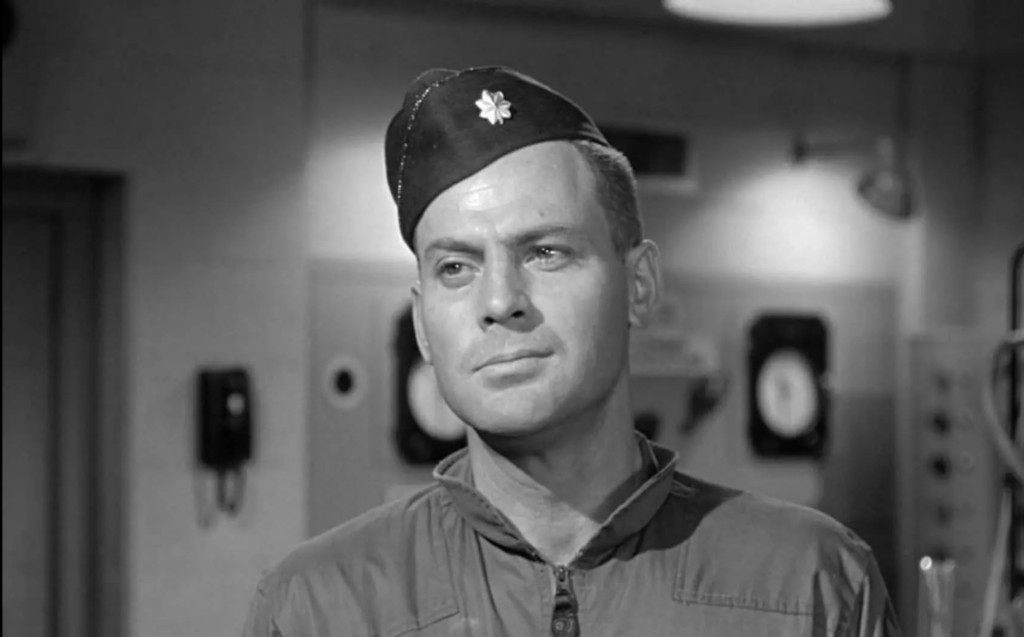
With the exception of Richard Carlson, few actors embody 50s science fiction like John Agar. Agar’s career started promisingly in 1946 with a marriage to Shirley Temple and a contract with producer David O. Zelznick. But after a few co-starring roles behind stars like John Wayne and Kirk Douglas, he didn’t rise any further in the ranks: a divorce and bad press ended his career with Zelznick in 1951. A seven-year contract with Universal in 1954 rekindled his hopes of entering the A-list, but instead Universal cast him as their go-to lead in B-movies, particularly westerns and science fiction. He is best known for starring in Revenge of the Creature (1955, review) and Tarantula (1955, review), but also had leads in films like the voodoo horror The Golden Mistress (1954), the noir Hold Back Tomorrow (1955) and the western Star in the Dust (1956), alongside Mamie van Doren, as well as the science fiction clunker The Mole People (1956, review).
In the mid-to-late 50s, Universal was grooming leading men like Rock Hudson, Tony Curtis and George Nader, and John Agar was clearly not among the top contenders to these names. Daunted by the idea of chasing mole people and lizard men and shooting Indians for the next five years, Agar saw the writing on the wall and terminated his contract with the studio in 1956. But freelancing did little to improve his fortunes. While he managed to maintain his minor marquee draw as a B-movie leading man, the films he was offered bore little difference to the ones he had been doing at Universal – with the exception that they were often cheaper and worse. He was mainly employed by low-budget studios AIP and Allied Artists, as well as Robert Lippert’s Regal Films, that made “B+” movies for 20th Century-Fox, and an assortment of independent producers. With only a few exceptions, he starred in just the kind of films he had tried to get away from: science fiction and westerns. He appeared in five science fiction movies between 1957 and 1962 – some of them fair programmers like The Brain from Planet Arous (1957, review) and Attack of the Puppet People (1958, review), others below par, like Invisible Invaders (1959) and Journey to the Seventh Planet (1962).
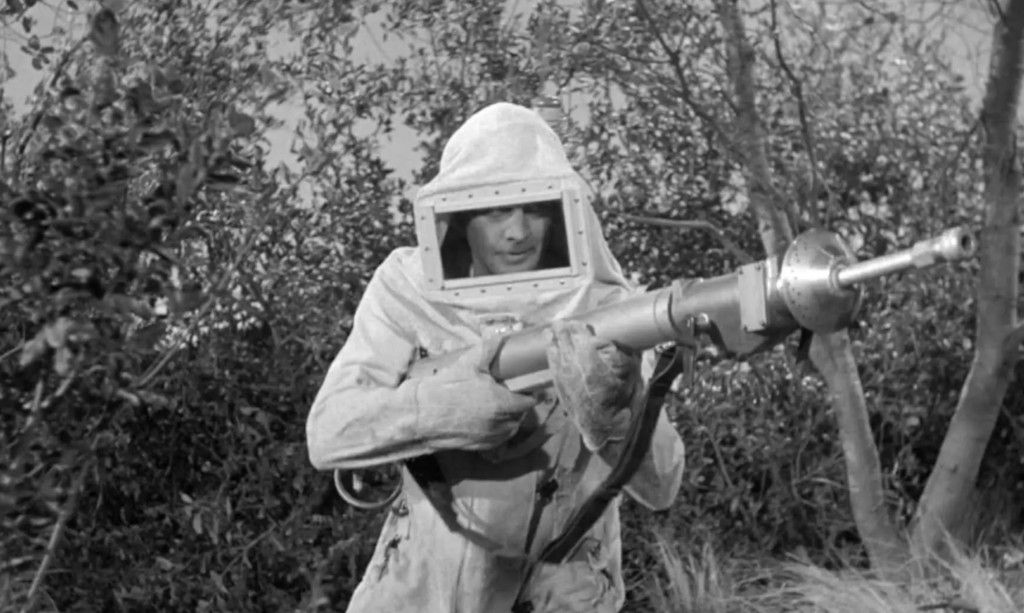
By the mid-60s, Agar was mostly doing supporting parts in westerns and occasional dramas. Only super-cheap sci-fi still gave him leading roles: Arthur Pierce’s Women of the Prehistoric Planet (1966), Wallace Clyce’s Night Fright, and as frosting on the cake, Larry Buchanan’s legendarily shoddy TV movies Zontar: The Thing from Venus (1967) and Curse of the Swamp Creature (1968). By the 70s he was primarily doing TV guest spots, smaller supporting roles and cameos. Roger Corman and John Wayne cast him in a few of their movies, probably out of generosity, in the early 70s, but from that it was pretty much downhill. Agar kept soldiering on until the early 90s, when he went into semi-retirement.
John Agar was a reliable, capable actor and particlularly in his early career he could rely on his boyish charm to win over audiences and casting agents alike. There is always the “what if” he had stayed with Universal – might he have segued into a career as a respected character actor? His chances of reaching A-level status as a leading man would have been very slim – he lacked both the range and the charisma of the up-and-coming stars of the studio. “Milquetoast” is a word that is often used to describe his impact on screen. However, Agar was popular with B-movie producers because of his earnest straightforwardness and innate likeability, lending to him an air of a clean-cut, all-American hero. This seems to have been derived from his own personality: he is unanimously described as an easy-going, grounded and extremely nice man who would behave professionally on set and never complained, regardless of what he thought of the quality of the film he was currently making. And while he might not have been happy with his career trajectory at Universal, he had only good things to say about Jack Arnold, who directed him in his two best SF movies while at the studio. In later years he whole-heartedly embraced his cult status among SF aficionados and said “I don’t resent being identified with B science fiction movies at all. Why should I? Even though they were not considered top of the line, for those people that like sci-fi, I guess they were fun. My whole feeling about working as an actor is, if I give anybody any enjoyment, I’m doing my job, and that’s what counts.”
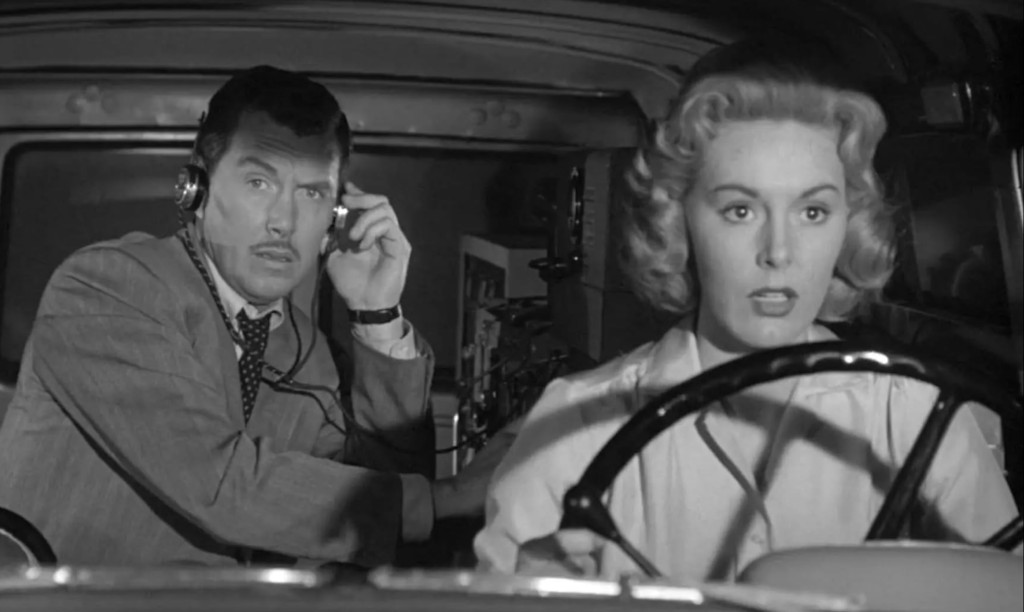
Best known for her role as the “vivacious” mother to the titular character in The Patty Duke Show (1963–1966), Jean Byron fared better on the small screen than on the big one. Born Imogene Burkhart in Kentucky in 1925, she started doing local stage and radio work at a young age before securing a one-picture contract with Columbia in 1952, and making her screen debut opposite Johnny Weissmuller in the Jungle Jim movie Voodoo Tiger (1952). Her second role was that of Richard Carlson’s wife in Ivan Tors‘ above-average sci-fi film The Magnetic Monster (1953, review). After a co-lead in yet another B-movie, Serpent of the Nile (1953), she saw which way the wind was blowing and relocated to TV in search of more interesting work. The move served Byron well, and she was in high demand for guest spots on TV shows in TV plays and in TV movies from the 50s to the early 70s. Among other things, she appeared in four episodes of Science Fiction Theatre. She also appeared in the odd movie, such as Invisible Invaders (1959), in a nondescript lead opposite a likewise nondescript John Agar, and in a cameo in Conquest of the Planet of the Apes (1972).
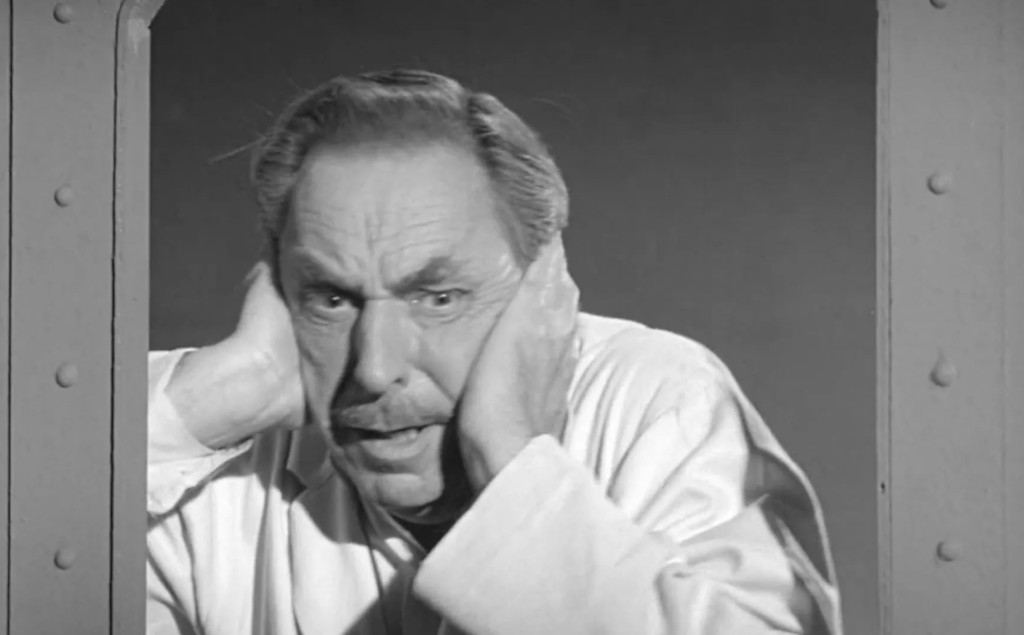
The de facto lead of Invisible Invaders, Dr. Penner, is played by British-born character actor Philip Tonge, very far removed here from his familiar surroundings on Broadway. A child actor on the London stage, he moved with his family to New York at the age of 17 with the outbreak of WWI. He quickly became a fixture on the New York stage, where he spent the lion’s part of his career, mostly in character roles. He was a regular in Noël Coward’s plays. Tonge made his screen debut as early as 1913 in England, but really didn’t take up film and TV acting in earnest before the mid-40s. He appeared in television plays as early as 1946 – before the format was popularised by Kraft Television Theatre in 1947. In that same year, Tonge got one of his most memorable movie roles as Julian Shellhammer in Miracle in 34th Street. His other major movie appearance came 10 years later in Billy Wilder’s Witness for the Prosecution. He was particularly active in film and television during the 50s, possibly because his health and age didn’t allow for stage work. Tonge appeared in around 60 films and TV shows during the decade. His genre fare includes House of Wax (1953), Macabre (1958) and Invisible Invaders (1959) – possibly his only movie lead.

Robert Hutton carried some minor marquee draw – his likeness to James Stewart awarded him a seven-year contract with Warner Brothers in the early 40s when Stewart himself was one of the many stars drafted for the entertainment division of the US armed forces in WWII. In so-called “victory casting”, Hutton was put in the lead in a number of B-movies in Jimmy Stewart-type roles.
When his contract with Warner ran out in the early 50s, Hutton struggled to find decent roles, but kept busy in TV shows and B-movies. Hutton is well-known to fans of science fiction because of his co-leads and supporting roles in The Man Without a Body (1957, review), The Colossus of New York (1958, review), Invisible Invaders (1959), The Slime People (1963), The Vulture (1966) and They Came from Beyond Space (1967). He also appeared in The Colossus of New York (1958) and Trog (1970). In 50s sci-fi movies, Hutton was often cast as the third wheel in a romantic triangle, the “friend-zoned other man”. He seldom left any great impression on the viewer in these pictures.
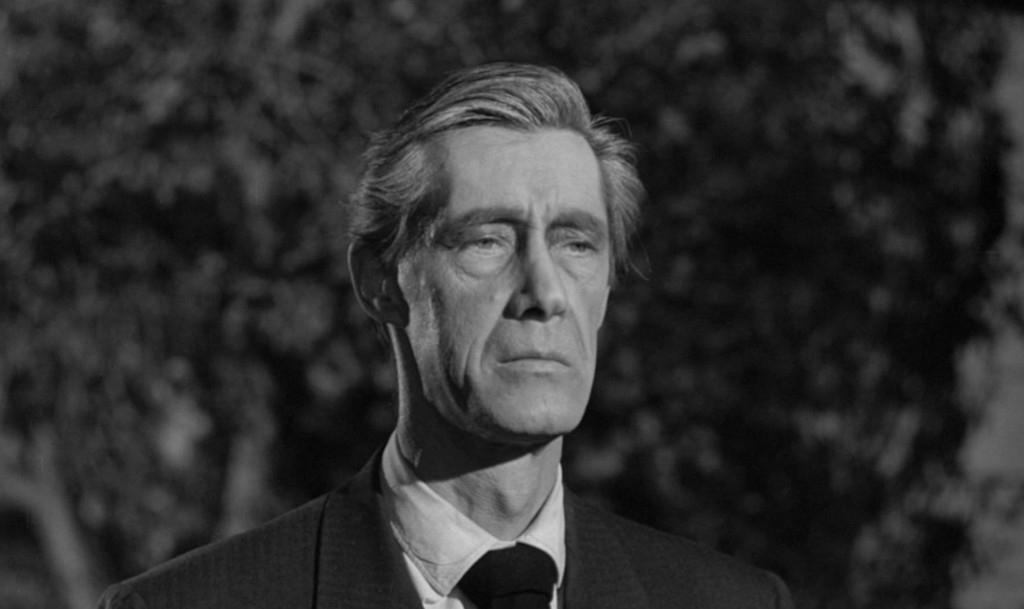
John Carradine really only has a single scene in Invisible Invaders, the one where he first confronts Dr. Penner. However, his voice is heard as the voice of the aliens throughout the movie. This kind of Carradine casting would become a staple in the B-movies he appeared in in years to come. He would be included as a floating head or a narrator in a frame story, allowing him to do all his work in a single day and cash the paycheck, which went into financing his own Shakespeare company. A legend among hammy character actors, Carradine is as well known for his memorable roles the films of John Ford as his over-the-top performances in no-budget Z-movies. For more on Carradine, see my review of The Cosmic Man (1959).
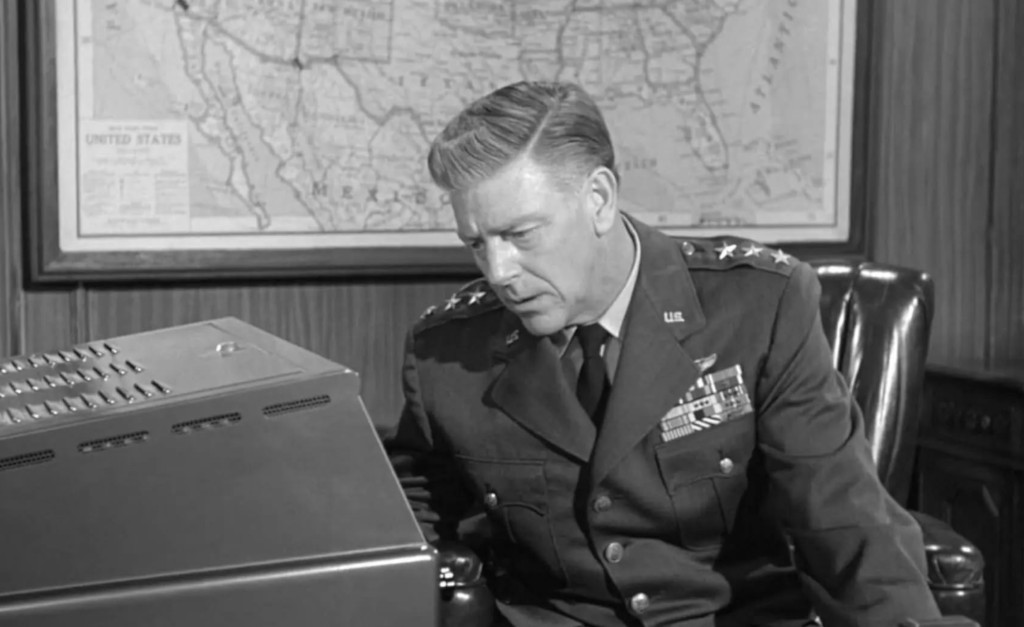
Paul Langton, playing General Stone in Invisible Invaders, was a respected but little-known character actor. We have bumped into him on this blog before, as the obnoxious lead in W. Lee Wilder’s terrible yeti film The Snow Creature (1954, review), and as the brother of the titular The Incredible Shrinking Man (1957, review). He also turned up in the cult classic It! The Terror from Beyond Space (1958, review), as the spaceship crewman who is cornered by the space monster and fends it off with a blowtorch. Later, he appeared alongside SF veterans John Carradine in Allied Artists’ The Cosmic Man (1959) and John Agar in United Artists’ Invisible Invaders (1959). Furthermore, he had the honour of appearing in the very first episode of The Twilight Zone, as one of the doctors revealed at the end the episode, monitoring Earl Holliman’s astronaut trainee in an isolation booth. However, Langton’s definitive claim to fame is his recurring as the wily Leslie Harrington on the soap opera Peyton Place, a role he reprised in 219 episodes between 1964 and 1968.
The rest of the cast is rounded out by steady-working extras, including memorable faces like John Dehner, Jack Kenney and Edwin Rochelle. Among the bit-part actors is also famous radio DJ Chuck Niles as the announcer at the hockey game. Niles is the only jazz DJ ever to get a star at the Hollywood walk of fame. He appeared as an extra in around a dozen films.
The crew also contains a number of interesting characters. Assistant director on Invisible Invaders was Herbert Greene, who directed two movies himself, the Ed Wood-penned western Outlaw Queen (1957), as well as the afore-mentioned The Cosmic Man (1959). Makeup artist Phillip Scheer created the monster makeup for Herman Cohen’s cult classics I Was a Teenage Werewolf (1957, review) and I Was a Teenage Frankenstein (1957, review), as well as many other SF and horror movies.
Invisible Invaders was the first film credit for special effects creator Roger George. George then continued to rattle around the B-movie scene of Hollywood during the 60s and 70s and probably gained a reputation as a cost-effective but talented and reliable special effects creator. He became a go-to guy for American International Pictures and later United Pictures and Roger Corman’s New World Pictures. The majority of his work was done on science fiction or horror movies, but he was also the makeup man on other genre films, for example all of AIP’s bikini beach movies. Eventually he started working for many of the graduates of “the school of Corman“; Peter Fonda in The Hired Hand (1971), Jonathan Demme in Fighting Mad (1976), Allan Arkush and Joe Dante in Hollywood Boulevard (1976), Deathsport (1978) and Rock ‘n’ Roll High School (1979), Ron Howard in Grand Theft Auto (1977), Jimmy Murakami in Battle Beyond the Stars (1980) and Humanoids from the Deep (1980), Fred Dekker in Night of the Creeps (1986), as well as Jim Wynorski in The Lost Empire (1984) and Chopping Mall (1986). In the process George also came to work on productions that were essentially low-budget movies, but went on to become timeless classics, like Joe Dante’s The Howling (1984), the sword-and-sorcery epic The Beastmaster (1982), the SF cult classic Repo Man (1984), and not least The Terminator (1984), directed by another Corman alumni, James Cameron. In the 80s Roger George founded a special effects shop, Roger George Special Effects, which supplied special effects equipment to movies. The shop is still in business, even if Roger George himself has stopped functioning.
Janne Wass
Invisible Invaders. 1959, USA. Directed by Edward Cahn. Written by Samuel Newman. Starring: John Agar, Jean Byron, Philip Tonge, Robert Hutton, John Carradine. Paul Langton, Hal Torey, Eden Hartford. Music: Paul Dunlap. Cinematography: Maury Gertsman. Editing: Grant Whytock. Art direction: William Glasgow. Makeup: Phillip Scheer. Sound: Al Overton. Special effects: Roger George. Produced by Robert Kent for Premium Pictures & United Artists.


Leave a Reply