
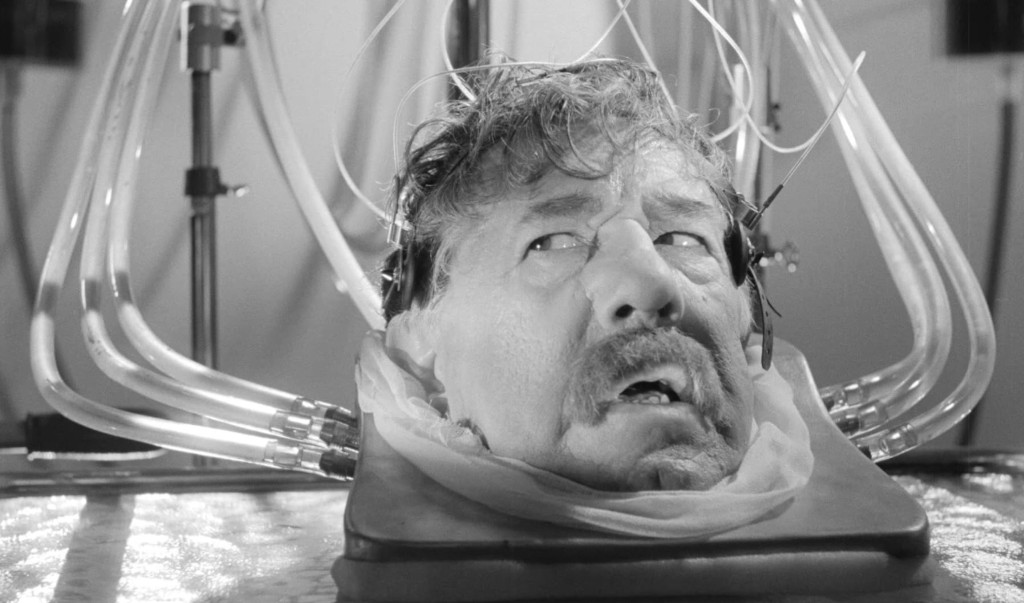
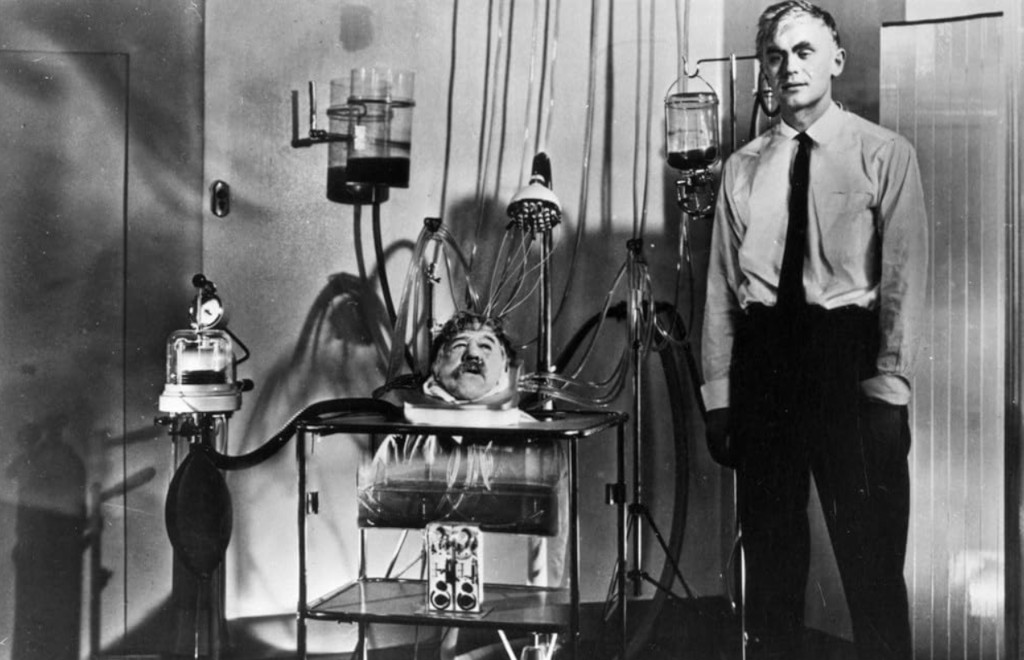
A mad doctor keeps the head of his boss alive on a plate, while grafting the head of a hunchbacked nurse onto the body of a stripper. Released as “Die Nackte und der Satan” in Germany in 1959, this is a stylish schlocker that lures you into thinking it is more sophisticated than it is. 5/10
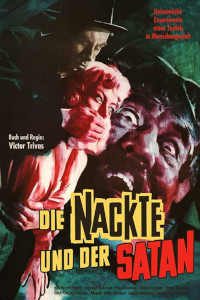
Die Nackte und der Satan. 1959, West Germany. Written & directed by Victor Trivas. Starring: Horst Frank, Karin Kernke, Michel Simon, Dieter Eppler, Christiane Maybach. Produced by Wolf C. Hartwig. IMDb: 5.3/10. Letterboxd: 3.1/5. Rotten Tomatoes: N/A. Metacritic: N/A.
Groundbreaking experimental surgery is taking place at Dr. Abel’s (Michael Simon) fancy clinic in an unnamed city. Here, Abel, his colleague Dr. Burke (Kurt Müller-Graf) and assistant Bert Jaeger (Helmut Schmid) are preparing cure nurse Irene (Karin Kernke) of her back hunch. This is to be done partly through Abel’s new transplantation technique, aided by his secret serum. But – Abel has also hired a new surgeon, mysterious Dr. Ood (Horst Frank). Ood is there to give the dying Dr. Abel a heart transplant. A mysterious doctor with s suspicious past taking Abel’s life in his own hands – what could go wrong?
This West German science fiction/horror movie was released into cinemas in 1959 with the schlocky title Die Nackte und der Satan, which English-speaking readers should be able to understand without a translation. While the English title, The Head, is a lot less eye-catching, it is also much more truthful, as there is very little nudity and no Satan in this film. Directed by Oscar-nominated screenwriter, art director and occasional director Victor Trivas, the movie’s atmospheric cinematography and expressionism-inspired set design belie its schlocky roots.
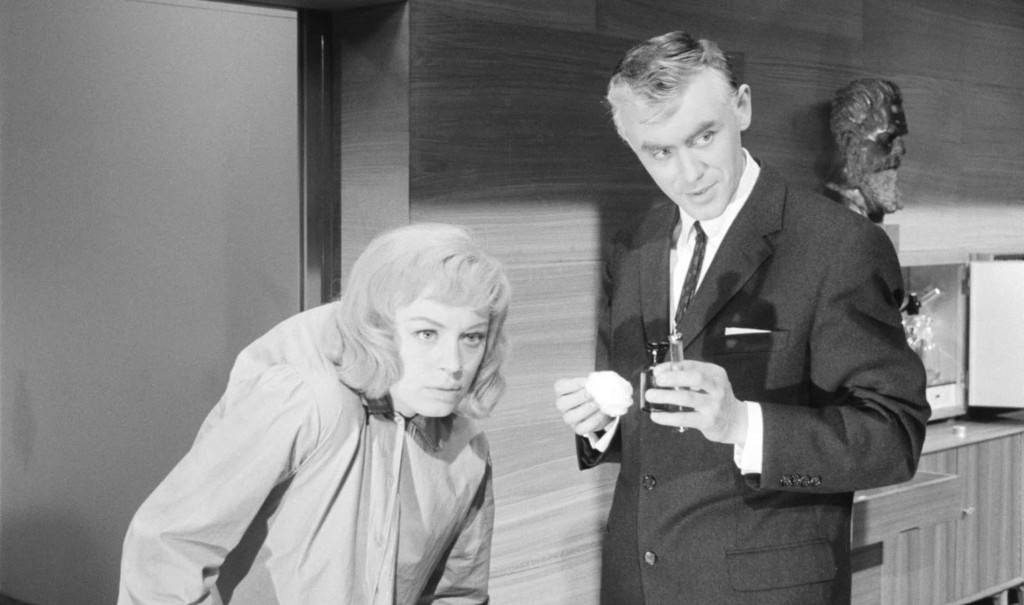
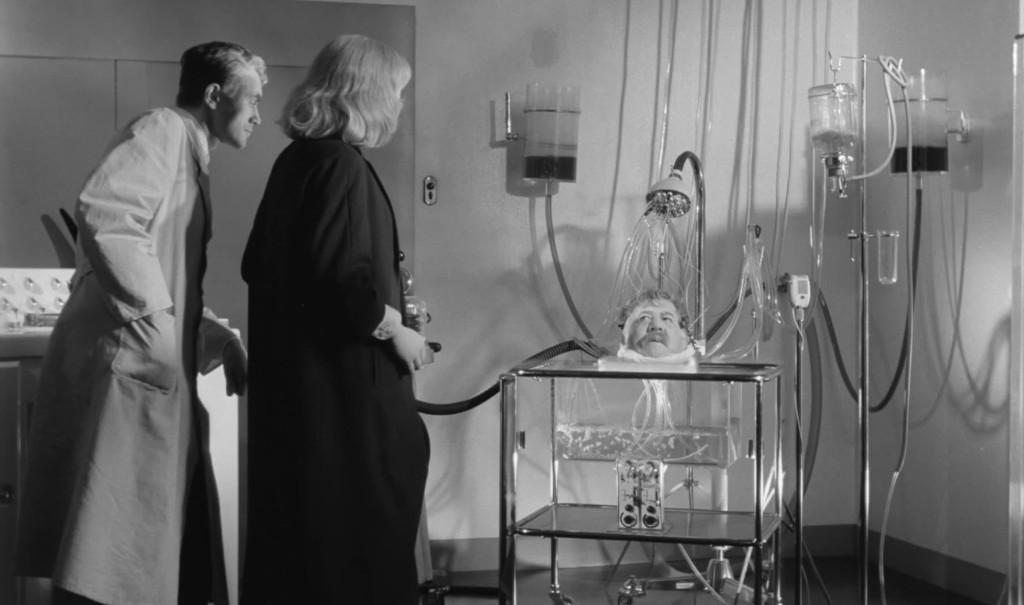
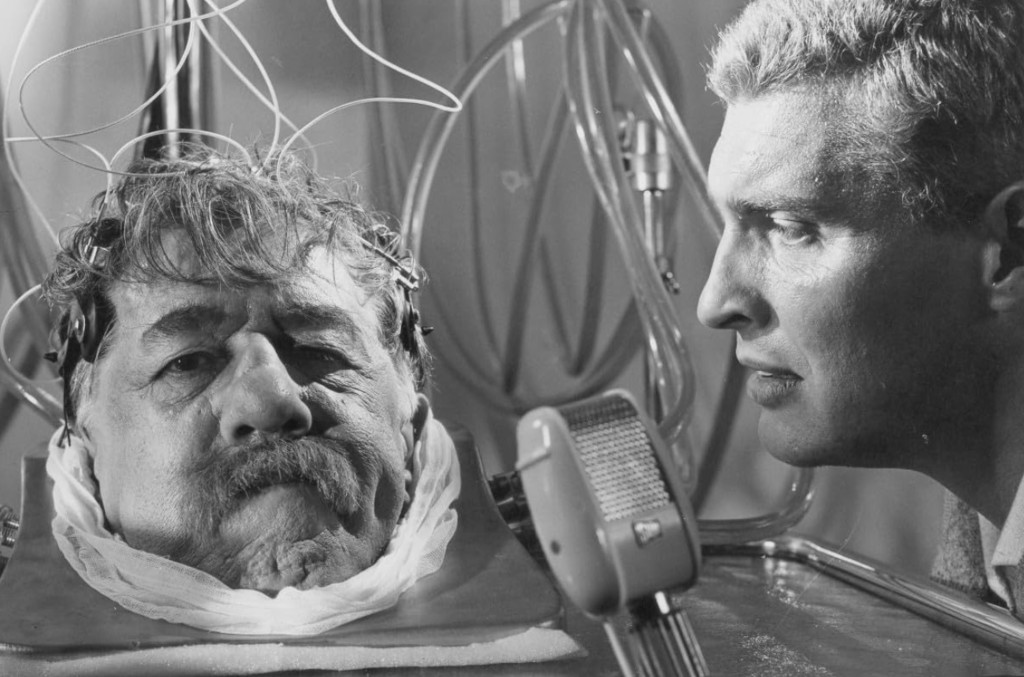
Not long after Dr. Ood arrives at the clinic, he kills Dr. Burke in a disagreement over whether they should proceed with Dr. Abel’s heart transplant despite complications. Ood proceeds, but is unable to get the new heart functioning. Instead, he removes Abel’s head, and keeps it alive on a table with the help of Abel’s serum. Now he wants Abel to reveal to him the formula for the serum. Abel initially refuses, but relents when Ood says that he wants to use it to help hunchbacked Irene.
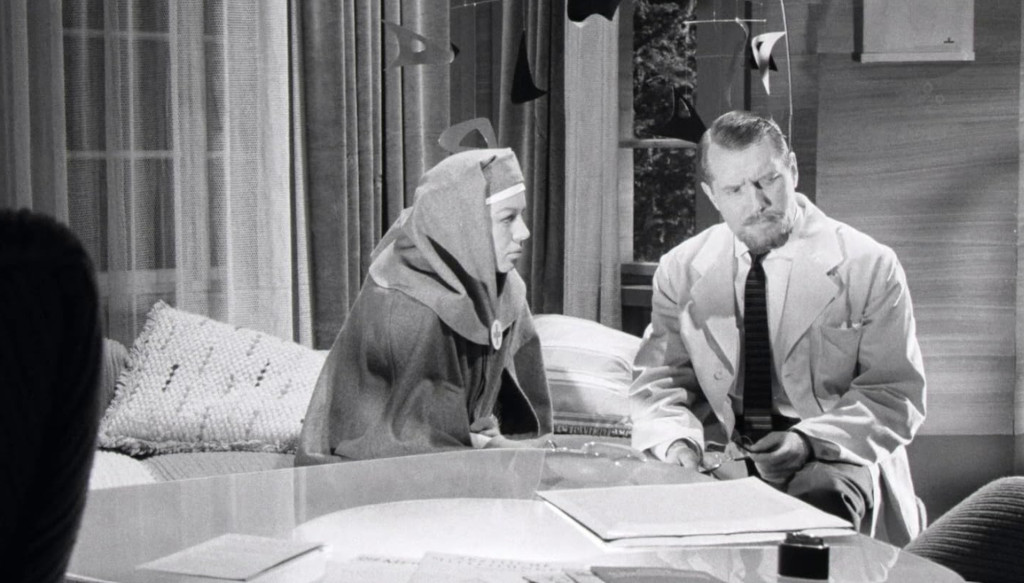
Meanwhile in the seedier parts of town, stripper Lilly (Christiane Maybach) drinks, smokes, strips and nags her kind-hearted boyfriend Paul (Dieter Eppler). When Ood turns up, we are made aware that they have a shady past together – seems she killed her husband, and he is on the run from the authorities. This, however, is never brought up again and has no significance for the plot. Anyway, Ood lures Lilly to the lab and sedates her. Now, with both Dr. Abel and Dr. Burke missing, hunchbacked nurse Irene hesitates to go through with her operation, but Ood convinces her. At the clinic, she also happens to get a glimpse of stripper Lilly.
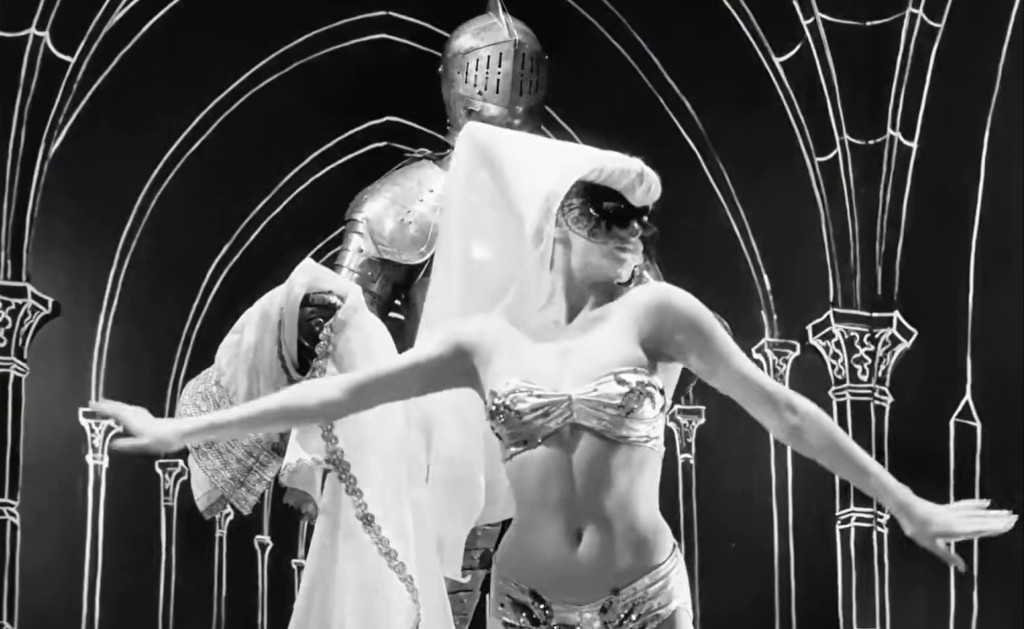
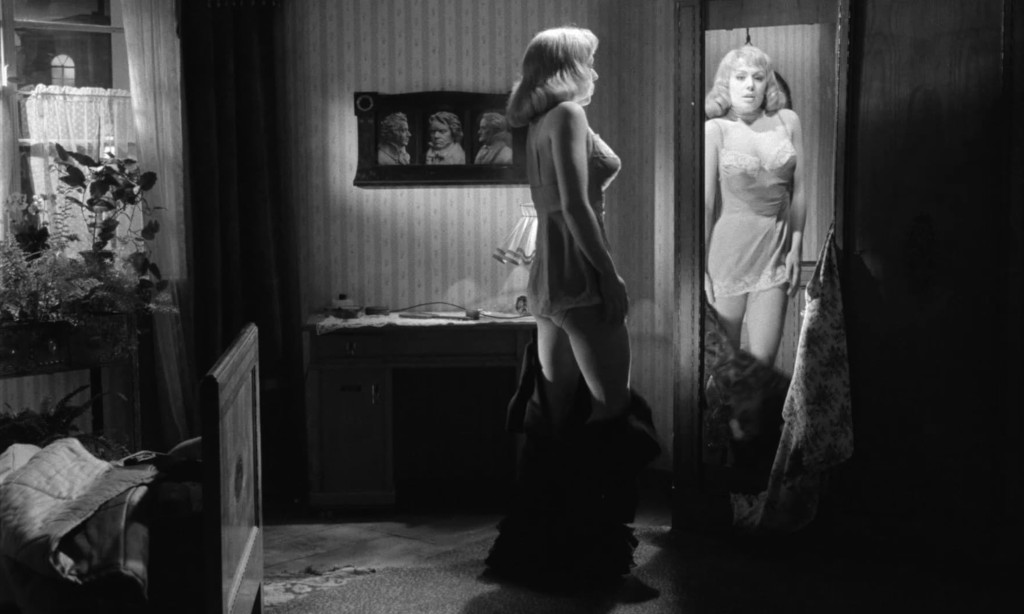
When Irene wakes up from her operation, she is made aware that the procedure has taken three months to complete. While happy for her new – sexy – body, she starts having misgivings, as she no longer recognises it as her own: her feet are smaller, for example. She also goes through a sexual awakening, seemingly attracted to her new body. Gradually Irene starts to realise (with the help of Paul, whom she hooks up with) that Dr. Ood has killed Lilly and grafted her body onto Irene’s head.
By now, the police are slowly (ever so slowly) starting to put two and two together, as they have been investigating one disappeared doctor and another doctor found without a head. By the time Irene discovers the decapitated head of Dr. Abel in Ood’s lab, assistant Bert has also finally turned on Dr. Ood, who eventually meets with the same fate as every other mad scientist in these movies.
Background & Analysis
Production of horror and science fiction movies all but stopped in Germany with the otbreak of WWII, and very few such films were made during all of the 50s. We have reviewed three German SF films from the decade here on Scifist: the comedy Hilfe, ich bin unsichtbar (1951, review), the second remake of Alraune (1952, review) and the German-Finnish co-production Moonwolf (1959, review), – all of which are borderline sci-fi, and none of them really horror.
In communist East Germany, the film industry was guided by the artistic ideology of social realism, which did not allow for genre films of this kind. In West Germany, the audience’s tastes were not for horror and scientific speculation – they had seen enough of that sort during the Nazi regime and the second world war. However, towards the end of the 50s things started to change. This partly had to do with the re-popularisation of the so-called Sittenfilm, or “vice film”. Highly popular from 1918 onwards until the rise of the Nazis, the vice film often circumvented the censors by framing salacious or taboo themes as moral or educational stories. While the genre had been on the back-burner since WWII, the emergence of teen culture in both the US and large parts of Europe in the late 50s, as well as the influx of US American teen delinquency films, spurred independent producers in particular to start producing films with salacious titles, often containing scantily clad women, frequent allusions to sex and depictions of drinking and drug abuse.
Another factor to take into consideration was the commercial decline of German cinema. After WWII, West German cinema had no money. In order to promote and rebuild the West German movie industry, the government issued credit guarantees, essentially stepping in as loan backers for bank loans when studios sought to finance their movies. Thanks to this guarantee, studios were able to produce expensive historical melodramas and so-called Heimat films (films promoting unity by nostalgically looking back at an often mythologised pre-Nazi German culture) for the masses. However, when TV took German homes by storm, cinema attendance dropped dramatically, and the government suddenly found itself owing millions of deutchmarks to the banks. Furthermore, the system was heavily criticised for functioning as indirect state censorship, as the body that granted credit backing didn’t approve films with political or social critique. Recognising the situation as unsustainable, the government abruptly ended the credit system in 1955. As a result, German film production plummeted to nearly a half within a couple of years, and several mainstream studios threatened to go bankrupt. Independent producers were forced to adapt, but were also opened a new door by this development. With state-backed loans gone, making expensive melodramas was out of the question, and instead producers started looking at cheap, commercial genre films, as well as movies that would have an appeal with both co-producers and distributors outside of Germany, taking advantage of financial loopholes and subsidies regarding international co-productions, as well as hopes of international ticket revenue. This led to both the krimi boom and the rise of Euroschlock in the early 60s.
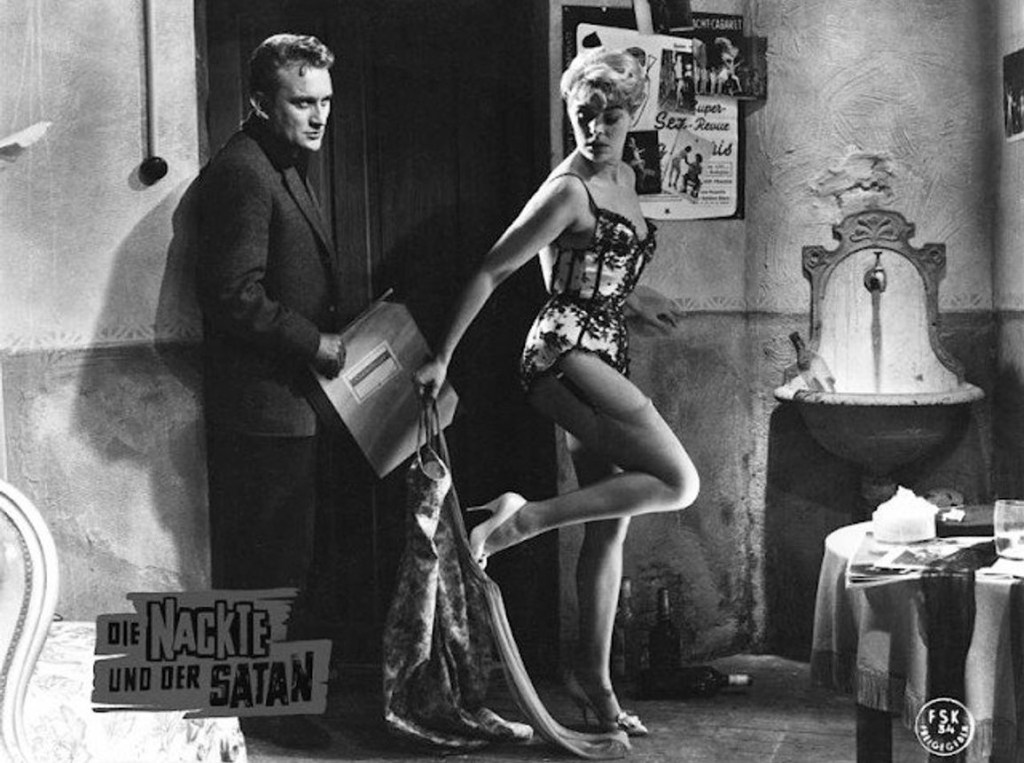
It was in this arena that producer Wolf C. Hartwig founded Rapid Film in 1957, and started producing movies with titles that translate as “Love, Like Women Want It”, “All the Sins of the World”, “Sin Began With Eve” and “Yerning Led Me Astray”. It was in this production line that Die Nackte und der Satan – “The Naked and Satan” – saw the light of day in 1959.
Hartwig often brought in both actors and crew from the pre-war era that had their careers interrupted by the war, or that were returning from exile abroad – people that needed work and money, but who were forgotten by the German movie industry, and thus would work cheap on less than prestige pictures. One such gentlemen was Victor Trivas, who was a well-respected art director, co-writer and director in between the wars, having worked with Soviet expat Fyodor Otsep, designed G.W. Pabst’s The Love of Jeanne Ney (1927) and co-written and co-directed the well-received WWI drama Hell on Earth (1931), or Niemandsland. After the rise of the Nazis, his career was patchy – he worked briefly in France and Czechoslovakia before emigrating to the US, where he worked primarily as a screenwriter in the late 40s and early 50s. His greatest claim to fame is the fact that he was nominated for an Oscar, as part of the team behind the screenplay for Orson Welles‘ Nazi hunter drama The Stranger (1946). However, work ran dry in the 50s, and he returned to Germany, where he tried to pick up his career, with little success. The Head was his first film produced in Germany after his return, and he assumed responsibility for both writing and directing.
While horror films were certainly not foreign to Germany – one could argue it was the birthplace of horror movies – this type of graphic body horror was rather new to the country’s film culture. One imagines that Victor Trivas drew inspiration from Hollywood, where floating brains, surgically created monsters and preserved heads were already commonplace in the B-movie universe. Another possibility is that Wolf C. Hartwig saw his chance of getting legendary Swiss actor Michel Simon, now partly paralysed, into one of his films by creating a role for him that mostly required him to act with his head. Trivas needed the work, and might have seen this as a way back into German film industry. It was also a rare chance for him to direct. There are scholars who read more into the film than is visible on its surface, and argue that Trivas put more thought into it than would have been required or commonplace for such a schlock movie.
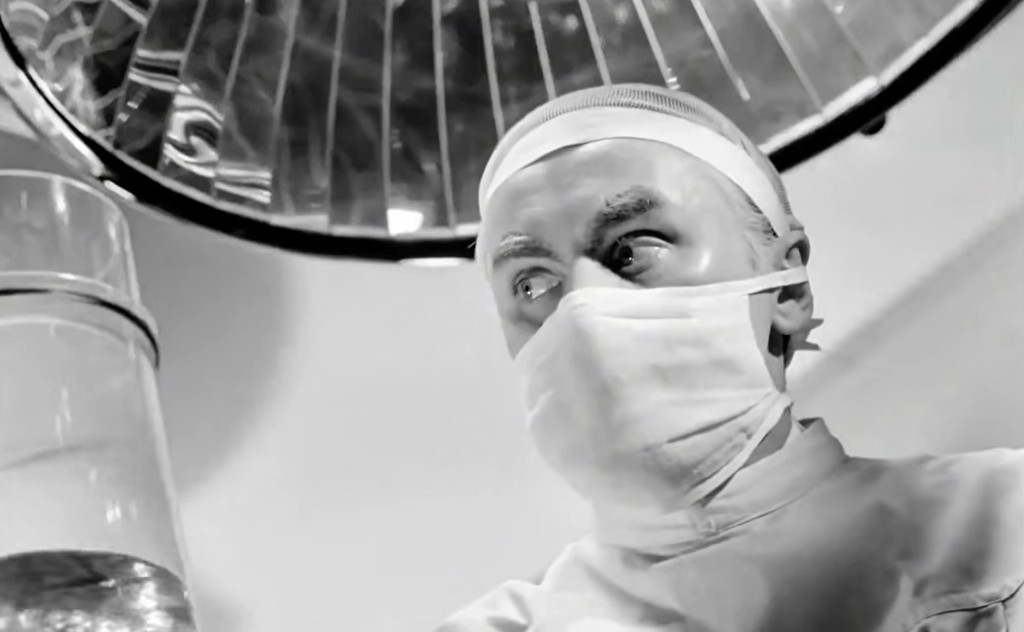
Trivas has sole screenplay credit, but one imagines that the idea for The Head came from Hartwig. The many scenes in which we see Christiane Maybach and Karin Kernke in various stages of undress certainly have Hartwig’s fingerprints all over them. Because Trivas has screenplay credit, scholars like David Del Valle and Edith Blaschitz argue that he may have set out to write a Faustian post-war allegory as a way of dealing with his home contry’s real-life mad scientists and the Nazis’ obsession with ideas of racial purity and perfection, because you expect something more from Trivas than just a schlock movie. And … yes, you can certainly read such notions into the story if you look at non-expressed subtext, but it is questionable whether Trivas consciously set out to make an anti-Nazi statement with this movie, as the motivations of Dr. Ood remain irritatingly opaque throughout. That Ood is mad is clear as day, but the script never makes it clear why his is so hell-bent on performing his head transplants. At some point is seems as it is all for science, for exploring the impossible and making it possible, and at another time it seems as if it was all in order to create his perfect sexual plaything. However, the film never makes any overt references to values or ideologies that could easily be identified as those harboured by the Nazis. Ood’s motivations never seem to be racial, neither does he seem to have any larger designs on changing the face of the global population, as one would expect if the film was meant as a nod towards Hitler and Mengele. On the other hand, WWII was still fresh in the minds of Germans, and it is possible that Trivas thought that the mere theme itself was enough for the link to be made by audiences. But in that case, this is a case of rather sloppy screenwriting, as the film fails to make any coherent point.
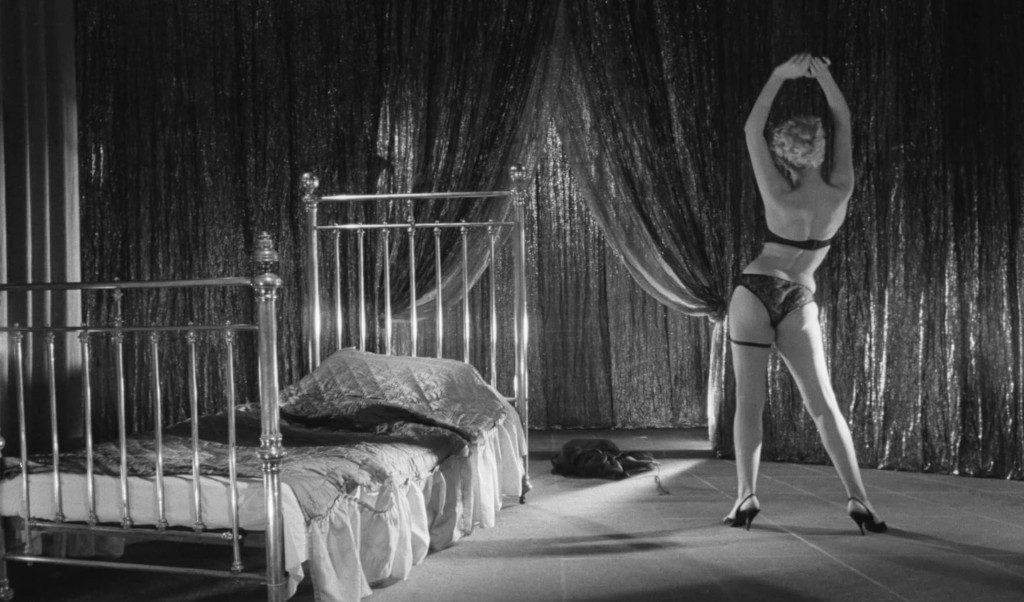
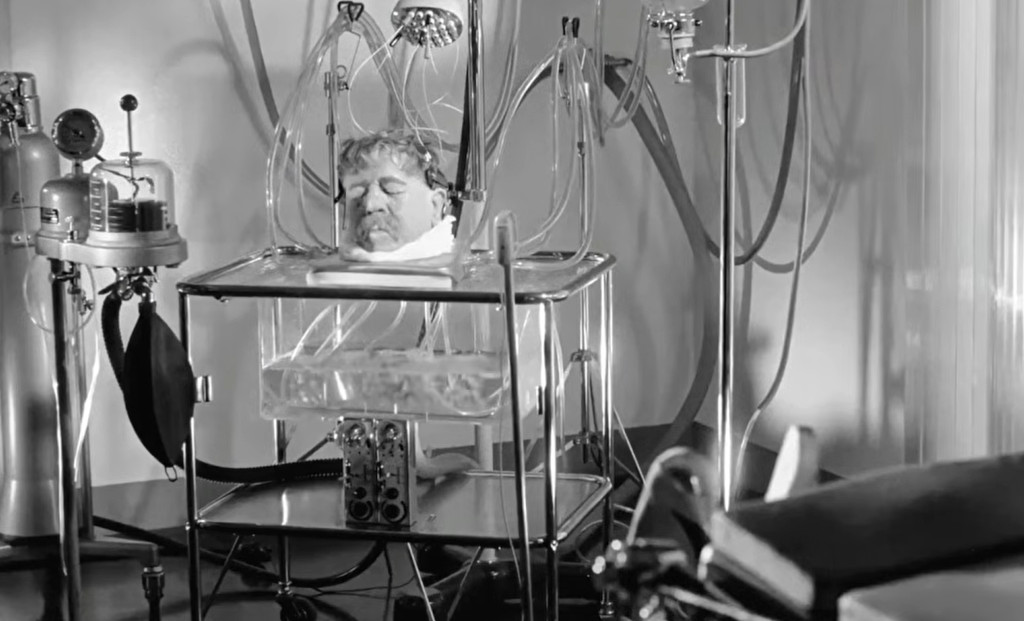
The Head is fascinating mainly for its lurid premises and its atmospheric, expressionistically inspired photography and design. Coupling the already old horror movie idea of the head transplant with that of half-naked women and sexual lust and even auto-eroticism was too much for many critics and conservative pundits. It brings a salacious vibe to the movie that we associate more closely with late 60s and 70s horror films. Irene caressing her own body in front of a mirror and Dr. Ood essentially creating a sex doll for himself are surprisingly explicit ideas for a 50s movie, even in Europe. The film was outright banned in Finland and met with heavy religious protests and censorship in Austria. However, much of the lurid content is suggested rather than visual, spoken or even built into the plot itself. Like many similar films of the era, Die Nackte und der Satan isn’t particularly salacious, even if the ideas that it puts into the viewer’s head are. There are no nude scenes and the film contains no blood or gore. The scenes with Dr. Abel’s head sitting on a table are creepy, but clean.
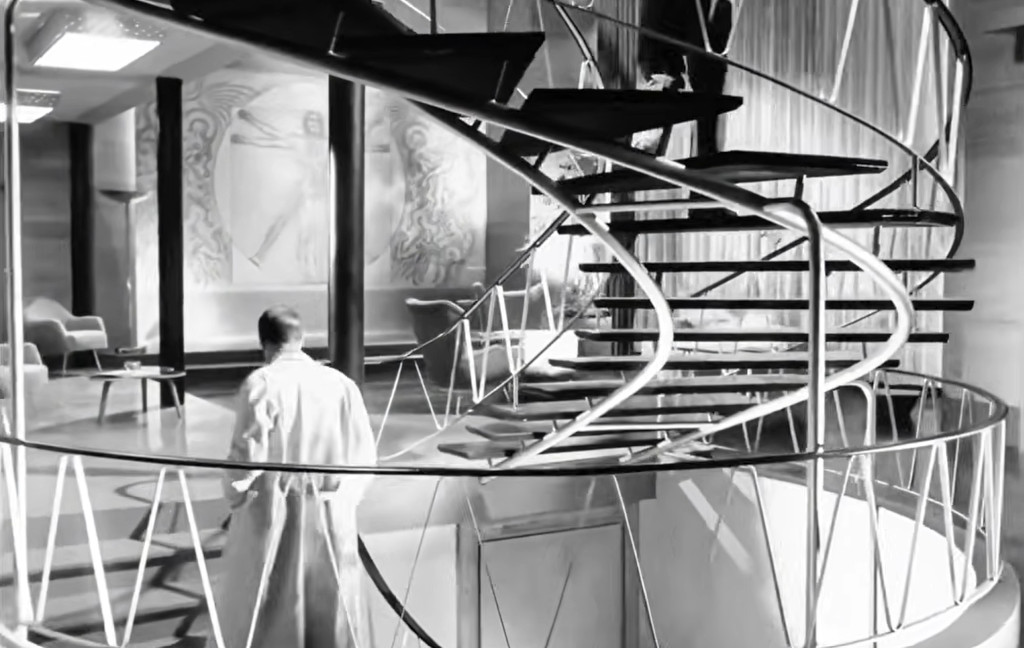
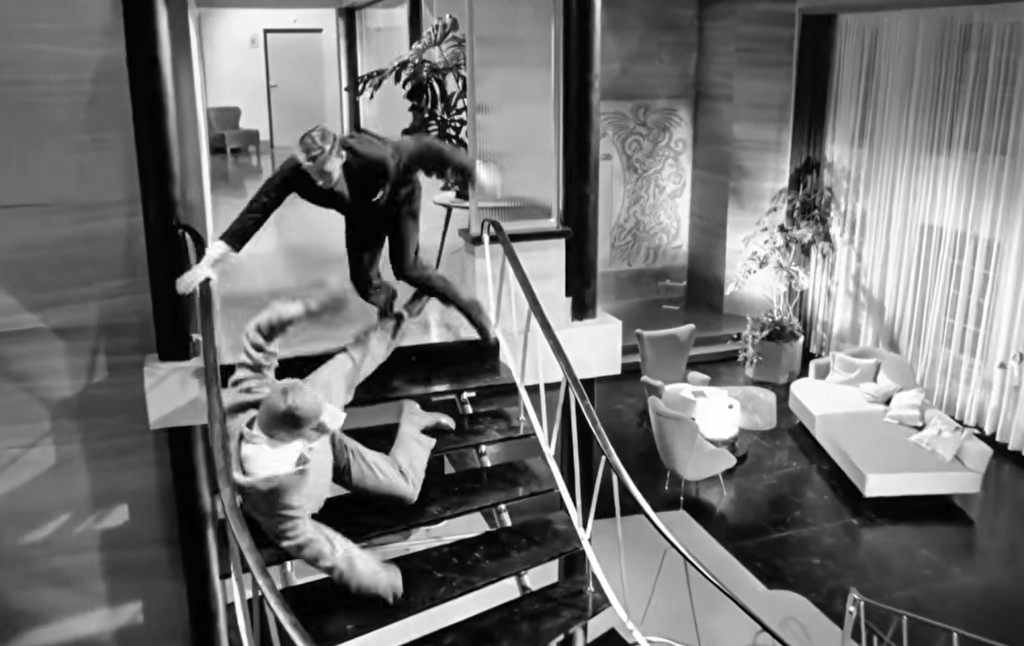
The visuals of the film are better than they have any right to be in a schlock movie of this type, which may contribute to the fact that modern-day critics sometimes like to view it through a more sophisticated lens. First, of course, this is due to the fact that it was directed by Victor Trivas, who had a background in production design. But the aesthetic of the movie is also heightened by the presence of cinematographer Georg Krause and production designer Hermann Warm. Both were veterans of the German movie industry dating back to the silent era. Both the sets and the lighting conjure up memories from German expressionism, 30s era horror movies and film noir. Warm practically created the expressionist visuals of German horror with films like The Tales of Hoffmann (1916, review), The Spiders (1919), The Cabinet of Dr. Caligari (1920) and Destiny (1921). In The Head, Warm contrasts the gothic exteriors of Dr. Abel’s clinic, eternally draped in darkness, with its clean, white and sterile interiors. The large spiral staircase and the spacious rooms belie the film’s low budget. Georg Krause had just come off shooting Stanley Kubrick’s Paths of Glory (1957), and uses the same semi-wide lenses and deep focus that give the movie a sharp, almost glossy feel, contrasted with dramatic chiaroscuro lighting on characters prowling in the dark.
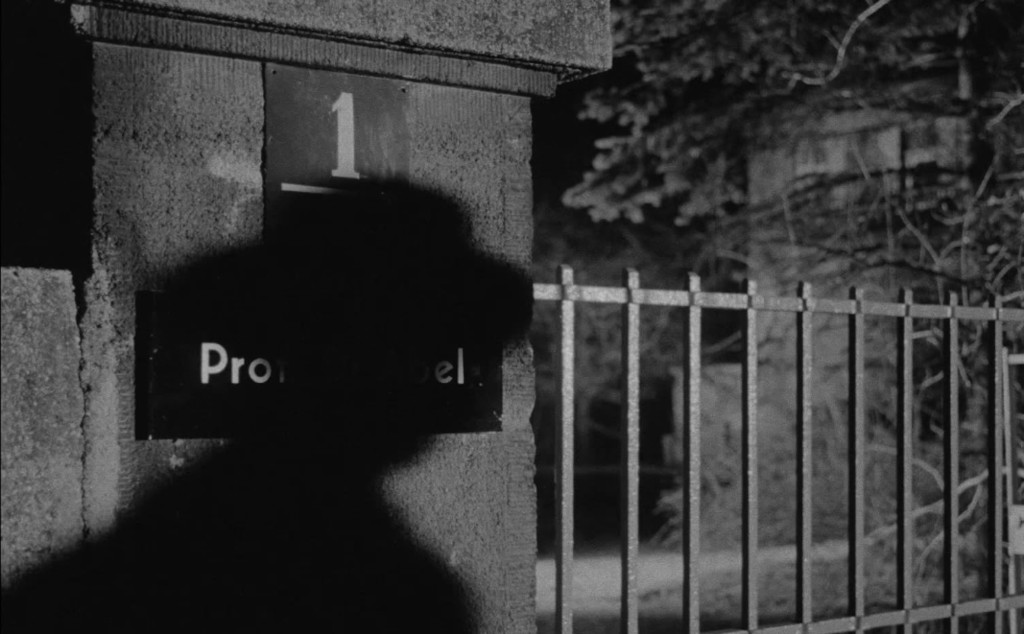
Even today, the shots of Michael Simon’s detached head sitting on a metal table with tubes coming out underneath is eerie, and the effect is nearly flawless, as you can see the rest of the room beneath the table. According to Simon, Krause and special effects wizard Theo Nischwitz (Das Boot) created the effect with an age-old stage illusion trick: a mirror placed at an angle under the table, behind which actor Simon sat. However, I wonder if this is the whole truth, as I can swear that I see something that looks like a faded matte line in the left upper corner of the table in some shots.
There is one odd aspect of an otherwise well-filmed production. There’s a couple of scenes in which we are introduced to Dr. Abel in the beginning of the film, where we only see the character with his back turned to the camera for long stretches of time. At first I suspected this was down to bad direction, but that didn’t gel with the rest of the movie, as nothing of the sort happens with any other character. After doing some research I found out that the award-winning Swiss actor Michel Simon had had an accident with poisonous makeup and had suffered a partial paralysis in 1958, which is visible in his face in later scenes. Some commentators have suggested that a body double of Simon was used since he was unable to walk, but from what I can tell this is not the case. It is clearly Simon walking in the shots, but we only see his face for short moments at a time, before he turns his back to the camera. It is reported that the accident caused problems with his memory, and it is possible that he couldn’t memorise longer dialogues and had to dub his lines in post-production, which would explain the odd blocking. As several sources report that Simon did have some difficulty with his motor skills for a few years after the accident, it is plausible that he accepted the role in The Head because it allowed him to do most of his acting sitting down. Simon suffered the effects of the accident for the rest of his life, but made a good recovery and continued a highly successful career in the 60s.
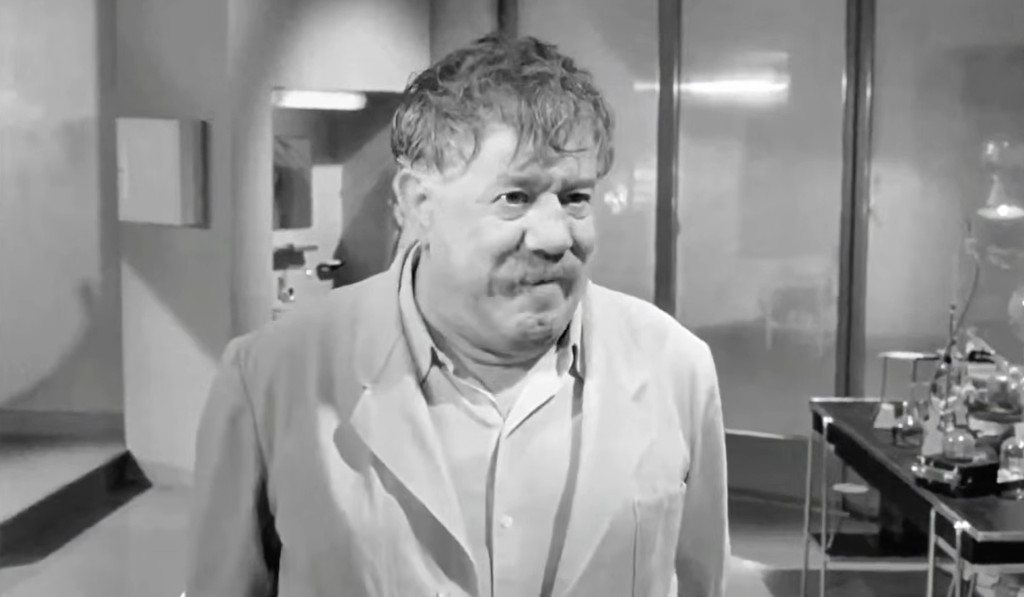
Michel Simon, or at least his head, also gives the most memorable performance of the film. Horst Frank as Dr. Ood is approriately creepy and is able to work up a good deal of energy in his madcap performance at the end, but his Dr. Ood is not a character that sticks with you. Karin Kernke, a formally trained stage actress of note, does what she can with her bizarro dual role as the timid, hunchbacked nurse and the sexually awakened vamp in the second part of the movie. She has moments of magnetism, but a tendency to stagey melodrama. In all other areas, the acting is never more than adequate. Minor star Kai Fischer, known for portraying gun molls and prostitutes, was slated to play stripper Lilly, but when she heard that she was required to spend much of the movie in little more than a bikini, she refused, and was replaced with Christiane Maybach. Producer Hartwig later quipped that Maybach certainly wasn’t hired for her acting talents, and she is perhaps not at her best in this role, but her long career in film, and as a favourite of Rainer Werner Fassninder, indicates that she had no lack of talent. Helmut Schmid as the mentally challenged, well-meaning assistant does a completely different role from his brutish portrayal in another German SF, Moonwolf (1959, review), and he and the rest of the cast are at least adequate.
The music of The Head is a sometimes bewildering mix of traditional chamber piece movie scores, a lot of big band jazz and then, suddenly, eerie, avant-garde sci-fi/horror instrumentation based on droning, glassy sound carpets and echo-y percussion. The score is credited to Willy Mattes, an established composer of both traditional film music and jazzy numbers, and it was recorded by band leader Erwin Lehn and his orchestra. The avant-garde portions of the score are unusual for both Mattes and Lehn, even if Mattes was not wholly inexperienced with horror scores. IMDb lists experimental composer Jacques Lasry as an uncredited co-composer for the film, but this is not backed up by any first-hand sources readily available online. Some online critics go as far as crediting the entire Lasry-Baschet quartet for these parts of the score, although in all cases without any credited source. Lasry-Baschet were famous for their “structural sonores” often created by stroking a set of glass rods, sometimes distorting and amplifying the sounds through specially designed metal cones or funnels. However, if Lasry-Baschet would actually have created original music for the film, this would definitely have been used in the marketing, or at least shown up in the production credits. One possibility is that Rapid Film bought stock music by Lasry-Baschet or Lasry alone, which would explain why it didn’t show up in the credits. On the other hand, the music in the movie might also have been created with more traditional, early synthesisers like the ondes martenot or the ondioline – that could have been composed by Mattes. It is definitely not, as someone has supposed, a theremin. Whatever the case, the score is occasionallly eerie, bit it’s an odd mishmash of happy jazz and avant-garde spookiness that doesn’t quite gel.
The idea of heads living on without bodies has been explored as far back as Greek, Celtic and Norse mythology, with Orpheus, Bran the Blessed and Mimir as examples, often portraying the idea of mind over matter, that intellect and spirit transcend the material world. However, it wasn’t until the 19th century, with the growing understanding of our bodies as electrical and mechanical entities, that themes of separating the mind from the body became more widely prevalent in literature. This was often used to explore the idea of the soul and what makes us human. However, the trope as used in The Head can be viewed as dating back to the explosion of pulp fiction in the 20s. The blueprint was Soviet author Alexander Belyaev’s story Professor Dowell’s Head, published in 1925, and the pulp magazines of the following decades saw numerous stories exploring severed heads and brains in vats. H.P. Lovecraft’s The Whisperer in the Darkness (1930) and Curt Siodmak’s Donovan’s Brain (1942) were both central to the development of the trope. Several factors probably contributed to the rise of the trope: post-war trauma and the rise of Taylorism and Fordism contributed to both the exploration of the human body as a machine and to the thought of the terror and helplessness of being of sound mind but completely vulnerable and dependent on others for survival. New medical breakthroughs with keeping mortally wounded or ill people alive, as well as early experiments with transplants, stoked fantasies of keeping heads alive without bodies, spurred on by the real-life demonstration of Sergei Brukhonenko in 1925 of a severed dog’s head seemingly reacting to external stimuli. The boom of films dealing with brains in vats, disembodied heads and head transplants in the late 50s and early 60s was probably inspired, more than anything, of the revelation in the West that Soviet surgeon Vladimir Demikhov had spent the larger part of the 50s creating two-headed dogs by means of head transplants, which fuelled speculations in the media.
Disembodied, living heads had turned up in film history before – Georges Méliès frequently played around with his head in his early short films. Also, the closely related brain-in-a-vat trope went back at least as early as the horror film The Lady and the Monster (1944, review), based on Donovan’s Brain. As far as I can tell, however, the first cinematic instance of a whole head being kept alive without a body by scientific or magical means was W. Lee Wilder’s British low-budget movie The Man Without a Body (1958, review)in which Nostradamus’ head is resurrected and kept alive on a platter. It was followed by Universal’s The Thing That Couldn’t Die (1958). Die Nackte und der Satan (1959) was third movie of its kind, and it was followed by a small cottage industry of similar films. The Brain That Wouldn’t Die – in which Virginia Leith’s head is kept alive by her boyfriend – was actually filmed in 1959, but not released until 1962. In 1963 two films were released featuring the trope: The Madmen of Mandoras / They Saved Hitler’s Brain and Mexican entry La cabaza viviente, which translates simply as “The Living Head”. The TV title of the former film should make it clear whose head is being kept alive, and in the latter, archaeologists accidentally awaken the head of an Aztec mummy.
It is doubtful that either The Man Without a Body or Die Nackte und der Satan had anything to do with the fact that a number of similar films popped up in the following years. The Demikhov experiments, the science race between the East and the West, and emergence in Europe and the Americas of ever more gruesome and salacious horror movies all probably fed into trend that saw head movies being produced on all three continents.
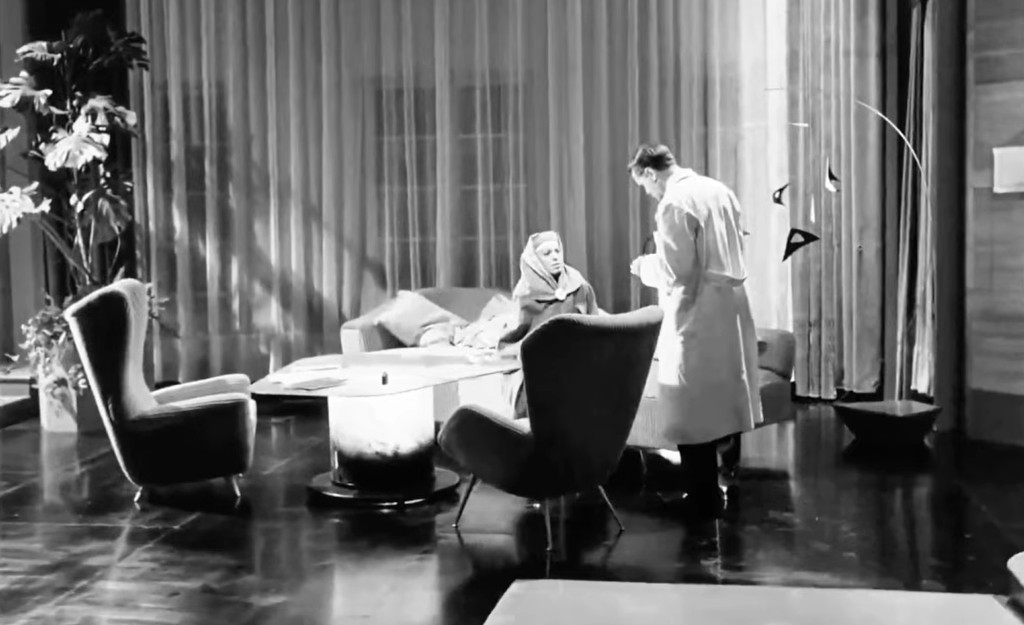
The Head / Die Nackte und der Satan is deceptive in that it seems more sophisticated than it is, and thus seemingly transcends its ultimately simple and somewhat vulgar story. It’s a film that’s nice to look at. The special effect of Dr. Abel’s head on a table invokes a genuine reaction even in a modern viewer. The movie doesn’t, however, live up to its German title, and apart from a handful of shots in beautiful blondes in lingerie, there’s nothing particularly salacious on screen. However, Wolf C. Hartwig and Victor Trivas know that the trick is to make you imagine things beyond what you can see. Ultimately it was still dated in 1959, and adding a few bare legs and sexual innuendo doesn’t change that this is at its core a stale rehash of mad scientist movies from 20 years ago. It’s a fun watch and interesting as a starting point for the more outrageous horror and sci-fi films of the 60s.
Reception & Legacy
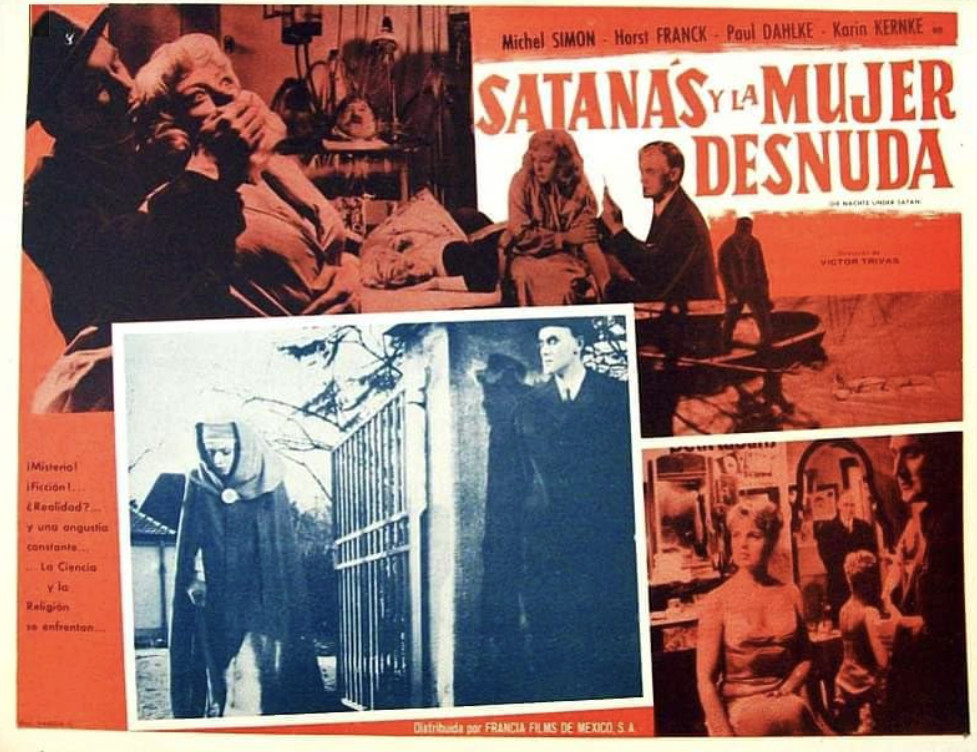
Die Nackte und der Satan premiered in 1959 in Germany and Austria and in 1960 in France. It opened in the US in 1961 with the title The Head, and in Mexico in 1962 as Satanas y la mujer desnuda. It may have been shown in other European countries as well. It was supposed to have been released in Finland, but was banned due to its percieved “brutalising” nature. While the film did premiere in Austria, it met with harsh backlash, especially from Christian organisations. Public protests in Salzburg led to a police investigation of a theatre owner who had screened the film, and the Styrian state government outright banned the picture, once again for “brutalisation”. In particular, critics voiced grievances about the combination of medical horror and mutilation with sex and nudity. However, in 1961, the Constitutional Court of Austria overturned the ban as unconsistutional, in a watershed censorship trial.
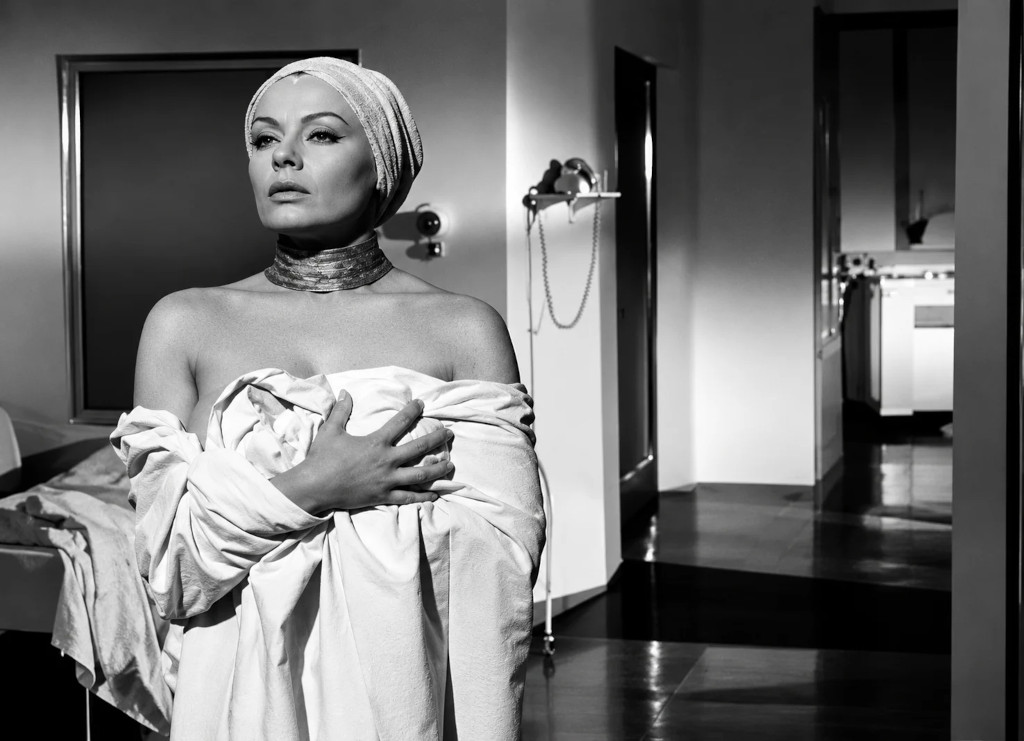
German film critics generally panned the film. According to Wikipedia, Wilhelm N. Weingarten at Film Revue summarized that everything in the film was so poor that it could not possibly get any worse and that at the screening he attended, the audience was amused at the expense of the film. He concluded that felt sorry for actors Horst Frank and Michel Simon for having to lend their talents to the film. According to Edith Blaschitz’s dissertation about the Austrian pushback against “Schmutz und Schund” in the movies, the majority of trade publications in Austria wrote about the film in decidedly negative terms, calling it a “shoddy horror film”, “pseudo-medical horror-kitsch compounded by boredome”, “a thriller of the lowest grade” and “a profane and tasteless fantasy”. According to Blaschitz, “only Paimann’s Filmlisten offered a different take, noting that the film was ‘a production banking on thrills and sex appeal, yet precisely directed, competently acted, and elegantly presented.’”
American critics were divided on the film’s merits. Larry Tubelle, or “Tube” at Variety was of the same opinion as his Austrian colleagues, that The Head was “tedious and tasteless”, “overlength” with a “shabby, shopworn nature”. However, he admitted that the visuals and the music occasionally had some merit. Boxoffice, on the other hand, praised the film’s “gruesome, albeit spine-tingling aspects”, and wrote that the “unerring skill” of Victor Trivas is largely to be credited “for the above-average rating of the photoplay”. Allen M. Widem of Motion Picture Herald found it good and that it “accomplishes its objectives with a [flair] that spells out dramatic dash of unprecedented lure.”
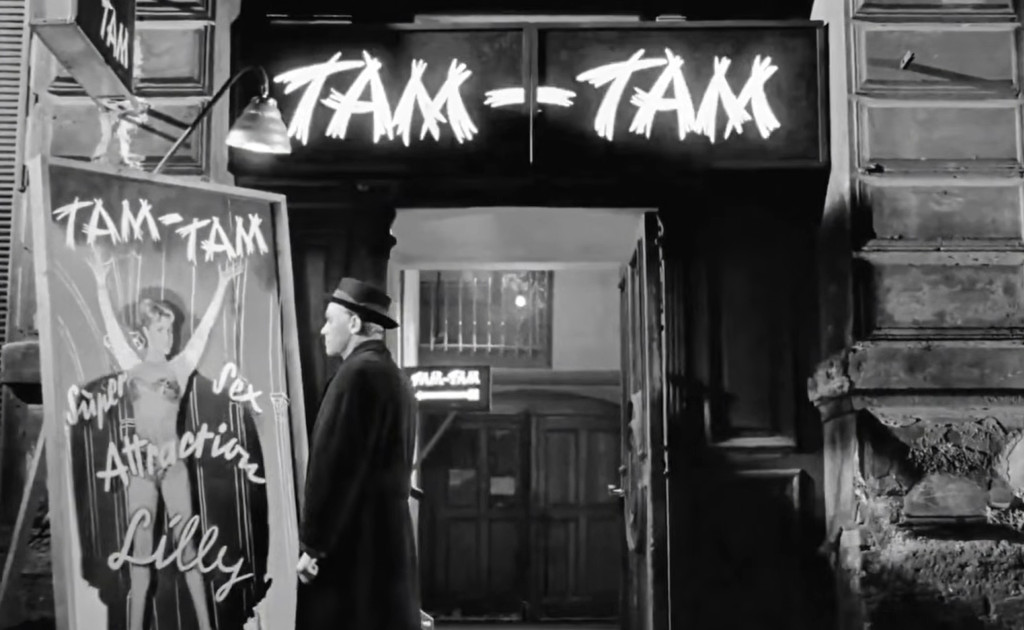
Needless to say, all the buzz surrounding the movie didn’t bother producer Wolf C. Hartwig in the least. The more notoriety his film got, the more people were interested to see it, and German Film Revue magazine also noted that Die Nackte und der Satan was an “unusually big success” for a film of its kind.
German critics today seem a bit divided on the film’s merits. The country’s oldest film publication Filmdienst in a capsule review calls it “A silly horror film that tries to generate chills with absurd medical experiments”. At Hannes Filmarchiv, the titular Hannes notes that the movie plays around with interesting ideas, but then drops them at the bat. He opines the film falls into the “schlock” category, but that it is “nevertheless, quite entertaining”. At Home of Fantastic Cinema, the anonymous critic states: “Compared to most of the American exploitation films that were already proliferating at the time, Die Nackte und der Satan stands out due to its longer runtime and more successful character development”.
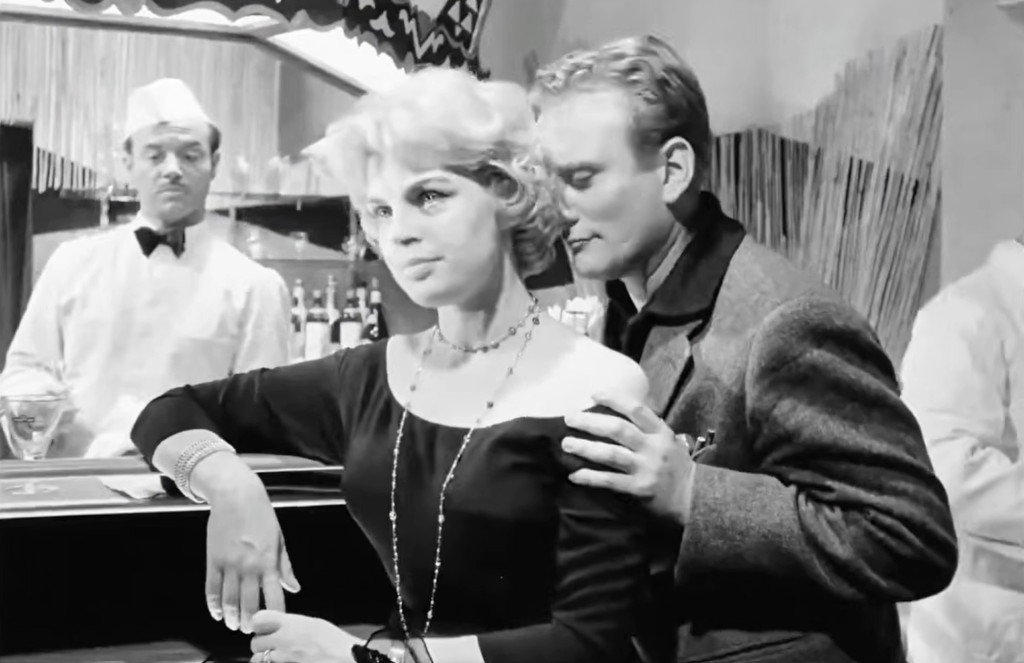
American critics of our time likewise can’t quite agree if the film is a cut above its ilk or a failed opportunity. Mark David Welsh says the it is a film that could have been a lot of fun: “Unfortunately, what kills the drama stone dead is the lack of any real plot development and the dire pacing”. Mark Cole at Rivets on the Poster writes: “It never really builds up the energy a truly nutty film needs. There are a lot of interesting ideas here […] and yet the film never quite takes off, preferring instead a sedate stroll. Oh, well, there are worse midnight movies out there. It may be slow, but never quite boring, and there are enough strange things going on to keep it interesting. The Head deserves points for its unique vision and willingness to throw in anything that popped into the filmmakers’ heads.”
However, Glenn Erickson at Trailers from Hell is on board: “Partly a girlie show – most every scene involves some form of disrobing – it’s nevertheless an intriguing horror cocktail with top production values. The capable cast is really into the melodramatic shocks – it may not be Georges Franju but it’s several cuts above other ‘severed head’ epics – an insane carnival of flesh confusion that’s technically tame but truly adults-only by 1959 standards.”
Die Nackte und der Satan was later reissued with the title Des Satans Nackte Sklavin, and English-language versions, Satan’s Naked Slave, have therefore also circulated.
The movie was available on video tape at least as early as 1993, and the English dub has long been available on bargain bin DVDs. There’s a fairly good 2020 DVD release with both the German and the (shorter) dubbed English version of the film. 2022 saw a Blu-ray release of the German version with English subtitles, which is the best version out there. The film is available on YouTube – most uploads are of the cut English dub, but if you scroll a bit you’ll also find the German version. The auto-generated English subtitles were excellent on the video I watched.
Cast & Crew
Director/writer Victor Trivas is sometimes described as a former big shot who fell on hard times later in his career, but his film career was always patchy, at best, with a promising start, a couple of big successes and a lot of struggles. For a long time, Trivas’ origins were in question, but later research has confirmed he was born to Jewish parents in St. Petersburg in 1896, where he studied art, and moved to Moscow after WWI, where he worked as a set designer for different theatres. He moved to Berlin in 1925, where he continued to design sets for the stage, but also started a career as a scenarist for silent films. Almost straight out of the theatre, he was hired as art director for G.W. Pabst’s classic The Love of Jeanne Ney (1927), and later worked as both art director and screenwriter for fellow Soviet emigrant Fyodor Otsep on two films based on Fyodor Dostoevsky’s The Brothers Karamazov. Trivas made his directorial debut in 1930, and in 1931 directed Niemandsland, or Hell on Earth, a pacifist movie set in the trenches of WWI. It was well received, but was banned by the Nazis in 1933. He left Germany in 1935, and worked for a few years in France, until the Nazis came rolling over the border, and he relocated to the US in 1941.
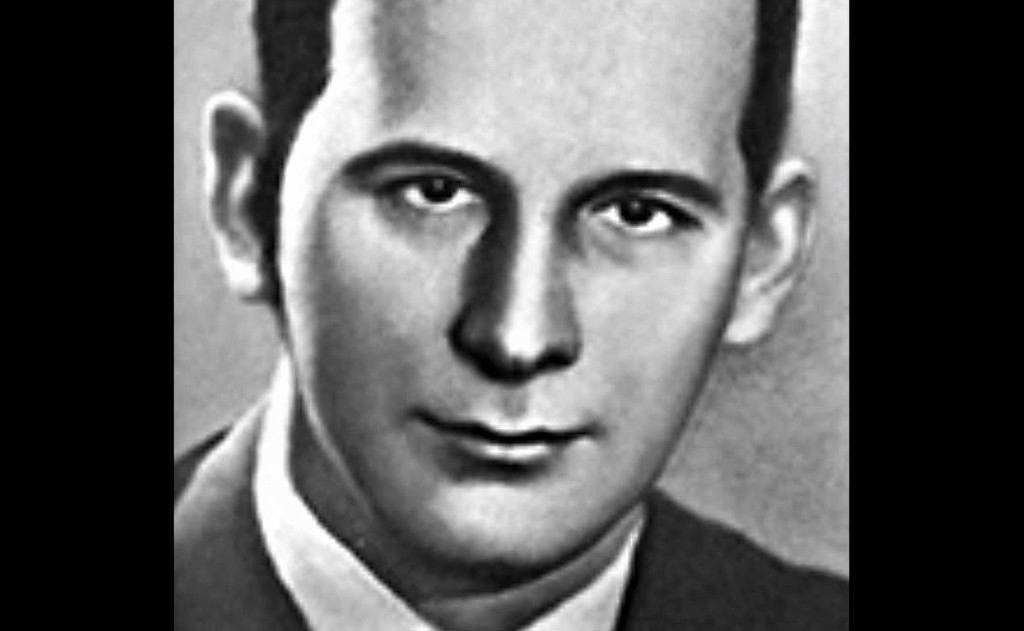
Here Trivas was helped into Hollywood by the East European emigré community – his first job was as co-writer on Fyodor Otsep’s Three Russian Girls (1943), starring Ukrainian-Swedish Anna Sten and produced by Hungarian Gregor Rabinovitch, and the second was Song of Russia (1944), directed by Russian Gregory Ratoff and produced by Hungarian Joe Pasternak. It’s possible that it was German co-producer Sam Spiegel that presented Trivas’ original story for The Stranger (1946), about the hunt for an infamous Nazi who had fled to Connecticut, to John Huston and Orson Welles, who had it fleshed out and adapted by several other writers. The film brought Trivas an Oscar nomination, but didn’t help propel his career. If 1946 was a high point with Welles, it was also a low point, as he co-wrote the dreadful Mexican Buster Keaton sci-fi comedy El moderno Barba Azul (review) with Jaime Salvador. With only two screenplays produced between 1947 and 1954, he returned to Europe, where he wrote a couple of low-budget movies, including Die Nackte und der Satan (1959), which he also directed, before retiring and moving to New York.

Wolf C. Hartwig, born 1919 in Düsselforf, was a legendary German schlock producer. While working as a film distributor in the early 50s, he produced a documentary about Hitler and the Nazis, which at the time caused a stir – and made a good profit because of it. Realising the economic potential of controversy, Hartwig decided to begin producing a string of so-called Sittenfilme, or “vice films”, circumventing the censors by framing salacious or taboo themes as moral or educational stories. Most of his movies dealt with sex, and always had a good dose of scantily clad women in them. Most were melodramas, crime films or comedies. Die Nackte und der Satan (1959) was his only sci-fi. By the early 60s, Hartwig followed Roger Corman’s example and started producing films abroad, partly because filming in Asia was cheaper than Germany, and partly because co-producing films with companies from other countries made him eligible for grants and subsidies. Such movies were Heißer Hafen Hongkong (1962) and Das Todesauge von Ceylon (1963).
1970 saw the start of yet another phase of his career – which is the one he is best known for. This was the year that teacher and author Günther Hunold published the book Schulmädchen Report (“Schoolgirl Report”), allegedly based on interviews about sex with 36 teenagers. It didn’t take long for Hartwig to see the potential of the book as a continuation of his vice film string, and he cooked up a wobbly frame story into which he plonked twelve dramatised interviews with teenage girls from the book, and depicted their sexual encounters and fantasies with vignettes featuring full frontal nudity. The result was the mockumentary Schulmädchen-Report: Was Eltern nicht für möglich halten (“Schoolgirl Report: Things Parents Can’t Even Imagine”). Germans (presumably males) flocked to the theatres, and at one point the movie was the hottest box-office ticket in the country. During the following decade, Hartwig produced twelve sequels, giving rise to the Schulmädchen Report franchise. In between, he continued to produce his “normal” movies. By the late 70s, his schoolgirl movies had made him so much money that he set out to produce a serious big-budget movie with Hollywood pedigree about WWII seen from the perspective of Yugoslavia. The result was The Iron Cross (1977), directed by Sam Peckinpah and starring James Coburn and James Mason. The picture was a success, both critically and commercially, and earned the eternal smut producer a German Bambi award for best picture.
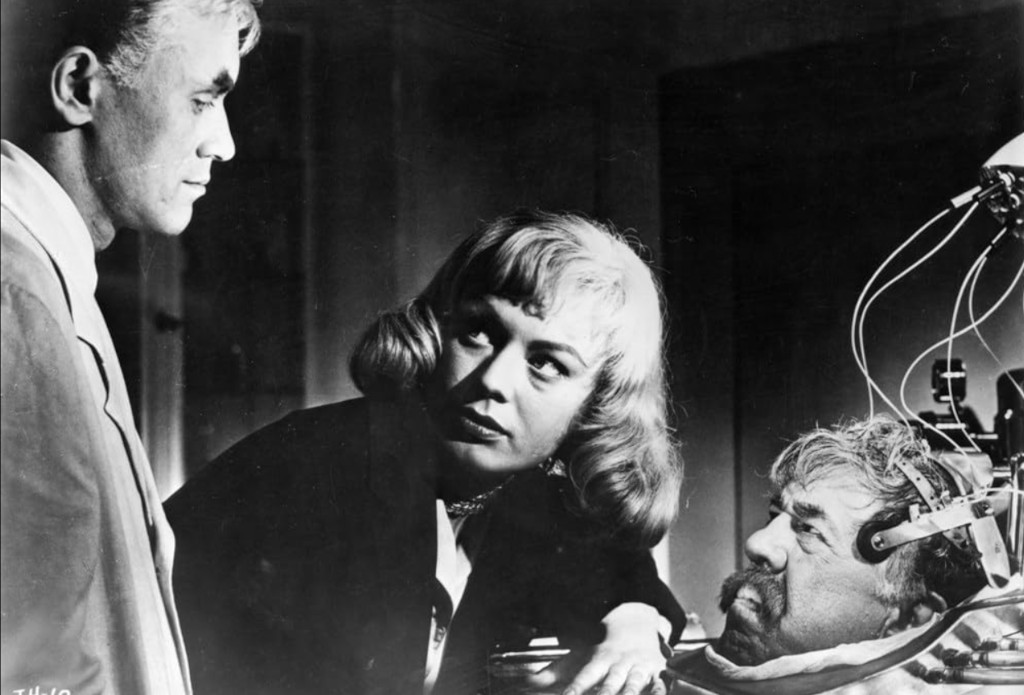
Horst Frank, who plays the sinister Dr. Ood in The Head was on his way to become one of Europe’s most recogniseable B-movie villains. He made his film debut in 1959, and by 1959 he had already established himself as a specialist in villainous roles, thanks to his steely, menacing countenance. Like a fellow John Carradine, Frank didn’t seem to mind his typecasting and made little effort to break out of it, continuing to play killers, gunslingers, criminal masterminds and assassins until his death in 1999. Because of his relative lack of exposure in international films, he is rather unknown in the Anglophone world, but in mainland Europe, he was a sought-after actor for krimis, giallos, costume thrillers, eurohorror, mysteries and spaghetti westerns. His career peaked in the late 60s and early 70s. He went up against Terence Hill in Django, Prepare a Coffin (1968), played a mad doctor in Dario Argento’s Cat o’ Nine Tails (1971), drew revolvers against Lee Van Cleef in The Grand Duel (1972), and played a smaller, but central role in Mario Caiano’s flawed but well-liked giallo Eye of the Labyrinth (1972). In the Germanic world, he is also remembered for his role as Baron de Lefouet in the mystery TV show Timm Thaler (1979–1980).
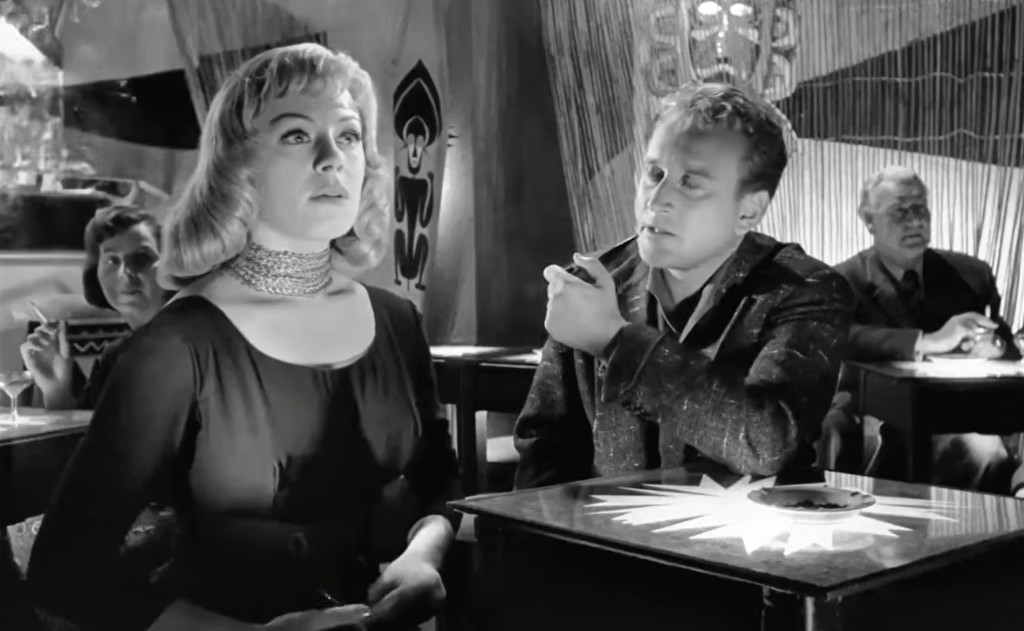
Karin Kernke plays the hunchbacked nurse who gets a body transplant. While best known for her appearances in a handful of krimis and horror films, as well as numerous TV movies and shoes, Kernke was a classically trained stage actress who continued an active presence on the theatre stage throughout her career. The Head was her film debut, and she continued a successful TV career until the year 2000. Apart from her role in The Head, she is best remembered for her performance in the Edgar Wallace krimi The Terrible People (1960). However, her bread and butter came from her work from the dubbing industry – she provided the German voice for actresses like Bette Davis, Anne Bancroft, Gena Rowlands, Hope Lange, Barbara Stanwyck and Lauren Bacall.
Michel Simon – aka the head – was a legendary Swiss character and lead actor whom Charlie Chaplin called “the greatest actor in the world”. Pamela Hutchinson at the Guardian writes: “one of the most distinctive presences in 20th-century French cinema: a soft-faced, gravelly voiced clown capable of tremendous pathos, and true chaos”. He started his career in the 20s on stage, and made his film debut in 1925. However, it was with the advent of talking pictures that he became famous. He is best remembered for his role in Jean Vigo’s L’Atalante (1934) as an eccentric, uncouth sailor sharing a barge as a flat with the film’s romantic couple. But, as Hutchinson puts it, the list of the legendary directors he worked with in classic films is a mile long: “he played the timid man transformed by his affair with a sex worker in La Chienne (1931) and the incorrigible tramp in Boudu Saved from Drowning (1932) for Jean Renoir. He worked with Marcel Carné in films such as Le Quai des Brumes (1938), with Carl Theodor Dreyer in The Passion of Joan of Arc (1928), with René Clair, Marcel L’Herbier, Julien Duvivier, GW Pabst … even John Frankenheimer in The Train (1964).”
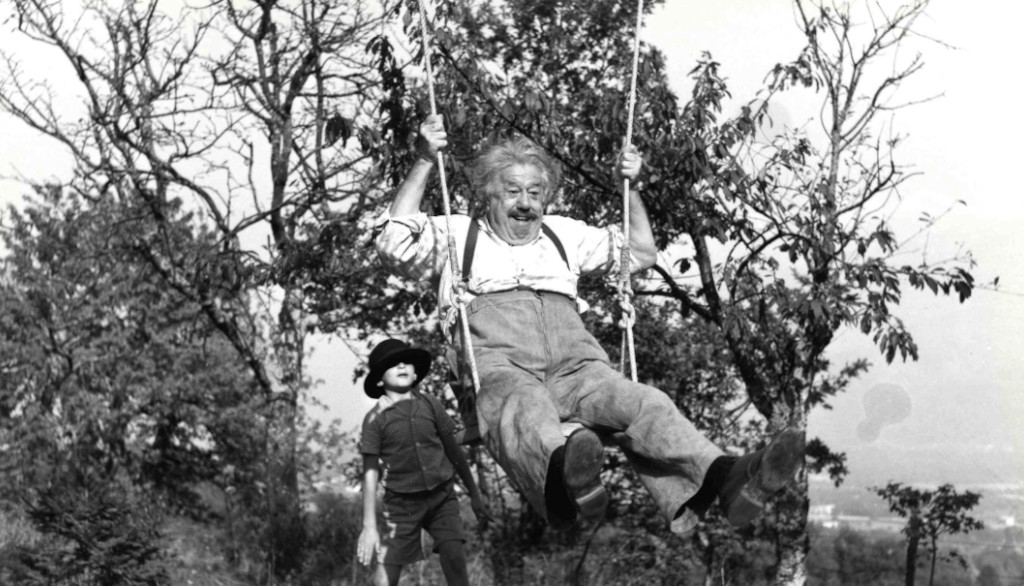
Simon’s career took an unfortunate turn in 1958 when he was severly poisoned by a faulty beard pigment, which led to serious health considerations. It badly affected his memory, effectively ending his stage career, and also left him partially paralysed in one side of his body. This limited what movie work he could accept, and was probably the reason he chose to star as a head in a low-budget shlock film like The Head. However, his disability didn’t hold him back for long, and by 1962 he was back in the game, and in 1967 he won a Golden Bear at the Berlin Film Festival for his performance in Claude Berri’s The Two of Us. Simon acted until his death in 1975.
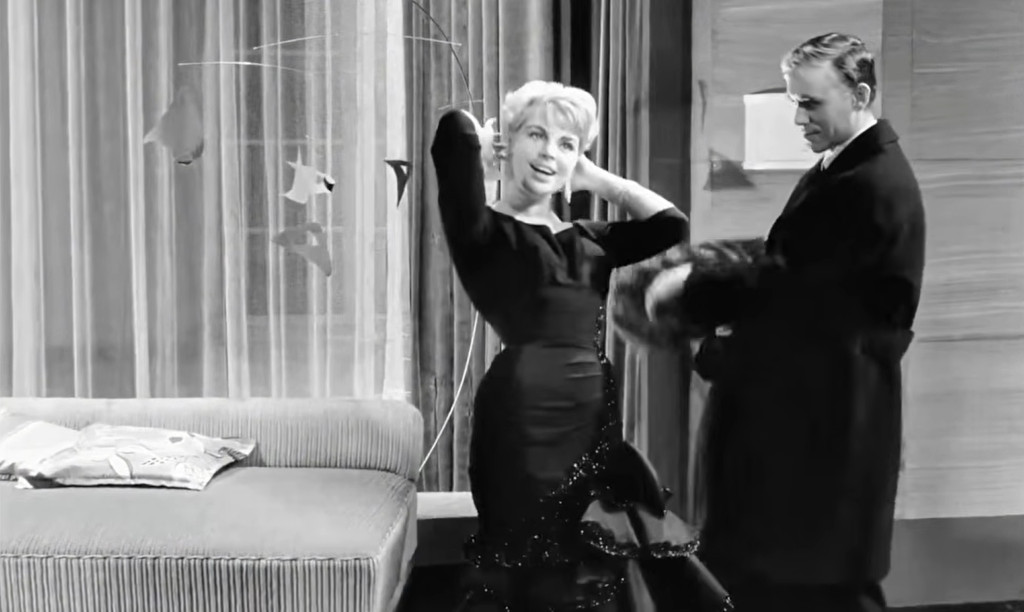
The alluring role of the stripper Lilly in Die Nackte und der Satan was played by Christiane Maybach, who replaced Kai Fisher, as she pulled out of the movie due to the costume requirements. Maybach, also a trained stage actress, had already built up a reputation as a bad girl actress, and was marketed as a “sexmbombe” and as Germany’s answer to Marilyn Monroe. She worked extensively, mainly in supporting roles, in both film and TV during the 60s, and in the 70s became a favourite of Rainer Werner Fassbinder. She appeared for him in World on a Wire, Eight Hours Don’t Make a Day, Fox and His Friends, Satan’s Brew, and the TV series Berlin Alexanderplatz. A younger audience in Germany remembers her best as a member of the cast of the soap opera Unter uns (1995–2005).
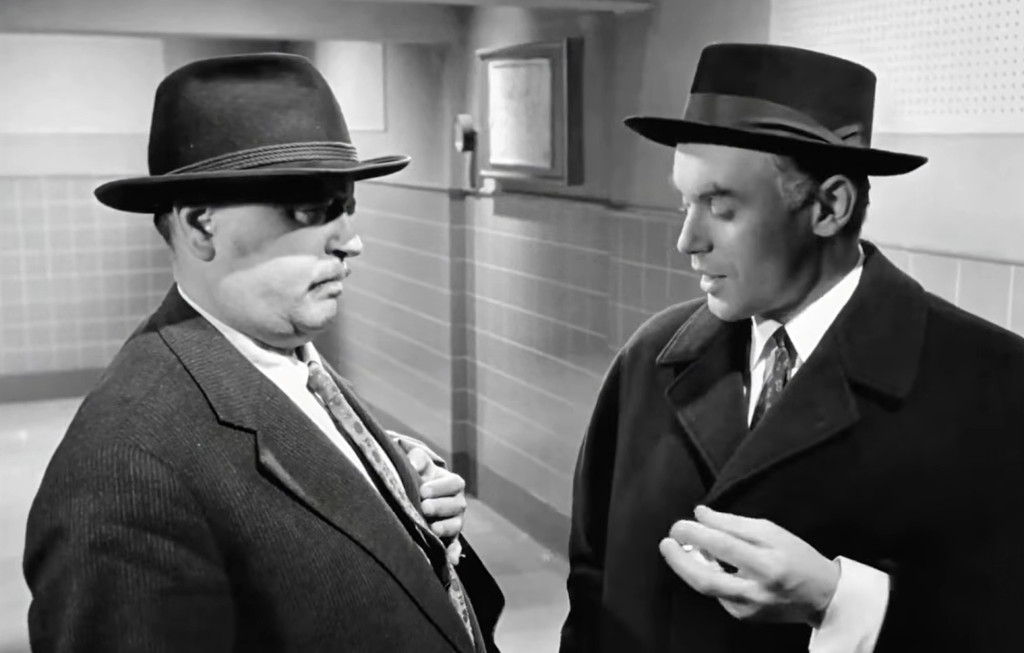
Die Nackte und der Satan was the second science fiction film for Paul Dahlke, who plays the police inspector, in 1959. He had previously appeared as Anneli Sauli’s father in Moonwolf (review). Dahlke was one of Germany’s most revered character actors both before, during and after WWII, and was one of the few movie stars whose career doesn’t seem to have been affected by the fact that he “collaborated” with the Nazis. In general, artists and actors who kept working under and benefitted from the Nazi rule faced serious career hurldes after the ending of the war. He was awarded the German Film Award (the Lola) in 1957 for his work in the Thomas Mann adaptation Confessions of Felix Krull, and a lifetime achievement award in 1974. Dahlke’s only SF movies were Moonwolf (1959) and Die Nackte und der Satan (1959).
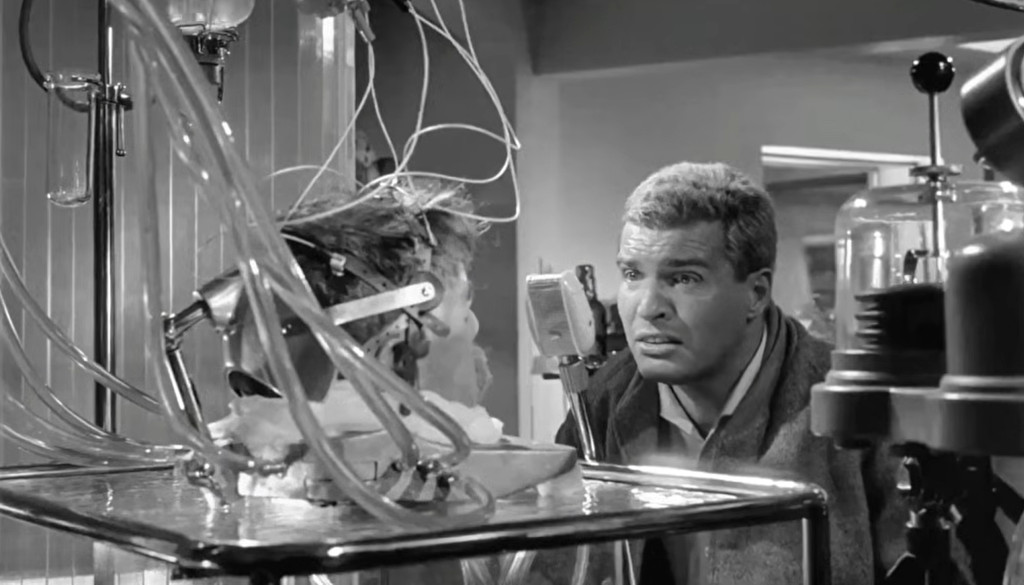
In Moonwolf, Dahlke appeared alongside Helmut Schmid, who plays Dr. Abel’s assistant in The Head. This is a very different role for Schmid, who played a Rutger Hauer-like villain in Moonwolf. Schmid had a solid background in the theatre, and never left the stage even when his film career took off – he eventually became a theatre director as well. From the mid-50s to the mid-60s Schmid was a mainstay in German mainstream movies. Although never among the country’s brightest stars, he worked steadily and successfully in pretty much every genre, often in co-leads or large supporting roles, not seldom opposite his wife Liselotte “Lilo” Pulver. In the mid-60s he transitioned from film to TV, where he worked until the late 70s, after which he focused on the stage. Schmid also appeared in a number of British and American movies filmed in Germany – most noteworthy in a co-lead capacity in the war/heist movie A Prize of Arms (1962). He had a bit-part in Billy Wilder’s One, Two, Three (1961) and had small supporting roles in Commandos (1968) and The Salzburg Connection (1972). His only SF movies were Moonwolf and Die Nackte und der Satan.
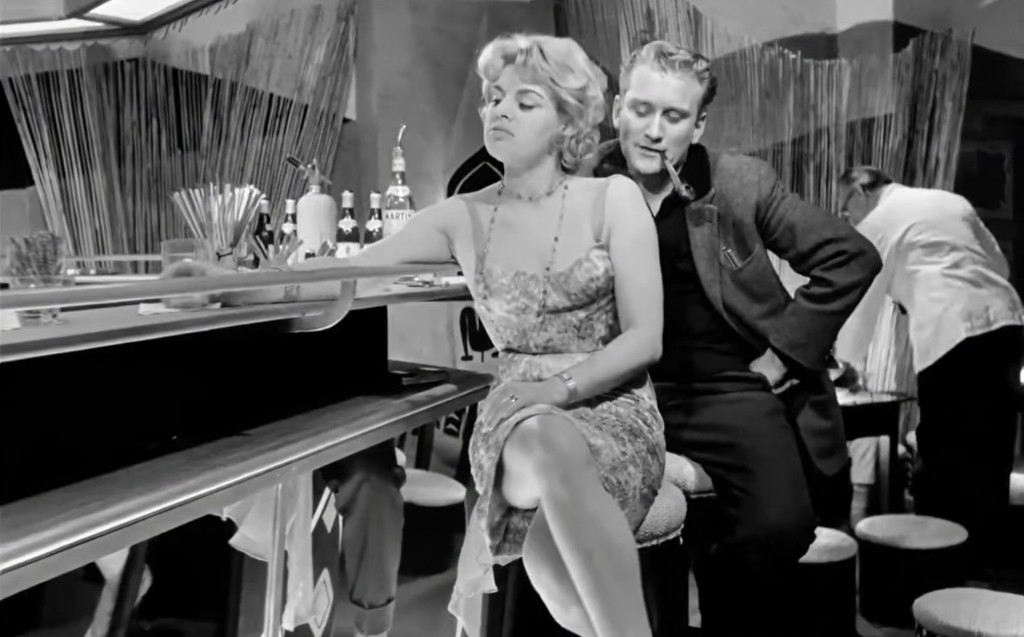
The male “romantic lead” in The Head is played by Dieter Eppler, who had just come off a minor success as the titular lead in the WWII submarine movie U47 – Kapitänleutnant Prien (1958). Eppler was a mainstay in Edgar Wallace mystery and krimi adapations in the late 50s and 60s, and a prolific character actor. In the 70s he became a regular face on many krimi TV shows. His biggest science fiction role was a lead in the television show Mission Terra (1988–1990), in which he played a co-lead as the commander of a crashed spaceship. He also appeared in The Head (1959) and The Death Ray of Dr. Mabuse (1964).
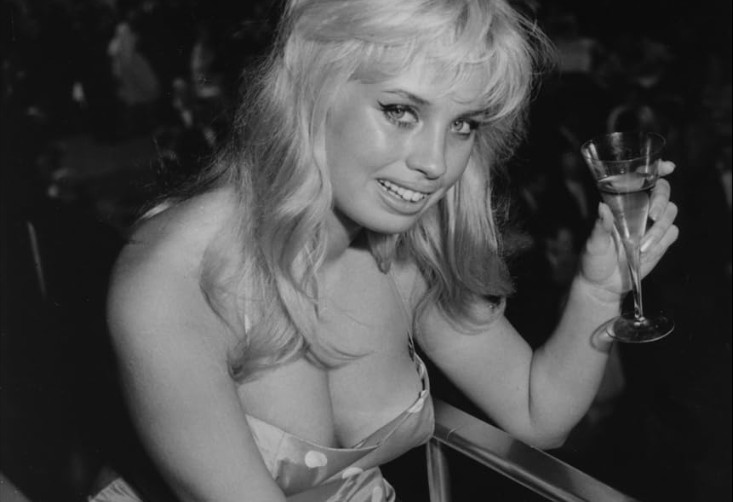
Die Nackte und der Satan was the debut of Barbara Valentin, “Germany’s Jayne Mansfield“, who would go on to have a similar career trajectory as Christiane Maybach. In the 60s she was a mainstay in sexploitation films, krimis and eurospy movies, and in 1973 became a Rainer Werner Fassbinder staple, appearing in small roles in around half a dozen of his productions. In 1973 she was part of the main cast of Fassbinder’s science fiction mini series World on a Wire. In the 80s and 90s she was a familiar face on TV, with her greatest claim to fame problably a recurring role in Fassbinder’s classic TV show Berlin Alexanderplatz (1980), alongside Maybach once again.
Die Nackte und der Satan was an early credit for Heidi Genée as an assistant editor. Genée would later go on to be a successful director, producer and screenwriter in her own right. Her film Grete Minde (1977) won the Silver Ribbon for best film at the German Film Awards, and was nominated for a Golden Bear at the Berlin Film Festival, and Kraftbrobe (1982) was nominated for a Golden Bear. Her most successful film was the 1979 feminist comedy drama 1+1=3, which followed a pregnant actress fighting for independence and self determination. It swept the table at the German Film Awards, with best picture, best direction, best screenplay and best actress awards and also earned Genée the Ernst Lubitsch Award.
Polish camera operator Andrzej Jerzy Piotrowski also went on to become a director and screenwriter. He is best known for the movie Znaki na drodze (1970) (“Signs on the Road”), about an ex-con who becomes a union activist. The movie won the Golden Leopard for “best second work” at the Locarno Film Festival.
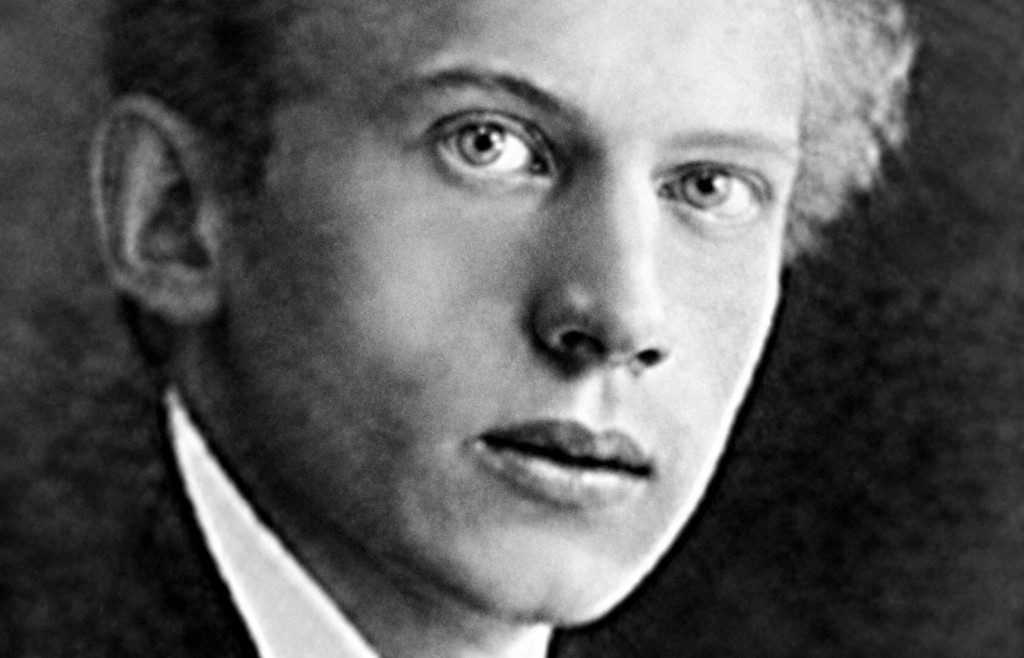
The man responsible for the simple but well-executed mirrors shots of Dr. Abel’s floating head was Theo Nischwitz, who was one of the pioneers of visual effects and special effects photography in Germany and worked on a number of high profile films in his career. His best known work is probably in Wolfgang Petersen’s classic submarine movie Das Boot (1981), where he was responsible for the scenes of the crew in the submarine tower during a storm. He also created visual effects for several science fiction films and TV shows: F.P.1. Does Not Answer (1932, review), Gold (1934, review), Der Herr vom andern Stern (1948, review), Super (1984), Hard to Be a God (1989) and Moon 44 (1990), the film Roland Emmerich directed just before his international breakthrough with Universal Soldier in 1992. Moreover, he did the effects for the hugely popular TV show Raumpatrouille – Die phantastischen Abenteuer des Raumschiffes Orion (1966) and its 2003 movie adaptation, as well as the TV series Telerop 2009 – Es ist noch was zu retten (1974).
Makeup artist Susi Krause’s first credit was on the 1952 remake of Alraune (review) starring Hildegard Knef. Over the years she became a sought-after makeup artist and hairdresser, and worked on a number of big-budget Hollywood movies filmed in Germany, such as Willy Wonka and the Chocolate Factory (1971) and Cabaret (1972).
Janne Wass
Die Nackte und der Satan. 1959, West Germany. Written & directed by Victor Trivas. Starring: Horst Frank, Karin Kernke, Michel Simon, Dieter Eppler, Christiane Maybach, Helmut Schmid, Paul Dahlke, Kurt Müller-Graf, Barbara Valentin. Music: Willy Mattes (& Jacques Lasry?). Cinematography: Georg Krause. Editing: Friedel Buckow. Production design: Hermann Warm, Bruno Monden. Makeup: Susi Krause, Karl Hanoszek. Sound: Rudolf Kaiser. Visual effects: Theo Nischwitz. Wardrobe: Anna Hanoszek, Otto Suckrow. Produced by Wolf C. Hartwig for Rapid Film.


Leave a Reply