

Jack Arnold’s crowning achievement from 1957 is a haunting parable about coping with a world that loses its meaning. An occasionally sluggish script is the only thing keeping it from masterpiece status. 9/10
The Incredible Shrinking Man. 1957, USA. Directed by Jack Arnold. Written by Richard Matheson & Alan Richard Simmons. Based on novel by Matheson. Starring: Grant Williams, Randy Stuart, Paul Langton, April Kent, William Schallert, Raymond Bailey. Produced by Albert Zugsmith.
IMDb: 7.6/10. Rotten Tomatoes: 8.10/10. Metacritic: 73/100.

While on a romantic boating trip with his wife Louise (Randy Stuart), ordinary middle class husband Scott Carey (Grant Williams) gets enshrouded in a strange mist, which leaves a glittery residue on his body, on the sun deck of the boat. Louise, in the cabin below, is not affected by the cloud. The couple think no more of it, but soon Scott starts losing weight. They chalk it up to Scott eating too little and stressing at work, but soon it becomes obvious that Scott is actually shrinking. When his doctor (SF staple William Schallert) can’t explain the phenomenon, Scott is sent to a specialist, Dr. Silver (Raymond Bailey), and after a series of tests, he concludes that Scott’s shrinkage is due to a unique combination of having been exposed both to a certain kind of insecticide and nuclear fallout. What’s worse: Dr. Silver can’t say if Scott will ever stop shrinking, nor is there any known cure.
This is the build-up to The Incredible Shrinking Man (1957), Universal’s last great SF classic of the 50’s, directed by the studio’s genre master Jack Arnold, the man who directed almost all of Universal’s iconic science fiction movies: It Came from Outer Space (1953, review), Creature from the Black Lagoon (1954, review), Revenge of the Creature (1955, review), This Island Earth (at least partly, 1955, review) and Tarantula (1955, review).

Scott and Louise do their best to adapt to their new reality, but become gradually estranged as Scott continues to shrink. Scott becomes ever harsher and sterner with his wife, trying to compensate for his physical emasculation, while Louise begins to talk down to her husband as if he were a child. Eventually Scott loses his job, and to make matters worse, news leaks out to the press about the Incredible Shrinking Man, and before long, journalists are picketing the Careys’ lawn. His shrinkage is momentarily halted with a new experimental treatment, and for a while it seems that Scott might be able to live out his life the size of a little person. At a carnival, Scott meets sideshow performer Clarice (April Kent), one of the many little people working as entertainers, with whom he finds an equal companionship. However, when after a while he realises that he is beginning to shrink once more, and escapes back into the care of Louise.

Eventually Scott becomes small enough to to fit in his wife’s palm, and she furnishes a doll-house for him to live in, where he is now completely reliant on his wife feeding and caring for him, as if she was playing with a doll. One day the family cat attacks him, knocking over the doll-house and chasing Scott across the living room floor. Scott takes refuge behind the door to the cellar, but gets pushed down the stairs into a yawning abyss. When he comes to he is trapped, with no way to make it up the towering stairs. This cellar jungle is where he must make his new home, while finding some way to escape. At his size, everything familiar becomes foreign and changed. Scott finds shelter for the night in a matchbox, locates a drip from a boiler as a water source, and furnishes a sword out of a sewing needle. A crumb of dried cheese becomes an everlasting pantry and a spider a gargantuan monster.

After his first shock and despair, Scott decides to take his fate into his own hands, refusing to die useless and resigned to to his destiny in the damp basement. He must use his ingenuity and wits to find a way to claim mastery over his environments — and to find a way out and back into the world. A pin and piece of thread become a grappling hook, a wooden box and a can of paint a mountain to climb, and the spider becomes the dragon he must slay in order to regain his manhood. But as Scott keeps getting smaller, time is running out. And in the back of Scott’s mind is the ever nagging question: Will I eventually be reduced to nothing at all?

Analysis
When author Richard Matheson in 1956 was working on his novella The Shrinking Man, he was approached by Universal producer Albert Zugsmith, who had recently had a smash hit with the star-studded drama Written on the Wind (1956), but who had begun his career with low-budget science fiction movies. Zugsmith proposed to turn the story into a film. Matheson agreed, but on the condition he was allowed to write the script himself. Matheson, who eventually became one of the most adapted SF authors in film history (with many adaptations written by himself) had only had one brush with the visual medium, as his short story Shipshape Home had been adapted for a TV show in 1955. Matheson wrote the script the same way as he wrote the book, telling the story in flashbacks. Universal however, wanted a more linear story, and turned the script over to Richard Alan Simmons, a staff writer who had worked mostly with the studio’s B movies. Simmons removed the flashback structure and turned the plot into a linear one. Matheson finished the book at the same time as he wrote his script, and the book was released in 1956, when the film had gone into production.

As director, Zugsmith wanted Jack Arnold, who had given Universal such great SF movies in the past, and who understood the special effects needed, but who left the studio in 1955, complaining that the popularity of AIP’s super-cheap schlock films caused Universal to shun intellectual depths and artistic quality in their science fiction projects. However, impressed with Matheson’s story, Arnold agreed to be called back for another project.
The studio wanted Mara Corday and Dan O’Herlihy for the roles of Scott and Louise, but both declined. O’Herlihy (best known as “the Old Man” in RoboCop [1987]) had recently played Robinson Crusoe, and didn’t want to be typecast as a man in isolation. Corday thought the role of Louise “thankless”. Universal then turned to stock player Grant Williams, whom they pegged as a future star (didn’t happen), giving him his first starring role, and Jack Arnold proposed his old friend Randy Stuart, at the time a busy TV actress, for the role of Louise. After readings, Williams and Stuart were deemed acceptable in the leads, and having essentially no-name actors in the starring roles also meant Universal could put most of the budget on the special effects, which were what was going to sell the film anyway.

Shooting began in the end of April, 1956, with process photography, particularly so-called black velvet shots, the precursor of blue and green screen photography. Shooting took place almost exclusively at Universal Studios, with little location work. Clifford Stine, a Jack Arnold veteran, was in charge of the special effects photography. Arnold employed a number of different techniques for shrinking Grant Williams, such as the afore-mentioned black velvet composition shots, but also oversized furniture, props and sets, as well as good old forced perspective shots. Scenes with oversized furniture were shot at Universal’s backlot and the basement scenes in studio’s largest sound stage. Williams, apparently a trooper, was injured on several occasions while climbing the sets, and at one point visited the hospital because of eye problems. 20 almost identical cats were used to film the scenes in which the family pet was involved, and Arnold put food inside the doll house in order to coax the feline menace to try and get inside the house. Arnold originally tried to use a black widow spider, which is the species described in the book, but found they were too small for film. He instead turned to tarantulas, which he had also used in his previous film Tarantula (despite the fact that tarantulas don’t weave webs, which are a central part of one of the film’s set pieces). The spiders were “directed” with the help of puffs of air. Sadly, the hot studio lights led to the death of 15 spiders. All in all, the budget for The Incredible Shrinking Man has been reported as somewhere between $700,000 and $800,000, and the movie was shot in about five to six weeks, including special effects work.

Despite the script being (largely) written by Richard Matheson himself, there are several differences between book and film. The most obvious is that the script, as stated, is written in a linear fashion, while the book is told in flashbacks, beginning with Scott running from the spider, and thinking back on the events that led him to his predicament. But the book is also much more straightforward in describing Scott’s sexual emasculation. And while neither Matheson’s script nor Arnold’s direction shy away from the theme, which is clearly identifiable by adult viewers in the subtext, it is never explicitly outspoken. In the book, Scott is preoccupied with the notion that he is no longer able to satisfy his wife secually, and that the more he shrinks, the more she begins to regard him as a child, emasculating him both in a sexual and social sense. When diminished to the size of a child, Scott also starts losing interest in his wife, and instead secretly lusts after the family’s teenage babysitter. In the book, he also spends the night with the midget Claire. These notions were probably considered too adult for the adolescent science fiction audience that Universal was, at least initially, aiming the movie at. The script also leaves out other, more violent passages.

However, this does not mean that the film would be devoid of these more adult themes — they are simply more subtextual than outspoken. As many film scholars have pointed out, among them Bill Warren and Glenn Erickson, The Incredible Shrinking Man is one of the most sublime treatises on American 50’s cold war anxiety. In other hands, this movie could have been one where the audience had been continuously warned about reds under the beds or the dangers of nuclear bombs. But Matheson and Arnold are not interested in making ideological statements, or even moral ditto. Instead, they choose to illustrate the psychological dilemmas in a world the familiar becomes threatening and the rug is pulled out under one’s feet in terms of security and meaning. In Stephen King’s Danse Macabre, Matheson is quoted on the inspiration for his original story: “I had gotten the idea several years earlier while attending a movie in a Redondo Beach theater. In this particular scene, Ray Milland, leaving Jane Wyman’s apartment in a huff, accidentally put on Aldo Ray’s hat, which sank down around his ears. Something in me asked, ‘What would happen if a man put on a hat which he knew was his and the same thing happened?’ Thus the notion came.”

On the one hand, The Incredible Shrinking Man can be seen as an exploration of the changing gender roles in American society, which it certainly is, on one level. But to simply dismiss it as a comment on the rise of women’s liberation would be to do it a huge disservice. In fact, the film is not very interested in women at all, but rather explore the role of men in 50’s American society. Or even more accurately, that of Americans and humans in general. And while its themes are closely related to the social and global upheavals of the era, Matheson’s script is not an allegory, but one which deals with timeless philosophical and pshychological issues, which explains why it holds up so well even today.
Scott Carey is the everyman poster boy for the 50’s suburban middle-class. An anonymously good-looking man with an anonymously good-looking wife, working an anonymously respectable job and living in an anonymously comfortable house. Scott has achieved everything that 50’s American society says that he should achieve in order to be a happy, successful model citizen. He is the man of the house, his wife chirps happily when bringing him his after-work beer and it looks as if it is only a matter of time before the statistical 2.4 children are running around Scott’s feet, completing his middle-class happiness. Then, everything slowly starts to slip away. When stripped of all the modern material and social trappings of “manhood”, Scott must fall back on his basic instincts of survival, reduced to a stone-age hunter/gatherer, and assert his territory in his new reality.

When explained like this, I realise that the film can come across almost as a jordanpetersonesque critique of how modern society emasculates young men, and when analysed from a modern perspective, I suppose this is one possible interpretation. However, firstly, 50’s America was very much a man’s world, and the tentative female liberation achieved during WWII had been pretty much stamped out in 1956 through a decade of indoctrination into the idea of “traditional family values” and the notion of middle-class suburbia, where a woman’s greatest happiness lie in caring for her family. Secondly, Matheson never suggests that there is anything wrong with Scott’s middle-class suburban life. His descent into caveman-mode isn’t the climax of the book, and is never portrayed as a “liberation”. It’s a circumstance, and a pretty shitty one, at that.

My interpretation (and that of the afore-mentioned Warren and Erickson as well) is that Scott’s loss of normalcy is a description of the bewilderment of the American citizen during the 50’s cold war communist and nuclear paranoia. Keep in mind that his shrinking is caused by the passing of a radioactive cloud from a nuclear test. One must remember that for a lor of Americans, the threat of a communist takeover or a nuclear war was just as all-encompassing and dread-inducing that climate change is for many young people today. The media and and politicians warned us about reds under all the beds, and there was a perpetual mushroom cloud hanging over everyone’s psyche. The world was still in a state of bewilderment over the power of nuclear fusion – and now scientists were already talking about hydrogen bombs and nuclear fission, that would make Hiroshima and Nagasaki look like pop guns. As Glenn Erickson puts it in his review at DVD Talk, Scott is confronted with “a world in which common values, presumed facts and assumed conventions might be completely transformed. Scott Carey must come to grips with an imminent and implacable fate that may not only destroy his life but render it meaningless as well.” Ian Nathan writes in Empire: “Such everyday comforts as his own pet cat, climbing off a kitchen table, and the dusty confines of a basement, are transformed into a terrifying vertiginous world fraught with peril”. Whatever you think of climate activist Greta Thunberg, one can imagine that she is driven by the same kind of oppressive fear that renders her existence completely meaningless. When young people today watch the world inevitably steering itself – deliberately – toward oblivion (in their minds at least), they must feel the same bewilderment at the loss of meaning and logic, as Scott Carey. And back in the 50’s, many surely had a similar feeling about the post-WWII world.
We have not yet discussed the famous – and contested – ending of the film, and if you have not yet seen it, I suggest you skip forward to the five asterisks ***** further down, as I don’t want to spoil it for you.

At the end of the film, Scott Carey shrinks to such small a size that he is able to crawl out of a grate in a window. When he steps out and looks at the stars, he realises that they look exactly the same as before: in the awesome scale of the universe, his size change doesn’t even register. In a voice-over narration, Scott exclaims:
And in that moment, I knew the answer to the riddle of the infinite. I had thought in terms of man’s own limited dimension. I had presumed upon nature. That existence begins and ends is man’s conception, not nature’s. And I felt my body dwindling, melting, becoming nothing. My fears melted away. And in their place came acceptance. All this vast majesty of creation, it had to mean something. And then I meant something, too. Yes, smaller than the smallest, I meant something, too. To God, there is no zero. I still exist!

This final monologue has been interpreted in a number of ways. One popular interpretation is that this meant Scott’s death – dwindling, melting, becoming nothing, and accepting that he still exists, in a religious sense, as a soul in heaven. However, it isn’t death as such that has preoccupied Scott’s mind for the duration of the film, but rather loss of self, meaning and purpose. If he just ups and dies, it would make The Incredible Shrinking Man something of a shaggy dog story.
Rather, and in keeping with the interpretation that the film is trying to deal with Scott’s disillusionment with his place in a world gone topsy-turvy, the ending can be interpreted as Scott living on, and finding affirmation in the vastness of the universe: “I still exist!” No matter how small, seemingly lost and estranged from the normalcy of his former life, Scott realises that he is still in control of what matters – himself, his thoughts, his actions and his “soul”, if you believe in such a thing. No matter how small, he is not “less”, no matter how lost, he is not “gone”. His value as a being, as himself, has not diminished, has not been lost, but he is still as much himself as he ever was: “I still exist”. Furthermore, the line “To God, there is no zero”, indicates that Scott will never disappear or die because of his shrinking, but will carry on living (unless eaten by a bird or something) until he dies of old age, however minuscule. In short, it Scott’s realisation offers comfort for those lost in an incomprehensible world.
******

Welcome back to those who skipped the discussion on the ending. One could continue analysing the themes in and the interpretations of The Incredible Shrinking Man for ages, but let’s move on to the special effects, which were the original selling point of the movie. Rather than any philosophical message, it was the exploitable possibilities of the material that drew Albert Zugsmith to Richard Matheson’s story. Zugsmith had began his career by changing the title of Jack Pollexfen and Aubrey Wisberg’s halfway decent and fairly thoughtful post-apocalyptic script “3000 A.D.” into Captive Women (1952, review) for its marketing potential, and then went on to produce the terrible red scare film Invasion U.S.A. (1952, review). When left to his own devices after being shunned by major studios, he started producing and directing sexploitation movies.
It was on the special effects and the exploitation angle that Zugsmith sold the idea of the film to Universal, and the studio was aware that the effects had to be good in order to pass muster. And boy, were they good. Exactly who did what on the effects is somewhat unclear. Clifford Stine is credited for “special effects”special photography”, but his field was mainly rear-screen projection. The composition shots were probably handled by Roswell Hoffmann, who had worked closely with special effects master John Fulton on most of Universal’s classic Invisible Man movies. Tom McCrory also has a credit for special photography, and he later went on to become an assistant director, so one can assume he worked on some sort of live action photography. Cleo E. Barker, a miniature man, is credited for special effects, as is Fred Knotts, who picked up a technical Oscar in 1955 for developing a new kind of fog machine, so it’s probably safe to assume these gentlemen worked on practical effects.

Whoever did what, the effects were superbly done. Apart from the oversized sets and props, the special effects team pulled out every trick in the book in order to make the giant world around Grant Williams believable: forced perspective, rear-screen photography, black screen photography, split-screen photography, matte shots and probably many more. None of this was pioneering – Universal hade made good use of the same techniques in 1933’s The Invisible Man (review), and most of them had been around since the dawn of cinematography. But much of it is refined with the help of better technology and more refined practices. Much of what is done here holds up surprisingly well even i today’s world of seamless CGI. Not everything is perfect. Sometimes you can see the split-screen lines, some of the rear-projection is obvious, the light and exposure in the composite shots don’t always add upp, there are sometimes visible matte lines and in in several shots, Williams lacks a shadow. But these are nitpickings.

Director Jack Arnold was not an auteur – he had no discernible style, which is probably one of the reasons he is all but forgotten today, except within the science fiction community, despite directing some of the most iconic movies of the 50’s. You can watch a Hitchcock film, an Orson Welles film or a Howard Hawks film and immediately recognise it as the handiwork of said director, but it’s impossible to pick out the works of Arnold simply from watching a movie. When you do know it’s him, you can recognise many Arnoldian elements, but they are often too subtle to give away the identity of the director. Arnold adapted his style according to the story, and could use bold and striking elements when this was called for, but more often than not, he let the script and the actors tell the story, rather than smother them with his own visual interpretations of the material. In a way, one can say Arnold worked within a realist tradition, despite many of his films being thematically far removed from realism. Arnold’s mundane photography works particularly well in The Incredible Shrinking Man, as it sets a realistic and believable backdrop for the incredible story. And instead of creating a nightmarish vision of Scott’s ordeal, Arnold lets the realism of Scott’s predicament be what creates the horror.
Scott and Louise are also mundane characters living a mundane life, and the decision to cast the roles with no-name actors was the right one. Grant Williams and Randy Stuart are also forgettable actors, in the kindest sense of the word. They don’t step in front of the camera in order to knock you over with their charisma or panache, but rather try their best to inhabit the characters they are given — in this case, a rather colourless, if sympathetic, couple. That is not taking away from the awesome acting challenge that Williams takes on in The Incredible Shrinking Man, a movie which he carries entirely on his own shoulders. Would he not have been able to sell the story and make the audience emotionally invested in the character, the whole film would have fallen flat.

The Incredible Shrinking Man is guaranteed a spot among the 10 best science fiction films of the 50’s on anybody’s list. It has a smart, tight script that doesn’t pander to audiences and is generally devoid of most of the typical 50’s SF clichés. While the special effects naturally don’t hold up to modern scrutiny, many of them are good enough to sustain the illusion even for a critical audience of the CGI age. But what really makes it feel fresh even today boils down to two main reasons. First of all, it is not a message film, but at heart an adventure that can be enjoyed in any day and age. But it is also a film with serious and adult themes. And while it alludes to the nuclear bomb, it is not an allegory. Scott’s shrinking is a result of radiation, but it could really be interchanged with anything else, and it wouldn’t change the rest of the film. While it can be interpreted as a comment on the looming nuclear war and cold war anxiety, the psychological and social themes are timeless, meaning new audiences can find new interpretations of it — such as, as I have alluded to — the threat of climate change.

Secondly, what makes this film stand out is its ambiguous ending. I’m still not going to spoil it, but as I pointed out earlier, the ending can be interpreted in a number of ways. It is not a necessarily a happy ending, but it can be interpreted as such, depending on your analysis of the film and your point of view. What it is not, however, is a typical sugary Hollywood ending where everyone lives happily ever after. This was a bold move in 1957, especially for a film that was primarily produced for a market of adolescents, those who went to see films with giant monsters and flying saucers. The ending makes you feel you have watched a film with substance, one that actually makes you ponder the meaning of it. That is what makes The Incredible Shrinking Man one of the best science fiction movies of the 50’s.
However, it has never been one of my absolute favourites. Despite all its qualities, it is a film that has always left me just a little bit cold. Part of it is the fact that the plot is somewhat messy, and lacks a clear dramatic structure. This is partly what makes it stand out, but also makes it a bit arduous to watch, and it especially makes the middle sag a bit.
The Incredible Shrinking Man was certainly not the first film to include giants and tiny people, but very few science fiction movies to date had actually tackled the idea of size change. The first film to do so was probably Tod Browning’s The Devil Doll (1936, review), in which Lionel Barrymore in drag shrinks people and uses them as assassins. The only other SF entry prior to 1957 that took on the idea was the underrated Dr. Cyclops (1940, review), an early Paramount colour chiller in which a mad scientist shrinks his guests from the confines of his hut in the Peruvian jungle.

Reception & Legacy
Director Jack Arnold has stated that he met with considerable opposition from Albert Zugsmith and the studio. However, to his relief, Zugsmith was mostly absent from set. According to Arnold, Zugsmith thought he was making an exploitation movie, and, as a result, so did the studio. However, at some point during post-production, Universal seems to have changed its mind about the movie, and advertised it not only from the effects angle, but also as a serious film with adult themes. The studio and Arnold especially clashed over the ending, with the studio demanding two endings be shot, the downbeat one that ended up in the final film, and a happy ending, where everything turns back to normal and everyone lives happily ever after. The film was shown to test audiences with the original ending, and the audience responses overwhelmingly showed a dislike to the film’s ambiguous ending. However, for one reason or the other, Matheson and Arnold convinced the studio to take a risk with the bleaker ending.
The film opened in February, 1957 in New York, followed by a release in Los Angeles in March, and a general release in April. It was an instant hit with theatre-goers, and grossed over 1.4 million dollars in the US, making one of the highest-grossing films of the year.

The film received mixed reviews at the time of its release. Few were as negative, however, as Bosley Crowther’s in the New York Times, which panned the film completely: “unless a viewer is addicted to freakish ironies, the unlikely spectacle of Mr. Williams losing an inch of height each week, while his wife, Randy Stuart, looks on helplessly, will become tiresome before Universal has emptied its lab of science-fiction clichés.” Generally, the effects were universally praised, by for example Variety, in which Brog wrote that the film “isn’t a thoroughly satisfactory chiller, even though there is enough on the good side to carry it”.
However, most reviews were positive. Philip K. Scheuer of the Los Angeles Times called the film “a fascinating exercise in imagination, as terrifying as it is funny […] Science-fiction admirers who are accustomed to finding food for thought as well as vicarious thrills in such flights of fancy will not be disappointed, either.” Photoplay called the movie “a refreshing variation on the themes of giant monsters and space stravels”. And Harrison’s Reports named it “an unusual and fascinating horror melodrama”.
The film was unusually well-received by science fiction fans, happy that, for once, a studio actually hired a science fiction writer to write science fiction, and the film received the first ever Hugo Award for Best Dramatic Presentation in 1958. In 2009 it was chosen to be preserved in the US National Film Registry.

In his 1970 book Science Fiction in the Cinema, John Baxter calls the movie “a fantasy that for intelligence and sophistication has few equals”. He continues: “Written with Matheson’s usual insight and directed with persuasive power, this film is the finest Arnold made and arguably the peak of SF film in its long history.”
In The Encyclopedia of Science Fiction Movies (1984), Phil Hardy writes: “One of the great anxiety movies of the fifties, The Incredible Shrinking Man, is far more than a collection of suberb special effects. Matheson’s script perfectly captures the paranoia rampant in Cold War America as the hero’s life, marriage and prospects literally collapse around him as he shrinks to oblivion.”
The Incredible Shrinking Man is a staple on lists of the best SF movies of the 50’s, however, it very rarely cracks the top-3. One reason may be that it was oddly obscure in the decades after its initial release. The film was rarely shown on US TV, and it wasn’t until 2021 that the movie got a proper all-the-bells-and-whistles release on home video, as Criterion released a new restoration. However, over the years the movie has secured its place in the Pantheon of science fiction movies. And if imitation is the highest form of flattery, then the movie should indeed feel flattered. As stated above, size change in humans had been a surprisingly rare theme in SF movies up until 1957. Giant spiders and insects abounded in the mid-fifties, following the superb Them! (1954, review), but only two SF movies had addressed humans shrinking – and none that of humans growing. Shrinking didn’t quite catch on as a general trend, but The Incredible Shrinking Man instead inspired a slew of films about individuals growing uncontrollably – thus combining the old giant monster trope and the size change idea. The Amazing Colossal Man (1957, review) was first out the gate, followed by the classic of the genre, Attack of the 50 Foot Woman (review), the same year.
Today, The Incredible Shrinking Man has a 7.6/10 audience rating in IMDb, based on 20,000 votes, and an 83% Fresh rating on Rotten Tomatoes (with an 8.10/10 critic average). The other big review aggregate, Metacritic, awards it 73/100 points. AllMovie gives it a 4.5/5 rating.
In 2006, Empire Magazine’s Ian Nathan gave the film a 4/5 star review, writing: “Whilst paranoid in a very 1950’s way and a little downbeat at times this is very enjoyable”. Slant Magazine’s Chuck Bowen praises the film, writing: “Arnold, a shrewd and resolutely direct journeyman stylist, embraces Scott’s transformation with becoming matter-of-factness, springing trick images that underscore the wonder and torment of the everyday. In short, Arnold takes Scott seriously, as Matheson did on the page, allowing amazing adventures to stem out from his psyche.” Though he notes that “It’s a pity that the film, constrained by the censorious standards of its time, couldn’t dive deeper into the psychosexual implications of this scenario the way that Matheson did in the book”. TimeOut says: “Not merely the best of Arnold’s classic sci-fi movies of the ’50s, but one of the finest films ever made in that genre”. And finally, TV Guide writes: “Notable for its relatively intelligent script, for some imaginatively amusing special effects, and for an existential streak which finally has our hero pondering the meaning of existence.”

Following the film’s success, Universal asked Matheson to pen a sequel, and he delivered a script called “The Fantastic Little Girl”. According to film historian Bill Warren, the script follows Scott’s wife Louise, who also starts shrinking, and eventually teams up with her tiny husband, fighting microscopic monsters. Warren feels the script has little of the magic of the original, and seems tailored for Hollywood exploitation. However, the film never got off the ground, but for decades, Universal had plans for a semi-sequel. That finally seemed to come about in 1979, when John Landis was set to write and direct The Incredible Shrinking Woman. However, the project was ultimately deemed as too expensive, and the project was shelved. However, instead Universal gave the project to writer Jane Wyman, and hired a young Joel Schumacher to direct. This version, a parody of the original film, was released to generally negative reviews in 1981. A comedy remake was announced in 2003, as an intended Eddie Murphy vehicle, but never got off the ground. The rights to the source material was bought up by MGM in 2012, and the studio put Richard Matheson to work on a remake, along with hus son, Richard, Jr. However, this project was buried with the death of Matheson, Sr. in 2013.
Cast & Crew
During his career, which stretched from 1950 to 2013, American author Richard Matheson won the World Fantasy and the Bela Lugosi lifetime achievement awards, two World Fantasy literary awards, and was inducted into the Science Fiction Hall of Fame. He died days before he was about to receive the Saturn lifetime achievement award. He is one of the most frequently adapted post WWII science fiction and fantasy writers, and wrote numerous scripts for both film and TV himself.
Matheson published his first short story as a professional writer in 1950, and his first novel in 1953. His first brush with TV came in 1955, as his 1952 short story Shipshape Home was adapted for an episode of the show Studio 57 (as “Only Young Lovers”. This supernatural paranoia contains a janitor described as a Peter Lorre-lookalike, and the studio shrewdly hired Peter Lorre to play the role. However, Matheson had no involvement in the production. As stated, The Incredible Shrinking Man was his first screenplay, and also the first time one of his works was turned into a movie. Matheson says he quickly took to screenwriting.

Matheson published close to 30 novels and close to 100 short stories. Much of his writing concerned the supernatural or science fiction, but he also wrote psychological thrillers and western stories. He is best known for two of his early SF novels, I Am Legend (1954) and The Shrinking Man (1956). I am Legend deals with vampirism from a scientific point of view, and is often viewed as a precursor to modern zombie fiction. It has officially been adapted for the movies thrice; first in 1964 as The Last Man on Earth, starring Vincent Price, then in 1971 as The Omega Man, starring Charlton Heston and lastly in 2007 as I Am Legend, starring Will Smith. The premise was also “borrowed” for the pioneering zombie movie Night of the Living Dead in 1968, and it was unofficially adapted as the straight-to-DVD film I am Omega in 2007. EDIT: As of March, 2025, a sequel to I Am Legend is in production by Warner Bros., teaming up Will Smith with Michael B. Jordan in a film co-penned by sci-fi blockbuster specialist Akiva Goldsman and directed Francis Lawrence of The Hunger Games fame.
Matheson also became a frequent contributor to the legendary TV show The Twilight Zone. Matheson contributed to 16 Twilight Zone episodes, either as a source author, teleplay writer or both. The best known Matheson episodes are probably “Third from the Sun” (1960), “Nick of Time” (1960), “The Invaders” (1961), “Steel” (1963) and especially Nightmare at 20,000 Feet (1963). Two of these starred William Shatner. Matheson also contributed to TV shows like Star Trek, Night Gallery, The Martian Chronicles, Amazing Stories and The Outer Limits. He also wrote the screenplay for AIP’s 1961 Jules Verne adaptation Master of the World, starring Vincent Price and Charles Bronson, and his short story Steel “inspired” the battlebot movie Real Steel (2011), with Hugh Jackman.
As a screenwriter, however, Matheson was more prolific in the supernatural, fantasy and horror genres, and is particularly well known for his collaboration with Roger Corman on five Edgar Allan Poe adaptations. In 1968 he wrote the screenplay for one of Hammer’s most intriguing horror movies, The Devil Rides Out and in 1980 he adapgted his own novel Bid Time Return into the successful romantic fantasy Somewhere in Time, which won a Saturn Awarrd as best fantasy movie of the year. Conversely, in 1983, he co-wrote the screenplay for Jaws 3-D, which was nominated for five Razzie Awards, including worst script. However, this was the year that The Lonely Lady swept the awards at the Razzies. In 1998 Polygram had a hit with another romantic fantasy, What Dreams May Come (starring Robin Williams), based on Matheson’s novel with the same title, and in 1999 David Koepp recieved critical praise and commercial success for the supernatural horror film Stir of Echoes, starring Kevin Bacon, and based on Matheson’s novel. And in 2009 Richard Kelly had some modeset success with The Box, starring Cameron Diaz, a speculative horror thriller based on Matheson’s short story Button, Button, which had previously been adapted as a Twilight Zone episode.

By 1957, Jack Arnold had directed, basically, all of Universal’s most successful science fiction films of the 50’s in the ridiculously short time-span of three years. Before that he had primarily been known as a competent documentary filmmaker – he produced and directed several films for the International Ladies Garment Workers Union, including the docudrama With These Hands (1950), which received an Oscar nod.
Amazingly, the classic It Came from Outer Space (1953, review) was only his second feature film, a surprise hit in 3-D that gave Arnold the chance to update Universal’s classic monster roster with The Creature from Black Lagoon (1954, review) and the inferior sequel Revenge of the Creature (1955, review). He did some uncredited directing on the costly This Island Earth (1955, review) and followed up with the B-movie classic Tarantula (1955, review).
Arnold was an anomaly among science fiction directors in Hollywood inasmuch that he was a science fiction fan himself. Thus, he understood that SF was not only juvenile escapism fuelled by flying saucers and giant monsters, but about ideas.
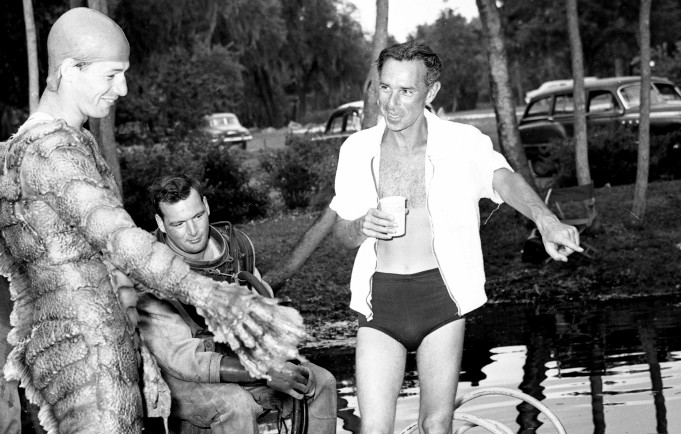
By this time, however, Arnold was working as a freelancer. He exited Universal in 1955, partly because he grew frustrated at the studio’s unwillingness to take science fiction seriously, although he did return on occasion, as evidenced by The Incredible Shrinking Man. Unfortunately, by the late 50’s science fiction was being viewed as being good for little else than exploitation cash-grab by most studios, partly thanks to the success the low-budget schlock films of Roger Corman over at American International Pictures, which meant thatArnold was offered few possibilities to make the kind of films he wanted to make. His frequent producing partner William Alland had moved to Paramount in 1958, and called on Arnold to direct the intriguing but flawed pacifist message film The Space Children in 1958 on a shoestring budget. His last American SF film of the 50’s, and for a long time to come, was Universal’s Monster on the Campus (1958, review), a trivial re-tread of 1953’s The Neanderthal Man (review). It contains nothing of Arnold’s usual quality, and he must have simply been in need of work.
Arnold then made the well-regarded western No Name on the Bullet for Universal, after which he had enough of Hollywood for a while and instead teamed up with Peter Sellers in the UK, to shoot The Mouse that Roars, a cold war comedy satirising US foreign policy. Co-produced by Columbia, it became a critical and commercial success in the US, and introduced Sellers, here in his first solo starring role, to an American audience. However, the film didn’t necessarily lead to a lot of bigger and better things for Arnold. For a while, he was pegged as a comedy director, a genre that simply wasn’t his forte. In the early 60’s he directed two moderately successful Bob Hope comedies, and in 1969 returned to sci-fi at Paramount, along with another genre veteran, Ivan Tors, for the underwater comedy Hello Down There. He and former gill-man Ricou Browning, here as assistant director, were hired for their underwater work with the Creature series. However, in the 60’s Arnold largely transitioned into TV, where he had a decent career as a journeyman director, including longer stretches at shows like Gilligan’s Island and The Love Boat, as well as occasional SF shows. His movie career dwindled, and in the 70’s his output co nsisted exclusively of softporn romps and a couple of Fred Williamson blacksploitation films. Arnold retired in 1984 and passed away in 1992.
Producer Albert Zugsmith seems to have been a character who was universally loathed in Hollywood. According to director Arnold, Zugsmith’s only interest in the movie business was money. Having made a good deal of money as a media broker in Hollywood, Zugsmith entered the world of producing as the founder of American Pictures Corporation, APC, nominally alongside producers/writers Jack Pollexfen and Aubrey Wisberg, in 1952. With Pollexfen and Wisberg he produced the low-budget SF films Captive Women and Port Sinister (1953, review), and without them the vile invasion clunker Invasion U.S.A. and the comedy drama Paris Model (1953). Zugsmith had his greatest success between 1955 and 1958 at Universal, where he made such bona fide classics as Female on the Beach (1955), Written on the Wind (1956) and most notably Orson Welles’ Touch of Evil and The Incredible Shrinking Man. In 1963 Zugsmith produced and directed The Great Space Adventure in the Philippines, which was never finished, and he had a cameo in The Thing with Two Heads (1972).

In 1958 Zugsmith moved briefly to MGM, where he made a string of movies with bombshell Mamie Van Doren, which all lost money. He continued producing comedies with suggestive titles (Sex Kittens Go to College) at Allied Artists, some of them starring Van Doren, made a brief return to Universal, again teaming up with Van Doren for College Confidential (1960), produced and/or directed a couple of films in Berlin and in the Philippines with George Nader, and made a dozen films for his own company or collaborating with other independent producers on movies with titles like The Incredible Sex Revolution, Psychedelic Sexualis, Sappho Darling, The Very Friendly Neighbours and Violated!.

Born John Williams in 1931 in New York, lead actor Grant Williams served in the US Air Force between 1948 and 1952, and then returned to his hometown, where he got a degree in journalism, and studied acting under Lee Strasberg. He performed off-Broadway and had a few minor broadway roles, and a couple of TV appearances in New York, before relocating to Hollywood in 1955. After a few more TV shows, he was picked up by Universal, who groomed the handsome chap as a potential leading man. His first two films were directed by Jack Arnold. However, The Incredible Shrinking Man would remain the pinnacle of his career.
In the late 50’s Williams divided his time between TV and B-movies at Universal, often in the lead, but in small productions. His SF pedigree earned him leads in such films as The Monolith Monsters and The Leech Woman (1960). The latter was perhaps the last straw for Williams, who left Universal for Warner Bros. in 1960. His film career didn’t improve substantially, but he managed to carve out a little bit of recognition with a recurring role in the TV series Hawaiian Eye between 1960 and 1964. As his acting career dwindled, he opened a drama school. He continued to act in low-budget pictures after his contract with Warner ran out in the mid-sixties. In 1967 he starred in the notorious low-budget SF Doomsday Machine, but filming was interrupted when the money ran out. It was completed in 1972 or 1977 (accounts vary) without the original cast or sets. According to different sources, it was released either in 1972 or 1975 or 1977. Not much better was his lead in Al Adamson’s Brain of Blood (1971). After this, William called it quits on the movie business. He passed away in 1981.

Randy Stuart was born Elizabeth “Betty” Shaubell in Iola, Kansas, in 1924 to a family of vaudevillians, so got a taste of showbiz from birth. The family moved to Los Angeles when Betty was a kid, and she performed with the family show and on various stages, until she was picked up by Fox in 1947. She primarily had bit and supporting parts, and returned to TV in the early fifties, where she was in demand as a guest star. She had her chance to shine in the co-lead in the TV series Biff Baker, U.S.A., about a husband-and-wife spy team. She retired from acting in 1975. Her most lasting legacy remains her role as Louise Carey in The Incredible Shrinking Man.

Other roles in the movie are not much more than minor parts. As Scott’s brother, left to comfort Louise in the second half of the movie, the studio cast Paul Langton, a respected but little-known character actor. We have bumped into him on this blog before, as the obnoxious lead in W. Lee Wilder’s terrible yeti film The Snow Creature (1953, review). He also had a supporting role in the cult classicIt! The Terror from Beyond Space (1958, review), and turned up alongside SF veterans John Carradine in Allied Artists’ The Cosmic Man (1959, review) and John Agar in United Artists’ Invisible Invaders (1959). He also had the honour of appearing in the very first episode of The Twilight Zone, as one of the doctors revealed at the end the episode, monitoring Earl Holliman’s astronaut trainee in an isolation booth. However, Langton’s definitive claim to fame is his recurring as the wily Leslie Harrington on the soap opera Peyton Place, a role he reprised in 219 episodes between 1964 and 1968.

Raymond Bailey plays the specialist who gives Scott his diagnosis. Bailey was another actor who would make his biggest impression on TV, in the recurring role as tight-fisted banker Milburn Drysdale in the principal cast of The Beverly Hillbillies (1962-1971). Bailey also had bit parts or supperting roles in the SF films S.O.S. Tidal Wave (1939), alongside Boris Karloff and Bela Lugosi in Black Friday (1940, review), Tarantula, The Space Children, The Absent Minded Professor (1961), Irwin Allen’s Five Weeks in a Balloon (1962) and Disney’s The Strongest Man in the World (1975), starring Kurt Russell. He appeared in several SF anthology shows, including three episodes of The Twilight Zone.
Scott’s physician is played by SF veteran William Schallert. Schallert is perhaps best known in the industry as a well-liked president of the Screen Actors Guild, and as a hugely prolific bit-part and supporting actor with credits for nearly 390 films or series. Hs career lasted almost all the way up to his death at 93 years old in 2016. For baby boomers he may be best known as family father Martin Lane in the Patty Duke Show in the sixties.

For sci-fi fans, on the other hand, Schallert is something of a cult actor because of his numerous bit-parts in science fiction from 1949 all the way to 2010, including many by Wisberg & Pollexfen. He began his journey in the pseudo-sci-fi movie Mighty Joe Young, and appeared in an episode of the TV show Space Control in 1951 before The Man from Planet X (review) was released, in which he played the villain. He appeared, sometimes in more substantial supporting roles, sometimes in bit-parts and sometimes as no more than an uncredited extra, in The Man from Planet X, Invasion, U.S.A., Port Sinister, the film serial Commando Cody: Sky Marshal of the Universe (1953), Tobor the Great (1954, review), Gog (1954, review), as an uncredited ambulance attendant in the classic giant ant film Them! (1954, review), as the weatherman in The Monolith Monsters (1957), and as the Earl of Warwick in Irwin Allen’s highly pretentious The Story of Mankind (1957). He had a substantial role as the head of CIA in the underrated A.I. movie Colossus: The Forbin Project, and appeared as Martin Short’s doctor in the hilarious sci-fi comedy Innerspace (1987), as a nod to his appearance in The Incredible Shrinking Man.

On TV, Schallert is probably best known for playing the Federation representative Nilz Baris in the Star Trek episode The Trouble with Tribbles (1967), as well as appearing in both the original The Twilight Zone (as a policeman in episode Mr. Bevis, 1960) the remake of the episode A Good Life, directed by Joe Dante (as the father) in Twilight Zone: The Movie (1983), as well as Father Grant in the remake of the episode Shadow Play (1987) in the TV series reboot of The Twilight Zone in the eighties. He also guested a host of other sci-fi series, including Men Into Space (1960), The Wild Wild West (1967-1969), Land of the Giants (1969), The Six Million Dollar Man (1974), The Bionic Woman (1976), Quantum Leap (1989), Star Trek: Deep Space Nine (1993), Lois and Clarke: The New Adventures of Superman (1994) and Medium (2010). Vampire fans may recognise him as Mayor Norris in True Blood (2008-2011).
The Incredible Shrinking Man also has cameos by legendary short actor Billy Curtis, who, among other things, operated one of the robots in Gog, and Luce Potter, immortalised as the Martian leader in a fish bowl in Invaders from Mars (1953, review). There’s also a brief appearance by tall actor Lock Martin, who will be forever remembered as the imposing robot Gort in The Day the Earth Stood Still (1951, review).

The all-important set design was supervised by Universal’s supervising art director Alexander Golitzen, who during his career was perhaps Hollywood’s most famous art directors. Golitzen was nominated for Oscars 14 times and won three. He was aided by veteran Robert Clatworthy, who won an Oscar in 1966 for Ship of Fools, and was nominated five times. Clatworthy has an eclectic resumé, illustrated by the fact that in 1960, he designed the sets, back-to-back, for both The Leech Woman and Psycho. Set decoration was handled by another Oscar-winner, Russell Gausman, who worked on an astonishing 800 films between 1925 and 1960. Gausman worked on pretty much all of Universals classic horrors from the 40’s and all of Jack Arnold’s SF movies.
I haven’t mentioned the music of the film, although it deserves a mention, as it is crucial in carrying the story and the emotional punch from the halfway mark forward, as there is very little dialogue, except for that between Louise and Scott’s brother, and little spoken words, save Scott’s narration and internal monologues. Born in Vienna, composer Hans Salter studied music in the Mecca of classical music, before relocating to Hollywood in 1937 at the brink of WWII. Salter worked for Universal for over 30 years, on films big and small, including many horror and SF movies. Many of his compositions were uncredited, as he often was billed “musical director”, especially in instances that he wrote some of the music, but patched it up with stock music or other composer’s material.
Janne Wass
The Incredible Shrinking Man. 1957, USA. Directed by Jack Arnold. Written by Richard Matheson & Alan Richard Simmons. Based on the novel The Shrinking Man by Matheson. Starring: Grant Williams, Randy Stuart, Paul Langton, April Kent, William Schallert, Raymond Bailey, Frank J. Scannell, Helene Marshall, Diana Darrin, Billy Curtis, Luce Potter, Lock Martin. Music: Hans Salter. Cinematography: Ellis Carter. Editing: Greg Rodin. Art direction: Alexander Golitzen, Robert Clatworthy. Costume design: Martha Bunch, Rydo Loshak. Gowns: Jay A. Morley, Jr. Sound: Leslie Carey, Robert Pritchard. Special effects: Cleo Baker, Fred Knoth. Visual effects: Clifford Stine, Roswell Hoffmann, Everett Broussard, Tom McCrory. Produced by Albert Zugsmith for Universal International Pictures.

 Scifist.
Leave a comment