

A femme fatale leads a gold hunt into the jungle and falls foul of a mad doctor turning women into voodoo monsters. Alex Gordon’s super-cheap AIP schlocker from 1957 is mildly entertaining as a so-bad-it’s-good film. 3/10

Voodoo Woman. 1957, USA. Directed by Edward L. Cahn. Written by Russ Bender, V.I. Voss. Starring: Marla English, Tom Conway, Mike “Touch” Connors, Lance Fuller, Mary Ellen Kaye, Martin Wilkins, Paul Blaisdell. Produced by Alex Gordon. IMDb: 4.1/10. Rotten Tomatoes: N/A. Metacritic: N/A.
Three shady characters meet up at a dive on the doorstep of the jungle in a fictitious French colony in Africa – Harry West (Norman Willis), Marilyn Blanchard (Marla English) and her estranged boyfriend-in-crime Rick Brady (Lance Fuller). Blanchard and Brady are to join West in a perilous heist in the heart of the jungle, with the promise of making a profit out of it. Ransacking West’s room, they find a voodoo doll with golden ornaments and a pile of paper with voodoo symbols. Caught in the act, they kill West, and the couple decide to strike out on the gold hunt themselves. The next day, Brady assumes West’s identity, as they meet up with a guide West has hired, the world-weary hunk Ted Bronson (Mike “Touch” Connors). Blanchard tries to seduce Bronson, but he brushes her off, opting for a “strictly business” approach. ‘
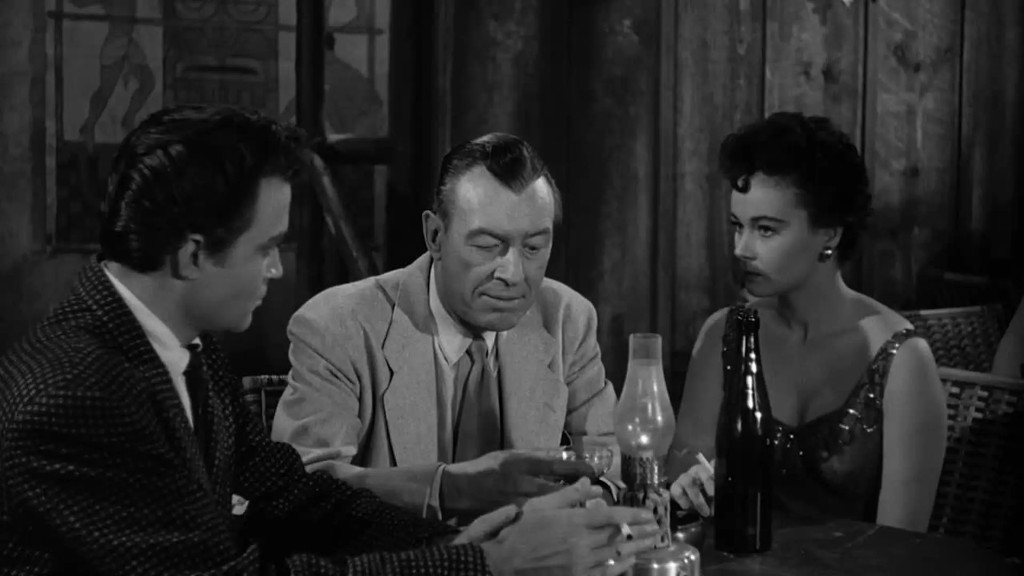
This is the introduction to B-movie studio American International Pictures’ 1957 jungle adventure Voodoo Woman, produced by Alex Gordon and directed by journeyman low-budget specialist Edward L. Cahn. Or actually, it isn’t really the introduction, as it is preceded by another scene, in which we meet the rest of the players. The film opens with a brief segment in an African jungle set, where local girl Zuranada (Jean Davis) is the subject of a voodoo ritual performed by Chaka, the Witch Doctor (Martin WIlkins) and a thin, white man in dress trousers, white shirt and a ridiculous fur hat. This is Roland Gerard (Tom Conway), a mad doctor, whose intent it is to combine the “science” behind voodoo with western science and medicine, in order to create a new race of invulnerable beings, which he will control telepathically. Poor Zuranda here is the first test subject, because, for some reason never properly explained, the subjects need to be women.

A bit away, Dr. Gerard keeps his very estranged wife Susan (Mary Ellen Kaye) a prisoner in their African home of seven years, along with valet Bobo (Otis Greene), and guarded by the spear-wielding Gandor (Emmett Smith). Susan is appalled at her husband’s dark experiments and wishes only to escape.
Meanwhile, Bronson leads our two treasure hunters along with their porters to the heart of the jungle, guided by the papers with the voodoo symbols (“all tribes have their own symbols”). Bronson refuses to shoot at natives at random, and gets into repeated fistfights over the matter with Brady, who is also jealous, since Blanchard has taken a liking to Bronson. Eventually, of course, they are led to Dr. Gerard’s village, where Brady kills a native girl, and the party is captured. In order to avoid getting all of them killed for the murder of the girl, Blanchard shoots Brady dead. Gerard then invites Blanchard as his guest and Bronson as his “guest”.

Gerard has plans for cold-blooded Blanchard, since he has hit a snag. He has been able to transform Zuranda into a giant, scaly monster-woman, but is unable to make her kill. Turns out, when monster Zuranda is commanded to do anything that goes against their her moral code, the “spell” breaks, and she returns to her normal self. In murderous Blanchard, he sees the perfect subject. Blanchard agrees to undergo the experiment in return for power and gold. Meanwhile, Susan and Bronson have become an item and plot escape. Blanchard undergoes the experiment and becomes a monster woman, only to be told that the only gold in the village is the witchdoctor’s golden bust next to the flaming pit. You can probably imagine where the, as one reviewer put it, “lively if barely credible finale” will take place.

Production & Analysis
The origins of Voodoo Woman lies in The She-Creature, a horror film that Alex Gordon produced for AIP in 1956. The film, unusual for its female monster, was a big hit for the studio, and Gordon liked it so much that he wanted to follow it up with another “female monster” film. Ideally, he wanted to bring in The She-Creature’s screenwriters Lou Rusoff and Charles Griffith, but they were busy working on Roger Corman’s The Undead (1957), another AIP film with a female protagonist/antagonist. Instead Gordon gave the assignment to actor Russ Bender, who had never written a movie script before, and would never do so again. In the book Paul Blaisdell, Monster Maker by Randy Palmer, creature creator and suit actor Blaisdell figured that Gordon and Bender set out to make a zombie movie, but probably had no idea what a zombie actually was – in real life or in fiction: “In fact, I think no-one involved in Voodoo Woman had ever read a pulp magazine as a kid in order to find out what a zombie was”.

Despite what some film historians have assumed, the movie didn’t spring out of the title (as was often the case with AIP movies); the script that Bender delivered to Gordon was originally entitled “Black Voodoo”. In making The She-Creature, Gordon was given a budget of $100,000, a minuscule budget for a movie as such, but by AIP standards generous. However, AIP execs didn’t want to splash the same amount of money on Bender’s less-than-great script, and cut Gordon’s allowance to $60,000, a tiny budget even by AIP standards. Gordon cut where he was able, namely on sets, makeup, special effects and actor salaries. He decided to use several actors currently under AIP contract, which led to him re-using five actors from The She-Creature; co-leads Marla English, Tom Conway, Lance Fuller, monster actor Paul Blaisdell, and Paul Dubov, as the innkeeper. Mike “Touch” Connors was a struggling B-movie leading man and an AIP staple. Originally Alex Gordon had wanted George Zucco to play the mad scientist, perhaps as a call-back to his memorable role as a voodoo priest in Monogram’s Voodoo Man (1944, review). However, the 71-year-old horror icon was too ill to come out of retirement, so Gordon defaulted on Tom Conway, not a stranger to horror movies, either. As for his director, Gordon chose another AIP veteran, Edward Cahn, who had also directed The She-Creature, and was known for churning out passable films even cheaper and faster than Corman.

In an interview with Tom Weaver, Mike Connors says that the budget only allowed for a jungle set measuring 10 square feet, and that director Cahn simply switched the camera around and rearranged the plants for each new shot. This would account for the film’s extremely static cinematography. According to Connors it was a bit of an acting challenge standing among ten feet of potted plants, imagining you were in the dark heart of Africa.
When it came time to realise the all-important “zombie”, Blaisdell, who was also busy doing effects for The Undead, was told that he had pretty much a zero budget for the monster suit, which meant that his original draft had to be thrown out the window. When he informed Sam Arkoff that there was no way he would be able to create an original monster on the budget and time frame allotted, Arkoff suggested he modify the spiky, scaly she-creature suit, which didn’t even look remotely like a zombie, but like the aquatic, reptile-like being that the monster was supposed to represent. In Palmer’s biography, Blaisdell says it was at this point he lost all interest in the film. He agreed, on the condition that someone else make the head and face of the monster. Blaisdell and his wife and partner Jackie removed the tail, fins, horns and spikes from the she-creature suit, and patched it up. In order to disguise the fact that it was the she-creature, they also covered much of its body with a tattered burlap “sarong”. Gordon passed on the task of creating the monster’s head to makeup artist Harry Thomas. This is the same Harry Thomas who created the infamous ping-pong ball eyes (actually egg tray bottoms) for the aliens in Killers from Space (1952, review).
Thomas and Blaisdell’s biographer Randy Palmer have very different views on what happened next. According to Thomas, he delivered the head, such as it turned up in the film, to Sam Arkoff, who, according to him, liked it. In an interview with Tom Weaver, Thomas says he was horrified when he learned they would put it on top of the she-creature suit.

However, several people connected with AIP, including prop man-turned-collector Bob Burns and Blaisdell himself, tell a different story to Randy Palmer: When the finished product arrived, Gordon couldn’t believe his eyes: Thomas had simply purchased a skull mask from a costume shop and attached a white wig to it. Desperate, Gordon sent the mask to Blaisdell and asked if there was anything he could do to fix it up. Frustrated, Blaisdell agreed, and started building the mask up almost from scratch, by adding teeth, eyes and bulking it up with foam rubber to create a more zombie-like creature. Out of respect, Blaisdell says he let Thomas have the “special makeup” credit.
Whatever the case, nobody involved was happy with the final look of the monster, but at least it was workable. In the film, Cahn mostly kept the it partly obscured by shadows or foliage.

Blaisdell remembers the shoot being beset by problems from beginning to end. Starting with Bender’s weak script, the film’s low budget and tight schedule, things only went downhill. Edward Cahn was well aware of the pressure to get the film done quickly, and was hard on both cast and crew, and didn’t tolerate setbacks to the schedule. This would have been stressful enough for a healthy cast and crew, but the film was made during a particularly cold and wet California winter, and the flu quickly started circulating among the ensemble. Worst hit was leading lady Marla English, who had to complete most of the film with a high fever. According to Blaisdell, this was ultimately what defused a potentially explosive atmosphere on set. Marla English was a real trooper and battled the incapacitating flu in order to complete the relentless pace, sometimes stretching to 15-hour workdays. When the ensemble realised English was struggling, they pulled together to support her. This supportive atmosphere, according to Blaisdell, also rubbed off on Cahn, who relented a bit in his demanding attitude.

But it wasn’t the flu that landed Blaisdell himself at the studio’s dispensary, but acid. In one scene, Dr. Gerard is supposed to demonstrate his creature’s invulnerability by pouring acid on its scales. Blaisdell was wearing the “zombie” suit when a prop man delivered a vial of “acid” to actor Tom Conway. Blaisdell, well-versed in the art of film effects, knew that the liquid often used to make “acid smoke” on film was a mix of ammonia and hydrochloric acid — great for smoke, but not so great for the skin of a potential actor. The prop man assured him that this was some new, perfectly safe, concoction, and Cahn rolled the cameras for action. Soon Blaisdell started feeling his leg burning where the “safe” liquid was poured, and when Cahn shouted “cut”, he screamed in pain, and ended up in the sick bay, alongside Marla English. Blaisdell was patched up and able to continue shooting, but wore a scar from the incident for the rest of his life.
Such were the circumstances of the shooting of Voodoo Woman, and the fact that it resulted in a comprehensible film is almost a miracle. This is by no stretch among the worst films we have reviewed on this blog, partly because Edward Cahn was, if nothing else, an extremely seasoned and capable filmmaker. And partly because the script is so inane that it verges on so-bad-it’s-good. Most of the plot is made up by padding — the protagonists and the villain don’t even meet until two thirds into the movie, and everything before that is basically treading water. Giselle D’Arc, a very accomplished singer, has not one, but two musical numbers in the bar at the opening of the film, just to stretch its running time, and much on-screen action comprises of meaningless fistfights and overlong shots of “natives” shaking their spears and chanting gibberish.

As film scholar Bill Warren points out, the jungle movie had its heyday from the 20’s to the 40’s, and was now the domain of B-movies. This film is particularly anachronistic, as it features black natives with names like “Bobo”, who speak broken Pidgin English and say things like “Bobo go make nice cup hot tea for lady”. The lack of a budget shows in the fact that two of the central characters are mute — actors in speaking roles were guaranteed a higher salary by union regulations than those in non-speaking roles, regardless of screen time. It’s hilarious that poor Zuranda is is the subject of at least three ceremonies and experiments, dragged from one place to another, turned not once, but twice into a monster, ordered to kill twice and being the subject of a debate about her morals — without saying a single word during the whole film. Also, the guard Gandor has numerous interactions with both Susan and Ted, without speaking a single line.
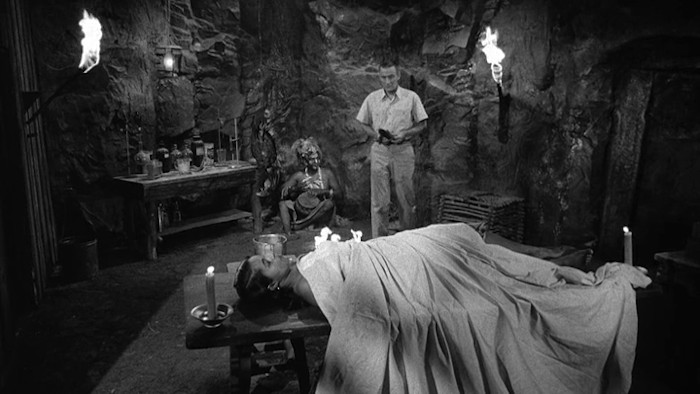
As a whole, the script is awkwardly structured and focuses more on the — ultimately redundant — trek to the village — all filmed on the same 10 square feet of jungle set. Marilyn Blanchard is a juicy role of a literal femme fatale for feverish Marla English to play, despite the impossibly trite dialogue. Rick Brady as a character exists only in order to provide an antagonist to Ted Bronson’s hero, and give Blanchard someone to shoot. Bronson, on the other hand, is just as oddly useless as the male protagonists in these B-movies often tend to be. He succeeds only in getting captured twice and throw a redundant Molotov cocktail at some natives in the end of the movie. His only interaction with the monster is shooting a couple of pointless bullets at it. Dr. Gerard seems to have even less of a motivation in creating a “new race of superhuman beings” than most hapless mad scientists, mumbling something about proving the disbelievers wrong and “shattering the foundations of science”. What he actually intends on accomplishing by creating this super race remains unclear. Also, if only women can be turned into voodoo monsters, the issue of procreation raises some worrying questions. The character of his wife Susan has even less agency in the movie than Ted Bronson, and one gets the feeling that these two roles were included only to have a happy couple at the end of the movie. They could both be excluded without it having any bearing on the plot whatsoever. The entire plot is forwarded by Marilyn Blanchard and Dr. Gerard, who are also the ones ultimately facing off in the film’s rather disappointing finale.
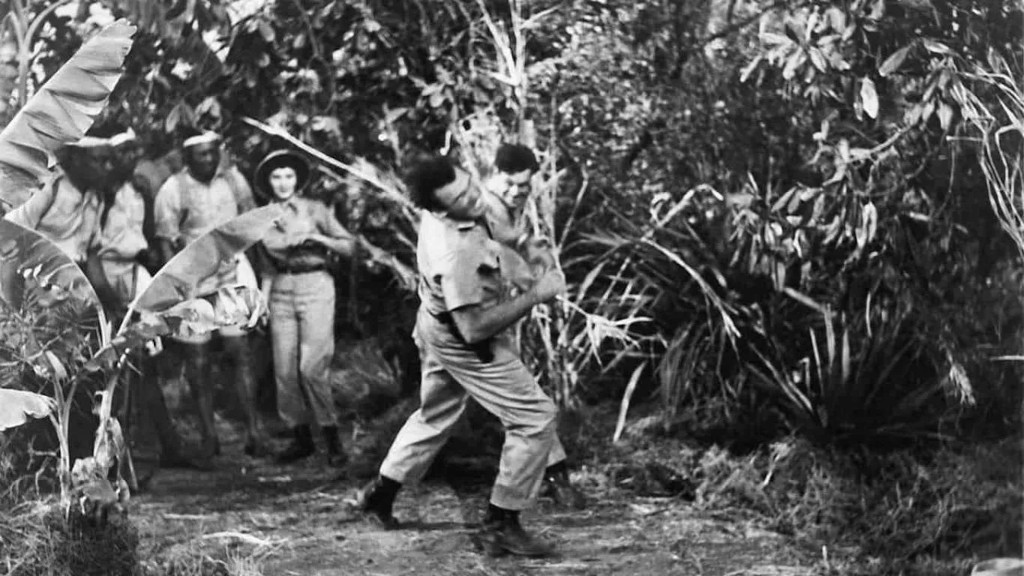
The entire premise of the film is bonkers: imagine setting out on a potentially fatal trek into Voodoo Land simply on the strength of a few small gold fittings on a voodoo doll. Nothing here hints at any sort of hoarded gold treasure, making this perhaps the flimsiest excuse for a treasure hunt in movie history. Plot holes as big as a voodoo monster abound. One hilarious gaffe is the wardrobe change that Gerard’s experiments seems to affect in its subjects. Both times when Zuranda is turned, she is wearing a beautiful flowery sarong. After she has turned, she is wearing a tattered potato sack. When she turns back into her own self, shrinking down to half the size of the monster, she is again wearing her rather tight-fitting dress, which is miraculously intact. Marilyn’s lack of hesitation when agreeing to be turned into a monster is astonishing. Just what is she supposed to do with all of that gold after having been transformed into a bug-eyed, scaly monster? Take a bikini vacation on the French Riviera and visit all the fancy restaurants?

It is never exactly clear where the film is set. Several sources (including Wikipedia) claim the setting to be “the French African colony of Bantalaya”. However, if my memory serves me correctly, the made-up name “Bantalaya” is used to describe the expedition’s destination. Ted Bronson, for example, says several times lines along the line of “I’ll take you as far as Bantalaya, but there I turn back”. Furthermore, the locale is never established as Africa, which would make sense, because voodoo has never been practiced in Africa. It is a religion developed by liberated slaves in the African diaspora, particularly Haiti. We just assume the film takes place in Africa because of the black natives and paraphernalia recognisable from many films set in Africa. The setting in a “French colony” is derived from the fact that the innkeep at the bar speaks with a French accent.

There are few optical or visual effects in the film, and apart from the cramped sets, the only suggestion of jungle we get are a couple of stock footage inserts of animals. The transformation from woman to monster is achieved by dissolve shots of the women’s feet. The transformation back is done rather neatly off-screen, showing the shadow of the monster change into the shadow of the women — probably done very simply by placing a monster cutout between a stage light and the women, and then slowly turning the cutout, thus removing the shadow.
The main actors involved are all professional, but seriously hampered by the script, the tight shooting schedule and the cheap, cramped sets. Mike Connors brings his lively charm to the game, reminding us of why he eventually became a TV star. Marla English is delicious in the far-fetched role of gangster femme fatale “from the slums of Pittsburg”, but her lines are absolutely turgid. Tom Conway, sans trademark moustache, gives a wobbly performance, as if never quite sure of the tone of his character. He has some strong scenes, in particular with Mary Ellen Kay, but in most scenes he just looks too old and frail to be able to hold a whole village in his grip. Conway phones in his performance, and tries to carry the ridiculous fluffy hat he is given with a straight face.

Artistically and technically, Voodoo Woman looks and feels cheap and rushed, with a barely serviceable script and lazy direction. However, we have reviewed far worse jungle movies on this blog. Voodoo Woman stands head and shoulders over, for example, Jungle Hell (1956, review), which was cobbled together as a TV pilot and padded with endless stock footage of elephants. Whatever one may say about AIP’s products, at least they always felt solid. And while one can criticise Eddie Cahn for a lack of originality and flair, at least he was a competent director. Dull, perhaps, but competent. While terrible in many ways, Voodoo Woman is watchable and even entertaining, at least if you’re the type that likes to watch bad movies for a chuckle.
The movie was remade (sort of) for TV in 1968 by “schlockmeister” Larry Buchanan as Curse of the Swamp Creature.

Reception & Legacy
Voodoo Woman premiered on March, 1, 1957 in the US. I haven’t been able to find any box office numbers, but considering its low budget, one assumes it made its budget back.
The trade press was not impressed. Variety wrote: “This is one of those ‘forbidden jungle’ plots with scant rhyme or reason”. Harrison’s Reports called it “confused and confusing”; “There is not much sense to anything that happens […] Moreover, the action is slow.” Alex Gordon’s future wife Ruth thought the film was so bad, that at its premiere, she handed back her engagement ring, appalled at the quality of the films Gordon was making. Gordon’s brother Richard eventually convinced her to take the ring back, and the couple got married and stayed married until Gordon’s death in 2003.

Later assessments have been somewhat varied. In his 1984 book The Encyclopedia of Science Fiction Movies, Phil Hardy writes: “This is undoubtedly Cahn’s worst film as a director”. Leonard Maltin’s Classic Movie Guide gives it 1.5/4 stars, IMDb has a 4.1/10 audience rating based on a little more than 600 votes, and AllMovie gives it 1.5/5 stars. TV Guide calls it “one of Cahn’s shabbier productions”.
However, many modern critics appreciate the film for what it is. Dave Sindelar at Fantastic Movie Musings and Ramblings cites a “serious taste-lapse” when he confesses to “actually like” Voodoo Woman: “I found it plain dumb fun, and far less boring than some of the other voodoo flicks I’ve seen”. Likewise, Derek Winnert calls it “muddled, murky and illogical”; “But, with its terrible acting, feeble plotting, risible dialogue and rotten effects, it is definitely camp fun to laugh at if you’re in the mood and it’s short enough at 75 minutes not to outstay its welcome.” And Mark Cole at Rivets on the Poster writes: “If you don’t ask too much of it, it isn’t a bad midnight movie”.
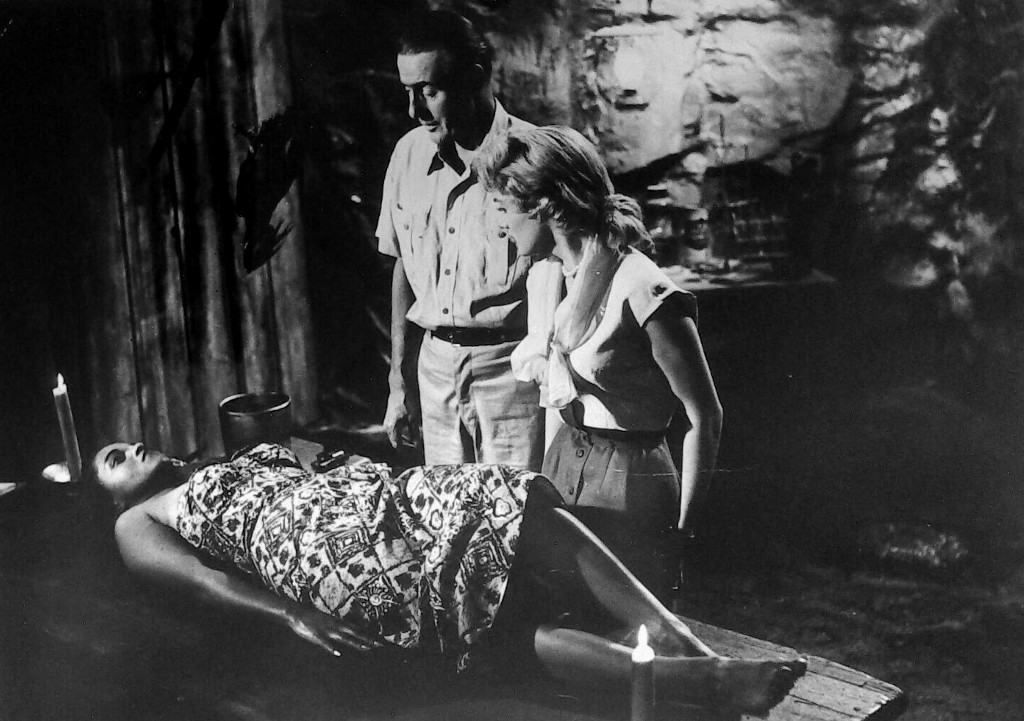
But there are also those who aren’t amused. Kevin Lyons at EOFFTV states: “Voodoo Woman really isn’t very good at all. The unwarranted intensity of some of the performances liven things up a bit but the story has nothing new to bring to the table and tends to mope about killing time to bring the film up to feature length.” And Bill Warren calls it “one of the worst movies ever made”; “The illogical, trite and unimaginative script is made even worse by Cahn’s leaden direction. The cast is amateurish and uninteresting, and so is the movie.”
Despite its shortcomings, Voodoo Woman has become something of a cult classic among bad movie aficionados, as proven by its occasional inclusion on “worst movies ever made” lists, a bona fide love declaration from fans of this kind of silliness. As I have written before, anything that is remembered today as one of the worst movies ever made can by consequence not be one of the worst movies ever made – if it was, it would not be remembered at all.
Cast & Crew
British producer Alex Gordon came to New York along with his brother Richard as a film publicist in 1947, and in 1952 moved to Hollywood. Here he befriended Bela Lugosi and legendary Z-movie director Ed Wood, with whom he collaborated on the script for a western. Gordon shopped around a few scripts of his own, and they wound up being directed and produced by Wood; Jail Bait (1954) and Bride of the Monster (1955, review). Stories vary on how he and Sam Arkoff met, but whatever the case, Gordon wound up as a producer at the newly founded ARC in 1954, before the company changed its name to AIP. In 1955-1956 he produced three films for Roger Corman, including the post-apocalyptic Day the World Ended (1955, review), but then worked almost exclusively with Edward Cahn, producing eight of his films between 1956 and 1958, several of which starred Marla English and Mike Connors, although no SF films, except Voodoo Woman. After making a couple of more pictures for other directors, Gordon got fed up with AIP, most notably Sam Arkoff, who he thought made a business of ripping people off, according to an interview with Tom Weaver. He left the company in 1958 and set up shop as an independent producer with limited success, producing four films between 1959 and 1965, including The Atomic Submarine (1959) and The Underwater City (1962). After this, he found work at 20th Century Fox, where he did some producing and started a film restoration program, which led him to discover over 30 Fox films that had been considered lost. In 1975 he accepted a position at the Gene Autry Foundation, working for his childhood hero, the singing cowboy. He eventually became vice president for the foundation. Gordon was extremely well liked by everyone that worked with him, according to several Tom Weaver interviews. Mike Connors says that Gordon was the reason he kept coming back to AIP.

Although not nearly as well-known to a mainstream audience as Ed Wood or Roger Corman, Edward L. Cahn is synonymous with the 50’s subgenre of so-bad-they’re-good Z-movies. Cahn began his career in the films as early as 1917 as a production assistant, and soon graduated to editing at Universal. Eventually, he became one of the studio’s top editors, before switching to directing in the early thirties, “turning out cheap and cheerful crime melodramas and comedies”, according to an IMDb bio by I.S. Mowis. Pretty much flying below the radar at Universal and MGM, he struck out as a freelancer in 1945, with much work but little recognition, making B-movies and shorts for various companies.

However, after a dry spell in the early 50’s, Cahn was back with a vengeance, now with his eyes set on the minor studios that were producing B-movie quickies for a teenage audience, like Columbia, Allied Artists and not least AIP. Cahn was hired to make movies that called for little artistic flair, but a steady directorial hand by someone who agreed to work fast, cheap and didn’t care too much about the end result, as long as there was a comprehensible film in the can, which could be sold to indiscriminate teenagers on the power of the poster alone. Not quite as prolific as Corman, Cahn still churned out at half a dozen films, sometimes more, each year between 1955 and his death in 1963. He became a go-to guy for crime thrillers, westerns and horror movies, with a seeming knack for zombie films. But he also made more traditional teen or “rock and roll” movies, as well as girls-in-prison films. His science fiction films include Creature with the Atom Brain (1955, review), Voodoo Woman (1957), Invasion of the Sauce Men (1957), Curse of the Faceless Man (1958, review), It! The Terror from Beyond Space (1958, review) and Invisible Invaders (1959). Best known of these is probably It! The Terror from Beyond Space, on the merit of it being one of the many works to inspire Ridley Scott’s Alien (1979).

California gal Marla English was one of the many young women who got into the pictures through modelling, as she was put under contract with Paramount after winning a beauty contest in 1952. English received only uncredited bit-parts at Paramount, until she was cast opposite Spencer Tracy in The Mountain. However, she walked off the production and was recast, allegedly because Paramount would not cast her boyfriend, also on contract at Paramount, in the film, which was to be filmed in France. English’s three-year contract with Paramount ran out in 1955, and she began freelancing, mainly making B-movies for minor studios. Voodoo Woman was her last film, as she retired from acting after marrying in 1957.
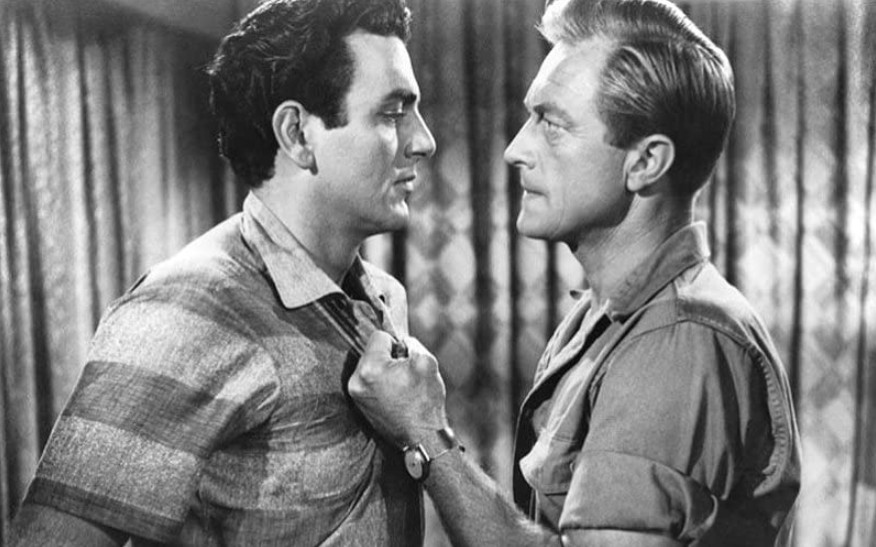
Mike “Touch” Connors was born to Armenian immigrant parents as Krekor Ohanian in 1925, and in 1952 entered the movie business by sneaking into RKO Studios and demanding to get an audition with the director of the Joan Crawford vehicle Sudden Fear, for a role he knew was not yet cast, and he had been told he would be perfect for. He got the role. Ohanian’s talent agent told him that his name was too similar George O’Hanlon, another Hollywood actor, and came up with “Conners” for his last name, and used a nickname he had gotten when playing basketball, “Touch”, as his first name. Thus Krekor Ohanian became Touch Conners, which he later changed to Connors. Connors tells Tom Weaver he hated the nickname “Touch”, and would have chosen to act under hos own name. Later, a producer told him he could drop the “Touch”, but keep “Connors”, as it was the name he was known for. “Krekor Connors” would have sounded a bit off, so he chose “Mike” or “Michael”.

Names aside, Mike Connors’ path at RKO didn’t go further than one film, and he struggled to find work, appearing mostly in larger roles in minor studio B-movies and occasionally smaller roles i major studio B-movies. An interesting tidbit is that in 1954, he played the apostle Andrew in the first American sound movie about the life of Jesus to get a wide theatric release, Day of Triumph. His next film after that gave him a major role – and that was Roger Corman’s directorial debut for AIP, the western Five Guns West (1955). That was the beginning of Connors’ seven-picture-long collaboration with AIP, with whom he made three films for Corman and four for Gordon, including the western Flesh and the Spur, which he also co-produced. Despite the odd bit-part for Universal and Paramount, Connors’ film career seemed to be stuck in the B-movie swamp, despite his good looks, magnetic charisma and undeniable acting talent. However, things would start to change in 1959. Connors had done a fair amount of TV work parallel with his movie career, and in 1959 he was cast in the lead of the CBS series Tightrope, about an undercover police investigator infiltrating crime syndicates. Even though it was canceled after one season, it was well received and cemented Connors’ “tough guy” image. It didn’t immediately do any wonders for his career, at least he had a year with a decent pay check. In an interview Tom Weavers asks Connors if he was making a decent living from his acting before Tightrope, to which Connors replies: “I didn’t really make kind of living before I did Tightrope“.

Still, Connors struggled on in B-movies and TV guest spots, as well as the occasional A-film, even for major studios a couple of times, throughout the 60’s. One exception was a moderately costly James Bond spoof called Kiss the Girls and Make Them Die, produced by Dino De Laurentiis and filmed in Rome and Rio de Janeiro, which premiered in 1966. However, despite being a fairly well-made film, it flopped at the box office. The reason was spelled Our Man Flint, the father of all James Bond spoofs, which premiered the same month. Then, in 1967, came Connors’ breakthrough, as he was cast in the lead of the hugely popular series Mannix, a role which he played until 1975, and which made him a bona fide star. Considered one of the most violent TV shows of its era, it followed Joe Mannix, a private sleuth. Connors contrasted his tough guy image with bringing a vulnerability and a bit of a philosophical streak to the title character. The show was aided by sophisticated and off-beat scripts from the people who later went on to write for shows like Columbo and Mission: Impossible. Noel Murray at the Onion A.V. Club calls it “the coolest American detective series of the ’60s”. Connors tells Weaver that his experience with AIP came in handy while filming the show, as he did many of his own sunts, with several broken bones as a result. For his work on the series he was nominated for an Emmy four times and a Golden Globe six times – and won one in 1970, his first Globe nomination.
In a time where movie stars generally didn’t do TV, and vice versa, Connors’ TV fame didn’t exactly propel him to bigger and better movies, but after the show he was steadily employed in TV movies and guest spots, as well as offered leads in a handful of B-films, primarily crime thrillers and horror movies, including the slasher Too Scared to Scream (1985), which he also produced. Connors retired in 2007, and passed away in 2017. Unfortunately, Day the World Ended and Voodoo Woman were his only SF movies.

Born in St. Petersburg, Russia, to a wealthy British industrialist family, as Thomas Sanders, Tom Conway fled with his family back to England after the Russian revolution. After working a number of different jobs he started acting on stage and was lured to Hollywood by his actor brother, George Sanders in 1939, on the brink of WWII. According to the myth, he and Tom flipped coins to see who would change their names, but this is doubtful, as George already had a career going under his own name. However, Thomas Sanders became Tom Conway, and got his big break in 1942when he inherited the role that his brother had played with much success, that of the spy The Falcon, in a string of RKO movies. While at RKO he also acted in such horror classics as The Cat People (1942) and I Walked With a Zombie (1943).
Conway never quite broke into the A movie in the same way as his brother, although he had supporting roles here and there in the 40’s, and did have a contract with one of the major studios. This changed with the collapse of the studio system in the late forties, and by the 50’s Conway was on his own. His predicament is illustrated by the fact that in 1951, he appeared in Ed Wood’s Bride of the Gorilla. However, the same year he landed the lead in the ABC Tv series Mark Saber, playing a British homicide detective solving crimes in the US. He would play the role until 1954. Meanwhile he struggled on in B-movies and TV guest spots, and also appeared in a number of mystery films in the UK. He also appeared in the SF movies The Atomic Submarine (1959) and 12 to the Moon (1960), playing the Russian expedition member on the international mission to the moon.

Lance Fuller was a contract player at Universal, probably best known for appearing in a supporting role as the alien Brack in This Island Earth (1955, review). Like Conway, Fuller hit hard times with the collapse of the studio system and eked out a living in B-movies and TV. Toward the end of his career he had an uncredited bit part in The Andromeda Strain (1971).

The black actors of the film are seasoned supporting and bit-part actors, however, none of them very well known. Martin Wilkins was a mainstay of jungle movies in the 40’s and 50’s and could probably do his witch doctor role in his sleep. Emmett Smith, playing the guard was of a similar generation, but mostly seems to have avoided the native roles, instead playing at least 10 movies as a porter. Otis Greene, playing the valet Bobo, was of a younger generation, and it’s nice to see the changing attitudes in his career, as he progresses from “Bakuba boy” and “Bobo” in the 50’s to police officer, physician, government agent and airplane pilot in the 70’s. The poor girl playing Zuranda is named Jean Davis, and I suspect this is her only movie role. IMDb clumps her together with a Jean Davis that was active as a member of Universal’s dance group The Jivin’ Jacks and Jills in the early 40’s. But first af all, she seems to be too young for that, and second of all, I highly doubt that Universal would have had a mixed-race dance troupe in the 40’s.

As per usual, AIP insisted on having new music for their films, despite the low budget. There are, as stated, two song numbers in the film – the song “Black Voodoo”, as per the original title of the movie, and another, wordless musical number, both performed by actress and soprano Giselle D’Arc, who also composed the songs herself. D’Arc didn’t have many film appearances, but was a professional opera singer. John Blackburn is also credited for music. Blackburn was an incredibly busy character: stage actor and director at the Pasdena Playhouse, lyricist, author, song plugger, acting agent and record company owner. He is best known for writing the lyrics for the stare of Virginia’s unofficial state song “Moonlight in Vermont”. One suspects he wrote the lyrics for “Black Voodoo”. Also credited is Darrell Calker, who was an extremely prolific movie composer, arranger and conductor, who also wrote music for ballet companies. In the 30’s and 40’s he specialised in composing music for animated shorts, and is probably best known for his Woody Woodpecker compositions.
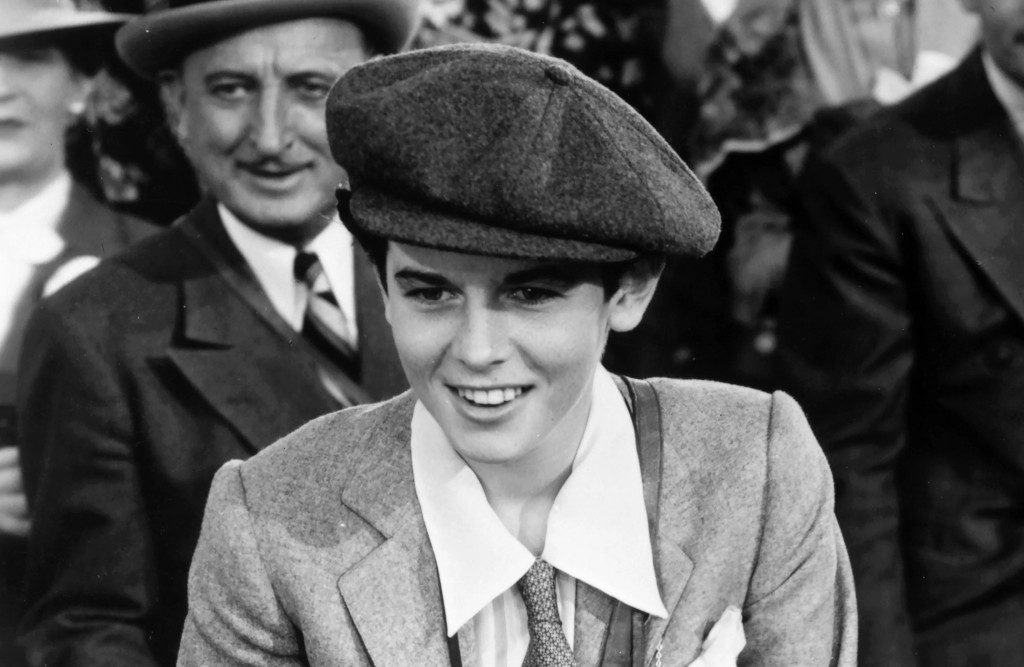
Editor was a man called Ronald Sinclair, a New Zeelander whose real name was Ra Hould. Sinclair had an interesting career – his parents got him started as a child actor in New Zeeland, before relocating to Hollywood in 1936. Through contacts, he was immediately hired by Paramount, but made his biggest splash at MGM, and became a fairly popular child actor, before entering service in WWII. Sinclair really wanted to be a cinematographer, but instead found work in the editing departments when he returned from service. He graduated to editor with Otto Preminger’s sex comedy Blue Moon in 1953, and then found steady work with AIP, and became one of Roger Corman’s favourite editors. He also edited a number of films with Bert I. Gordon, including The Amazing Colossal Man (1957, review). However, in the 80’s he got interested in sound editing, and got particularly involved in ADR – additional dialogue recording. As an ADR editor he worked on his biggest movies by far, such as Commando (1985), Spaceballs (1987), Die Hard (1988), Child’s Play (1988), Die Hard 2 (1990) and Predator 2 (1990).
Set decorator Harry Reif has the distinction of working on some of the lousiest films put to screen, like White Pongo (1945), Plan 9 From Outer Space (1957, review), The Bride and the Beast (1958) and Women of he Prehistoric Planet (1966).
Janne Wass
Voodoo Woman. 1957, USA. Directed by Edward L. Cahn. Written by Russ Bender, V.I. Voss. Starring: Marla English, Tom Conway, Mike “Touch” Connors, Lance Fuller, Mary Ellen Kaye, Martin Wilkins, Paul Blaisdell, Paul Dubov, Otis Greene, Norman Willis, Emmett Smith, Giselle D’Arc, Jean Davis. Music: John Blackburn, Darrell Calker, Giselle D’Arc. Cinematography: Frederick West. Editing: Ronald Sinclair. Art direction: Don Ament. Monster design and makeup: Paul Blaisdell, Harry Thomas. Costume design: Robert Olivas. Sound: Robert Post. Produced by Alex Gordon for AIP.

 Scifist.
Leave a comment