

A team of explorers get stranded in a lost world of dinosaurs in Universal’s flawed 1957 movie. Great sets and atmosphere and a decent cast aren’t enough to lift it above a bogged-down script and bad special effects. 5/10

The Land Unknown. 1957, USA. Directed by Virgil Vogel. Written by László Görög, William N. Robson, Charles Palmer. Starring: Jock Mahoney, Shirley Patterson, Henry Brandon, William Reynolds, Phil Harvey.. Produced by William Alland. IMDb: 5.7/10. Letterboxd: 2.9/5. Rotten Tomatoes: N/A. Metacritic: N/A.
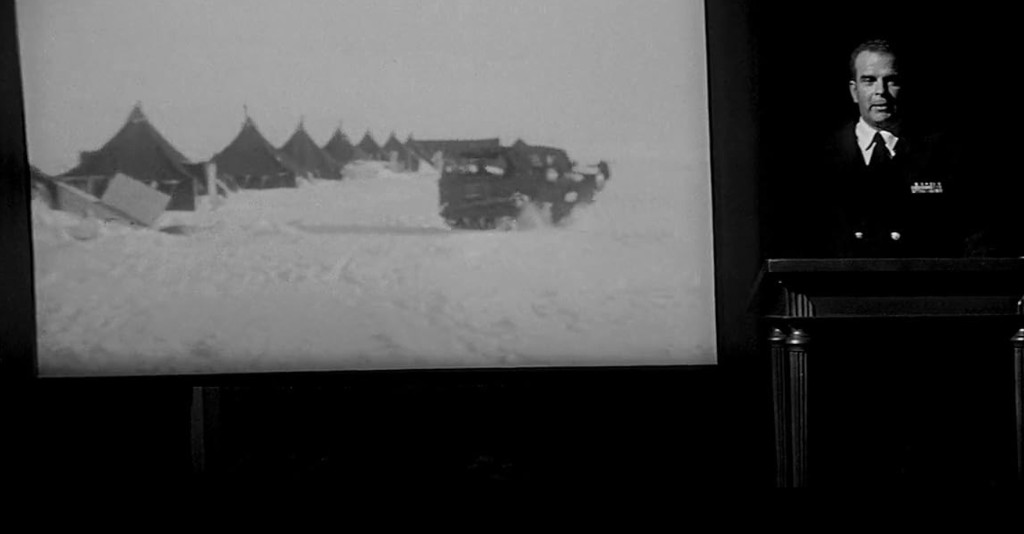
We open with a military lecture delivered by Captain Burnham (Douglas Kennedy) about the exploration about Antarctica, and in particular the documented existence of a warm lake area in the middle of the continent. The lecture is accompanied by a film about a previous expedition in 1947 (the film being set in 1957) with four explorers disappearing while flying over the mysterious lake area. Now the military is going to fly in the footsteps of this expedition, setting out with a naval ship to Antarctica, and finishing the journey by helicopter. The final helicopter flight will be undertaken by three brave men: world-weary Commander Alan Roberts (Jock Mahoney), young hothead Lt. Jack Carmen (William Reyolds) and Private Steve Miller (Phil Harvey). They will be joined by daredevil reporter Margaret Hathaway (Shirley Patterson). Said and done, the hardy team sets out from the ship in their helicopter, only to be caught in bad weather and a thick fog. Their flying machine is attacked by a huge winged creature, and they are forced to make an emergency landing in fog that is too thick for them to see more than a yard in front of them. To their astonishment, as the helicopter descends, it goes several thousand feet below sea level, with the temperature steadily rising, until they touch down in what turns out to be a prehistoric world, unaffected by the climate changes on the surface of the Earth. And here be monsters.

The Land Unknown from 1957 is one of Universal’s latter-day 50’s science fiction movie entries. This lost world epic had been in the pipeline for several years, planned as a big-budget colour spectacle. However, a slashed budget knocked any star actors off the board, reduced the effects budget and forced producer William Alland to settle for black-and-white photography and stock footage padding. Instead of a classic, this has become just another run-of-the-mill 50’s low-budget entry with slurpasaurs and men in awkward T-Rex suits.
Having landed, our intrepid heroes realise the impact with the flying something has bent a rotor control rod, which needs to be replaced. Radio signals won’t reach the command ship, and search-and-rescue planes flying tens of thousands of feet overhead can’t see them through the mist. Now they are trapped – their only chance is to replace the rod within a month’s time, before the command ship presumes them dead and returns to base. Easier said than done in a prehistoric landscape filled with flesh-eating plants and carnivorous dinosaurs commanding the air, the ground and the sea.

However, the four soon realise that the greatest danger aren’t the giant lizards, but plain old homo sapiens. One day Maggie is kidnapped by a caveman, who has built himself a fort on the edge of the great lake. When the team comes to her rescue, they discover that the “barbarian” is in fact Dr. Carl Hunter (Henry Brandon), sole survivor of the lost 1947 expedition, who has set himself up as the solitary master of this prehistoric land. In his humble opinion, everything in the valley belongs to him, including any and all female visitors. When forced at gunpoint to give up his love slave, Hunter proposes a deal. In exchange for Margaret, he will reveal the location wreckage of his expedition’s plane, where he promises they will find spare parts for their helicopter. However, Commander Roberts, who has been eying Margaret himself, bluntly refuses his offer.
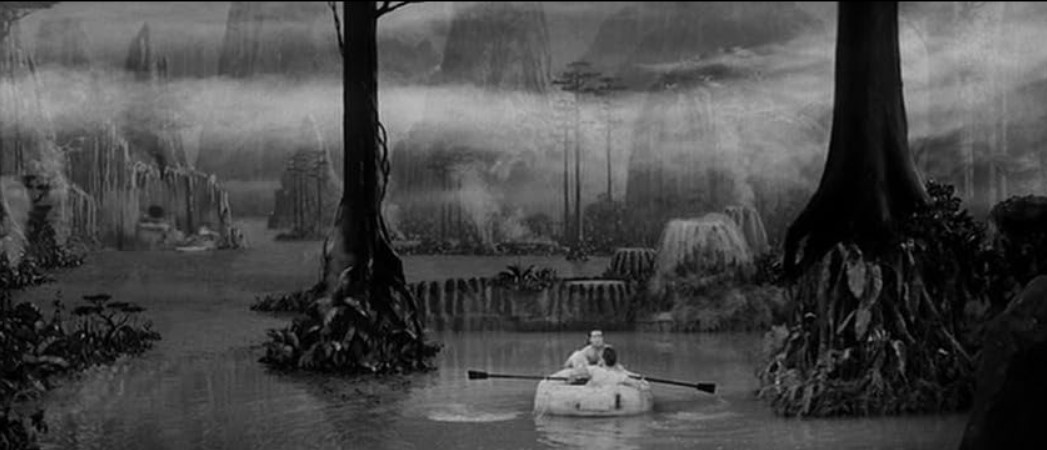
The team instead resolves to find the wreckage themselves. But as the window of escape grows ever narrower, Margaret begins to contemplate Hunter’s offer – to sacrifice herself in order to save the three men, and finally rows off in the team’s rubber dingy to Hunter’s fort. But Private Miller realises what’s going on, and storms the cave, getting into a fight with Dr. Hunter. He subdues Hunter and threatens to kill him, when Roberts and Carmen arrive and breaks up the fight. Roberts says: “We are not going to dig our way out of this hole through human flesh, not even Hunter’s”. Having been shown such mercy, Hunter remembers his own humanity, and offers up the location of the wreckage. Having retrieved the spare part and repaired the helicopter, the three men hear Hunter frantically blowing the horn he uses to scare off dinosaurs. As he and Margaret have undertaken the treacherous journey over the lake, they have been attacked by an Elasmoraurus, which refuses to back off. Our three heroes rush to the rescue in the chopper, but will they arrive in time?
Background & Analysis

While not quite as mysterious as it had been back in the days of H.P. Lovecraft, Antarctica still held its mysteries in the 50’s. The Land Unknown is based on the old pseudo-scientific myth of a vast ice-free or even tropical area behind a wall of ice in the Antarctic interior – and also draws inspiration from the Hollow Earth theory. Many of its adherents have speculated that the North and South Poles were entrances to a world existing beneath the hollow shell of the Earth.
The uninhabitable regions of the Arctic and Antarctica have fascinated us since their discovery. Ice giants, sea monsters and demigods have inhabited these regions for centuries if not millennia. And while Arctic was pretty well mapped out by sailors on the busy trade routs of the Arctic Sea in the 16th century, the Antarctic long remained terra incognita. It wasn’t until 1770, when Captain Cook circumvented the continent, that it was firmly established that Antarctica was “frozen and uninhabitable, and fringed by seemingly impenetrable pack-ice”, as Allegra Rosenberg writes in an interesting article on The Long Now. It didn’t take long for poets, authors and artists to start dreaming up horror stories inspired by Cook’s report; most famously, perhaps, Samuel Coleridge in his chilling poem “The Rime of the Ancient Mariner” (1798).

Still, the most important catalyst for Arctic and Antarctic science fiction was the publication in 1820 of John Symmes’ Hollow Earth theory, which stated that the Earth was really a thing shell hiding inside it a series of concentric spheres, with openings along the Poles. The theory was world news, and that very same year, a novel was publishes under the pseudonym of “Captain Seaborn”, called Symzonia, which followed a protagonist, Captain Seaborn, who sets out to prove Symmes’ theory. In the novel, Seaborn discovers that Antarctica only has a wall of ice surrounding it, and is not only habitable, but inhabited by a race of people who turn out to be the original humans, whose exiled members have inhabited the rest of the world. Unfortunately, the author’s imagination seems to have run dry before getting to the part about an entrance to the bowels of the Earth, and we are only told about the opening by the Symzonians, before Seaborn and his crew are exiled from Antarctica.

Utopian and dystopian fiction, as well as adventure fiction, of isolated, mysterious civilisations have been around for half a millennia, at least. However, the Lost World genre, per se, is generally seen to have been born out of H. Rider Haggard’s King Solomon’s Mines in 1885, although several works, such as Simon Tyssot de Patot’s Voyages et Aventures de Jacques Massé (1710), Jonathan Swift’s Gulliver’s Travels (1726), Edward Bulwer-Lytton‘s The Coming Race (1871) and Samuel Butler’s Erewhon (1872) also featured lost worlds – albeit for satirical purposes. The Lost World genre was propelled by two major scientific discoveries: that of dinosaurs and the pyramids of Egypt. Jules Verne was one of the first authors to include dinosaur-like creatures in his Hollow Earth novel Journey to the Center of the Earth in 1864 – although technically they are marine reptiles and not dinosaurs. And Bulwer-Lytton famously inhabited his underground civilisation with descendants of the ancient Egyptians in The Coming Race. In 1901, Frank Savile published the story Beyond the Great South Wall, in which an exploration team search for the lost Mayan civilisation, and run across a Brontosaurus – one of the very first fictional stories involving a dinosaur.

The Land Unknown, however, is primarily inspired by three later, but no less influential, works. First of all, Arthur Conan Doyle’s genre-defining story The Lost World from 1912, following an expedition to a plateau in South America, where dinosaurs roam. Secondly, Edgar Rice Burrough’s The Land That Time Forgot (1918), in which the crew of a submarine discover a lost world on the uncharted island of Caspak just off Antarctica. And thirdly, the film draws its inspiration from the military-produced, Oscar-winning documentary The Secret Land (1948), which documents the largest Antarctic mission in history, lead by naval officer Richard Byrd (who is also name-checked in the film – Dr. Hunter is supposed to have been part of this operation when he and his crew crashed). The operation involved over 4000 people and its aim was to catalogue most of Antarctica through aerial recoinnosance. Among other things, the Byrd expedition confirmed geothermally active areas in the Antarctic inland with dry ground and volcanic lakes. This, of course, is what The Land Unknown builds its premise on.
According to film historian Bill Warren, The Land Unknown was borne out of the foundation of Cap Palmer Productions by screenwriter and producer Charles “Cap” Palmer in 1953. However, Cap Palmer Productions never made the movie — and in 1954 Palmer founded Parthenon Pictures and became a major producer of business-financed documentaries. Palmer wrote a first script draft of The Land Unknown, but the rights to the script passed to Universal. In an interview with Tom Weaver, director Virgil Vogel says that Universal planned the film as a big-budget extravaganza. László Görög (who had written Universal’s The Mole People, 1956, review) was called in to write a new screenplay based in Palmer’s story, and Jack Arnold himself was reeled back in to Universal to direct. It was to be filmed in colour and CinemaScope on Universal’s large backlot. However, in 1955 Universal’s big-budget SF production This Island Earth (review) semi-flopped, signalling to the studio that science fiction was not a genre to invest in.
The Land Unknown was supposed to have an all-star cast headlined by Cary Grant, says Vogel, but Universal soon ditched these plans and went with what actor William Reynolds in another Weaver interview calls “the B-team”. Plans to film on the backlot was scrapped, and instead the entire movie was filmed at Universal’s biggest sound stage, which could accomodate all the sets. It was decided to film in black-and-white, but the CinemaScope was still kept. The studio was lined with a giganted cyclodrome matte painting and had an artificial pool standing in for the lake. According to Vogel, when Jack Arnold heard that Universal was slashing the funding, he lost interest and withdrew. Vogel had been helping Arnold storyboard the film, and apparently the studio thought he might as well take over as director. Stuntman-turned-minor-TV-star Jock Mahoney was the biggest name in the cast, which was otherwise made up by virtual unknowns. Mahoney had been the star of the western series The Range Rider (1951-1953) and according to Reynolds, Universal counted on that he would draw people to rural theatres in areas where the show had been popular.

That The Land Unknown is not directed by Jack Arnold is obvious from the start. Arnold would never have stooped to opening the movie with a dry lecture, which sets the movie off on the wrong foot from the very beginning. The lecture is illustrated with stock footage from the documentary The Secret Land. Then we have some casual sexism with the introduction of reporter Margaret Hathaway among the naval crew, saying lines like “remember, I was once alone with 900 men” and “I always like to meet men”.
Fortunately, the film does pick up a little bit once we get to the prehistoric valley. The script is certainly better than the one László Görög wrote for The Mole Men, another lost world movie, but it suffers from the same problem: once in the lost world, there is little plot other than the characters trying to get out of it, which inevitabely means that there will be need for padding. The introduction of Dr. Hunter (a callback to The Mysterious Island’s Tom Ayrton, perhaps?) gives the film some new energy, and Henry Brandon also injects some good acting into a rather bland cast. The script goes out of its way to make Private Miller a sort of fall-guy for all the team’s troubles. When trying to straighten out the helicopter’s control rod, he is the one that breaks it. He nearly drains the helicopter’s batteries in a futile attempt to contact the ship and he tries to reach a plane flying 3000 feet above with a flare that has a range of 400 feet. All the while, none of the other characters ever make any mistakes. This is just lazy writing, especially since Miller’s mistakes are, on the whole, inconsequential for the plot and he is never confronted with them by the other team members. It’s like Görög simply thought he needed a jerk on the crew.

There’s also plot holes galore. The most glaring one is that all the trouble with Dr. Hunter could probably have been avoided if the crew would simply have offered him a seat on the helicopter back home. But for some inexplicable reason, they never do, and he never asks. William Reynolds even brings it up in his interview with Weaver: “How illogical is it that we never say to the guy, ‘Hey Charlie [sic], we got room in our helicopter. Give us the push-pull tube and we’ll take you out of here.’ I don’t recall that as being part of the dialogue!”
Overall Virgil Vogel’s direction is flat and uninteresting, and the lighting uniformly grey and dull. However, this is counter-acted by the fact that the sets are quite impressive, and the matte paintings, while obvious paintings, are occasionally stunning. Clifford Stine’s process photography is also, for the most part, very good. The shots of the helicopter matted in over the footage from The Secret Land aren’t quite convincing, but there’s a number of impressive scenes of the characters running away from gigantic dinosaurs.
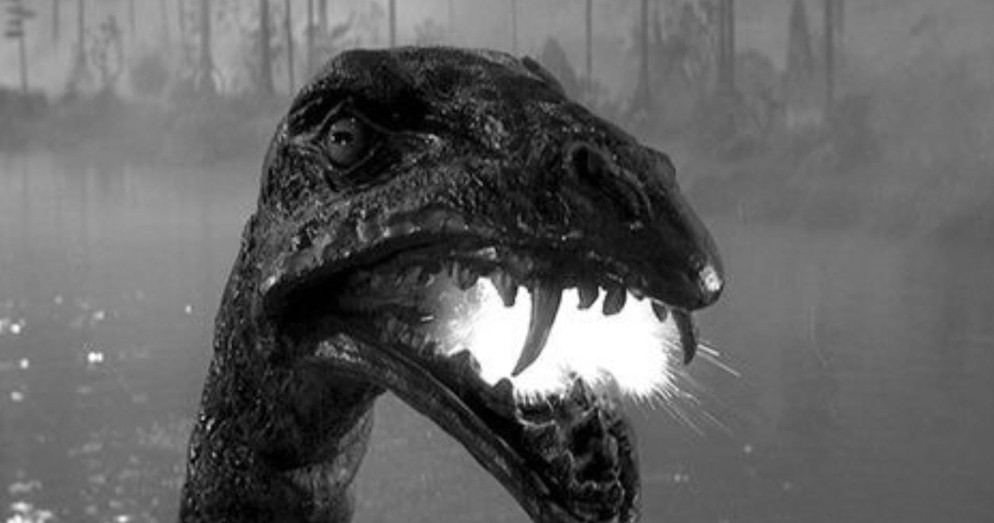
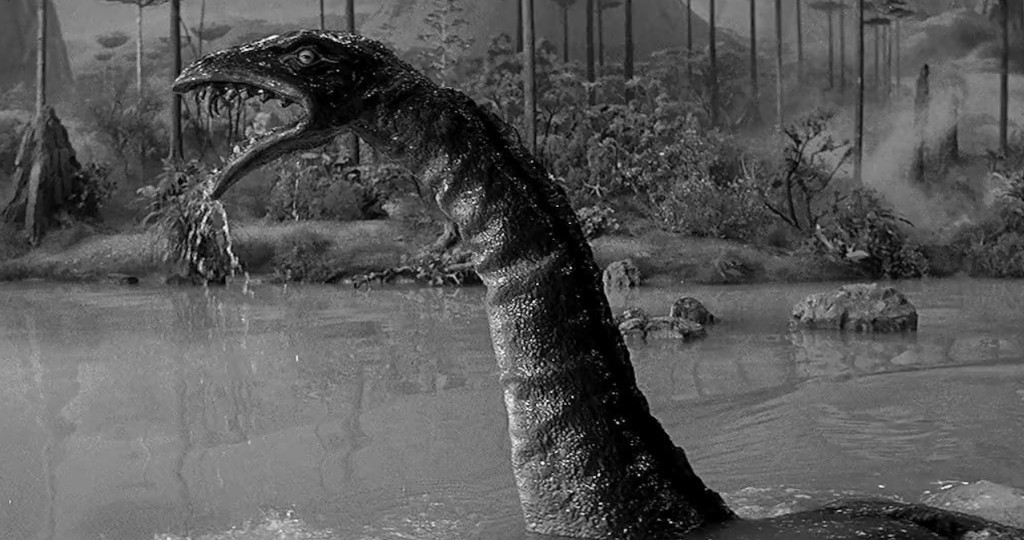
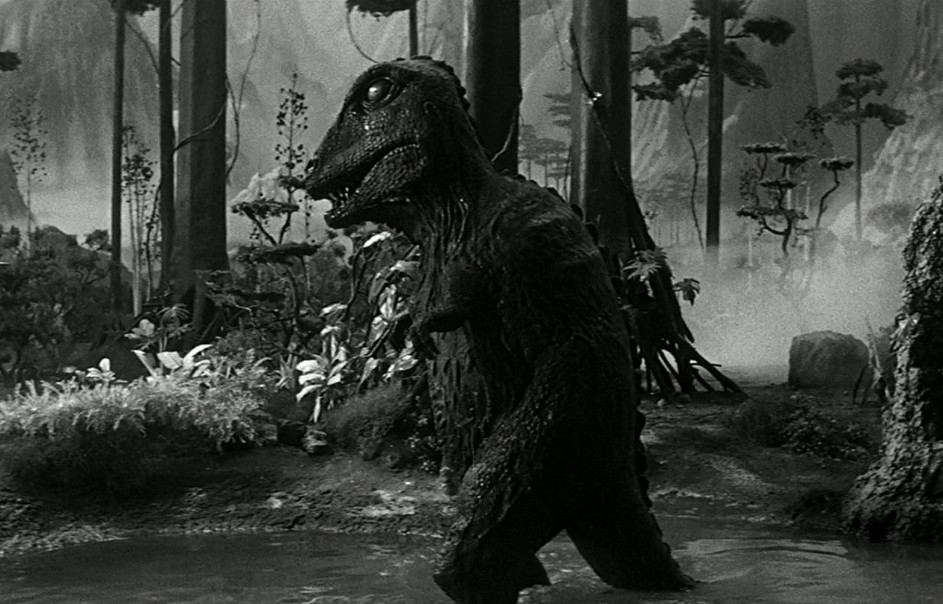
The dinos themeselves are a whole other matter. Granted, they are not as bad as the wobbly allosauruses in Unknown Island (1948, review), but the T. Rex in this movie is also terrible. It is clearly a guy in a suit. A bad suit, which looks to be expanded with spokes, like an umbrella. It’s given a hump on its back, probably to make it look more saurian, but it just comes off as ridiculous. This is not a scary monster. The flying pterosaurs look just fine. The sea-dwelling elasmosaurus has gotten a lot of flack, but I don’t think it’s all that bad. Yes, it’s got a cartoonish grin and looks a bit rubbery, but it moves rather well, and is well incorporated into the action. We never see more of it than its head and neck, flippers and the upper part of its back, the rest being submerged in the very milky waters (probably to hide the mechanics and operators). It is portrayed at towering at least 30 feet above sea level, but was probably constructed as a large mechanical puppet of around 6 feet or so, judging from its size against the model helicopter.
Producer Alland should at least be given credit for trying to create real-looking dinosaurs. I expect that he had planned some stop-motion work for a scene in which dinosaurs are battling each other, but had to abandon the idea when the budget was slashed. There’s little other explanation for the inclusion of a fight between two monitor lizards, something which is always sad to see in films like these. The shots are not repurposed from One Million, BC (1940), but they could as well have been.
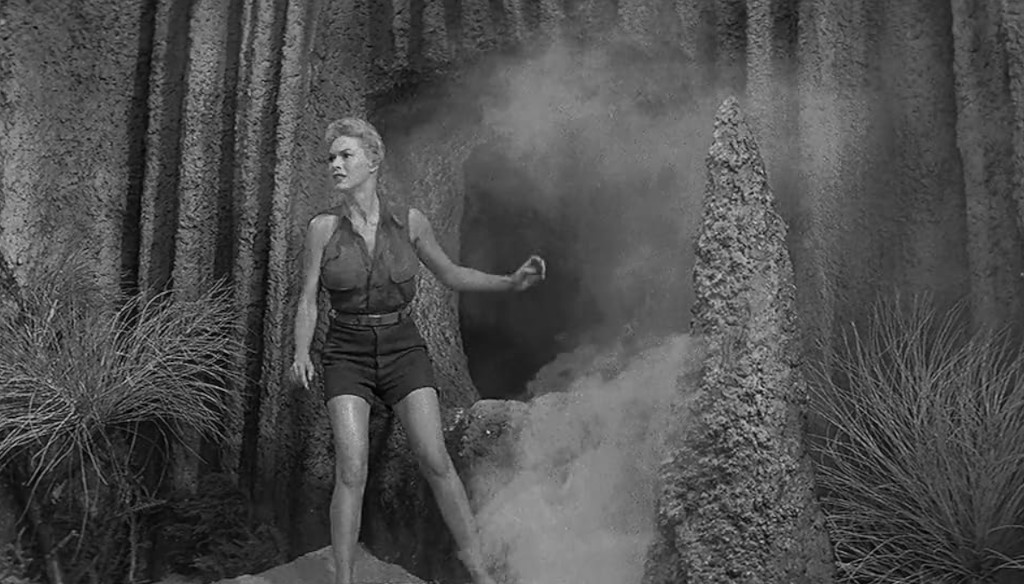
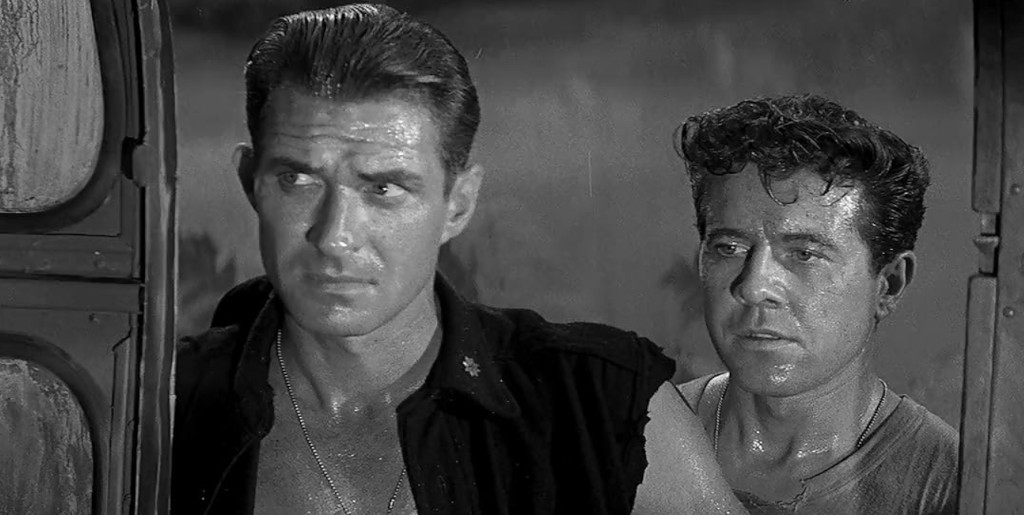
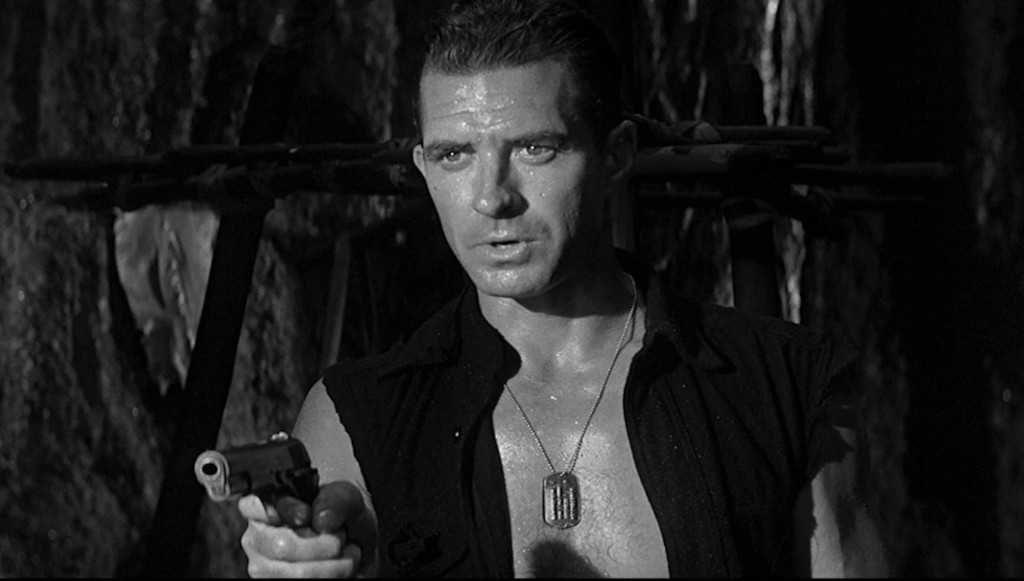
The acting is OK across the board. Jock Mahoney’s romantic lead is clearly modelled on Bruce Cabot’s character in King Kong (1933, review) — the quiet, serious leader who is awkward around his love interest. Mahoney carries off the role with dignity. The other standout is Henry Brandon as Dr. Hunter, who manages to bring some much-needed energy to the otherwise rather dull proceedings, chewing scenery as he mugs along. Shirley Patterson (billed under her comeback screen name Shawn Smith) is laden with a bunch of ripe dialogue, but comes off with flying colours, considering the circumstances. William Reynolds and Phil Harvey don’t get very much to work with, but provide stable support. A stronger set of actors may well have livened up the film a bit.
Like so many other SF movies of 1957, this is a middling B entry. The resources of a large studio ensures a certain mark of quality, but the varying quality of the special effects shows that this was not a prioritised production. Big studios’ aversion to science fiction was illustrated by the fact that Universal protested against The Land Unknown being described as science fiction. According to the studio, it was “science fact”. Universal argued that the movie was extrapolative, and therefore not science fiction. Of course, most science fiction is extrapolative. Whatever the case, you may extrapolate from this review that The Land Unknown is a perfectly good piece of entertainment if you enjoy old SF B-movies. It doesn’t bring anything new to the table, though, and neither its visuals or content are enough to lift it above average.
Release & Reception

The Land Unknown got a general release in October, 1957. There’s no information on its box office performance, other than it didn’t make Variety’s list of the highest-grossing films of 1957. Daily News wrote in its 2/4 star review: “while the large amount of fiction embroidering the fact does not strike original, or, even, semi-plausible veins, there are some chills along the way”.
The trade press was very positive. Harrison’s Reports said that “the monsters depicted are so life-like and flexible that one accepts them as real”, calling the film “a good science fiction programmer”. Variety called the movie “imaginative” and “expertly turned out”. The Motion Picture Exhibitor said the film was “well made” with “monsters that are terrifying and realistic”; “the cast is good, as is the direction”.

Today the film has a 5.7/10 audience rating on IMDb, based on 2,000 votes and a 2.9/5 rating on Letterboxd, based on a little less than 1,000 votes. It does not have enough entries on Rotten Tomatoes for a critic consensus, which speaks to its obscurity.
AllMovie gives The Land Unknown a 1/5 star rating, with Craig Butler writing: “Make no mistake, this is one bad film”. While Butler praises the opticals, he laments the bad dinosaurs and “a lame script, simply horrible dialogue, haphazard plotting and performances that are strictly from hunger” which amount to “a dreadful mess that can’t help but inspire laughter”. Glenn Erickson at Trailers from Hell says the film “comes through with high marks on things that were scarce in late-‘fifties sci-fi: convincing hardware, an impressive prehistoric world, and rather good special optical effects. Yet it fails to give us an engaging story. Not even eighty minutes long, it lacks forward momentum and feels like a slow two hours. TV Guide says: “Superior special effects make this fantasy adventure a respectable endeavor”.

Richard Scheib at Moria gives the film 2/5 stars: “If The Land Unknown were a film made today with say Jurassic Park (1993)-styled effects it could be a fine film. Alas, it befalls the same problem endemic to most 1950s dinosaur films – poor effects. The T-Rex is a thoroughly unconvincing man in a rubber suit and the sea monster laughably shabby, with the best effects being the good old standby of photographically enlarged lizards. It is these unfortunately that the film stands or falls upon.” Dave Sindelar at Fantastic Movie Musings and Ramblings is similarly unimpressed: “This is a rather tepid, forgettable lost world movie, and though quite a bit of money went into it, it’s not that impressive.”
Cast & Crew

Actor-turned-producer William Alland started his career as a member of Orson Welles’ legendary stage and radio theatre company Mercury Theatre. Among other things, he was part of the famous production of The War of the Worlds in 1938. As an actor he is probably best known for playing the newspaper reporter who ”narrates” Welles’ masterpiece Citizen Kane (1941).
Alland quickly moved up in his career, started producing radio shows and in the early fifties he joined Universal Studios as a movie producer. In 1953 the studio assigned Alland to produce a low-budget SF film in order to cash in on the 3D craze. The result was It Came from Outer Space (1953, review), which became one of the biggest grossers of the year for Universal, and is considered a genuine classic of the era today. It also brought together Alland and director Jack Arnold, who became the dynamic duo of science fiction at Universal during the mid-fifties. Eager to follow up on the success of It Came from Outer Space, the studio commissioned another 3D sci-fi from Alland and Arnold, but Alland, which became Creature from the Black Lagoon (1954), an even bigger success and considered a bona fide classic. The movie spawned two sequels, both of inferior quality, Revenge of the Creature (1955, review) and The Creature Walks Among Us (1956, review). The latter was hampered by the semi-flop of Alland’s costly SF epic This Island Earth (1955), which led Universal to start slashing its SF budgets. The result of the slashing is on full display in the studio’s following Alland-produced science fiction films, The Mole People (1956), The Deadly Mantis (1957, review) and especially in The Land Unknown (1957).

Disparaged at the situation at Universal, Alland struck out as a freelancer in 1958, and produced two low-budget SF pictures for Paramount, The Space Children and The Colossus of New York (review). While flawed, both are considerably more interesting than his last three SF clunkers for Universal. In between SF assignments, Alland also produced more “conventional” films, primarily westerns. In 1961 he tried his hand at directing a teen flick with Paul Anka in the lead, with dubious results. He produced a couple more films before leaving the film business in 1966. According to a Los Angeles Times obit, he then started developing and manufacturing sail boats, and during the last 10 years of his life worked part-time for the Los Angeles Times Poll. Like screenwriter Berkeley, Alland was one of the informants for the House Un-American Activities Committee, acknowledgeing his past as a member of the Communist Party and naming other members, many of whom were blacklisted, among them screenwriter Bernard Gordon, who worked on Earth vs. the Flying Saucers (1956) and The Man Who Turned to Stone (1957, review). Alland passed away in 1997.
Director Virgil Vogel had joined Universal in 1940 as an assistant director, but spent most of his career as an editor, as well as working with visual effects. Vogel edited This Island Earth and Abbott and Costello Meet the Invisible Man, among a number of other films. Feeling stagnated in his career, he begged the studio brass for a chance at directing, and since he was considered a “special effect kind of guy”, he was given The Mole People (1956, review) as his first directorial assignment. In an interview with film historian Tom Weaver, Vogel says he didn’t care one way or another which film he was given to direct, as long as he was able to direct. The low budget was not a deterrent, on the contrary, Vogel prided himself in knowing the tricks and short cuts for creating a decent movie on a thin dime.
His career as a film director was short, however. He directed a handful of pictures in the late fifties, including two more SF films. The first was The Land Unknown (1957), which was supposed to be another lost world epic, but which was also marred by its low budget. Finally, he directed Sweden’s first SF movie, Rymdinvasion i Lappland (1958), which was shortened and re-edited for US release as Invasion of the Animal People. Seeing that his movie career wasn’t moving forward, Vogel jumped ship to TV, where he enjoyed a long and successful career, and directed shows like Wagon Train, Bonanza, Mission: Impossible, The Streets of San Francisco, Magnun, P.I. and Miami Vice — but also SF fair like The Six Million Dollar Man, Knight Rider, Street Hawk, Airwolf and Quantum Leap.

Screenwriter László Görög was born László Guttmann in Austria-Hungary in 1903, and emigrated to the US in 1939. In his birth country, Görög worked as a journalist and a prolific writer of detective and crime novellas. It wasn’t until he arrived in Los Angeles, however, that he entered the movie business. Without a studio contract, Görög received commissions from various companies. His first produced screenplay was Tales of Manhattan (1942) for Fox, then he wrote The Affairs of Susan (1945) for Columbia, which earned him an Oscar nomination for best original story. However, film work seems to have run dry in 1947, and he has no credits before 1953, when he started writing for television. Görög mainly wrote for anthology shows and had a few film assignments as well. His science fiction movies include The Mole People (1957), The Land Unknown (1957) and Earth vs. the Spider (1958, review). He retired in 1963.

Jock Mahoney joined Hollywood in the mid-40’s as a stuntman, primarily making westerns for Columbia. His physical prowess, daring and meticulous preparation soon made him one of the most sought-after stunt men in Hollywood. He regularly doubled for Charles Starrett, Randolph Scott, Errol Flynn and Gregory Peck. Producers quickly realised Mahoney also had some actual acting talent and began putting him in speaking roles, particularly in a number of Three Stooges films in the late 40’s, which would benefit from his ability for spectacular pratfalls. Mahoney doubled for Charles Starrett in numerous low-budget Durango Kid movies, and eventually worked his way up to co-starring status. When Starrett’s contract ran out in 1952, Mahoney took over the mantle of the Durango Kid, but although Columbia made a film with him in the title role, it was never released, as the franchise was discontinued. However, by this time the former stunt man was already a minor star in his own right, as he starred in the Gene Autrey-produced TV series The Range Rider (1951–1953).
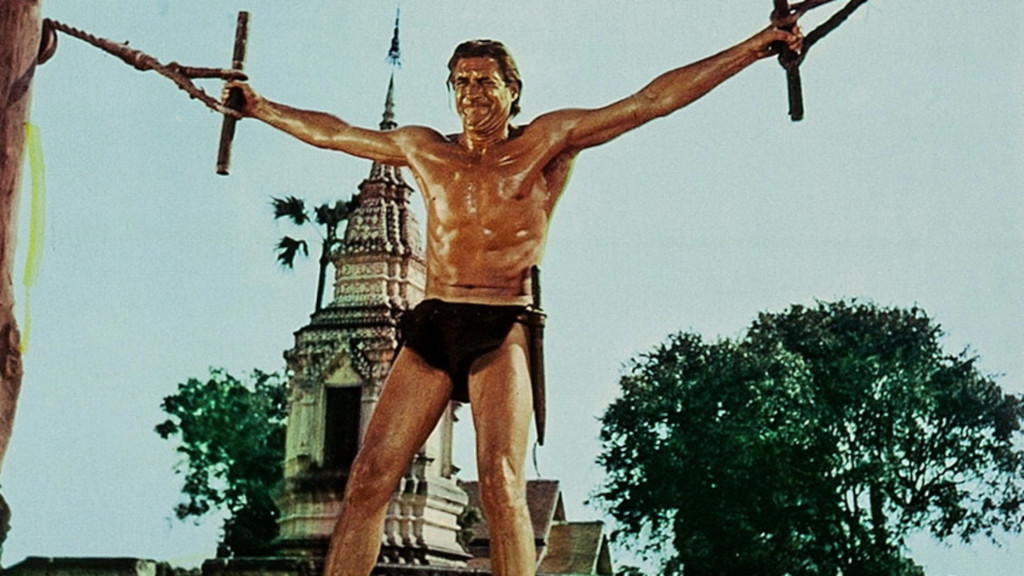
In the mid-50’s Mahoney had a few leads in B-westerns and a couple of supporting roles in A-movies, and in 1958 got another stab at TV stardom as the titular lead in the TV show Yancy Derringer (1958–1959). Back in 1948, Mahoney had been one of the 200 actors auditioning to replace Johnny Weissmuller as Tarzan, but lost the role to Lex Barker. Bodybuilder Gordon Scott took over the loincloth in 1955, and appeared in six films. In the last one, Mahoney had a co-starring role as a villain. When Sy Weintraub was looking for a replacement in 1962, he called on Mahoney for the films Tarzan Goes to India (1962) and Tarzan’s Three Challenges (1963). During the filming of the second one in Thailand, Mahoney suffered from dysentery and dengue fever, and needed over a year to nurse himself back to health. He was the 13th actor to play Tarzan in Hollywood, and by 1963 also the oldest, at 44, and Weintraub was looking for a younger hero in subsequent films. Given the ordeal in Thailand, Mahoney had no qualms about passing on the role. In 1981 he returned to the franchise as the stunt coordinator on Tarzan the Ape Man, best remembered for Bo Derek’s “performance”. Mahoney continued acting into the mid-80’s, but mostly in supporting roles.

Canadian-born Shirley Patterson moved to California with her family in the 30’s because of her father’s health issues. She began acting on stage and in 1941 won the Miss California pageant, however she was later disqualified when it turned out she was underage. She was noticed by a Columbia scout in a stage play, and was signed to the studion in 1943. She appeared in B-movies, sometimes as a leading lady, and is best remember from her work in the era for playing the female lead in the original Batman serial (1943, review).
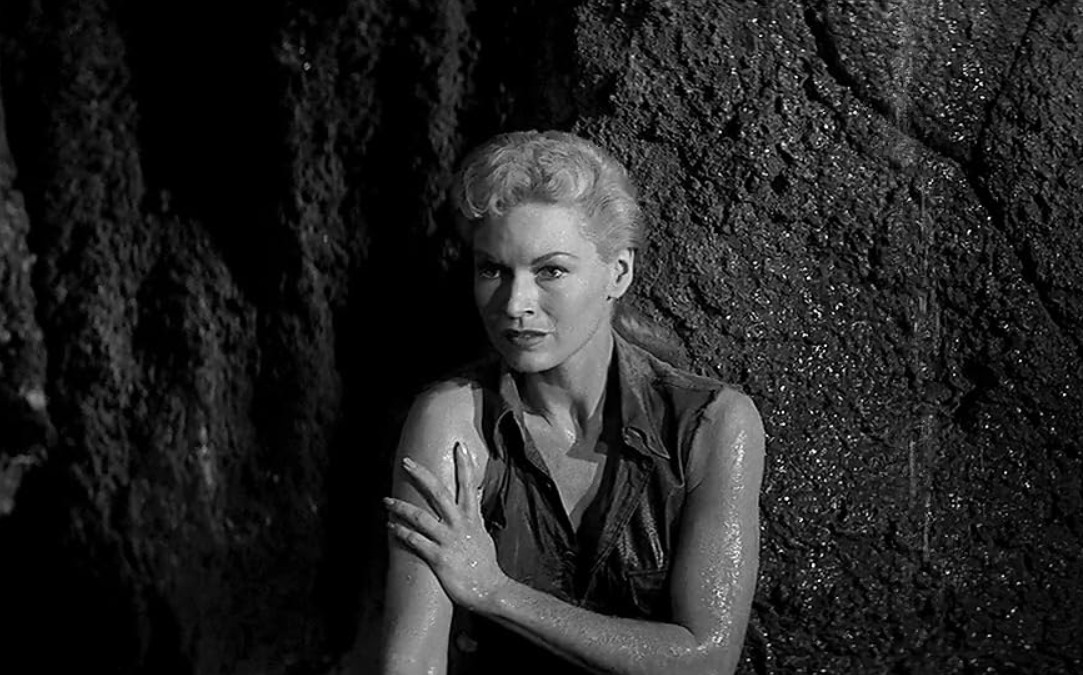
Patterson took a hiatus from acting 1947-1953 in order to raise her family, and re-emerged in Hollywood under the moniker of Shawn Smith, which is how she is credited in The Land Unknown. She mostly appeared in supporting and bit parts in this era, but science fiction returned her to leading lady status. She had a supporting role as the Martian woman Elaine in World Without End (1956, review), and appeared as the female lead in The Land Unknown and the cult classic It! The Terror from Beyond Space (1958, review). However, her comeback was cut short when she broke her leg in seven places in a skiing accident in 1958. She wore a cast for a year and a half, which ended her acting career.

Dark, handsome William Reynolds (born 1931) was spotted by a Universal talent agent in 1951, and was placed in the “fish bowl” of talented young actors. In an interview with Tom Weaver, he was young and cocky and prone to making trouble for himself, which hindered his career. He had a number of prominent supporting roles, often playing the son of the lead actor, most famously Laurence Olivier’s son in Carrie (1952). During the Korean War he worked at the US radio outfit in Japan. He returned to Universal after the war, appearing in such genre films as Cult of the Cobra (1955), The Land Unknown (1957) and The Thing That Couldn’t Die (1958) – the latter in a leading role. However, he got tired with the assignments given to him by Universal, and moved into television. He is perhaps best remembered by genre fans for his role in the iconic The Twilight Zone episode “The Purple Testament” (1960), as a US soldier in the Philippines having visions about his own death. He got a co-star assignment in ABC’s series The Gallant Men (1962-1963), but had his final breakthrough whe he was cast in the co-lead of the network’s long running series The F.B.I. (1966-1974). After the show finished, Reynolds more or less dropped out of acting and began working in real estate.

Phil Harvey was a Universal contract player who appeared in close to 20 films between 1956 and 1958, including three science fiction movies in 1957: The Deadly Mantis, The Land Unknown andThe Monolith Monsters (review). His last three roles at the studio were uncredited but parts, and he struck out as a freelancer in 1958.Harvey appeared in two AIP movies,Monster on the Campus (1958, review) and Why Must I Die (1960), and had a couple of TV guests spots. He called it quits in 1961 and became a music teacher, and later set up a camera shop.

Henry Brandon was no stranger to playing villains. German-born Heinrich Kleinbach made a splash in the earl 30’s, playing the villain in a record-breaking run of the stage play The Drunkard – a role which secured him his first featured film appearance, as the villain in the Laurel and Hardy film Babes in Toyland (1934). In 1936 he adapted the stage name Henry Brandon, perhaps because of rising anti-German sentiments. Brandon’s dark, sharp features often saw him playing “ethnic” roles, such as a Chinese in the title role of Drums of Fu Manchu (1940, his only leading role), a Mongolian in The Golden Horde (1951), African natives in Tarzan’s Magic Fountain (1949) and Tarzan and the She-Devil (1953) and native Americans in The Searchers (1956) and Two Rode Together (1961). Never a marquee name, Brandon was nonetheless an in-demand character actor who seemed to switch effortlessly between B-movie schlock and A-films.

Douglas Kennedy, here as Captain Burnham, had a rare leading role in The Amazing Transparent Man (1960), and also appeared in The War of the Worlds (1953, review) and The Alligator People (1959), as well as The Destructors (1968). The film also features the “furiously prolific” bit-part actor Kenner G. Kemp, who appeared in at least 500 movies, a good portion of science fictions among them – almost always uncredited. Bing Russel is best known for playing the recurring role of Deputy Clem Foster on Bonanza.
Janne Wass
The Land Unknown. 1957, USA. Directed by Virgil Vogel. Written by László Görög, William N. Robson, Charles Palmer. Starring: Jock Mahoney, Shirley Patterson, Henry Brandon, William Reynolds, Phil Harvey, Douglas Henderson. Cinematography: Ellis Carter. Editing: Fred MacDowell. Art direction: Alexander Golitzen, Richard Riedel. Makeup: Bud Westmore, Irving Berns. Special effects: Orien Ernest, Jack Kevan, Fred Knoth. Visual effects: Roswell Hoffmann, Ray Binger, Clifford Stine. Produced by William Alland for Universal.
 Scifist.
Leave a comment