

US astronauts bring back a creature from Venus to Italy, where it breaks loose, grows and runs amok in Rome. Ray Harryhausen’s memorable monster elevates this poorly written 1957 programmer. 6/10

20 Million Miles to Earth. 1957, USA. Directed by Nathan Juran & Ray Harryhausen. Written by Robert Creighton Williams, Christopher Knopf, Charlott Knight, Ray Harryhausen. Starring: William Hopper, Joan Taylor, Tito Vuolo, John Zaremba, Frank Puglia, Thomas Browne Henry, Bart Braverman. Visual effects: Ray Harryhausen. Produced by Charles Schneer. IMDb: 6.3/10. Letterboxd: 2.8/5. Rotten Tomatoes: 5.9/10. Metacritic: N/A.
A US spaceship returning from the first trip to Venus crashes just outside the coast of Sicily. The lone survivor, Col. Calder (William Hopper) is saved by two fishermen (George Khoury & Don Orlando) just before the ship sinks. A curious young boy, Pepe (Bart Braverman) finds an odd cylinder washed up on the shore, which contains a small creature encased in a block of gelatinous material. He brings it to Zoologist Dr. Leonardo (Frank Puglia) to whom he sells it for pocket money. Meanwhile, Leonardo’s daughter Marisa (Joan Taylor) is called in to take care of Col. Calder, as she is an “almost doctor”. When recovering, Calder immediately inquires about a certain cylinder, and the US military and Italian police all get involved in the search for it. It contains a specimen of a Venusian creature, which holds vital information for humans on how to survive the Venusian atmosphere. Pepe reveals (for a price) that he delivered it to Dr. Leonardo and his daughter. Unfortunately, the two are already en route to Rome. And when Calder and his team catch up with them, the creature has already grown to human-like size and escaped. Now the hunt is on.

So begins Columbia’s 1957 classic 20 Million Miles to Earth, featuring superb stop-motion and model work by Ray Harryhausen, the third collaboration between producer Sam Katzman and the legendary creature maker. This was a comeback, of sorts, after Columbia’s previous monster movie, released the same year, The Giant Claw (review), for which Katzman failed to secure the services of Harryhausen, with disastrous results.
The hunt for the creature commences as a joint operation between the US military, led by Maj. General McIntosh (Thomas Browne Henry), Dr. Uhl (John Zaremba) and Col. Calder, along with Ms. Leonardo, and the Italian police, led by Commissario Unte (Tito Vuolo). Calder explains that the creature only feeds on sulfur and is not aggressive, unless provoked. However, when attacked by a dog and shot at by its owner, it kills the owner (after a memorable fight with the pursuers in a barn) and escapes into the mountains.
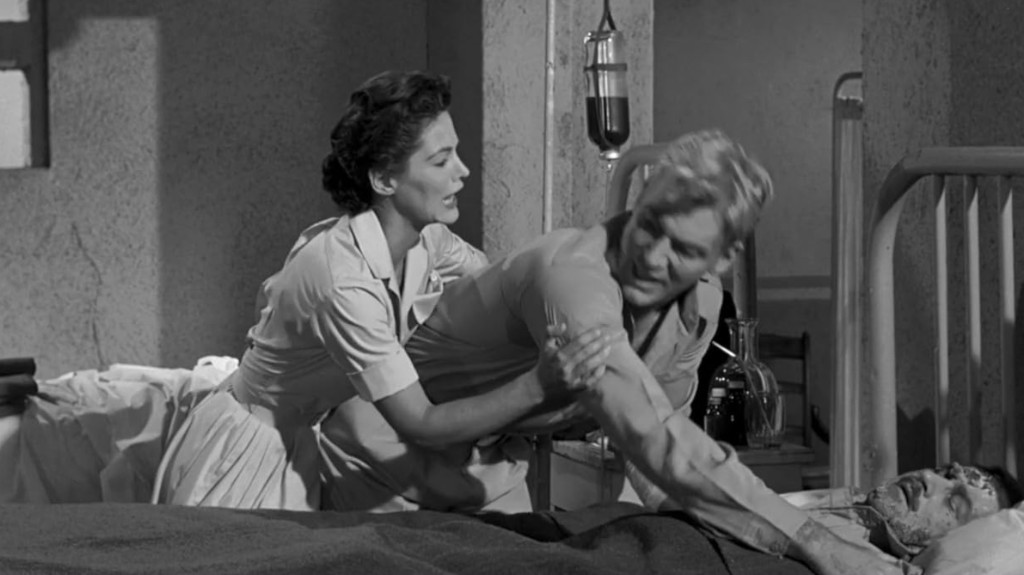
This is the tipping point for Commissario Unte, who orders a shoot-to-kill policy. Meanwhile, the US army are bent on capturing the creature alive, so the race is on to find the creature before the Italians do. And find it they do, with the help of helicopters and sulfur as bait. Captured, the creature is kept immobilised by means of a strong electic current, growing ever bigger, while scientsts keep experimenting on it. An accident cuts the power, and the creature breaks loose, wreaking havoc on Rome, and get ito a wrestling match with a circus elephant. It all comes down to a final showdown at the Colosseum. After a chase and bombardment, it falls to its death.
Background & Analysis

Although ’twasn’t beauty that killed the beast, the ending of the film wears its inspiration on its sleeve, highlighting the film’s attempt at to be the King Kong (1933, review) of the science fiction age. Also, both the plot and the title clearly emulate the King Kong of the 50’s, The Beast from 20,000 Fathoms (1953, review).
In his book An Animated Life, Ray Harryhausen writes that the concept of the story began with a story treatment called “The Cyclops” in 1954. In the original story, a spaceship with a cyclops inside crash lands in Lake Michigan, and the cyclops in confined at the Chicago Zoo, where it crows, breaks out and kills and elephant before going on a rampage in the city. The story was developed by Harryhausen and screenwriter Charlott Knight, and went into production with Columbia under the title “The Giant Ymir”. The final screenplay was written by Robert Creighton Williams and Christopher Knopf. Harryhausen at one point removed all references to “Ymir”, as he was afraid it was too close to the Arab title “Emir”. The action was purportedly moved to Italy, because Harryhausen wanted to vacation there.

20 Million Miles to Earth was the third collaboration between Harryhausen and Columbia, the previous being It Came from Beneath the Sea (1954, review) and Earth vs. the Flying Saucers (1956, review). Columbia boss Sam Katzman had also tried to get Harryhausen to do the effects for The Giant Claw, but probably couldn’t afford him. 20 Million Miles to Earth is produced not by Katzman, but by Harryhausen’s long-time collaborator Charles Schneer. This was the first collaboration between director Nathan Juran and Harryhausen. Together, they would make Harryhausen’s first film based on the ancient Greek myths, The 7th Voyage of Sinbad (1958) and First Men in the Moon (1964).
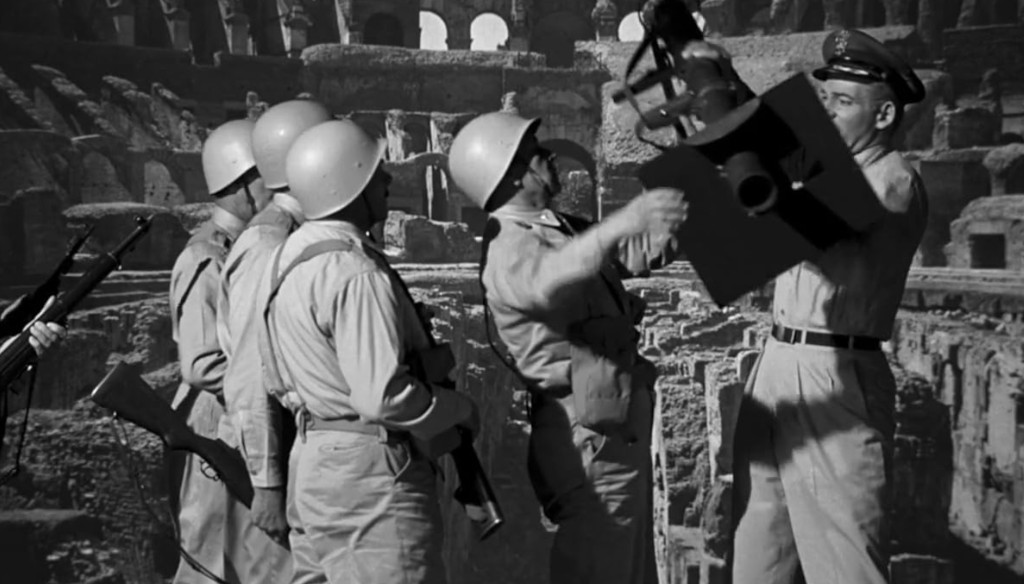
The scenes of the fishing village was filmed at the village of Sperlonga in Italy, and several shots were shot in Rome. Columbia was allowed to shoot at the actual Colosseum, which adds a sense of realism to the final proceedings. Of the principal cast only William Hopper was flown to Italy. Also not in Italy was Nathan Juran, as Harryhausen directed all Italian scenes. The rest of the movie was filmed in and around Columbia Studios in Hollywood. Harryhausen would direct the live-action scenes in which actors would interact with the creature, which still went by the moniker Ymir behind the scenes.
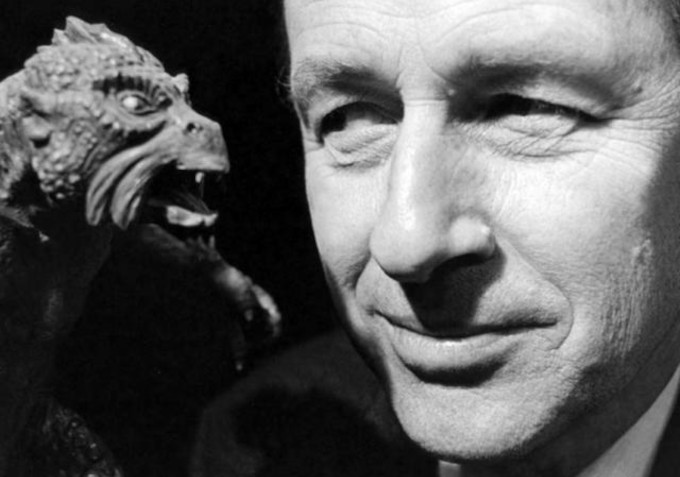
The animation work in 20 Million Miles to Earth is often described as some of Harryhausen’s best. The matching of the lighting between live-action and animation is impeccable, and the animation of Ymir is fluent, life-like and dynamic. The creature is constantly in motion, enchanced by Harryhausen’s astounding attention to detail. He was better than perhaps any animator in history at injecting emotion and personality into his creatures, and seldom has he done it better than in 20 Million Miles to Earth. The creature itself is simple enough that Harryhausen can focus on detail and emotion, not having dozens of limbs, tentacles or other appendages to take care of at the same time. The combination of live-action and animation is perhaps the best done in a science fiction movie in the 50’s.
It’s important to point out that the movies created by Harryhausen really only had one visual effects artist: Ray Harryhausen. Harryhausen did everything himself — except create the puppets. That was usually done by his father. Harryhausen often used the technique he later came to call “dynamation”, which was to essentially have three layers of images. In the background he had a rear-screen projection that he screened almost a frame at a time, in front of which he animated his puppets, and in front of that a third layer of mattes. He was the animator, the gaffer, the rear screen projectionist, the miniature set designer, the continuity controller, the director and often screenwriter — and of course, in his own way, the actor.

Of course, the film also has practical effects spliced in with Harryhausen’s work – and these are equally important for selling the illusions. These were handled by Lawrence Butler, who won an Oscar for his work on The Thief of Bagdad (1940).
Ymir’s design is fascinating, but somewhat illogical. With its bipedal, upright gait, opposing thumb, long, powerful legs, fangs and a large tail for balance, Ymir looks as if it is designed for hunting and gathering, but still we are told that it only eats sulfur. This would suggest a creature that has evolved for hacking a burrowing into rock, with powerful fore-arms equipped with large nails for digging, a quadrupedal gait and a low stance, for eating food buried underground. And it wouldn’t have fangs, but rather strong molars. And at one point, a scientist points out that one of the reasons Ymir is so hard to kill (bullets don’t seem to slow it down) is that it lacks a heart and lungs. Just a few seconds later we see Ymir lying on a slab, with its chest heaving and sinking, very much like the chest of an animal breathing with lungs. Another oddity is that its size is incosistent. When it has reached the end of its growing curve, it is presented as being around 30 feet or so whenever it is interacting with humans. However, when it wrestles the elephant, both are portrayed as being about the same height, however, elephants only grow to around 12-13 feet at most.

The weakest link of 20 Million Miles to Earth is the script, as was almost always the case with Harryhausen’s films. As such, this is a standard monster movie programmer. The film is at its best during its first half, when the creature is discovered and kept by Dr. Leonardo and his daughter, first in the camping van and later a cage, and when it is confronted by its pursuers in the barn. With its almost human form and human size, the creature is relatable, vulnerable. It can be hurt by a hay fork and coaxed and prodded with a wooden pole. It struggles at it is attacked by a dog. It is a creature lost and alone, bewildered in a strange world, 20 million miles away from its kin. The barn fight is the highlight of the movie, and feels like it should have been the climax. As it grows to gigantic proportions, Ymir really just becomes another giant monster on a rampage.

One wishes that 20 Million Miles to Earth had been better written, as there are ideas here that could have turned out fantastic if they had just been probed a little deeper. There is a clear attempt at making Ymir a sympathetic character, but there really isn’t anything in the script reinforcing this notion. While Calder notes that the creature is not hostile, it always attacks when threatened, rather than tries to escape or evade. The natural thing for a screenwriter to do would have been to have Marisa, the daughter of a zoologist, develop some kind of relationship with Ymir, trying to understand it and argue for it not being treated as a test animal, but rather as a potentially intelligent being from another planet. Having Ymir interact on friendly terms with a character would have brought depth and nuance to the film, and made the ending much more impactful. Or even portraying Ymir as curious, playful or occasionally happy would have made the creature relatable, rather than just a monster on the loose.

The movie starts out quite sprightly, with the scene of the rocket crashing close to a group of fishermen, of which two men and a boy row up to it to investigate, and end up rescuing two people from the sinking spaceship. This is a pretty exciting scene, and promises a little bit of originality. The Italian setting also sets it apart from many of its counterparts, adding a little bit of flavour. I like the way the actions of the Italian authorities is portrayed, as well as the cooperation between the Italian police and the US military. However, I do not buy the fact that the boy, Pepe, after having encountered a space ship and saved two dying men from it, just picks up a dangerous-looking cyliner, empties it of its content and sells it for pocket money in order to buy a cowboy hat, when he obviously knows it came from the ship. Neither do I buy that the renowned zoologist simply accepts that the boy has found a new species of monster just lying on the beach, and happily trots off to Rome with it, without contacting the local authorities — just as his daughter is treating patients from a rocket ship from Venus in the immediate vicinity. These events immediately put a strain on credibility, and reveals the film as the programmatic monster thriller that it is. Plus the terribly written, flat and cringy romantic subplot that producers insisted on cramming into these films, despite the fact that nobody watching them was remotely interested in a romantic subplot. The deus ex machina turn of events that set Ymir free after being captured is also just lazy writing.
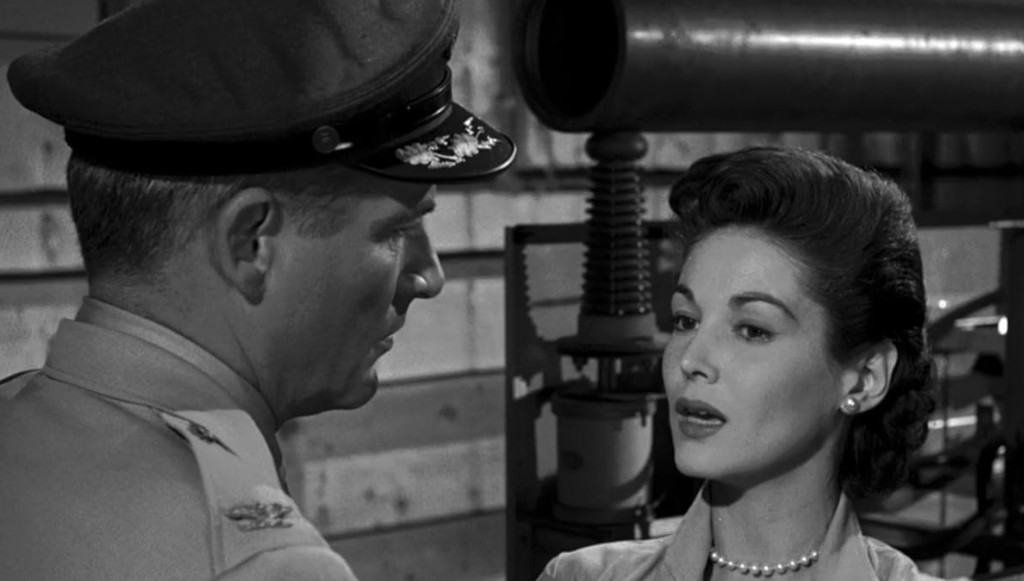
This said, the film has a little hint of originality and doesn’t at least copy the plot from Them! or The Beast from 20,000 Fathoms right off. The first half of the movie, at least, is engaging and original enough to put it neatly above the average.
Nathan Juran’s direction of the live-action sequences is competent, and there’s really no complaints in the directorial department, even if nothing stands out particularly either, except perhaps the tense opening sequence with the fishermen investigating the rocket, which is quite atmospheric and would have kept the kids in the audience on the edge of their seats, as well as the brilliant fight scene in the barn. But Harryhausen’s effects sequences, often involving the actors, are the stars of this movie.

The acting is likewise competent. William Hopper in the lead is somewhat bland but has an innate charisma that makes him pleasant to watch. Joan Taylor in the female lead is good, and has a noticeable prescence in the first half of the film, but she is relegated to onlooker in the second act. The rest of the cast is filled with competent Columbia character actors, such as the SF staples John Zaremba and Thomas Browne Henry in prominent roles. Tito Vuolo is memorable as the local chief of police, and George Khoury and Don Orlando give colourful, if hammy, performances as the Italian fishermen who rescue Hopper. Bart Braverman as Pepe the kid is shouty and annoying, as kid actors in these films tended to be. Ray Harryhausen makes a cameo as an elephant minder.
As usual in Columbia’s SF movies, the musical side is handled by the studio’s musical director Mischa Bakaleinikoff, who once again does an excellent job with splicing together a functioning score of orchestral stock music and adding his own bits and bobs where needed.

20 Million Miles to Earth is one of the best late-to-the-game monster movies of the last, prolific years of the 50’s SF craze (which, as film historian Bill Warren notes, really extended into the first years of the 60’s). It certainly contains some of Ray Harryhausen’s best work and includes a few scenes that are astonishing from a visual effects perspective, and really good from a pure cinematic perspective. However, the programmatic and uninspired script keeps the film firmly mired in the B-movie swamp. And while some B-movies exceed their limited budgets and busy shooting schedules with smart scripts and lively performances, this one makes you feel a bit disappointed, as it has all the ingredients of a really, really good film, but lacks the screenwriting talents (and interest) to follow them through. It’s a good film, but squanders the potential of being a great film.

As per usual with the SF movies of the late 50’s, there is little to analyse here from a political or social perspective. Again, there are hints and nods toward some ideas and themes, but the screenwriters never pick up the courage to run with any of them. What remains is a sort of mishmash of tropes from previous films that once carried thematic weight, but are now just tropes.
Reception & Legacy

I have found no box office numbers for 20 Million Miles to Earth, but one imagines that it did fairly well at the theatres, as these kind of films usually did. The most interesting aspects of the reviews in the trade papers at the time is that most of them fail to mention Ray Harryhausen, or if he is mentioned, it is only because of his story credit. Today, of course, the movie is known primarily for Ray Harryhausen’s animation.
The film got mixed reviews by trade papers. Harrison’s Reports called it “one of the better science fiction thrillers, mainly because of the exceptionally good special effects work and the interesting Italian background, particularly the streets of Rome”. On the other hand, the Motion Picture Exhibitor thought it was “not nearly so effective as some other science fiction entries” because of the “mediocre writing”. The magazine also opined that “the monster […] never generates too much interest” and in a sentence that has aged badly thought the “special effects are no more than fair”. Variety gave a mildly positive review, predicting good business for theatres thanks to “realistic special effects”.

In his 1984 book The Encyclopedia of Science Fiction Movies, Phil Hardy gives the film a negative review, calling the special effects “only partially successful”, and the film a “poorly scripted would-be epic”.
Later reviewers all agree that 20 Million Miles to Earth was Ray Harryhausen’s best black-and-white movie, and it was also his last. Most critics lament the poor script, but as DVD Savant Glenn Erickson writes: “A monster movie with a good monster is a good monster movie, which explains Savant’s disinclination to take 20 Million Miles to Earth to task for its cinematic deficiencies”. Erickson continues: “The only real disappointment in the show is the monster’s lack of character development”. Richard Scheib at Moria gives the movie 3.5/5 stars, as does AllMovie, where Craig Butler calls it “a typical genre effort in terms of the script”, but praises Harryhausen’s work.

20 Million Miles to Earth has a 6.3/10 audience rating on IMDb, based on close to 8,000 reviews, and a 3.2/5 rating on Letterboxd, based on 5,000 votes. It has a 5.9/10 and a 75 percent “Fresh” rating on review aggregate Rotten Tomatoes .
20 Million Miles to Earth has proven exceedingly popular in modern times, as proven by its 80+ external reviews on IMDb and its many thousand audience ratings. Over the last 20 years, it’s had numerous official DVD and Blu-ray releases, including one well-received colourisation. In 2007, there was also a spin-off comic book series. Ymir even made an appearance on The Simpsons in 2013.
Cast & Crew

Ray Harryhausen is best known for his fantastic work in the fantasy epics based on Greek mythology, such as The 7th Voyage of Sinbad (1958), Jason and the Argonauts (1963) and Clash of the Titans (1981), but he got his start in science fiction, when he was tasked to do the animation for the smash hit The Beast from 20,000 Fathoms (1953, review) It was was followed by It Came from Beneath the Sea (1955), Earth vs. the Flying Saucers (1956) and 20 Million Miles to Earth (1957). Much of his later work was produced by Charles Schneer, who also indulged Harryhausen his wish to co-create one of his pet projects, an adaptation of H.G. Wells’ First Men in the Moon (1964). The dinosaur movie The Valley of Gwangi isn’t his best film, and is one of those that some would call sci-fi, but which I call fantasy. His best known film outside the mythological movies is probably One Million Years B.C.. To be fair, the film is probably better known for Raquel Welch’s minimal bikini than for Harryhausen’s dinosaurs, but some claim that the movie contains some of his best animation.

Nathan Juran, born Naftali Hertz Juran in current-day Romania, moved to the US with his parents in 1912. He studied architecture and started his own firm, but with the constructing business grinding to a stop due to the Great Depression, he moved to Los Angeles in the late thirties, and started working in Hollywood’s art departments. During the 40’s he worked as an art director for 20th Century-Fox, was awarded an Oscar in 1942 for his work on How Green Was My Valley, and was nominated in 1946 for The Razor’s Edge. In 1949 he moved to Universal. When working on the horror film The Black Castle, he was asked to direct when the intended director dropped out two weeks before filming. Universal liked Juran’s work, and began giving him more directorial duties.
Juran primarily worked on B-westerns, but also the occasional costume swashbuckler. In 1957 he was assigned to his first science fiction movie, The Deadly Mantis (review). He then made a submarine movie starring Ronald Reagan for producer Charles Schneer at Columbia, which led Schneer, who had by then established his long-running collaboration with Ray Harryhausen, to assign Juran to work on the science fiction classic 20 Million Miles to Earth (1957). This led to Juran working on Schneer’s and Harryhausen’s first of many fantasy films based on classic Greek myth, The 7th Voyage of Sinbad (1958), which became both a box office and critical success. In 1962 he tried to recreate this success with Jack the Giant Killer, which he co-wrote and directed. However, the film received flack for its story, which blatantly ripped off the Harryhausen movie, and its stop-motion effects that deemed inferior to Harryhausen’s work.

Juran might have made a good living at Universal or another major studio, but wanted to get away from major studio restraints, and often worked for smaller outfits or independent producers, and had no qualms over accepting low-budget and schlock. In a later interview, he said he saw himself as a technician creating films for a living and not as an “artist”; “I always felt that my movies were temporary. They were just pieces of celluloid. You couldn’t eat them. You couldn’t sleep in them. You couldn’t use them in any practical way. So, I never really took the picture business too seriously.”
Apart from The 7th Voyage of Sinbad, Nathan Juran is best known for the four science fiction movies he directed during a span of two years in 1957 and 1958: The Deadly Mantis, 20 Million Miles to Earth, The Brain from Planet Arous (1958), and perhaps most famously, Attack of the 50 Foot Woman (1958, review). He returned to the genre (and Schneer) in 1964 with the H.G. Wells adaptation First Men in the Moon, co-written by Quatermass creator Nigel Kneale. He also directed episodes for a large number of SF TV series, particularly those produced by Irwin Allen. He directed his last film in 1973, before he returned to work in architecture.

William Hopper was born into a family of celebrities, his father a singer, comedian and theatre producer, and his mother the infamous gossip columnist Hedda Hopper, he naturally slipped into acting, but suffered from stage fright and a lack of ambition toward the trade, and after the war instead worked for nine years as a car salesman. In an interview with the Daily Review, he said: “I didn’t even think about acting much until a friend, director Bill Wellman, asked me to do a part in The High and the Mighty“. He eventually got over his stage fright as well. Hopper did substantial supporting roles i A movies and occasional leads in B-movies. He played Dr. George Fenton in George Pal’s Conquest of Space (1955, review), and leads in The Deadly Mantis (1957, review) and 20 Million Miles to Earth (1957). He found fame on TV, when he was cast as investigator Paul Drake, right hand man to Raymond Burr’s Perry Mason, as role he performed in over 270 episodes between 1957 and 1966. After the show ended, he declined further TV and movie roles, professing to be fed up with the business. Hopper had a difficult relationship with his controversial mother. Hedda Hopper was an extremely vocal supporter of the HUAC blacklist. Hopper died of complications related to his chain smoking on 1970, only 55 years of age.

Joan Taylor, real name Rose Emma, born in 1929, also came from a showbiz family: her father was a props man and her mother a vaudeville singer and dancer. Just after she was born, however, her father became the manager of a movie theatre, which is how she fell in love with the movies. After studying dancing in Chicago, she moved to Los Angeles, where she started working at the Pasadena Playhouse. At the age of 20, she made her film debut in the Randolph Scott/Victor Jory western Fighting Man of the Plains (1949). The next year she married writer and producer Leonard Freeman, who went on to three Emmy nominations and was the creator of the hit show Hawaii Five-O (1968-1980). Paramount quickly put Taylor under contract as part of their so-called “Golden Circle” of new stars, and she was one of many starlets whose legs were allegedly insured for a ridiculous amount of money, a common publicity stunt back in the day that has a somewhat sexist ring these days.

However, while she regularly played leads, Taylor never rose beyond the B-movie quagmire, and is best known for her two leads in science fiction: Earth vs. the Flying Saucers and its follow-up 20 Million Miles to Earth, another Schneer/Harryhausen production made for Columbia. In 1958 she transitioned to TV, where she was a popular guest star, and in 1960 was able to secure a recurring role on the family western show The Rifleman. However, after her two-year contract ran out, she abrubtly ended her acting career in 1963 to take care of her son. In 1968 the Freemans relocated to Hawaii for Leonard’s TV show, and after he died in 1973, Joan continued managing the business. She later tried her hand at screenwriting, and got a hit with her story for the Salma Hayek/Matthew Perry romcom Fools Rush In (1997). She passed away in 2012.
John Zaremba appeared in a multitude of sci-fi films and series over the course of his career, such as The Magnetic Monster (1953, review), Earth vs. the Flying Saucers (1956, review), The Night the World Exploded (1957, review), Frankenstein’s Daughter (1958) and Moon Pilot (1962). He was one of the stars of the TV series The Time Tunnel (1966-1967) as Dr. Raymond Swain, and had a recurring role in Batman (1966-1969) as Mr. Freeze’s butler Kolevator.

Italian-born Frank Puglia, who plays the zoologist father of the female lead, started his career as ateenager in Italian operettas, before his family emigrated to the US in 1907. Continuing his stage career, he transitioned into film in the 1910’s, and appeared in over 150 movies up until 1975, often playing small, but memorable roles. Tito Vuolo, as the memorable Italian cheif of police, was another Americanized Italian who worked on stage as well as in film. With his short, squat build and loud and often good-natured demeanor, he was typecast as the stereotypical Italian in a multitude of bit-parts and occasionally bigger supporting roles.

Thomas Browne Henry was an actor whom B-movie audiences of the late 50’s almost expected tos how up dressed in army fatigues. Sometimes in SF movies like Earth vs. the Flying Saucers (1956), Beginning of the End (1957, review), 20 Million Miles to Earth (1957), The Brain from Planet Arous (1957), Space Master X-7 (1958, review) and How to Make a Monster (1958, review).
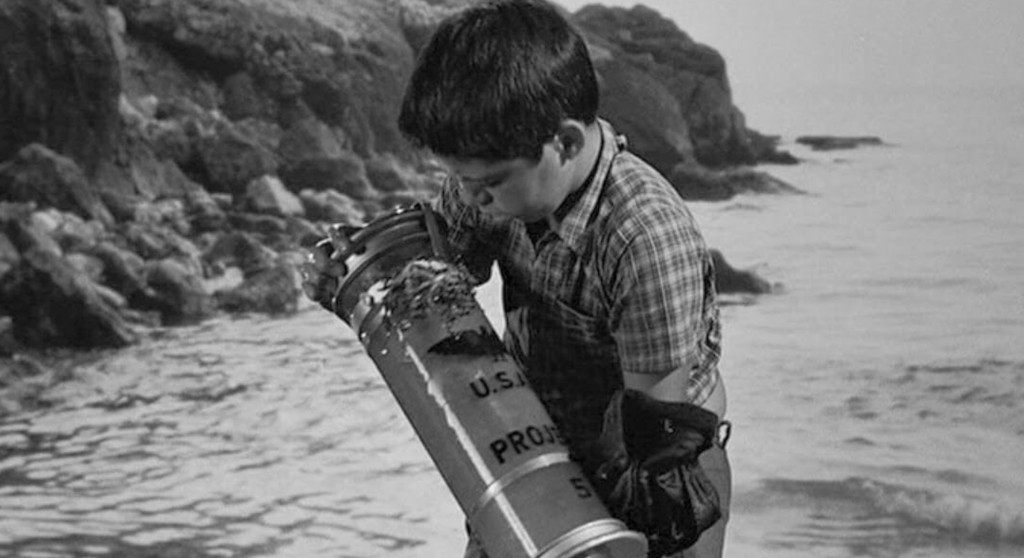
Bart Braverman was born into the movie industry, and made his TV debut as a child actor, along with brother Chuck, in milk commercials. He first appeared on screen in 1955, and between then and 1962 made appearances in many TV shows and a handful of movies. He then took a 13-year hiatus from acting but after returning to the TV screen in 1975, appeared in films and movies up until 2017, when he seems to have retired. He is best known for playing Binzer on the 1978-1981 TV show Vega$. He also appeared in the monster movie Alligator (1980).
Janne Wass
20 Million Miles to Earth. 1957, USA. Directed by Nathan Juran & Ray Harryhausen. Written by Robert Creighton William, Christopher Knopf, Charlott Knight, Ray Harryhausen. Starring: William Hopper, Joan Taylor, Tito Vuolo, John Zaremba, Frank Puglia, Thomas Browne Henry, Bart Braverman, Jan Arvan, Arthur Space, George Khoury, Don Orlando. Music: Mischa Bakaleinikoff. Cinematography: Irving Lippman, Carlo Ventimiglia. Editing: Edwin Bryant. Art direction: Cary Odell. Sound: Lambert Day. Special effects: Lawrence Butler. Visual effects: Ray Harryhausen. Produced by Charles Schneer for Morningside Productions & Columbia Pictures.


 Scifist.
Leave a comment