

Susan Winters finds her lost husband in a remote Mexican vally, now radioactively mutated into a giant monster. The first in Bert I. Gordon’s trilogy of giant bald monsters. 4/10
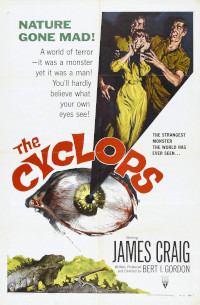
The Cyclops. 1957, USA. Written, directed & produced by Bert I. Gordon. Starring: James Craig, Gloria Talbott, Lon Chaney, Jr., Tom Drake, Duncan Parkin. IMDb: 4.4/10. Letterbord: 2.9/10. Rotten Tomatoes: N/A. Metacritic: N/A.
Susan Winter (Gloria Talbott) leads an expedition into an uncharted territory of Mexico in order to find her husband Bruce, who disappeared in the area three years ago. Failing to get a flight permit to the area from the local governor (Vicente Padula), she and her ragtag team knock out the security guard and take off in their small plane against orders. But things look doomed from the start. For one thing, none of her companions believe Bruce is alive, and if he was, they aren’t really interested in looking. Russ (James Craig) is Bruce’s old friend who is in love with Susan and tags along so he can finally prove Bruce is dead and stop “competing with a dead man”. Marty (Lon Chaney, Jr.) is a shady uranium prospector hoping to find radioactive material in the area. Drunken pilot Lee (Tom Drake) is only in it for the money.
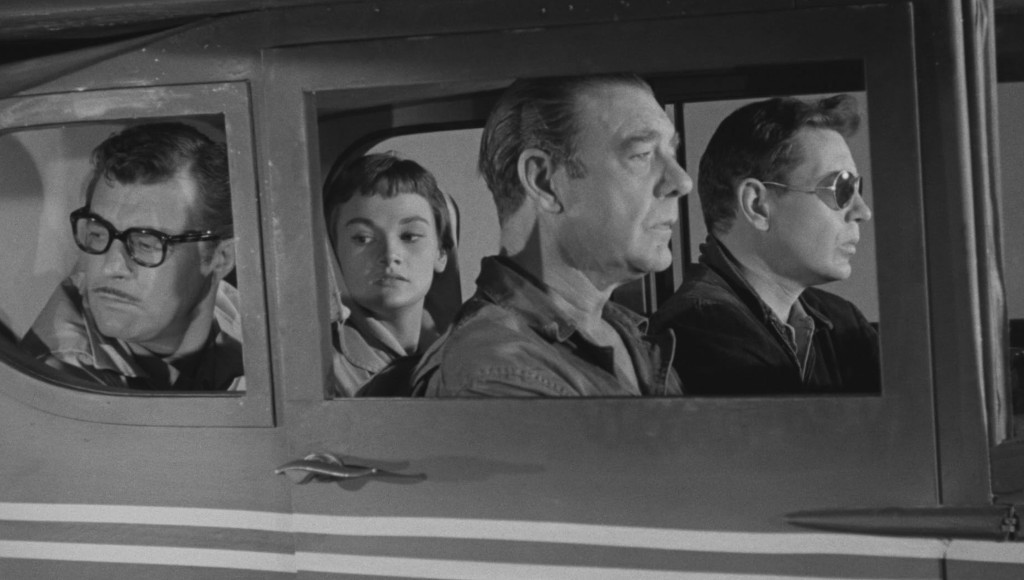
That’s the setup for Allied Artists’ 1957 low-budget production The Cyclops, directed by none other than Mr. B.I.G., Bert I. Gordon. The first in a number of “giant people” films Gordon was to direct in the following years, produced by him and his wife Flora, alongside Henry Schrage.
After a precarious landing near where Bruce’s plane crashed, Marty finds uranium and is ready to go home. Russ and Susan go out scouting, and proceed on Susan’s almost supernatural “feeling” that Bruce is still alive, Russ mostly so he can prove that he is really dead, and get it on with Susan. Meanwhile, Marty convinces Lee to take off in the plane, but they never get time to leave, as Susan and Russ return, and they all go out to look for Bruce, dead or alive.
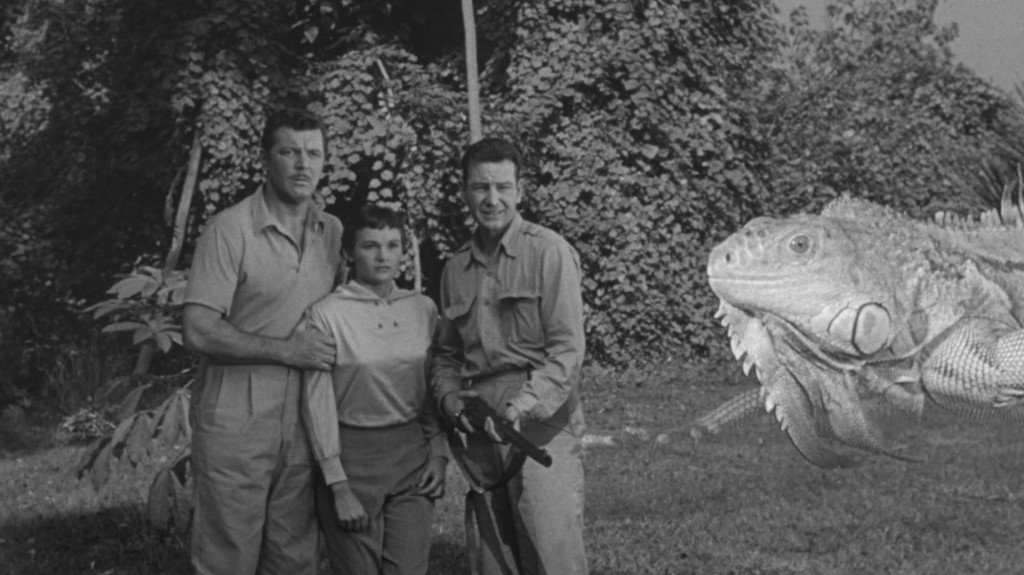
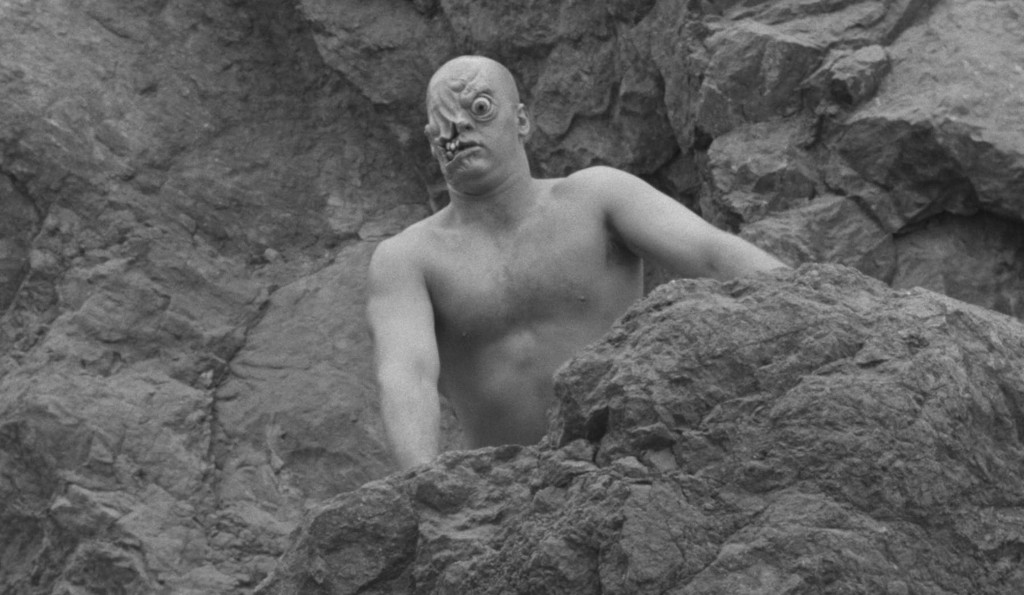
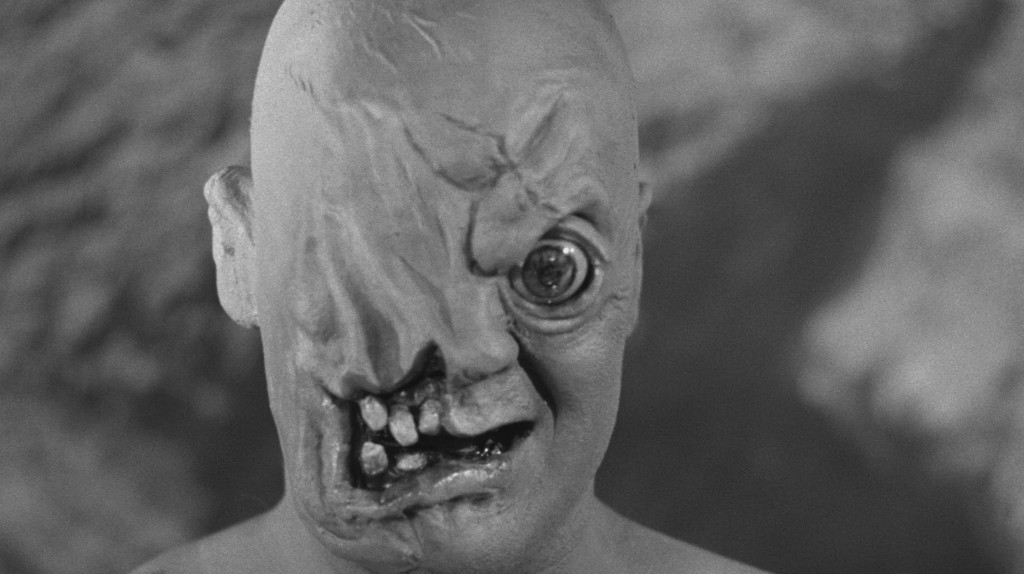
The team comes across giant animals: a rat, a hawk a squealing tarantula and a slurping lizard, and deduce that the radioactive material is making them grow at an unnatural rate. Just as they follow a trail of plane wreckage into a cave, they are trapped by a monstrously large man dressed in a loincloth (Duncan Parkin). The left part of his face is hideously deformed, and the right side sport a huge eye. Clearly demented, the cave man can only utter the syllables “aaar aaar”, and seems strangely fascinated by Susan. Marty tries to shoot at it, but is killed by the giant. The rest of the team escapes, and Russ explains to Susan that the giant is Bruce. Giant Bruce catches up with them, and Russ throws a burning spear into his one big eye. This gives the trio time enough to escape in the plane. The end.
Background & Analysis
As regular readers know, I review science fiction films i chronological order, and someone may be surprised that Bert I. Gordon released a film just weeks after another movie of his, Beginning of the End (review), had its premier in the summer of 1957. However, The Cyclops was made pretty soon after Gordon’s first SF movie, King Dinosaur (review), sometime in mid-1955. It was supposed to be released as a double bill with British import X the Unknown (review) by RKO. However, during production, the RKO film production unit started collapsing under the weight of Howard’s Hughes’ mishandling, and Gordon scrambled to get the film made on a meagre budget of around $70,000 and 5 days of location shooting. By the time of the premier date, RKO was almost exclusively working with TV and radio. Finally, Gordon managed to release The Cyclops through Allied Artists, as a double bill with Daughter or Dr. Jekyll, also starring Gloria Talbott.
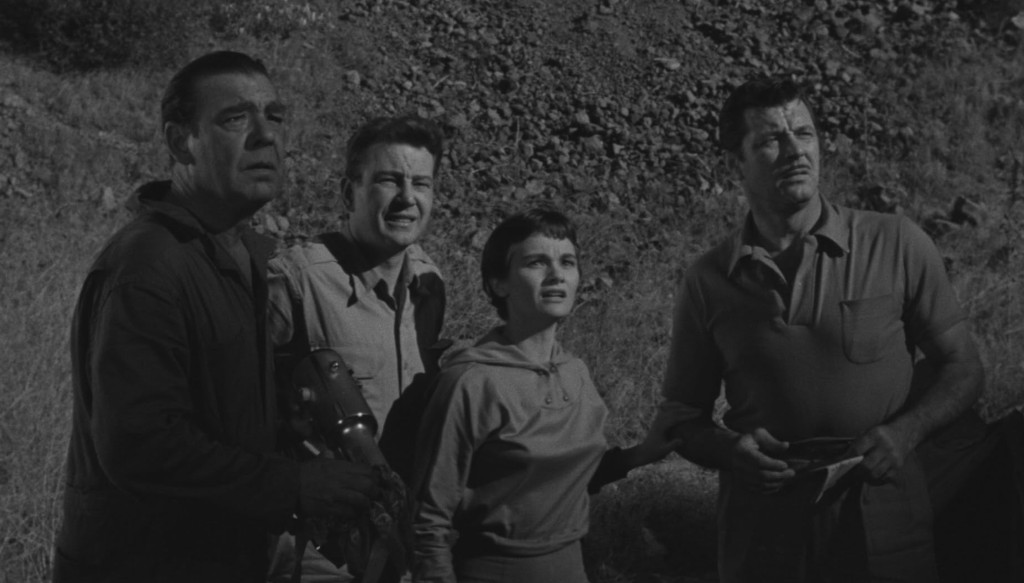
The RKO connection explains how Gordon, a virtual unknown in 1955, was able to scramble together a cast with some name recognition for a no-budget monster movie. Lon Chaney, Jr. may be the only name in the cast familiar to a mainstream audience today, but moviegoers in the 50’s would have still remembered the names James Craig and Tom Drake — both minor stars with a few leads in big hit films at MGM in the 40’s. Gloria Talbott had around a decade of film and TV work behind her, mostly in supporting roles. Lon Chaney, Jr., of course, needs no introduction for readers of this blog.
For the voice of the cyclops, renowned voice actor Paul Frees was hired. Gordon reportedly paid Frees $5,000 for the work — I suspect that the director/writer/producer wanted to inject some personality into the giant. However, this was money down the drain, as the cyclops does nothing but grunt and roar, and Duncan Parkin could probably have done the job himself just as well. Parkin had no acting experience, and in an interview he said he got the role as the cyclops simply because makeup artist Jack Young knew his parents.
The script by Bert Gordon is straightforward but perfunctory. It’s sort of a mashup between H.G. Wells‘ The Food of the Gods, the 1925 film adaptation of Arthur Conan Doyle‘s The Lost World, and the Greek myth of Odysseus and the cyclops Polyphemus.
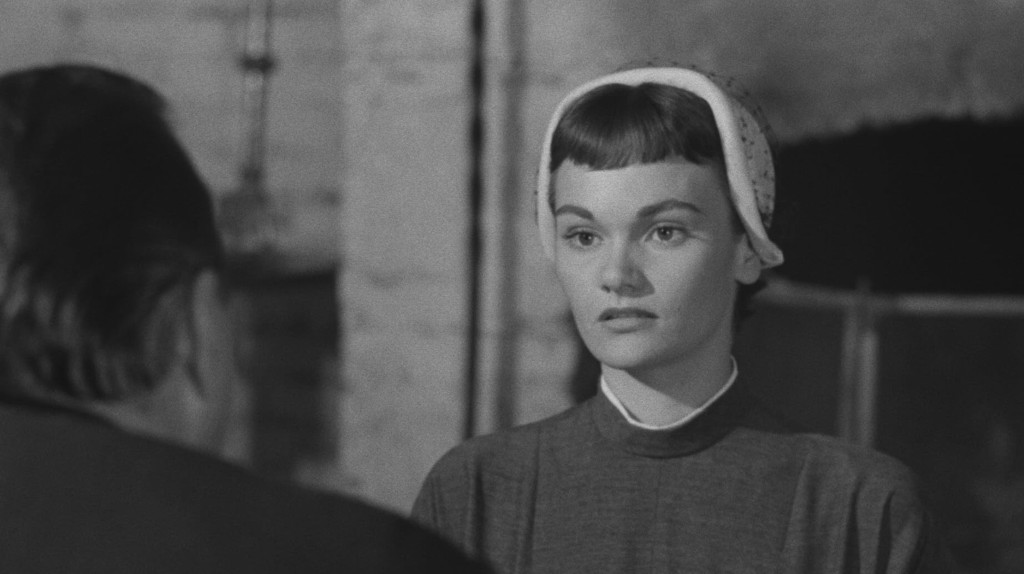
Like The Lost World’s Laura White, Susan Winters here struggles to put together an expedition to look for a family member lost during an expedition to an unexplored area in South America. But instead of taking a cue from Doyle (although Russ nods towards the story when he notes that “these are not prehistoric animals”), Gordon references Food of the Gods, which centers on a novel substance which makes all creatures grow large. But all this is really window dressing leading up to the centrepiece of the film, which is a retelling of Homer’s story of Odysseus and Polyphemus. Instead of being lured into the cave by provisions, like Odysseus and his men, Susan leads her party along a breadcrumb trail of plane parts. Like the Greek expedition, the Americans are trapped in the cave when the cyclops bars the entrance with a boulder. Polyphemus eats several of Odysseus’ men, while Bruce kills Arthur. Odysseus placates Polyphemus with wine, Susan with her female charm. Finally, both cyclopes are subdued with a spear to the eye, and while Odysseus and his men escaped tied to the belly of gigantic sheep, Susan & Co fly off in an airplane.
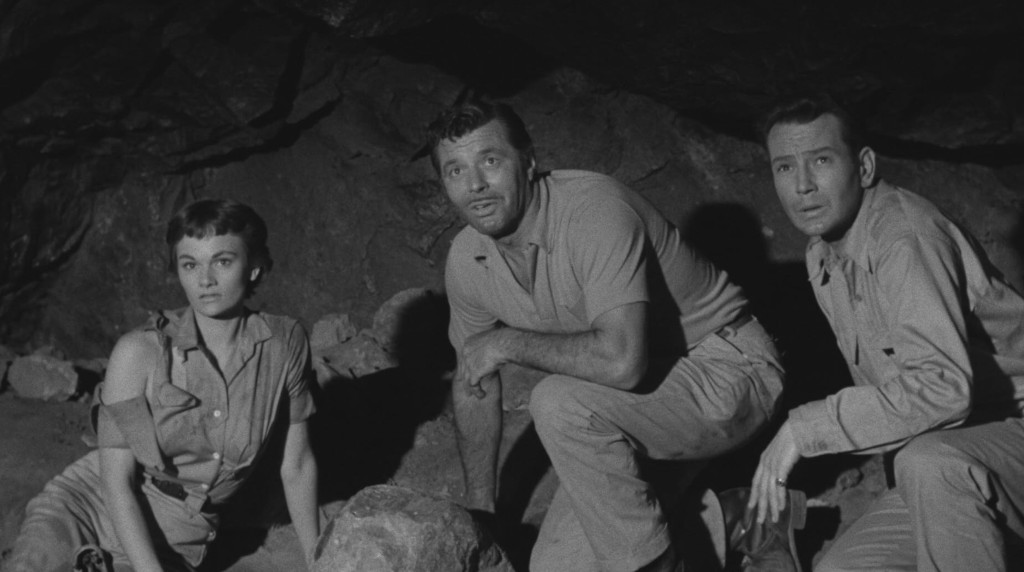
It’s clear that Gordon only really cares about the story of the cyclops, and the rest is padding. The other strands of the narrative are inconsequential, often illogical and never developed.
The story requires for some time to have passed between Bruce’s disappearance and the search party (giving him time to grow), and the idea of years having passed is lifted straight from the 1925 The Lost World movie. While it made sense in 1925, when travel to remote areas were still primarily undertaken by boat and foot trek, and people still communicated long-distance by letters, the fact that it has taken Susan Winters three years, in 1957, to purchase a plane ticket to Mexico is one of the most often ridiculed aspects of Bert I. Gordon’s script.
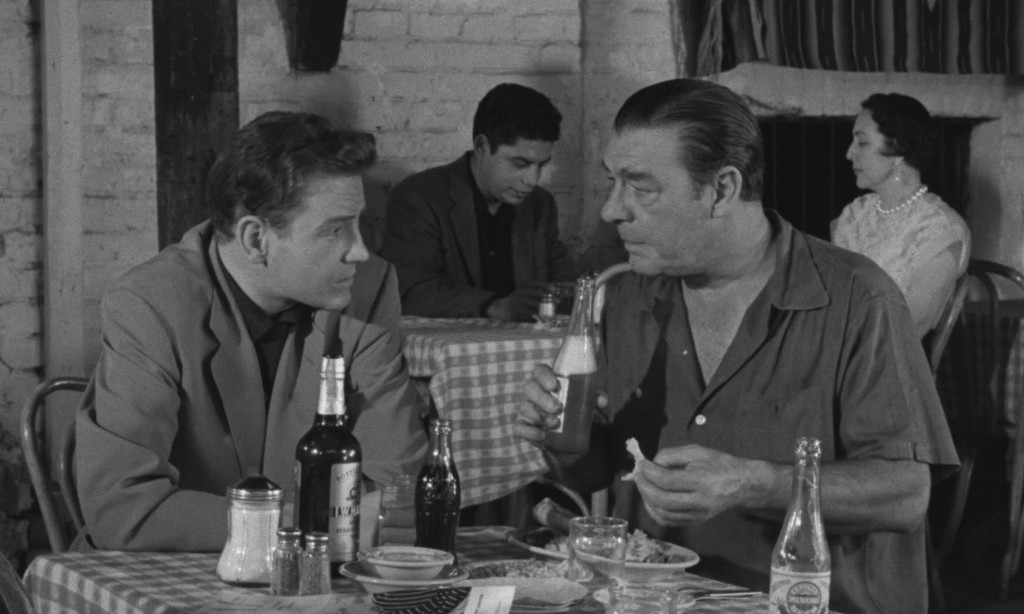
None of the other elements of the story have any bearing on the plot. Almost a third of the film is taken up by establishing that the authorities forbid Susan to fly into the uncharted area (because of “dangerous down-drafts” it is a no-fly zone), but they nevertheless leave without trouble and the thing is never mentioned again. Lee’s drunkenness is made much of in the beginning of the film, but plays no role in the story. During the flight Marty gets jittery and knocks out the pilot, which threatens to kill the entire expedition, but Lee recovers and lands safely. The incident is never mentioned again. Lee and Marty conspire to leave, but never have time to do so, and the whole proposed subplot just melts away without consequence. Even the fact that Bruce is the cyclops doesn’t really affect the plot in any way. Bruce has no real interaction or communication with either Susan or his old friend Russ, and in the end, he is simply dealt with like any other movie monster. There’s a brief mention that if the search party stays too long, they will start growing too, but nothing is ever made of this. Then there’s Susan’s downright supernatural mental connection with Bruce, which, again, is never explained nor explored (and indeed, she doesn’t even recognise him when she meets him). In short, this is a script with several fun ideas briefly mentioned but never developed — a whole bundle of missed opportunities.
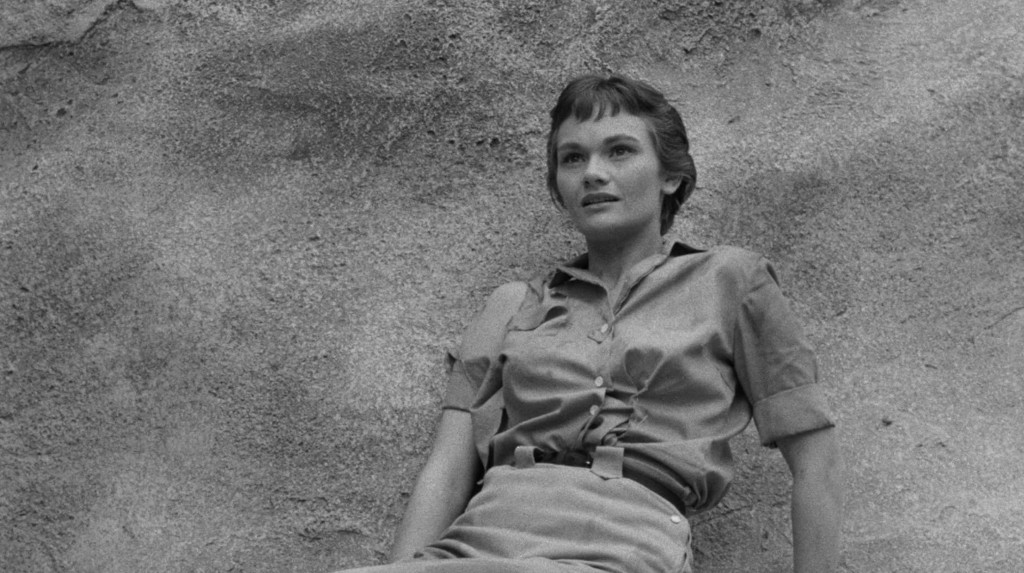
Gloria Talbott had an arduous shoot, as did probably all the other actors as well. Shot at a lightning pace in several locations, mostly in and around the Bronson Cave in Los Angeles, the film kept the cast and crew busy for a hectic week. Some of the movie was shot in the Los Angeles Arboretum, and at one point the script calls for Russ and Susan to take refuge in a lake. In an interview with film historian Tom Weaver, Talbott says the scene was filmed at a duck pond, and that the rims of the pond were caked with dried duck feces, thick enough for the actors to walk on. According to Talbott, the crew had to cut out a sheet of duck shit with a chainsaw to get their actors in the pond, excrement still floating everywhere. At another time, Talbott almost became drunk on the fumes from Tom Drake and Lon Chaney, Jr., as they were filming the scenes in the cockpit of the Cessna in a small, enclosed set at at a studio. She tells Weaver: “It was so close quarters and so hot I was ingesting alcohol through my skin, I was getting absolutely stoned, and by the time we got out of there I was weaving.”
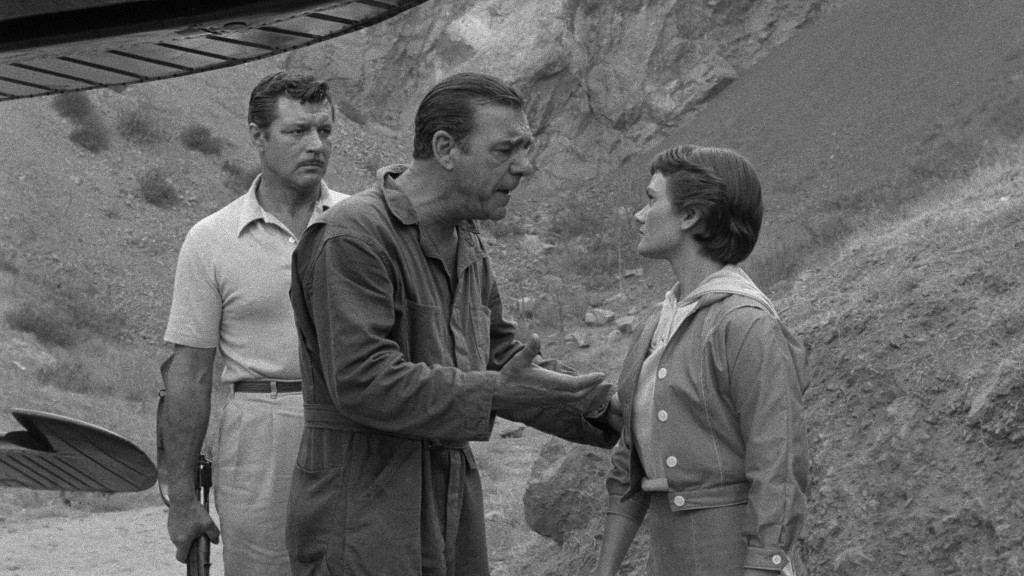
Talbott says that despite his drunkenness, Chaney was a sweetheart, and that his mom would bring him lunch to set, and brought an air mattress for him to sleep on. However, she did not have any rapport with James Craig, who wouldn’t speak to anyone during the entire shoot. According to Talbott he wasn’t mean or standoffish, but he would just say his lines and then go sit by himself in a corner.
Because of the rushed film, she never had a chance to get to know Duncan Parkin, who played the cyclops. However, she was on set during a scene in which he is wrestling a boa constrictor. I remember flinching when I saw the film, as the snake was clearly in constrictor mode, wrapped tight around Parkin’s neck and chest, before the scene cut away. Talbott confirms that things went south, and the actor went down with the snake, before the handler got it off him. In an interview with Filmfax, Parkin says it was a harrowing experience, as the snake clearly wasn’t happy with the situation, and became madder and madder each time she (her name was Consuela) was wrapped around him: “Why a trained stuntman wasn’t called in to do this, I’ll never know.”
Talbott did not like Bert I. Gordon, as, before her first scene, in which she argues with the Mexican governor, Gordon came up to her and critisised her acting in previous films. She was infuriated and almost walked off set. She says that to this day she doesn’t know if Gordon was simply being an asshole, or if it was his trick to get her in the right mood for the scene. But she stayed away from him as much as she could for the rest of the film. She also says his wife Flora was crucial during the entire filming process, but that Bert treated her awfully, like she was the help. Talbott admits that Gordon was under immense pressure to get the film done quickly, which turned him into a man obsessed.
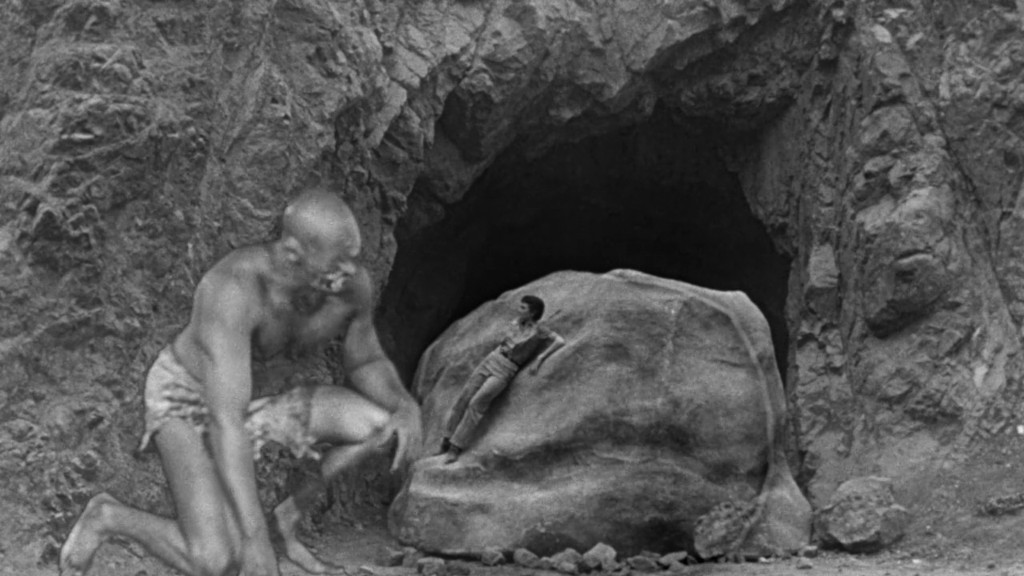
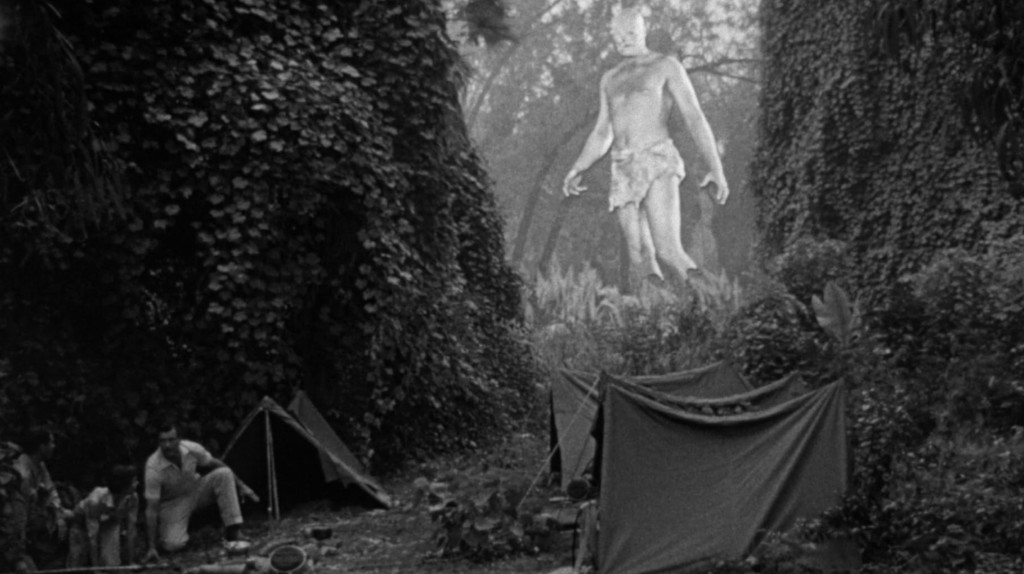
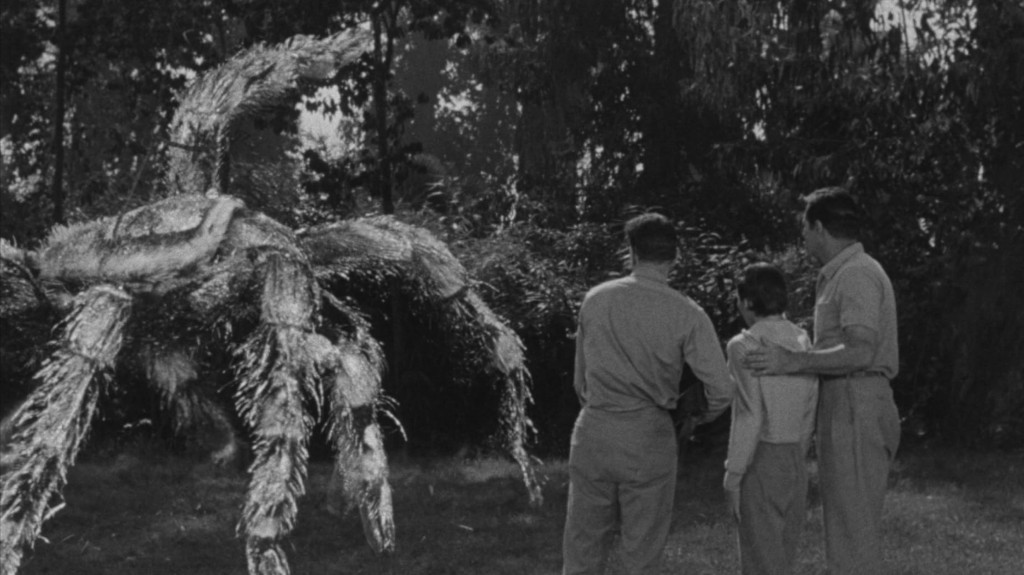
Bert I. Gordon is renowned for his cheapo effects portraying gigantic animals and people. This was often achieved simply through rear-screening of optically enlarged animals, or through a crude but effective in-camera bi-pack travelling matte technique that he developed himself. His effects shots involving animals were often shot with the help of his wife in his own garage. It is clear that Gordon had refined his technique in the two years between The Cyclops and Beginning of the End. In the latter, the effects are still cheap, but at least somewhat competent. In both King Dinosaur and The Cyclops his travelling mattes are of varied, but often terrible quality, with thick matte lines and the background showing through dark areas of the animals where the the image has remained unexposed. There are two scenes in The Cyclops with Duncan Parkin squatting where he is effectively translucent (actually I think it is the same footage reused twice). At another time, the cyclops picks up not only Susan, but the entire background image as well.
The special makeup effects used on Duncan Parkin are crude but very effective, courtesy of Jack Young. The cyclops doesn’t exactly look realistic, but harrowing enough to make a lasting impression. The “melting” effect on the left side of Parkin’s face is weird, and it looks as if his lips are all eaten away, exposing a black gash where his mouth used to be. The large, bulbous eye on the right side adds to the freakish effect.
The acting is, on the whole, just a notch better than in similar low-budget outings, however, none of the actors are done any favours by the dreadful dialogue. Gloria Talbott gives a sincere, emotional performance, well cast as the tomboyish, driven go-getter, who wan’t take shit from anyone. James Craig and Tom Drake had both mingled in the upper echelons of Hollywood, and were seasoned, serious actors. However, here they are phoning in their performances. They could do this in their sleep. Lon Chaney’s character is so poorly written, it’s difficult to take any line he says seriously. However, Chaney seems to have been in an unusually good mood while making The Cyclops, and was perhaps glad to play a livelier than usual character. While it is far from elegant, Chaney is still the only one able to insert any sort of energy into this movie. Apart, perhaps, from composer Albert Glasser, who never failed to inject any film with a sense of drama with his bombastic orchestral scores.
The Cyclops is aided by its short running time of 66 minutes, even if the actual plot could have been told in 20. Even if most of it is pointless, there’s a lot of action, keeping proceedings, if not interesting, then at least mildly entertaining. This was reportedly not the case with the TV version, which had to be padded out even further to get even close to the TV slot duration of 90 minutes, and included at least five minutes of extra animal footage and interminable opening and closing crawls.
Anyone looking to find food for thought in this film will be disappointed. As with many late-50’s SF movies, this was simply a mindless entertainment product devoid of any deeper message or meaning.
Reception and legacy
The Cyclops barely made back its budget at the box office, and received lillte to no attention from the press upon its release. Today, even B.I.G. aficionados tend to view the film, as Youtube critic Robin Bailes at Dark Corners puts it, “as a dry run for better movies”, those “better” (in hard quotation marks) movies being The Amazing Colossal Man (1957, review) and War of the Colossal Beast (1958, review), two films based on very similar premises, the latter even using the same actor and makeup.
There are exceptions. Barry Atkinson, in his book Atomic Age Cinema calls this “one of the best” films that Gordon ever produced, citing a “lucid script”, “marginally more accomplished trick photography” and Glasser’s “gleeful” music. Derek Winnert also calls the film “creaky but hugely amusing”, and gives it a 3/4 star rating.
More often though, critics are on the side of Bill Warren, who in his book Keep Watching the Skies! calls it a “dreary disaster” and “one of Gordon’s worst films”. In his 2/5 star review, Richard Schieb at Moria writes: “The Cyclops sets in with all the trademark aspects of a Bert I. Gordon film. There is the crude direction and photography. The drama is dreary going. Even when the party encounter the cyclops, all that we get is a scene of them trapped in a cave and blinding the cyclops and then the film is over”. Mike Brooks at Mana Pop says: “aside from the effectiveness of the titular character’s make-up, and the occasional fun freak-out by Lon Chaney Jr, the rest of the movie is rather bland and unengaging”. On the other hand DVD Savant Glenn Erickson points out: “On its own tawdry terms, The Cyclops works”.
The Cyclops has a 4.4/10 audience rating on IMDb, based on 1000+ votes, and a 2.9/5 rating on Letterboxd, based on around 500 votes. It has no Rotten Tomatoes consensus and no Metacritic entry.
Cast & Crew

Bert I. Gordon started to make home movies at the age of nine, and then moved into commercials before making his first film in 1954. Gordon became famous for his cheap visual effects, which he created himself along with his wife Flora, thus cutting costs on his productions. Unfortunately Gordon didn’t quite have the talent, the time, the money, nor the equipment to make good travelling mattes, such as for example Universal used on their giant bug films. Instead he often used high-contrast superimpositions, which sort of functioned as a poor man’s travelling mattes, but left fuzzy edges and often turned whatever critter he was adding to the picture more or less transparent, sometimes with big holes in them where they reflected highlights. Another one of his favourite techniques was the age-old method of back projection, which, when done well, can work very effectively, stationary mattes and split-screen. Sometimes his effects came out quite nice, but more often than not they looked very cheap and amateurish.
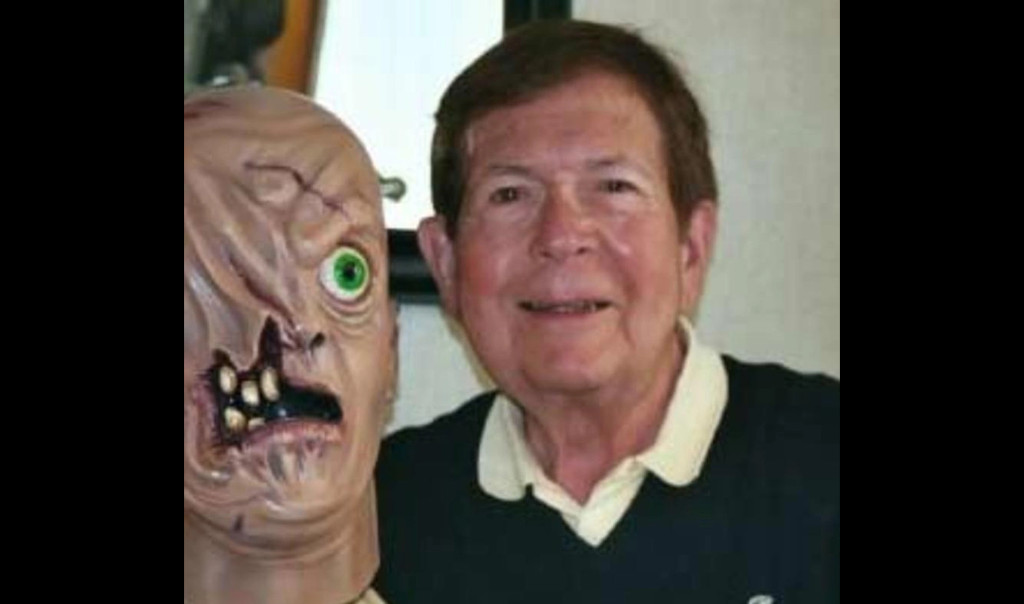
Gordon often used his effects to portray gigantic critters or people, earning him the moniker “Mr. B.I.G.” (which of course was also an allusion to his initials), and is best known for films like The Amazing Colossal Man (1957), Attack of the Puppet People (1958, review), Earth vs. the Spider (1958, review), and his later, most successful film Empire of the Ants (1977), which was nominated as best picture at the first annual international fantasy film festival Fantasporto in Portugal in 1982. It lost to the Croatian movie The Redeemer. He became a prolific director for American International Pictures, churning out super-cheap sci-fi pictures in the late fifties, but left the company in 1960, working as an independent director/producer. Some of his later pictures did hold a slightly higher standard, but not all of them. But Gordon also branched out to other genres, like sword and sorcery, children’s movies, pirate films, witchcraft and horror films, a few murder thrillers and sexploitation movies. He kept on directing until the late eighties, although his films became less frequent, and then retired from the business after the movie Satan’s Princess (1989). He released an autobiography, and in an interview in 2015 said to have written a few screenplays. In 2011 he got a lifetime achievement award from the Academy of Science Fiction, Fantasy and Horror Films, which apparently prompted him to prove that he wasn’t quite dead yet. So in 2014, at 92 years old, he returned to the director’s chair after 26 years with the independently produced B horror film Secrets of a Psychopath, which had a limited theatrical release and was hardly noticed outside of genre circles. It received lukewarm reviews when it was released on DVD in 2015. Gorden passed away in March, 2023, at the very respectable age of 100.
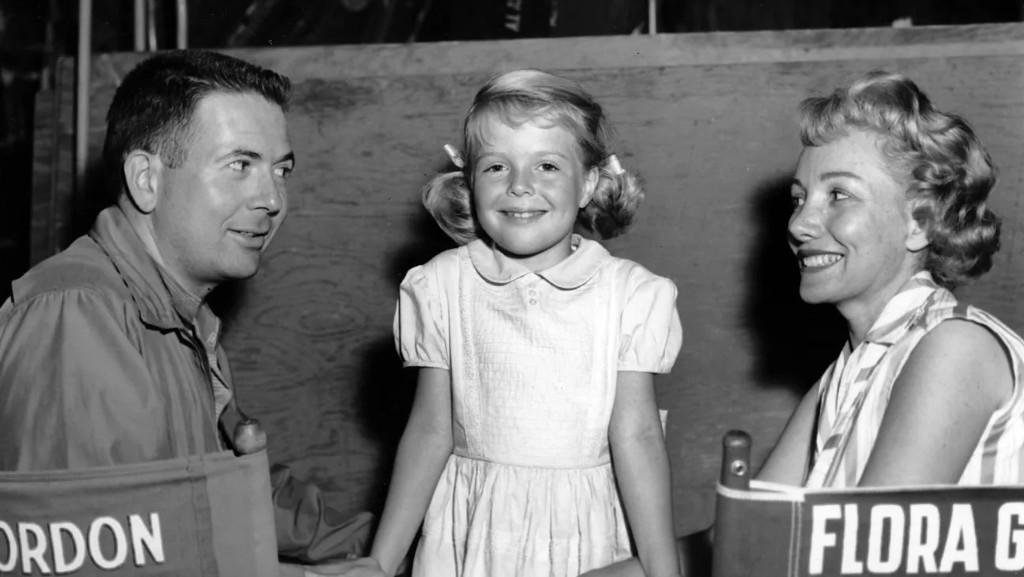
The schlocky director has his defenders, such as Gary Westfahl, who on his Biographical Encyclopedia of Science Fiction Film states that although horribly flawed from an adult point of view, his films still had a huge impact on children when they were released. According to Westfahl, children could relate to the idea of being small in a world of giants, and, he posits, children didn’t understand enough to realise how dumb the dialogue and the plots of Gordon’s films were, neither did it matter to them that the effects were bad. Giant insects were inherently scary.
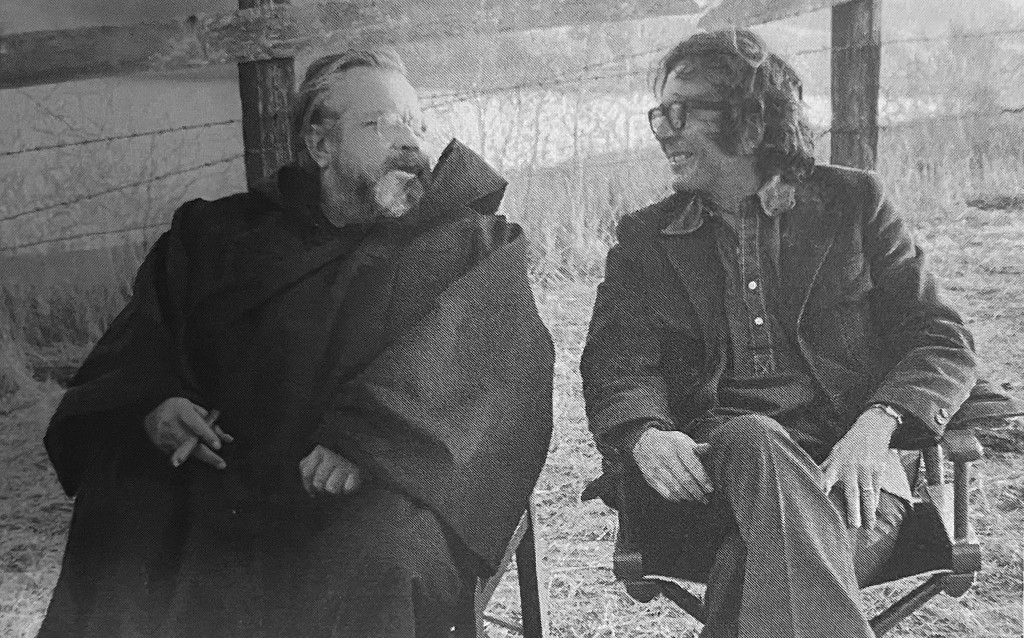
Westfahl also writes: ”Further, while his early films were usually threadbare – classic mom-and-pop operations, with Gordon and wife Flora Gordon chipping in for most of the offscreen labors – they were not slapdash; within the confines of his circumstances, Gordon usually tried to do good work, and if blessed with capable performers and a decent story, he might succeed. Only when Gordon attempted to cater to teenagers – an age group he manifestly did not understand – was an abysmal failure guaranteed.”
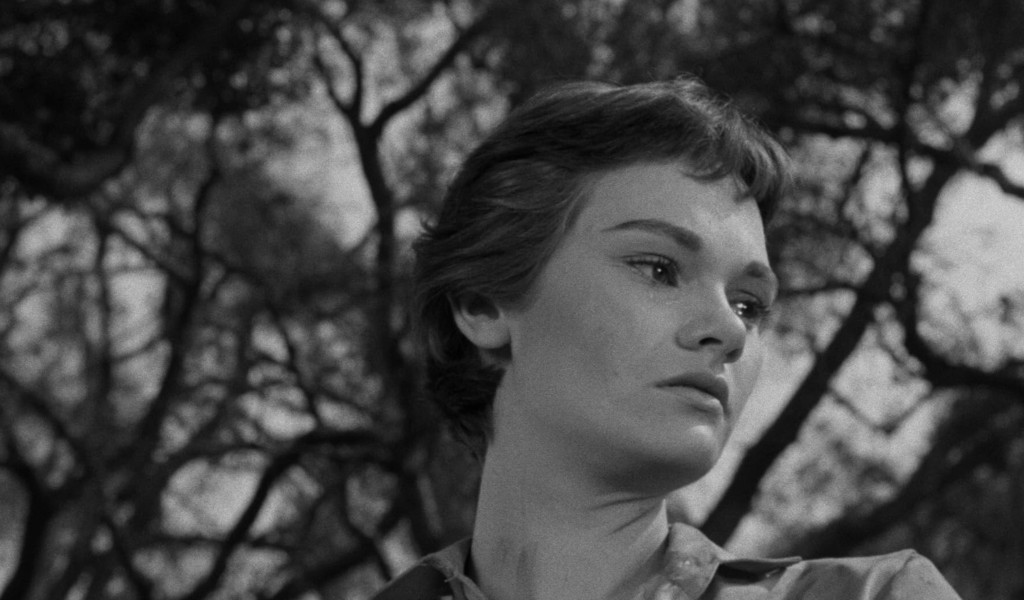
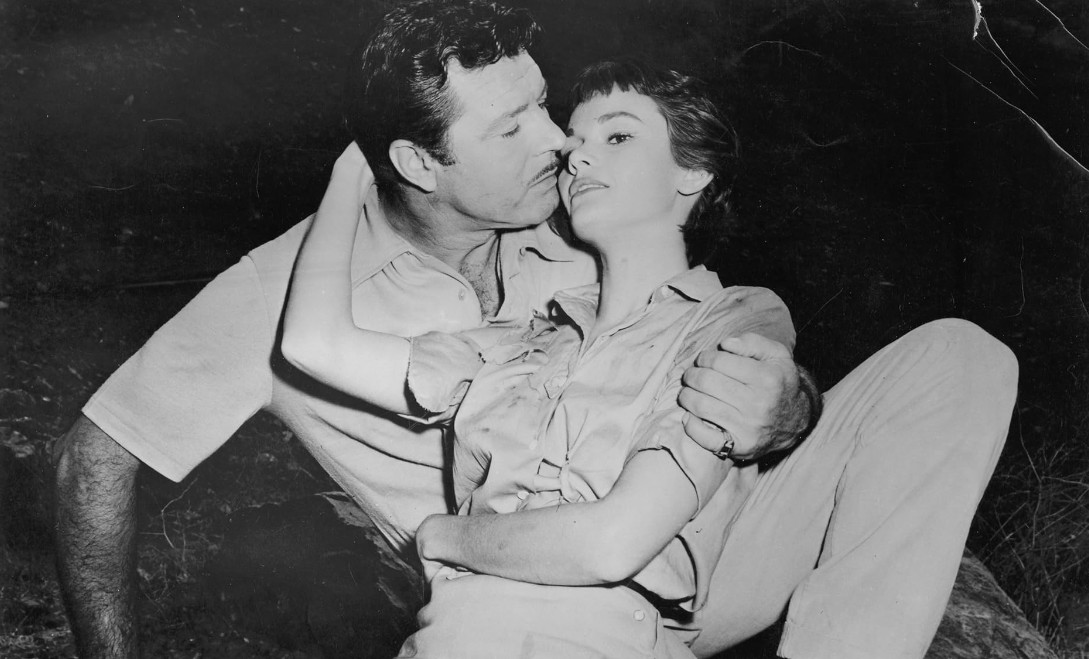
Gloria Talbott grew up in the town of Glendale just outside of Los Angeles, and started acting in school plays, and later founded her own drama group, and appeared in a handful of films as a child actress. At the age of 20, she became a Hollywood regular in 1951, appearing in guest spots in TV and bit-parts in movies, slowly working herself up the ladder, until she was rubbing shoulders with Humphrey Bogart in We’re No Angels and Rock Hudson in All That Heaven Allows in the mid-50’s. This is when she also started getting cast in leading roles in B-movies, mainly westerns, partly due to her competence on the horseback. She is best known as a scream queen in four genre films in the late 50’s and early 60’s: The Cyclops (1957) and its double bill Daughter of Dr. Jekyll (1957), I Married a Monster from Outer Space (1958, review) and The Leech Woman (1960). All the while, she worked steadily in TV, racking up over 100 TV credits 30 movies between 1935 and 1966. Then she called it quits, in order to get to spend time with her daughter.
In her interview with Tom Weaver, Talbott gives the impression that she enjoyed her time as an actress very much, partly because she never harboured dreams of stardom or bitterness when it didn’t present itself. She does give the impression that she would have liked a few more meaty roles in her career, but says that nevertheless, she was quite happy with the end result of films like The Cyclops and Daughter of Dr. Jekyll, considering the circumstances. She passed away in 2000.
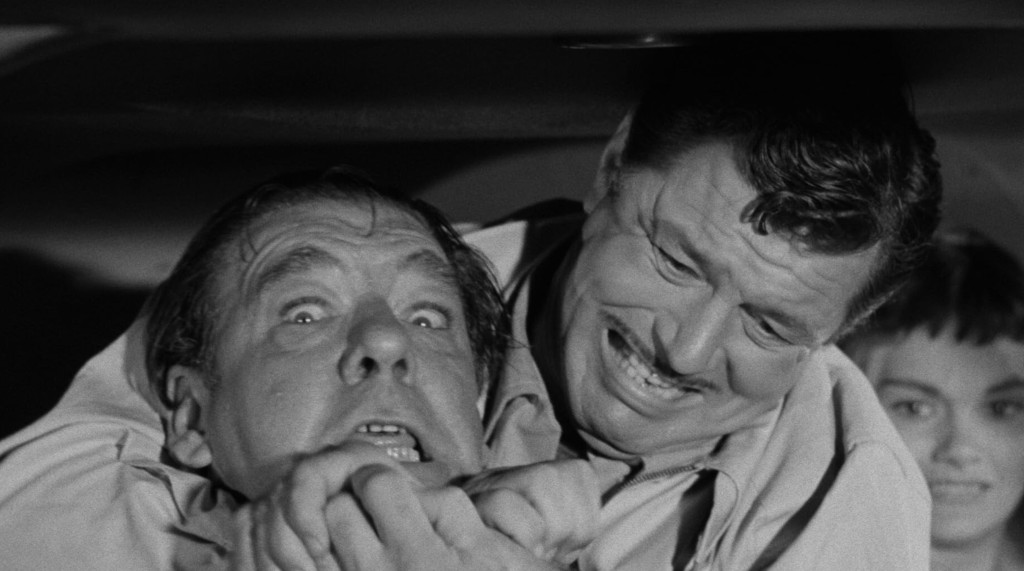
James Craig trained as a physician, but after graduation was bitten by the acting bug, and made his Hollywood in 1937. He started as an extra, but the tall, handsome actor who could easily approximate a Texas drawl was quickly pegged as a minor star for B-westerns. However, in 1942 he was picked up by MGM, mainly on his strong physical and vocal resemblence to Clark Gable, who was drafted into war service. As a replacement Gable, Craig had big successes in films like The Human Comedy (1943), The Heavenly Body (1944) and Our Vines Have Tender Grapes (1945). However, after Gable returned, it was back to the saddle in B-movies for Craig. After his contract with MGM ended in 1953, Craig navigated the precarious freelance waters, mostly in B-movies and as a television guest star. He left the business in the late 70’s and did what retired Hollywood actors tend to do, went into real estate.
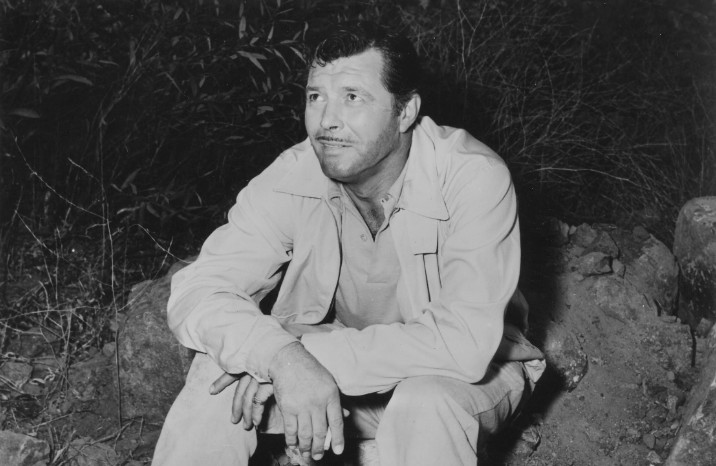
During his short stint at Columbia, Craig appeared in bit-parts in the Boris Karloff vehicles The Man They Could Not Hang (1939, review) and Black Friday (1940, review). And if he thought ill of The Cyclops, he hadn’t yet seen what the future had in store for him, as he later found himself appearing in such no-budget schlock as the confusingly obscure Body of the Prey/Venus Flytrap/Revenge of Dr. X (either 1967 or 1970), Bigfoot (1970) and Doomsday Machine (1976).
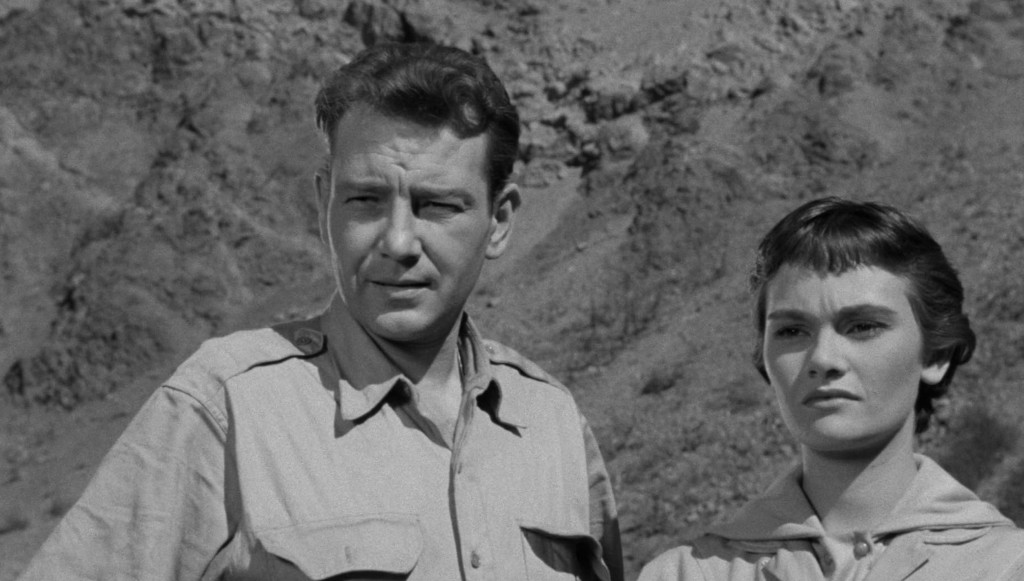
Tom Drake was born in 1918 as Alfred Sinclair Alderdice and made a name for himself on Broadway in the late 30’s, after which he was picked up by MGM at the outbreak of WWII. Here he rubbed elbows with James Craig, and like Craig, he was one of the actors that benefited from many of the stars being drafted into war service in 1943 (Drake was excused because of a heart problem). During the war, Drake played leads opposite Judy Garland in Meet Me in St. Louis (1944) and in films like One Man’s Navy (1944), and he managed to keep a good profile during the latter part of the 40’s as well, starring in films like The Green Years (1946), The Courage of Lassie (1946), Words and Music (1948) and The Great Rupert (1950). After he was let go by MGM, however, he, like Craig, found himself eking out a living doing B-movies and TV guest spots, arguably with a little more success than Craig. He retired in 1978.
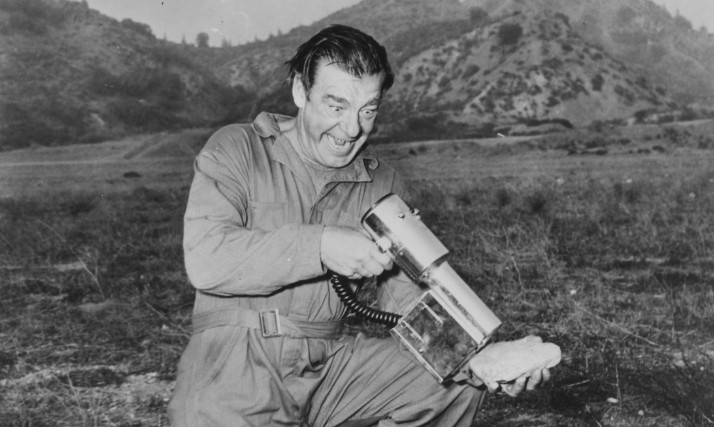
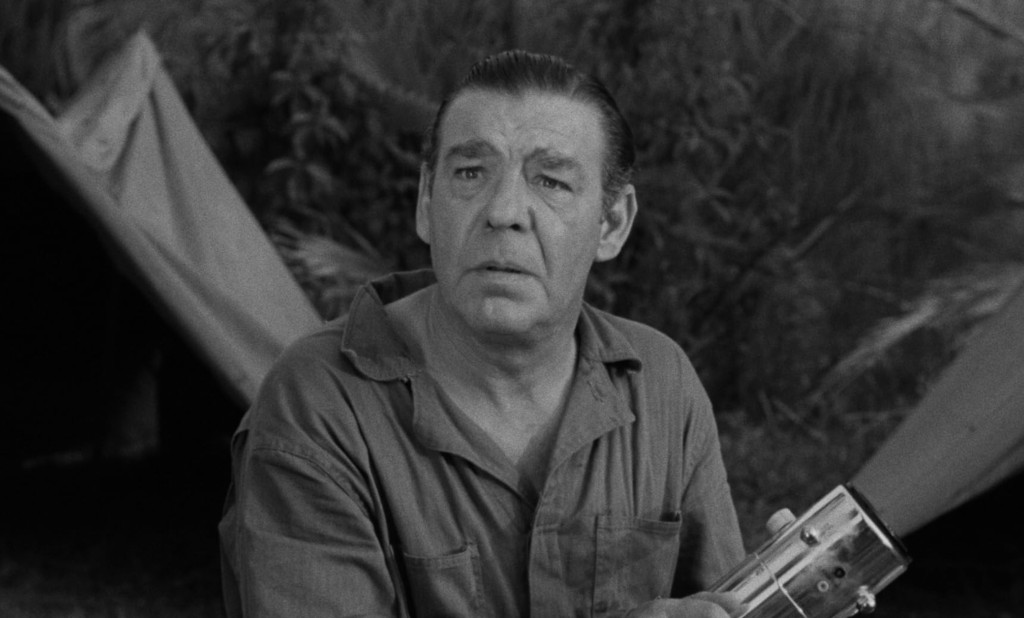
While best known for his horror output, Lon Chaney, Jr. was an extremely busy actor in the early 50’s, often playing heavies and, for some reason, Native Americans, in film and on TV in almost all conceivable genres. His star had diminished considerably since his heyday as Universal’s top monster in the early forties (as the Wolf Man, Dracula, Frankenstein’s Monster and the Mummy), but he was still turning out memorable supporting roles in A-grade films, primarily westerns like Springfield Rifle (1952), The Indian Fighter (1955), and not least in the classic High Noon (1952), as well as the occasional drama like Not a Stranger, opposite stars like Olivia de Havilland, Robert Mitchum and Frank Sinatra or comedies like the Martin-Lewis vehicle Pardners (1956) and alongside Bob Hope in Casanova’s Big Night Out (1954). So while not the major star he once was, Lon Chaney, Jr. still had som marquee draw left in him. And as his involvement in other less-than-prestige pictures prove, he didn’t quite have the luxury to choose his projects.

Chaney came a long way on his 6’2 stature and beefy build, combined with an intense stare and a mean scowl, often seeming as to hide a sense of vulnerability — a combination which made his turns as tragic monster in the Universal pictures so successful, and one that had first drawn attention in his break-through role as Lennie in Of Mice and Men (1939). But by the 50’s he also had a reputation as a heavy drinker and an actor that was difficult to work with. However, while he himself made no secret of his drinking, this reputation is probably somewhat overblown, considering the sheer number of films and TV productions that Chaney racked up in the fifties. It has often been suggested that his many mute or near-mute roles in the 50’s was due ti him being too drunk to remember his lines, but producer Jack Pollexfen has dismissed this: “Chaney could handle dialogue reasonably well [before lunch]. I found him intelligent, probably more so than most actors.” While Chaney’s heyday was certainly way behind him in 1957, he kept up a busy career, whether drunk or not. In 1957 he appeared to great success as Chingachook in nearly 40 episodes of Hawkeye and the Last of the Mohicans. While his frantic working pace lessened somewhat toward the mid-60’s, Chaney still appeared in three movies in 1971, despite illness taking a severe toll on his voice. After this, he was too sick to work, and passed away in 1973.
Bert I. Gordon’s wife Flora was more than a mere assistant. Particularly on his cheaper endeavours, Flora was everything from production manager and assistant director to catering service — credited or uncredited. She quickly became an apt visual effects creator, and in the 60’s started getting actual credit for her work as production coordinator and production manager. She worked on all of her husband’s movies between 1955 and their divorce in 1979. After that she struck out on her own (as Flora Lang) as a production manager on a handful of feature and TV movies, and worked as the unit production manager on the successful soap opera Dynasty between 1981 and 1985. She was one of the founding members of the Women’s Committee at the Directors Guild of America.
EDIT: 9.2.2024: Corrected Gloria Talbott’s year of death from 2020 to 2000.
Janne Wass
The Cyclops. 1957, USA. Written, directed & produced by Bert I. Gordon. Starring: James Craig, Gloria Talbott, Lon Chaney, Jr., Tom Drake, Duncan Parkin, Vicente Padula, Paul Frees. Music: Albert Glasser. Cinematography: Ira Morgan. Editing: Carlo Lodato. Makeup: Jack Young, Carlie Taylor. Sound effects: Douglas Stewart. Special effects: Bert I. Gordon, Flora Gordon. Produced for B&H Productions & Allied Artists.


 Scifist.

Leave a comment