
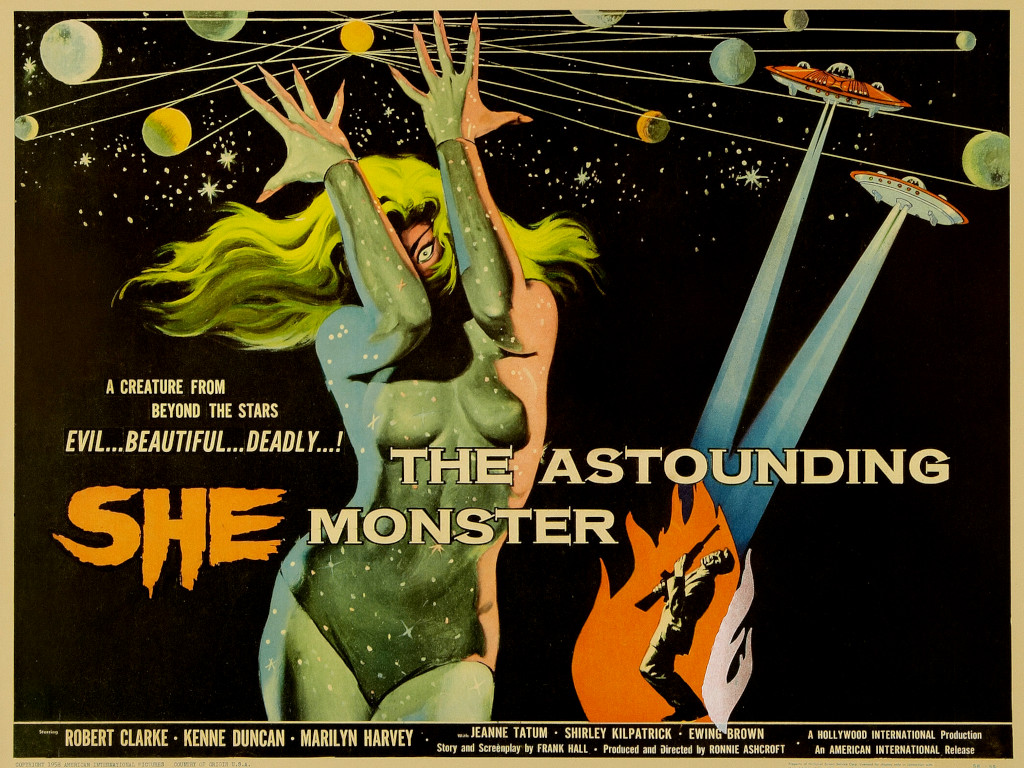
A busty radioactive alien woman terrorizes a geologist, a socialite and three gangsters in a mountain cabin. Ronald Ashcroft’s 1957/1958 no-budget picture is inept in all departments, and provides audiences with little else than a chance to laugh at how bad it is. The poster is awesome, though. 1/10
The Astounding She-Monster. 1957/1958, USA. Directed, produced & edited by Ronald Ashcroft. Written by Frank Hall, Ronald Ashcroft & possibly Ed Wood. Starring: Robert Clarke, Kenne Duncan, Marilyn Harvey, Shirley Kilpatrick, Jeanne Tatum, Ewing Miles Brown. IMDb: 3.6/10. Letterboxd: 2.7/5. Rotten Tomatoes: N/A. Metacritic: N/A.

A portentious voice-over narration (by Scott Douglas) guides us to the stars, telling us that ancient philosophers believed the Big Bang was actually caused by a nuclear explosion. The narrator speculates that this explosion may have been caused by an ancient civilisation that developed a super-weapon that blew up in their hands, and the entire universe as well. Now, the narrator continues, many fear that humans are on the road to repeat the mistake, and that one planet has now sent an emissary to Earth in spaceship disguised as a flaming meteor.
The narrator then takes us to California, where we meet rich housewife Margaret (Marilyn Harvey) exiting her house. The narrator tells us not only that she is going to her Cadillac, but also that she is about to have a life-changing experience. When she starts her car, he informs us that her car did not malfunction, and when she drives through her gate, he tells us that she drives through the gate. She is then kidpanned by two goons, and the narrator tells us that she is kidnapped by two goons, while at the same time adressing Margaret, telling her that she should not be surprised, since, in the life of a socialite, getting kidnapped is almost mundane. No, the kidnapping is not the experience that will shatter her world. We then cut to a night shot in a forested mountain, and the narrator helpfully tells us: “Night”, and continues narrating geologist Dick Cutler (Robert Clarke) as he walks his dog – calling him “the innocent bystander”. We then cut again to the kidnappers and their vitcim, driving along the road, when a strange woman in a skintight, silvery catsuit and glittery high-heel shoes appears by the roadside (Shirley Kilpatrick). One of the goons thinks he has seen a naked woman, swerves and crashes the car, so they decide they must now continue on foot. Now, the narrator drones, the stage is set, and these are our players.

Now twelve minutes into The Astounding She-Monster, hardly a line has been uttered, saving money on both production and post-production costs. Cutting edges was necessary, since this 1957 clunker had a budget of $18,000. Generally regarded as one of the worst science fiction movies of the 50s, the film was reportedly made to help writer/producer/director/editor Ronald Ashcroft avoid bankruptcy.
The 12-minute opening narration is the most fun part of this movie. However, the narrator then disappears and gives the stage to the actors. We get acquainted with our trio of kidpappers: the ruthless and bad-mouthed brains and leader of the operation, Nat (Kenne Duncan), the trigger-happy and dimwitted henchman Brad (Ewing Miles Brown), and the tag-along alcoholic has-been floozy Esther (Jeanne Tatum). Walking through the woods at night, they reach geologist Dick’s mountain cottage (identified as being situated in the San Gabriel Mountains) and demand to “borrow” his Jeep at gunpoint. That will do you no good, Dick informs them, as the headlights don’t work, and they’ll run off a cliff in the night without them. Instead, the trio, plus abductee, will have to stay the night.
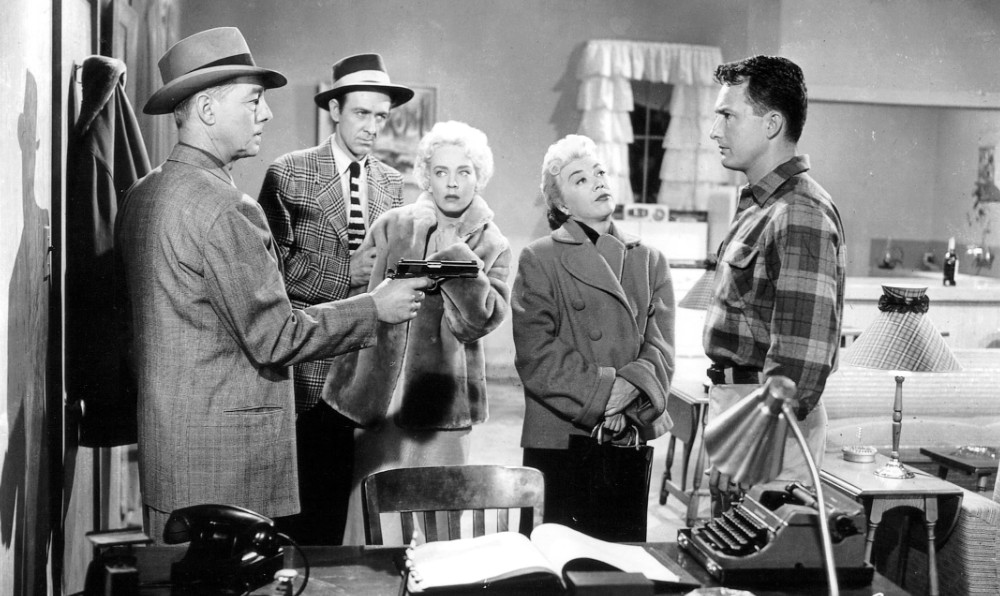
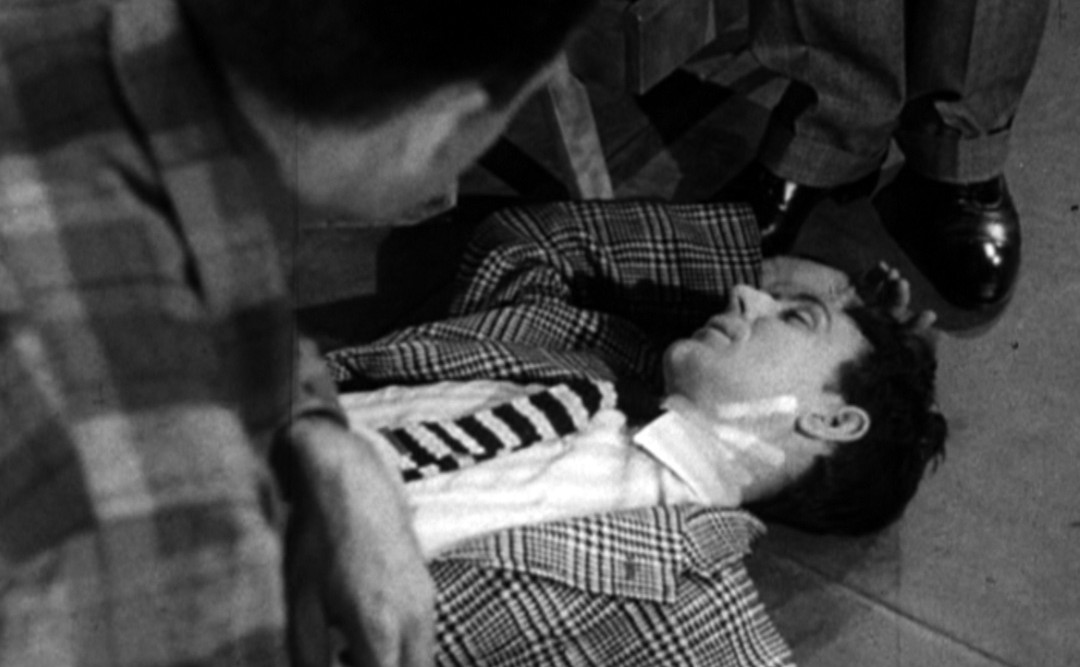
But the alien woman throws a spanner in the works as she shows up at the window, and lures Brad into the forest. Here, for no apparent reason, Brad empties his revolver at her, to no effect. She then leans over to touch his neck, killing him instantly. This will turn out to be the blueprint for the film: the alien shows up at the cottage, the heroes and villains escape into the nearby woods, and then return to the cottage. They try to kill her, and she retreats, and they return to the cottage. They try to get to the car, but she stands nearby, so they run into the woods and then return to the cottage.

When Brad is killed, geologist Dick spots a white handprint on his neck, and immediately recognizes this as the classic symptom of radium poisoning, meaning that the alien is radioactive. He speculates that her body is covered in some sort of thin sheet of an unknown metal (the spandex tights), which protects her from Earth’s atmosphere, and, apperently, from bullets. If they can burn it off her, he argues, she can be killed. So they make a torch for Nat to wield, and fill a bucket with gasoline. Unfortunately, Dick somehow manages to spill all the gasoline, so the plan backfires . This is when Esther is snuffed. But Nat manages to trick the alien into falling off a cliff (offscreen). They return to the cottage.
The three remaining “heroes” then see their chance to get the car, despite the malfunctioning headlights, and drive out into the the pitch-black night, with the sunlit hills as background. But alas, the alien has survived, and now blocks their path. Now Nat is snuffed, leaving only Dick and Margaret, who, despite having driven for what seems like a fair amount of time, manage to get back on foot to the cottage before sunrise. Here Dick gets another Eureka moment. He speculates that because the alien must produce gamma and beta rays in order to cause radium poisoning, her body must contain radium, which is why she needs a protective suit on Earth. This suit, he says, must also contain radium, but also some other metal. And if one could find out which metal this is, one could dissolve it. Luckily, he saw her spaceship/meteor crash, and from the colour of its flame, he deduces that the other metal is platinum, and sets about concocting a potion that will dissolve platinum. “I had no idea that geologists work with so many acids!”, Margaret helpfully offers. Said and done, when the alien next pays a visit, Dick throws the beaker at her and she collapses, gradually fading away in a lap dissolve.
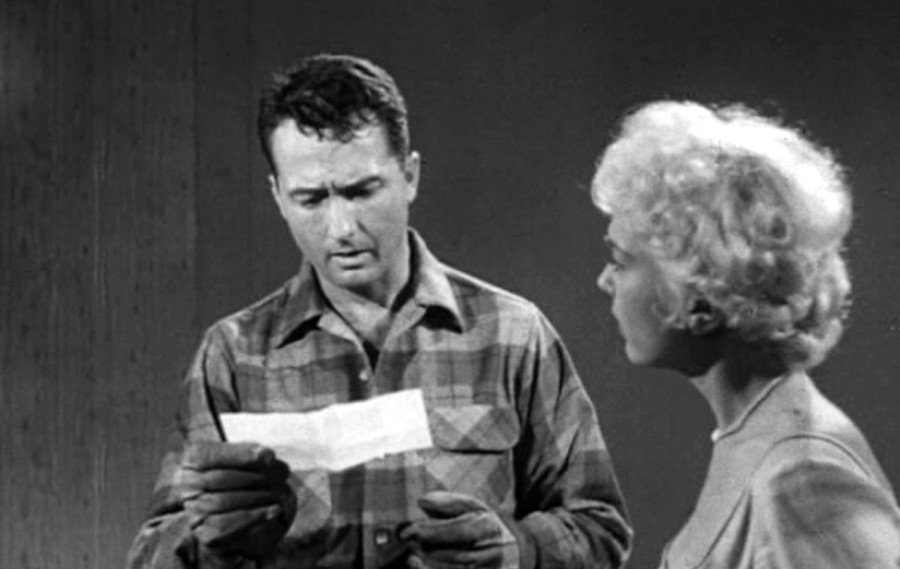
But: she leaves behind a locket with a message written in English. Dick speculates that the aliens learned to write English through listening to Earth radio. The message bears a twist ending: the alien is no enemy, but an emissary sent from space with an offer by a higher civilisation to help humans prevent to destroy themselves and the universe in a nuclear war. The helpers now say that they eagerly await humanity’s answer with the return of the emissary. Dick and Margaret realise they have been foolish humans, shooting first and asking questions later. Now they hope that the highly developed aliens will be highly developed enough not to take the murder of their emissary as an insult, and give humanity a second chance.
Background & Analysis

I have reviewed a lot of bad movies from the tail and of the 50s as of late, but few as bad as The Astounding She-Monster. It is clear from the get-go that the picture is made on pocket lint with little ambition other than to get a cohesive feature film as an end result. According to one source, it was produced merely as a way to help producer/director Ronald Ashcroft avoid a bankruptcy. SF historian Bryan Senn claims the film’s budget was only $18,000, and that looks about right. The film has one single indoor set: one room in Dick’s cottage. There’s talk about a kitchen and a bedroom, but we never see those. The rest is filmed outside on location, probably around someone’s mountain cottage. The movie had a shooting schedule of only four days.
There’s little information on how the film originally came together, but a good guess is that Ronald Ashcroft, originally an editor, saw how much money the low-budget science fiction films that AIP were putting out were hauling in, and decided to get in on the action with a skeleton crew, taking on the responsibilities for production, direction and editing himself as a way to cut costs. Ashcroft had sort of worked his way up the ladder – not very far – from editor to producer on the low-budget western Outlaw Queen (1957), directed by Herbert Greene and written by cult director Ed Wood – and it is possible that this film bombed at the box office, and created for Aschcroft a predicament where he needed to make a bit of money.

According to some sources Ed Wood worked as an uncredited “creative consultant” on the film, and IMDb lists him as one of the screenwriters. The credited screenwriter is Frank Hall, of whom virtually nothing is known, and who never wrote another script – thankfully. I can’t find any real confirmation that Ed Wood worked on the script or not, but at least the opening narration sounds very Wood-ish, resembling the opening narration in Glen or Glenda (1953), and a few other of Wood’s films. Ashcroft was friends with Wood, and had worked on many of the films Wood scripted and/or directed in the past. Many of the crew members and some of the actors were also part of the independent low-budget movie circles that Wood moved in, so it would stand to reason that he could well have been involved in one way or another.
Ronald “Ronnie” Ashcroft had edited Wetbacks (1956) and produced Outlaw Queen (1957), both written by Wood. He was an assistant director on Night of the Ghouls, directed by Wood, which was filmed in the spring of 1958, but never given a general release until 1984. For his cinematographer, Ashcroft hired William Thompson, a silent era veteran who had shot pretty much all of Wood’s films, from Glen or Glenda to Night of the Ghouls. The sound guy on The Astounding She-Monster was also a Wood regular, Dale Knight. The wardrobe person, Norma McClaskey’s, only other screen credit is Outlaw Queen. Composer Gene Kauer made his Hollywood debut with Outlaw Queen, and went on to score all three of Ashcroft’s directorial efforts.

Lead actor Robert Clarke had co-starred in Outlaw Queen, and when asked to star in The Astounding She-Monster, he was promised $500 a week, plus four percent of the film’s profits. In an interview with Tom Weaver, Clarke says that he was very happy with the arrangement, which made him several thousand dollars from a movie with an $18,000 dollar budget. This profit spurred him on to go into the movie production business himself, but that’s another story.
Kenne Duncan, who co-stars as Nat, the leader of the crooks in The Astounding She-Monster, was a staple western heavy, who had appeared in a number of films made by the Wood-Ashcroft circle, including Outlaw Queen and Night of the Ghouls, where he was top billed as Dr. Acula.
Most of the rest of the cast and crew don’t have more than a handful screen credits. The stunt double for the actress who played the alien was Ronnie Ashcroft’s wife Lorraine.

So it was with this ragtag team on the lowest rung of the Hollywood ladder that Ashcroft set about creating his movie under the pretentious-sounding production moniker “Hollywood International Pictures”, a name clearly intended to have the same ring as the leading low-budget science fiction distributor, American International Pictures. It’s not hard to point out flaws in the movie, so let’s start with what is good.
At least the acting is not worse than in many other no-budget pictures of the era. Robert Clarke was never a particularly outstanding actor, but he was at least competent, and could occasionally do quite good work. He does not appear to his advantage in The Astounding She-Monster, but considering the script and the circumstances, it’s hard to blame him. Kenne Duncan was a seasoned veteran and could pull the hard-boiled, brutal gangster type in his sleep. Duncan seems to go all in, and probably found it quite fun to have a co-starring role outside the western genre, no matter how small the movie. Jeanne Tatum does the stereotypical middle-aged, drunken, cynical has-been gangster hook-up that had been a staple in crime films for over a decade, and isn’t particularly terrible, but actively thwarted by the terrible lines in the script. Leading lady Marilyn Harvey gets nothing at all to do in the film, and what she does remains forgettable, and the same goes for the fifth cast member, Ewing Miles Brown. Shirley Kilpatrick as the alien was probably cast mainy because of her well-endowed curvature, but gets little chance to make any impression outside her physical appearance. She spends most of the film walking slowly and awkwardly with tiny steps in high heels in an actual forest, doing her best to look sexy and mysterious with questionable results. It probably didn’t help that she did the whole movie with an ongoing wardrobe malfunction – more on that later.

The story of The Astounding She-Monster is framed by the familiar pacifist SF theme as outlined by The Day the Earth Stood Still (1951, review): worried about humanity’s discovery of the A-bomb and plans to conquer space, a (sometimes) benevolent alien race sends an emissary to Earth to prevent us from destroying ourselves and the universe. Often it is not known from the beginning if the alien is here with peaceful or violent intentions, and this is also the case with The Astounding She-Monster.
The twist ending sets the film up as a morality tale about our culture’s tendency towards violence and our distrust of the unfamiliar. Only too late do Dick and Margaret realise that the alien was here to help all along. However, the theme is severely undercut by the alien’s behaviour: the fact that she kills three of the five people she encounters, plus the dog. The film argues that she kills only in self-defence, but she always kills after her victims have emptied their magazines without as much as ruffling her perfectly coiffed hair. At no point does she seem to be attempting to communicate anything, instead she approchaes everyone she meets menacingly, blocks roads, crashes in through windows and yes: kills people. She doesn’t quite cut a figure of an emissary of peace and understanding.
One also wonders if humanity really needs help from an alien race this stupid. For someone who wants to learn us to communicate with each other without resorting to killing, this race seems awfully keen on murdering everything in their path without even the slightest attempt at communication. Gee, why not take out the damn note you’ve been hiding in your necklace? Considering the numerous times she visits the cottage, one would think there would have been plenty of chances to just leave it on the table. You had one job: deliver the note. Also: how bad are the aliens at navigating? Instead of landing in, say, Washington, Moscow or London, where the people actually deciding our future live and work, the alien lands in the San Gabriel Mountains, next to a guy and his dog.
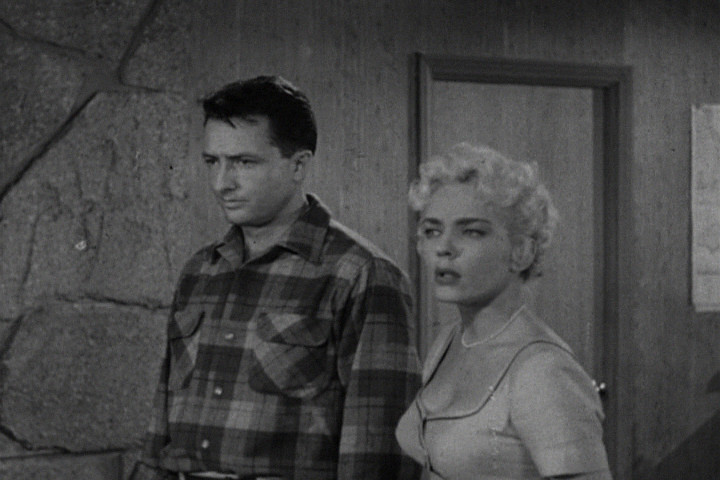
Of course, aliens landing in the middle of nowhere is another well-worn low-budget trope. Having a small group of people holed up against some outside menace in a small inn or a cottage is a cheap and easy way to create drama and tension with a small cast and without the need for expensive sets. In fact, the setting of The Astounding She-Monster is almost identical to Robert Clarke’s first science fiction movie, Edgar Ulmer’s taut and atmospheric The Man from Planet X (1951, review). However, the film that it most reminds me of is the British cult classic Devil Girl from Mars (1954, review), itself highly derivative of The Man from Planet X. In it, Patricia Laffan’s S/M dressed Martian dominatrix also menaces a small group of people holed up in a rural house, and most of the plot consists of Laffan visiting the house, then leaving, someone going out and being chased back inside, Laffan again visiting and leaving, and so on and so forth. Of course, in that film, Mars needed men, and as opposed to the alien in She-Monster, Laffan was quite efficient at stating her business on Earth.
But on the other hand: the humans of the film are none too bright, either. They just start shooting at the – supposed – alien for no reason. For all they know, she could just be a lost girl from the local cabaret. Apart from her somewhat Mr. Spockish eyebrows there is nothing particularly alien, or indeed frightening, about her. How many of you would start shooting if you encountered a woman in a silver catsuit and glittery shoes in the forest? Granted, she does have a strange shimmer and glow, but since nobody in the picture ever mentions this, I suspect that giving her a signature shimmer was a decision made in post-production. This was probably done by AIP, who wanted the alien to have even the slightest otherworldliness and menace – and not just look like a girl escaped from the nearest sex club.
The scientific leaps required by Dick and others to make are what are really astounding. First of all, everybody involved buy Dick’s explanation that the woman in the forest is an alien at the drop of a hat. Further, why a geologist would be an expert in the symptoms of radium poisoning is unclear, especially since the only outward sign on Brad after he has been killed is a white handprint. However, from the fact that he has been radiation poisoned, Dick deduces that the alien is radioactive, and therefore, she is made out of radium. And therefore, she wears a protective suit made of radium, and therefore, she will dissolve in Earth’s atmosphere if attacked with acid. More than anything, the decuction reminds me of Monty Python and the Holy Grail (1975): “If she weighs the same as a duck, she is made of wood, and therefore a witch!”. Nevermind that the alien’s head is not covered by the suit, and doesn’t dissolve in Earth’s atmosphere.
As all friends of B-movies agree, wonky science and bad logic do not necessarily a lousy movie make, if the film is otherwise well made and entertaining. Unfortunately this is not the case with The Astounding She-Monster. There’s a reason as to why there was a handful of directors in Hollywood that were continuosly assigned to make these science fiction B-movies on pocket money budgets with shooting schedules on less than a week: it required a certain amount of talent and ingenuity. Directors like William “One-Shot” Beaudine, Sam Newfield, Roger Corman, Fred Sears and even Edward Cahn in his best moments, managed to run a tight ship on set thanks to rigorous planning, effective scheduling, a natural feel for how to set up shots, framing and blocking in order to make the most out of limited sets and locations, moving actors instead of cutting and making good use of different angles and camera moves.
Ronald Ashcroft was not one of these directors. The movie is shot almost entirely in wide and medium shots, and almost completely devoid of cutaways and close-ups, giving the whole affair a static and distanced feel, and the lack of any dramatic angles or atmospheric lighting, or even camera movement makes this a dull movie to watch. It doesn’t help that many scenes are played out in long, continuous shots of people standing far away from the camera having meaningsless conversations. An entire fight scene is filmed in a single static wide shot, draining it of any kinetic energy. Much of the film feels like watching a stage play filmed with a single camera from the back of the theatre.
It doesn’t help that Ashcroft has too little in terms of script to rely on, and has to stretch scenes in absurdity in order to make the film’s 62-minute running time. There’s endless and endless shots of the actors walking, walking and walking through the woods, running up and down the same forest path, and driving along the same small stretch of road, up the stairs to the cottage, down the stairs from the cottage, into the car, out of the car, etc, or the alien tip-toeing in her bizarre gait among the trees for minutes on end. The script fails to make us feel anything for the disjointed group battling the she-monster. The script sort of hints at some kind of backstory for at least Nat and Ethel, but this feeble attempt at character development goes nowhere and is simply too badly written to strike any chord with the viewer. We get to know absolutely nothing about the romantic duo at the centre of the film.
When the bucket of gasoline and the torch came out, I was hoping the film would make an attempt at a full-body burn, as in The Thing from Another World (1951, review). But of course a 4-day shooting schedule with a crew of half a dozen wouldn’t allow for that. The most impressive practical effect of the film is the alien jumping through a window. Robert Clarke tells Tom Weaver that the most impressive thing about it was that the window was already broken when she jumped through it. The crew used a traditional break-away window made from sugar and water, but when the handlers fitted it onto the set, they dropped it and it broke. Since there was no time to make a new window, Ashcroft simply glued some of the shards onto the frame, and had Shirley Kilpatrick jump through them, editing it so that the shot actually works.
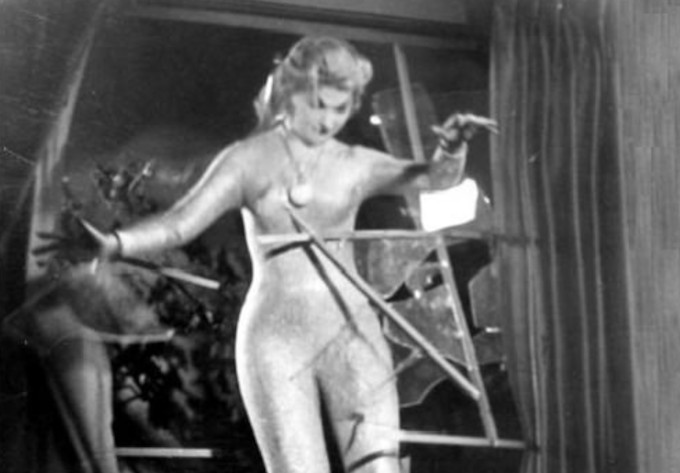
Another mishap that shaped the film was Kilpatrick’s suit, as hinted above. The suit was too tight for the actress, and on the first shooting day she bent down to “kill” one of the other actors, when the suit split down her back. Since there was no time to adjust it to her measurments, Norma McClasky at wardrobe duty simply stuck the back of the suit back together with safety pins. This resulted in the fact that Kilpatrick couldn’t show her back to the camera during the entire film, and is why she is often seen backing awkwardly away from the camera when exiting a shot.
The only visual effect of the film is a sort of wave-like, undulating shimmer laid over most of the shots of Kilpatrick. The idea here was probably to give the alien some sort of otherwordly feel, as she would otherwise just like like a busty lady in a silver catsuit wandering awkwardly around the woods. Since this shimmer isn’t ever mentioned in the dialogue, I suspect it was an afterthought. It’s a simple and cheap trick and does kind of work. The only problem is that the shimmer isn’t isolated to the alien, but affects the entire frame, making the whole world – sometimes including the other actors – undulate and shimmer. Other times, when there are other actors in the shot, the alien suddenly doesn’t shimmer at all.
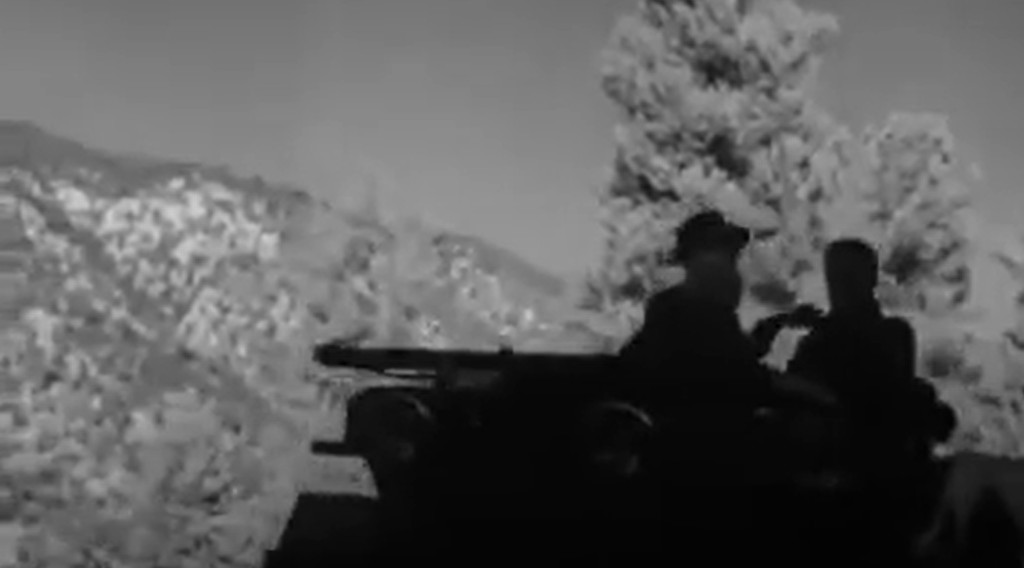
The photography, as mentioned, is static and dull and fails to create any kind of atmosphere. There are several obvious day-for-night shots, the worst of which are those in which the three survivors attempt to escape by car. Director Ashcroft films on the shady side of a mountain, underexposing the image so that the actors at times appear only as black blobs. But it doesn’t help when the sun obviously shines brightly on the mountains on the opposite side of the valley. The editing is atrocious, which is somewhat surprising, seeing as Ronald Ashcroft was originally an editor. Cast members testify that Ashcroft edited the entire film in his living-room.
The Astounding She-Monster can be fun for those who get a kick out of watching really bad 50s B-movies, but has little else to offer. The highest praise this film can get is that it is recogniseably a feature film, and as such is at least coherent, and has a story that makes sense within its own warped logic. Other than that, its low budget and rushed schedule are painfully obvious, resulting in a stretched-out, slow-moving picture that isn’t even able to wring any campy humour from its ridiculous premise. While Ashcroft’s colleague Ed Wood may not have made pictures that were technically better than this, they were clearly made with passion – something sorely lacking from The Astounding She-Monster.
Reception & Legacy
There doesn’t seem to be any clear information on exactly when The Astounding She-Monster first premiered. However, we do know that American International Pictures bought the film from Ashcroft, and distributed it as a double bill with Roger Corman’s The Saga of the Viking Women and Their Voyage to the Waters of the Great Sea Serpent. That film was released in December, 1957, so it would stand to reason that The Astounding She-Monster premiered at the same time. On the other hand, reviews in the US trade press were published as late as August, 1958. Despite its admittedly bad quality, the movie was a commercial success. One explanation for this may very well be the fantastic poster by legendary poster artist Albert Kallis. The poster, depicted above, is one of the most iconic images of 50s science fiction, and the alluring depiction of the sensual space woman certainly promised a lot more than the movie was able to deliver.
The Astounding She-Monster did not get a lot of attention in the trade press when it premiered. However, the few American trade magazines that did note it, gave it surprisingly good reviews, despite its obvious ineptitude. This is something which film scholar Bill Warren puts down to the general attitude towards science fiction in Hollywood: that it didn’t matter to the sci-fi audience if the films were any good as long as they had a monster or a flying saucer. Harrison’s Reports wrote: “The story has been handled in imaginative fashion and many of the situations hold one in tense suspense”. The magazine also had the chutzpah to write: “The photography is good”, even though it was clear as day to anyone with eyes in their head that the photography was not good. Likewise, The Motion Picture Herald called it “fair”, and noted that “the overall effect is one of satisfying melodrama”.
Across the pond, critics weren’t afraid to call a spade a spade. British Monthly Film Bulletin gave the film its lowest rating, writing: “The film is a feeble and ridiculous contribution to the science fiction library, weakly scripted and poorly acted”.
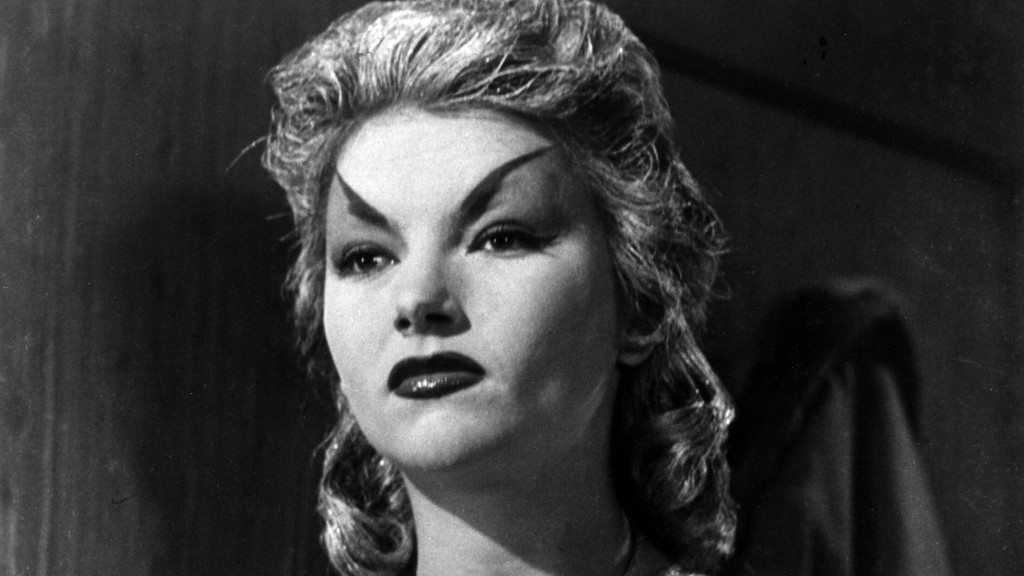
Bill Warren himself called the movie a “boring, dismal little picture” and “one of the worst science fiction movies ever made”. In The Encyclopedia of Science Fiction Movies, Phil Hardy says: “The only point of interest in this clumsily directed, silly film is its misogynistic attitude to women in its association of female beauty with evil and unconventional independence with male fears of castration”.
According to Robin Bailes at Dark Corners, “technically, the film breaks new ground in levels of ineptitude”. Glenn Erickson at DVD Savant compares the movie to a backyard production with a “dreadful script”, an “amateurish narrator”, “impossibly lazy and inexpressive exterior filming” and an “unimpressive resolution”. Mark Cole at Rivets on the Poster does give the film points for the twist ending, but: “That still isn’t enough to rescue this one from it’s impoverished production values. […] This one isn’t just cheap, it is threadbare.”
This movie’s greatest legacy is its amazing poster, and the fact that it actually made people see the film. Another legacy is that it inspired lead actor Robert Clarke to get involved in movie producing. Made on only $18,000, Ronald Ashcroft was able to sell it to American International Pictures for $60,000, making a good profit. Clarke, who had accepted a lowered fee in exchange for four percent on the profits, was amazed at how good money one could make on such a cheap and risible product, and decided he wanted in on the action. This led to him producing the SF movies The Hideous Sun Demon (1958, review) and Beyond the Time Barrier (1960). Unfortunately, none of these became the money-makers he had hoped for, although both were decidely better than The Astounding She-Monster. Not that the bar was high.
The film was released in the UK as Mysterious Invader. Cult director Fred Olen Ray described his movie Alienator (1990) as a semi-remake of The Astounding She-Monster. I have yet to watch that film, but based on the trailer and the plot synopsis, there seems to be little in common between these films, other than both featuring a scantily clad, glittery and indestructible woman sent to Earth and killing people. Plus, it features Robert Clarke as a narrator.
Cast & Crew

I have outlined most of Ronald Ashcroft’s career in Hollywood above. Ashcroft started as an editor in the low-low-budget circle of moviemaking inhabited by the likes of Ed Wood in 1956, but quickly graduated to producing with Outlaw Queen (1957) and directing with The Astounding She-Monster (1957/1958). He directed two more films, the drama Girl With an Itch (1958) and the sex comedy Like Wow! (1961), about a man who finds a pair of magic glasses that allows him to see women naked. He did a couple of more editorial jobs, and in the 60s seems to have moved into sound editing in TV. Ashcroft worked on several films with Ed Wood, and among his favourite actors were Kenne Duncan and Robert Clarke, who appeared in most of his movies.
Lead actor Robert Clarke came up through the ranks from school plays to radio and then Hollywood, where he gut stuck in the B or even Z movie quagmire before embarking on a rather successful career as a TV show guest star in the late fifties through to the late eighties, and even put in a few film cameos during the nineties and the naughties. He passed away in 2005.
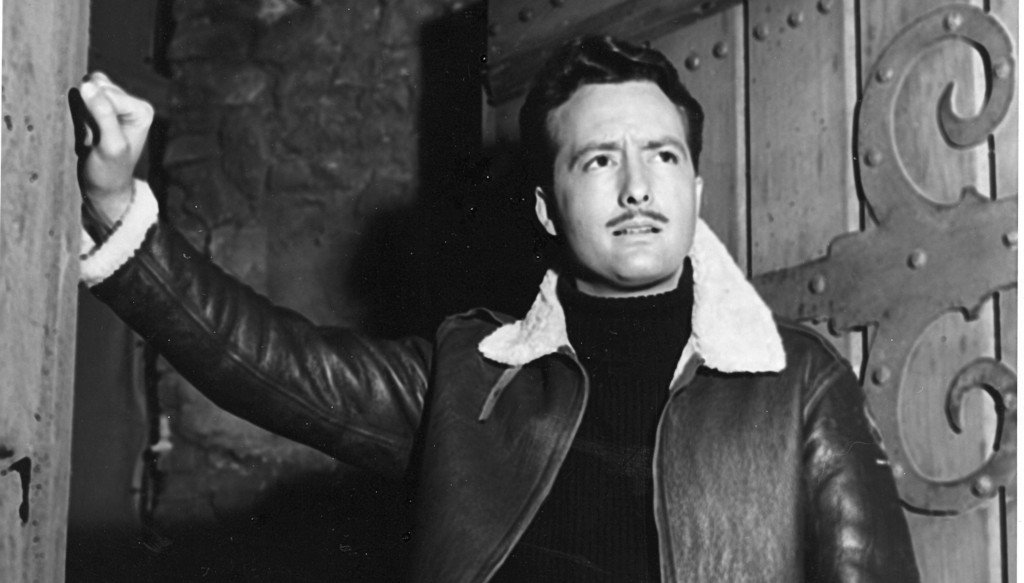
Despite having appeared in close to 150 films and TV shows, Clarke is best known as the hero of a number of schlock science fiction films. This included classic The Man From Planet X (1951, review) and the flawed but interesting post-apocalyptic Captive Women (1952, review). He was the hero again in The Astounding She-Monster (1957), The Incredible Petrified World (1957), opposite John Carradine, The Hideous Sun Demon (1959), which he co-wrote and co-directed, Beyond the Time Barrier (1960), directed by Edgar Ulmer and produced by Clarke, Frankenstein Island (1981), again with Carradine, and the sci-fi comedy Midnight Movie Massacre (1988). He also appeared as the narrator in Byron Haskin’s Jules Verne adaptation From the Earth to the Moon (1958, review), in Where’s Willie, Alienator (1990), and The Naked Monster (2005), his last production. Clarke guested a number of sci-fi TV shows as well, including an episode of Knight Rider (1984). Clarke is not to be confused with Robert Clarke, director of The Whispering Shadow (1933, review).

Kenne Duncan was born in 1902 and began his Hollywood career at the tail end of the silent era. Sound was a boon for Duncan who had a good voice, and he quickly established himself as a bit-part player in movies for studios like Universal, Paramount and MGM. However, for larger parts he had to venture into smaller production companies, and his background as a professional jockey made him wanted in western movies and serials. Duncan quickly established himself as a staple western heavy in both low-budget films and several Republic serials in the 30s. Even though he appeared in several other genres, it was the western that he was always called back to. A heavy drinker and notorious womanizer, Duncan fell naturally in with the eccentric crowd to which Ed Wood, Alex Gordon and Ronald Ashcroft belonged. After his death in 1972, his wake was held at Wood’s swimming pool.
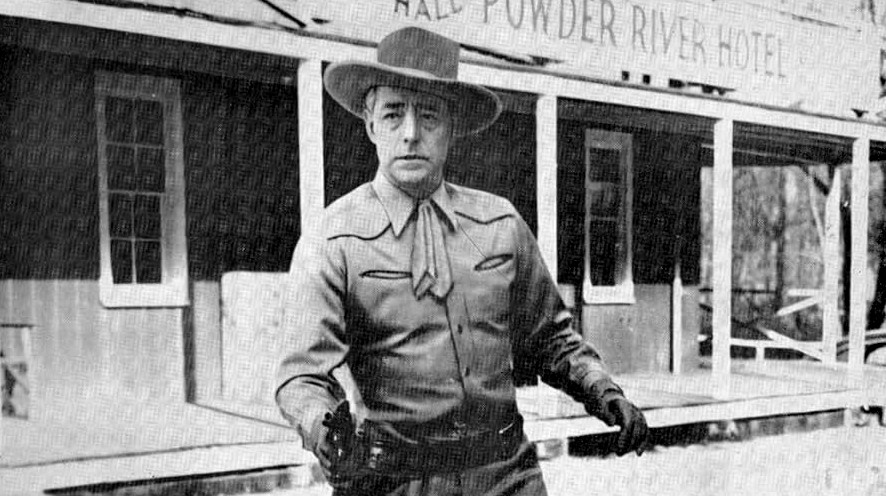
Duncan appeared as a heavy in several science fiction serials, including Flash Gordon’s Trip to Mars (1938), Buck Rogers (1939), Adventures of Captain Marvel (1941), Captain America (1944), Manhunt of Mystery Island (1945), and Batman and Robin (1949). He also appeared in the SF films Sky Bandits (1940, review) and The Astounding She-Monster (1957), and played the lead as Dr. Acula in Ed Wood’s Night of the Ghouls (1959).
Neither Marilyn Harvey, playing the kidnapped socialite, nor Jeanne Tatum, playing the female crook, had very long acting careers. The Astounding She-Monster (1958) was Harvey’s only movie role outside of a bit-part in Rosemary’s Baby (1968), and outside of those, she only had a handful of TV credits in the early 60s. Tatum appeared in around 20 films or TV shows between 1952 and 1961. In films, she was mainly confined to uncredited bit-parts.

However, Ewing Miles Brown, playing the third crook in The Astounding She-Monster (1958) was something of an industry insider. IMDb gives him 30 acting credits, however, his Hollywood career spanned over 90 years, from the silents of the 20s to his death in 2019. Brown appeared in numerous films, mainly in uncredited bit-parts, and worked behind the camera in a multitude of capacities, often uncredited. Brown started his career in uncredited bit parts as a child actor, and then moved into various behind-the-camera assignments in his teens, and worked on TV shows, films and serials in the editorial department, as a director’s assistant, second unit work, etc, all of it uncredited, work which continued after WWII, when he also returned to acting – sometimes even credited.
Eventually, Brown branched out into producing and directing his own movies, although he did no more than a small handful of films of his own. He produced Al Adamson’s two infamously bad John Carradine vehicles Blood of Dracula’s Castle (1969) and Horror of the Night Monsters (1970), and both wrote, prodcued and directed the reportedly bizarre and terrible Marineland kiddie picture A Whale of a Tale (1976), best known for starring William Shatner and containing a soundtrack by Journey’s keyboardist.

Eventually he got tired of working for other studios and set up his own small studio in the San Fernando Valley, called Movie Tech Studios in 1980, which offered full, albeit small-scale, studio facilities for rent for independent movie makers. Ewing “Lucky” Brown was something of a mentor and teacher to young filmmakers in the 80s and 90s, and a well-liked figure within the industry. He rubbed shoulders with most of Hollywood’s big stars, although he himself was always miles away from the limelight. It’s an overstatement calling his own movies B-movies, as they almost invariably fell into the Z category. However, as he states in a great article and interview published at Reel Cowboys, there was always a market for B-films, and someone had to make them. However, it is questionable if the world could not have survived without the abysmal films Brown produced and directed in the early 00s, like The Stoneman (2002), starring a washed-up Pat Morita and American Gladiator Steve Henneberry as a caveman in something that looks like a school project, the serial killer bore Dismembered (2003) and the reportedly terrible Troma movie The Ruining (2004). At the time of his death in 2019 he was working on a film called Curse of the Gorgon, which IMDb lists as completed, but which has never been released.

For a long time, little was known about Shirley Kilpatrick, the curvy woman who plays the alien, and The Astounding She-Monster was thought to be her only screen credit. The mystery around her later led magazine editor Tim Lucas to speculate that she was actually the same person as cult actress Shirley Stoler of The Honeymoon Killers (1970) fame, and that she changed her name in order to reinvent herself. This was based entirely on the similar appearance of the two women, and complete nonsense – and it’s about time it is debunked once and for all. We now know that Kilpatrick was born 1935 in Los Angeles, while Stoler was born in 1929 in New York. Stoler’s parents were Russian immigrants, making it highly unlikely that her birth name would have been Kilpatrick. In fact, Shirley Kilpatrick was a successful pinup and nude model in the early 50s, and according to an article in Pulp International (NSFW), she” featured [naked] in pretty much every men’s magazine of her era”. She was given a chance at acting with a small supporting role in RKO’s western The Silver Lode in 1954. However, her acting was reportedly so bad that her role was almost completely cut from the film, and she didn’t appear in screen again until The Astounding She-Monster. She also appeared as a dancer in The Gene Krupa Story (1959). Sadly Kilpatrick died in 1971, only 35 years of age.
Composer Gene Kauer was born Günther Kauer in Germany, where he studied music, worked as a bandleader and arranged music for radio and nightclubs. He was drafted to the Nazi army in 1937, but got frostbite on his first day, and was reassigned to the entertainment division. After the war he played at a US army resort in Garmisch-Partenkirschen, which is where he met his would-be wife, an American, became a “male war bride”, and moved to California. After a stint as a hotel bar pianist, he moved to Los Angeles, where he befriended Ronald Ashcroft. Ashcroft asked him to score his films Outlaw Queen (1957), The Astounding She-Monster (1957) and Girl With an Itch (1958), which is how Kauer got his start in the movie business. He composed music for nearly 50 films between 1957 and his death in 1983, almost all of them independently produced genre clunkers, including a good portion of films that frequently show up on “worst movies” lists, like The Astounding She-Monster, The Beast of Yucca Flats (1961), Monstrosity (1963), Agent for H.A.R.M. (1966), Monster (1980) and the Faces of Death cycle (1978–1999). He often worked alongside fellow composer Douglas Lackey.
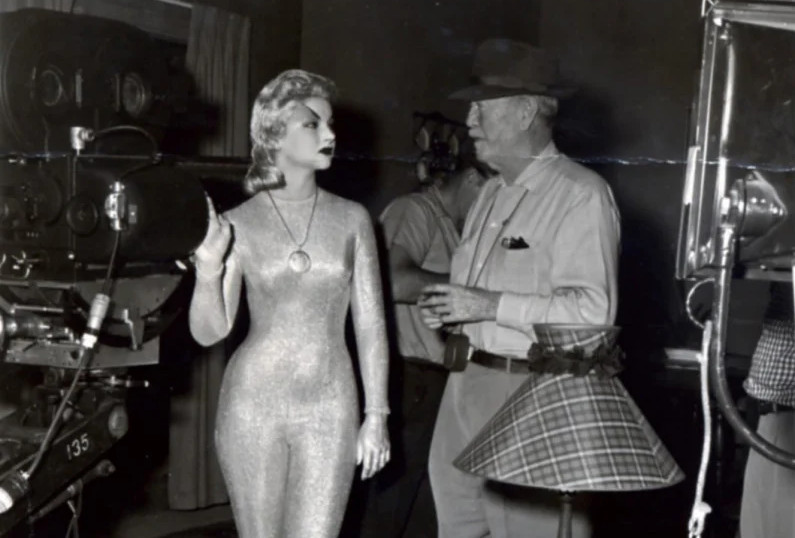
William Thompson started working as a cinematographer as early as 1914, and worked all of his career on low-budget films on the fringes of Hollywood. He was a part of the eclectic group of filmmakers to which Ronnie Ashcroft and Ed Wood belonged, and shot almost all the films that Wood directed. In addition to this, he also worked as cinematographer on such infamous movies as Maniac (1934), The White Gorilla (1945), Racket Girls (1951), Project Moon Base (1953, review) and The Astounding She-Monster (1957). Co-cinematographer Brydon Baker had a similar career.
Janne Wass
The Astounding She-Monster. 1957/1958, USA. Directed & edited by Ronald Ashcroft. Written by Frank Hall, Ronald Ashcroft and possibly Ed Wood. Starring: Robert Clarke, Kenne Duncan, Marilyn Harvey, Shirley Kilpatrick, Jeanne Tatum, Ewing Miles Brown. Music: Gene Kauer. Cinematography: William Thompson, Brydon Baker. Sound: Dale Knight. Makeup: Nicholas Vehr. Produced by Ronald Ashcroft for Hollywood International Pictures.
 Scifist.
Leave a comment