
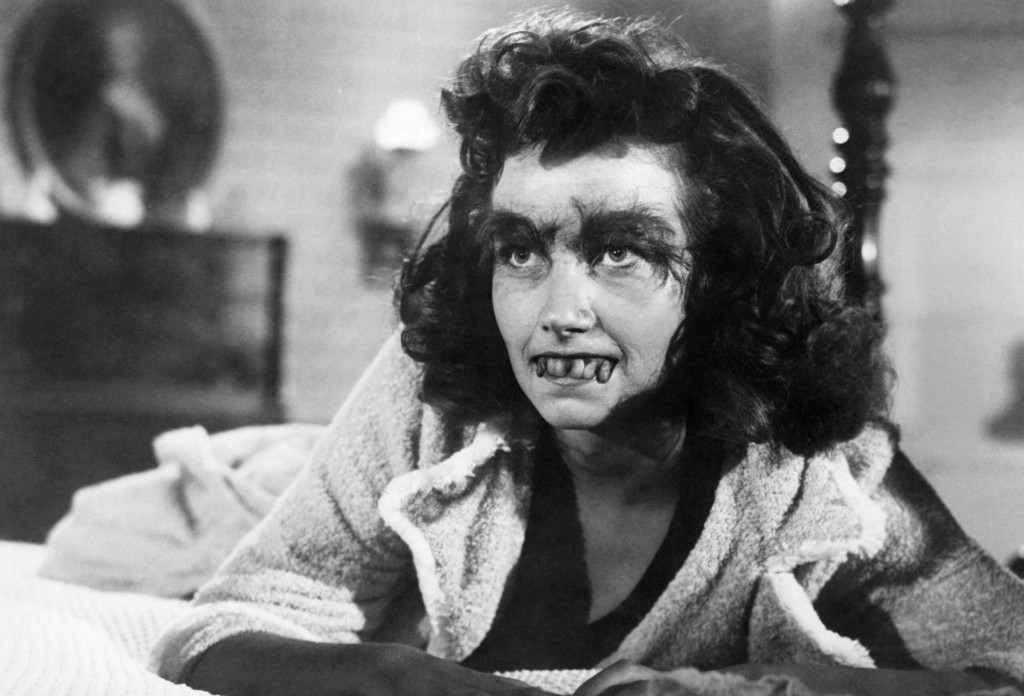
Dr. Frankenstein Jr continues his grandfather’s experiments in American suburbia – but this time it’s going to be a female monster. Richard Cunha’s 1958 “shocker” is low-budget schlock for the drive-in market, but it avoids scraping the bottom of the barrel. 3/10

Frankenstein’s Daughter. 1958, USA. Directed by Richard Cunha. Written by H.E. Barrie. Starring: Sandra Knight, Donald Murphy, Sally Todd, John Ashley, Felix Locher. Produced by George Foley & Marc Frederic.
Young Suzie (Sally Todd) and her boyfriend Don (Harold Lloyd Jr) join their friends Trudy (Sandra Knight) and her loverboy Johnny (John Ashley) for a game of morning tennis. But Suzie is shook up, as she has had a frightening dream – or was it real? – about being attacked by a horrifying she-monster last night. Strangely, Trudy distinctly remembers – in some dreamlike state – seeing the exact same monster as Suzie. Getting no support from their too-hip-to-be-decent boyfriends, they call off the tennis game.
Richard Cunha’s 1958 low-budget schlocker Frankenstein’s Daughter actually opens with a shot of the afore-mentioned she-monster attacking Suzie, so we know she is real. The film was Cunha’s and producer Marc Frederic’s answer to AIP’s successful “I Was a Teenage [insert monster]” movies, and catered to the same drive-in audiences, in the hopes of a quick buck. This one was released as a double bill with Cunha’s Missile to the Moon (1958, review).
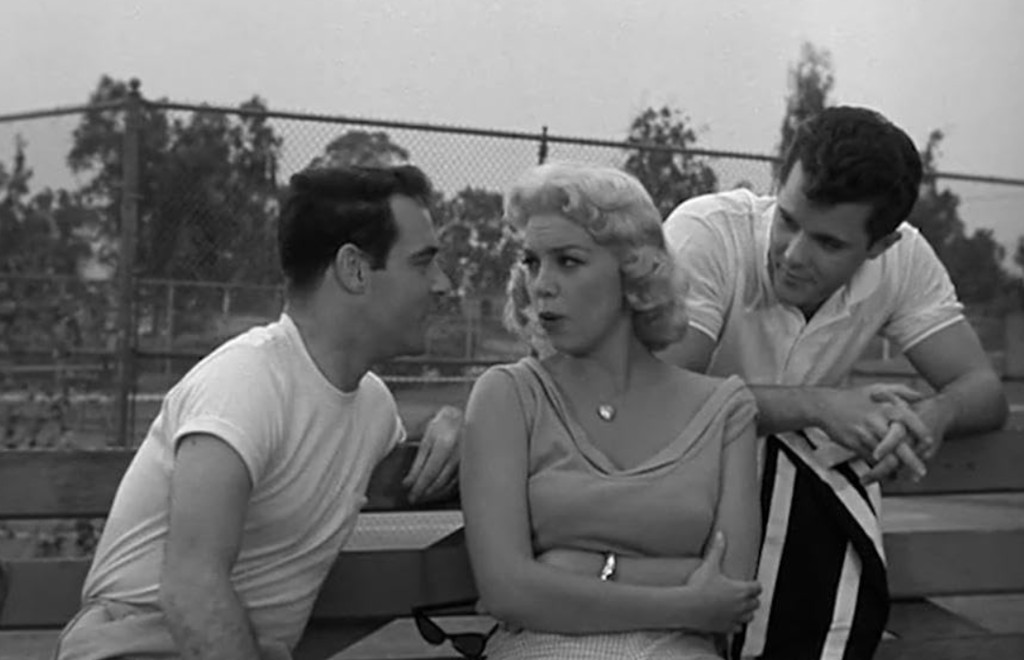
The prelude introduces two of the film’s main characters, Trudy and Suzie. Brunette Suzie is the niece of elderly scientist Prof. Morton (Felix Locher), who is working from his home lab with a cure-all drug. He is assisted by the mysterious but handsome Oliver Frank (Donald Murphy), of whom he knows nothing. For example, he doesn’t know that Oliver’s real name is not Frank, but Frankenstein. Prof. Morton also doesn’t seem to know that he has a secret lab adjacent to his own lab, which Frankenstein and “gardener” Elsu (Wolfe Barzell) use to recreate Oliver’s grandpappy’s old experiment.
Neither does Morton seem to know that not only is Oliver making unwelcome advances toward his niece, he also uses Morton’s experimental drugs to turn her into a she-monster at night. Yes, Trudy is indeed the she-monster that has attacked Suzie and vaguely remembers seeing herself in the mirror during her spells. However, one night monster-Trudy gets away from Frankenstein in a bathing suit and starts terrorizing the (small?) town (we have no idea where this movie is set) and is seen by numerous people. The police get involved and chase down the she-monster, however, Frankenstein gets to her first. Now, to his dismay, the cat is out of the bag and the press have a field day with his creation.
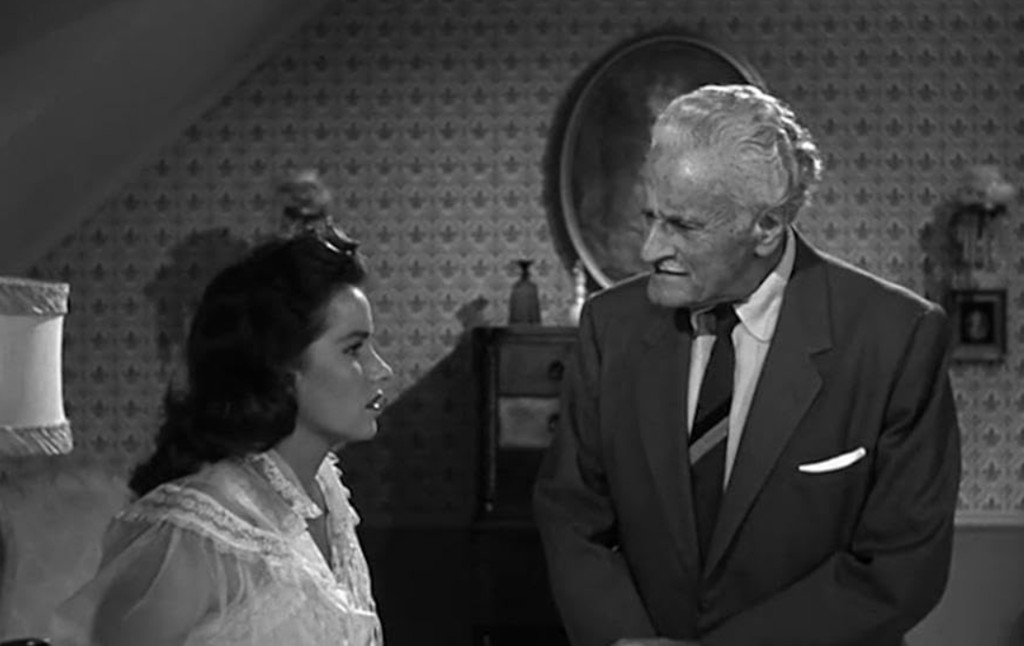
Making matters worse, Prof. Morton needs a rare and dangerous drug called digenerol for his experiments, and the only place he can get it is his former employer, a drug company. And only if he steals it. And when deformed monsters start roaming the streets, and a drug company reports theft of a drug that can cause deformations, the police start putting two and two together.
Meanwhile, we haven’t forgotten about Suzy nor about the thing on the slab in Frankenstein’s lab. See, Trudy isn’t really part of Frank’s project (nor are we quite sure why he keeps turning her into a she-monster). The real thing is in Frank’s secret lab – sans head. Womanizer Frankenstein isn’t content with forcing himself on Trudy. When he meets her slinky girlfriend Suzie, he immediately books a “parking lot date” with her. But when she puts a stop to his heavy petting in the car, he is not only enraged, but also sees his chance for getting a head for his monster, and runs over Suzie with his automobile.
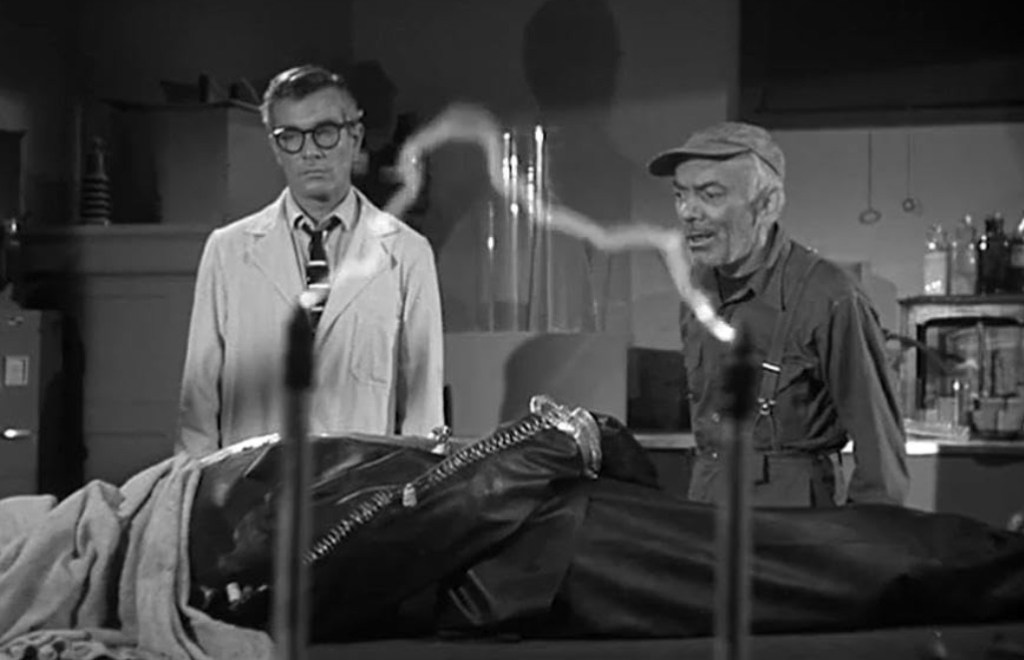
And that’s where the title of the film comes in. Frankenstein’s creature now gets the brain and the head of a woman, and the monster is thus dubbed “Frankenstein’s Daughter”. The resurrection of the monster is done away with in a somewhat prosaic manner, with the push of a lever and a couple of sparks from a Jacob’s ladder, and boom! we have a monster. Although this lumbering creature decked out on a firefighter’s rubber suit and its very male-looking, albeit deformed, face, does not look very much like either anyone’s daughter nor pretty Suzie. In fact, it looks quite a lot like Harry Wilson, who plays the creature.
Now follows the sort of back-and-forth that we are familiar with in these films. Trudy finally catches on and is able to get the police to consider that Dr. Frankenstein has created a monster in her uncle’s basement. However, the uncle is instead arrested for stealing drugs from his former employer. The police pay a visit and leave with unfinished business, the monster leaves and returns, Trudy escapes and gets caught and finally Trudy and Johnny are served to the monster. After serving three generations of Frankenstein, Elsu finally gets cold feet and turns on his master, who dispatches the monster on him. The police arrives but is unable to force themselves through the lab door (a padlock), Johnny throws a bottle of acid at Frankenstein and the monster kindly sets fire to itself.
Background & Analysis

Often referred to as the worst Frankenstein film of all times, Frankenstein’s Daughter actually isn’t all that bad. Yes it’s bad, but it’s not really worse than, say, How to Make a Monster (1958, review) or a number of other low-budget monster movies of the late 50s. In fact, this is probably director Richard Cunha’s best film – although the bar is not set particularly high.
Richard Cunha was a name that emerged in the late 50s, attached to a number of no-budget productions of questionable quality. Along with producer Marc Frederic, he made the clunkers Giant from the Unknown and She Demons (review) in 1958, with Arthur Jacobs as co-producer under the moniker Screencraft Pictures. The duo then founded Layton Film Productions and announced they were going to produce 10 films over the 24 following months. In actuality, they only made three: Missile to the Moon (1958), its double bill companion Frankenstein’s Daughter (1958) and Girl in Room 13 (1960).
Cunha and Frederic had a deal with distributor Astor Pictures, who would buy their movies for $80,000 apiece, which meant they had to keep their pictures under this figure to make a profit. Thus, their movies were generally shot in six days for around $65,000 – a low figure even for a low-budget movie at the time.
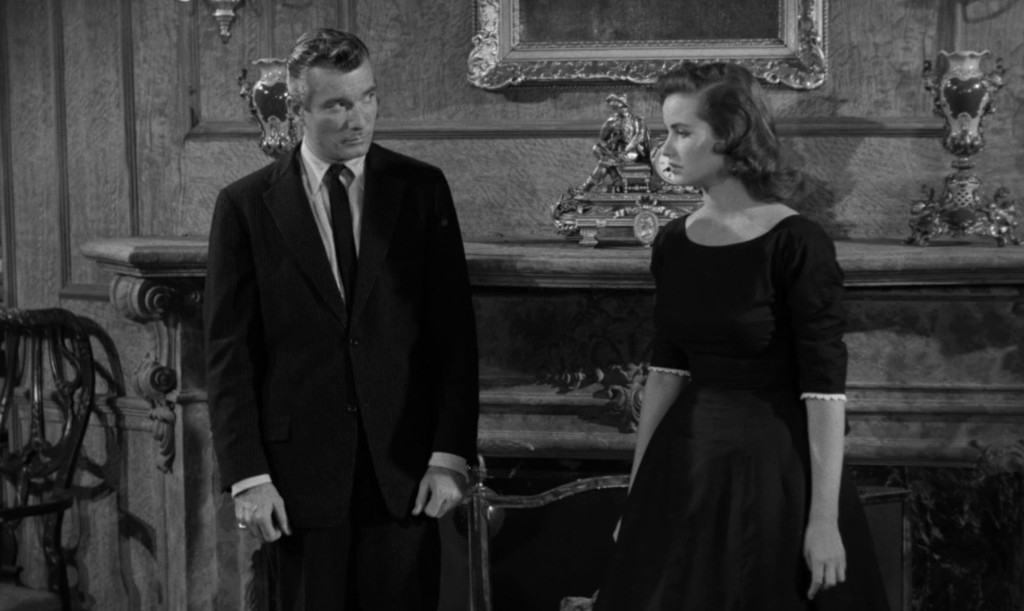
In an interview with Tom Weaver, Cunha reveals that he himself didn’t think particularly highly of the pictures he made. His day job, so to speak, was running a small studio where he and Jacobs made commercials and post-production work, and making feature films was a kind of side-job for a quick buck and for fun. With six-day shooting schedules and a $65,000 budget, the crew simply had to make do.
H.E. Barrie must have been a friend of Cunha’s, as he wrote almost all of Cunha’s films, and almost no other movies. Cunha wrote the script for She-Demons himself, and if nothing else, this proved that Barrie was a marginally better writer than Cunha, but that’s not saying much.

For Frankenstein’s Daughter, Barrie seems to be looking for inspiration from Herman Cohen’s teenie horror films I Was a Teenage Frankenstein (1957, review) and How to Make a Monster (1958). Both Frankenstein movies take place in a generic American suburbia and focus on a mad doctor with an unhealthy obsession with teenagers – teenagers that he uses as raw material for creating a monster in his basement. While Cohen’s film focused on the mad doctor’s relationship with his teenage monster, Cunha’s focuses on Dr. Frankenstein’s relationship with the two teenage girls in his vicinity – Trudy and Suzie. Like in Teenage Frankenstein, Frankenstein’s Daughter also has a monster (or two, actually) running loose in a suburbian era, scaring creti and pleti, with the police laughing away the sightings, leaving it to the civilians to get to the bottom of the goings-on. And like in How to Make a Monster, Frankenstein’s Daughter also makes the antagonistic relationship between the mad doctor and his colleague a central plot point. Like other teen SF movies of the time, like AIP’s Invasion of the Saucer Men (1957, review) and Paramount’s The Blob (1958, review), the protagonists are a teenage couple out to save the world.

Otherwise, there are the usual nods to numerous other Frankenstein movies, such as the mute and slow-witted monster that walks with a slow, clumsy gait, takes orders from its creator until it finally revolts (not that this monster’s revolt is much to write home about), and of course the obligatory creation scene. Where Ernest Thesiger in Bride of Frankenstein (1935, review) got to exclaim “the bride of Frankenstein!” in unveiling his creation, Donald Murphy as Dr. Frank gets his moment with “Frankenstein’s Daughter!” This exclamation is helpful, as it might otherwise have been tricky to figure out who the titular daughter actually is. Dr. Frankenstein has no daughter in the film, and his creation doesn’t quite bring anyone’s daughter to mind, but rather a very large middle-aged man with a facial deformation, wearing lipstick for some unexplained reason. There’s also Trudy, whom Frankenstein turns into a she-demon at night every now and then, but she is Dr. Morton’s niece. And then, of, course, poor Suzie, but she is nobody’s daughter in particular, but rather a poor girl that Dr. Frank picks up and attempts to rape in his car, before he kills her and puts her brain into his monster.
Barrie’s script is all over the place. It toys with several ideas, but is never able to knit them together into a coherent whole. We have Dr. Morton who is working on a cure-all drug, and despite being painted as one of the good guys, he must resort to stealing the all-important Digenerol drug from his former employer. However, this cure-all has nothing to do with the plot, and seems to be present only for Dr. Frank to be able to get his hands on the drug, which he uses to experiment on Trudy, turning her into a she-monster. However, it is also never explained why Frank keeps turning Trudy into a monster. It is implied that it has something to do with the creature he is creating in Dr. Morton’s basement, but how a drug that deforms its victims physically and makes them lose their memory and go about running the streets would aid in creating a creature out of body parts is anyone’s guess. It’s a subplot that takes up well over half the movie, but which has no bearing on the plot of the actual Frankenstein monster.

Then there’s the other plot, Frankenstein creating his monster. The fact that he needs a female brain is explained in the flimsiest of terms: women are used to taking orders from men, and that’s why a female brain works best for a monster that you want to order around. This disregards all of Frankenstein’s own experiences with the women in the film. Frank has an unhealthy obsession with his employer’s teenage niece Trudy, but Trudy certainly doesn’t stoop to taking orders from Frankenstein, but firmly brushes off all his advances. And Frankenstein doesn’t fare any better with slutty Suzie, who physically forces herself out of his attempts to rape her in his car, so enraging him that he drives her over and decides to use her brain for his monster. Suzie seems like an odd choice for raw material for a submissive woman, as she has demonstrated her agency and independence throughout the movie. And what exactly Frankenstein plans to do with his creature, other than proving the naysaysers wrong, is unclear. In the original movie, the fact that Frankenstein’s creature comes out intellectually challenged is described as a horrible mistake (Fritz providing it with the wrong brain), but here, making a completely useless monster seems to be Frankenstein’s actual goal.
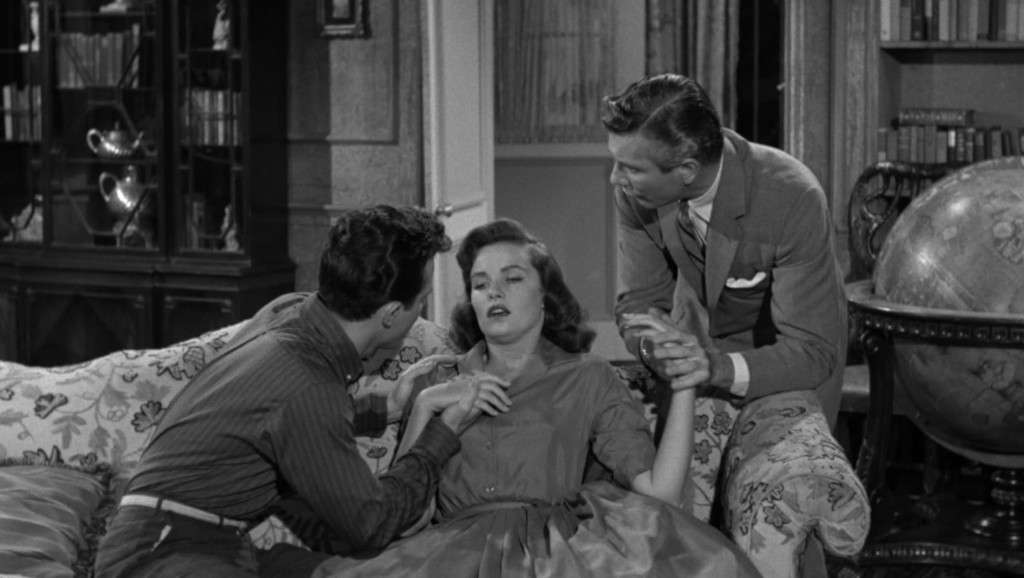
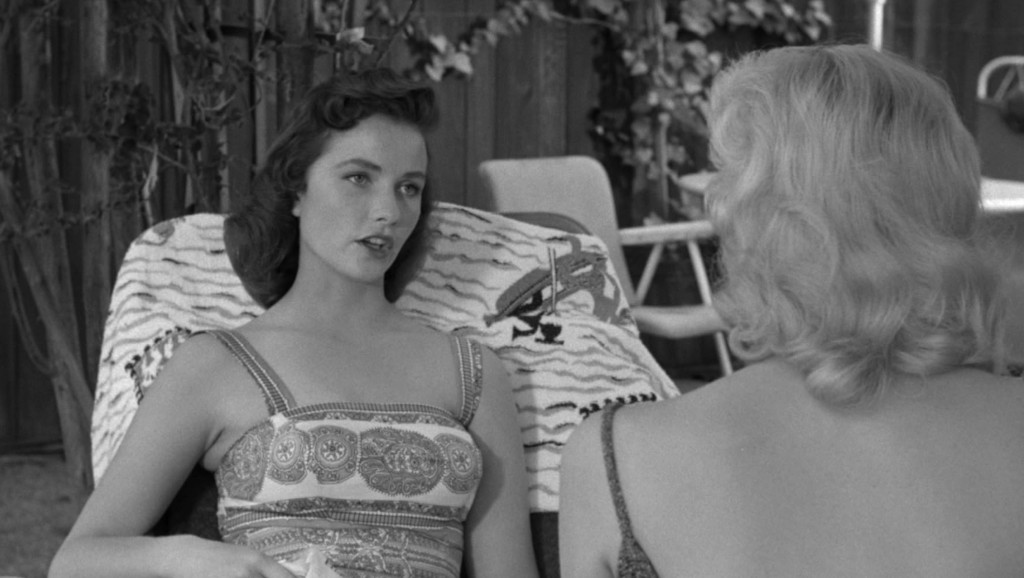
The gender politics of the movie is a hot mess, and I doubt Barrie put any deeper thought into it. On one hand, the two young women in the film are presented as both quite independent and intelligent. They are the ones who know what’s going on and try to warn the authorities. None of the men, conversely, are shown in any flattering light. Trudy’s (Sandra Knight) boyfriend Johnny (John Ashley) sort of mopes around and refuses to believe Trudy before she basically threatens to break up with him if he doesn’t stop questioning her sanity. Suzie’s (Sally Todd) boyfriend Don (Harold Lloyd Jr) is even worse, and Suzie actually gives him the foot. Dr. Frankenstein (Donald Murphy) has no redeeming qualities whatsoever – he is not only evil and quite clearly mad, but also a creep of major proportions, a rapist and a murderer. Not even Dr. Morton (Felix Locher) comes out with clean papers: not only does he steal in order to keep advancing his research, he also completely fails to notice that he has a mad Dr. Frankenstein doing experiments in his own building and turning his niece into a monster. Seen in this light, the movie actually seems to strike a blow for the women.
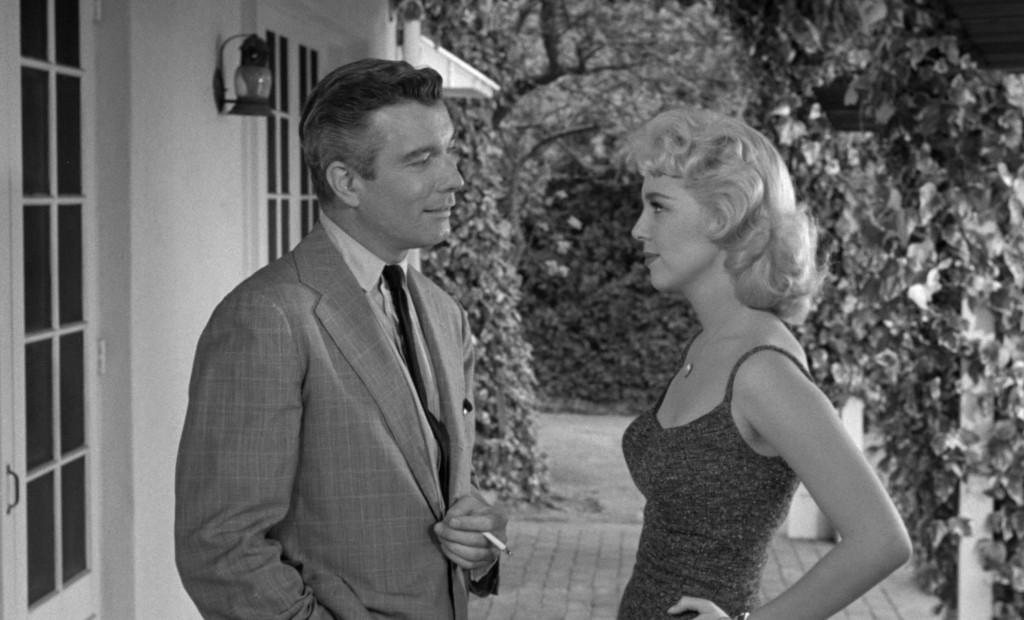
But – on the other hand, the women in the movie, despite the fact that they seem both independent and smart, are never treated as anything but victims. Trudy faints, freezes and screams like a waif everytime something remotely scary happens, despite it being completely against character. Suzie is portrayed as the bad girl, dressing slutty and hooking up with the first good-looking man she sees. The camera constantly objectifies her, lingering not one or two but three times on her as she is walking away, hips swaying, in her skin-tight dress. Naturally, it is the promiscuous girl who gets killed, as if she had it coming for inviting a man out “parking” with her. The men of the movie never believe a word the women are saying – it isn’t until Johnny goes to the police that they actually get going.
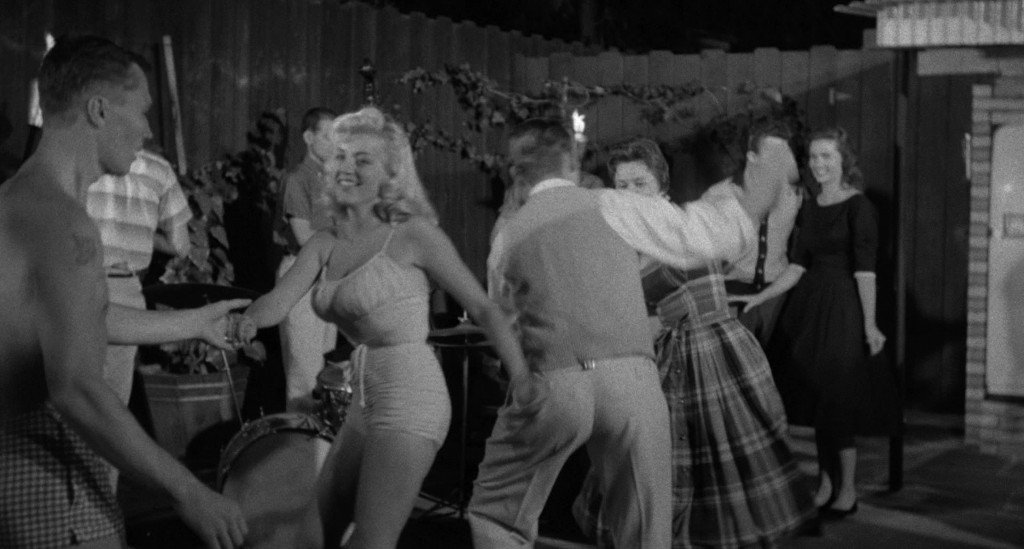
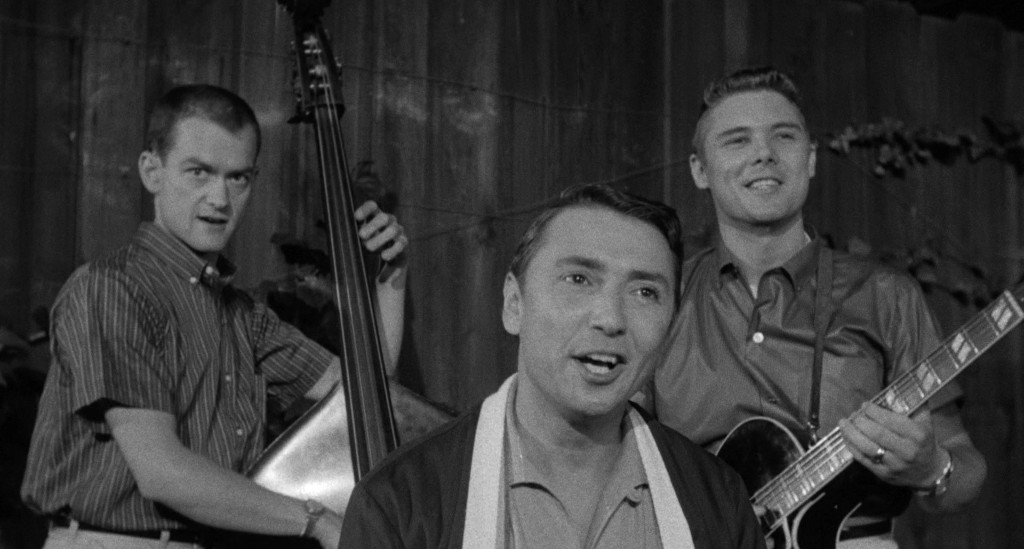
Then, there’s the usual bane of the 50s teen movie: the teenager party, this time in a backyard, with the obligatory musical number. This one comes from the Page Cavanaugh Trio, with two songs, “Daddy-Bird” and “Special Date”. It’s supposed to be rock, I think, but in fact the first is a boogie-woogie number and the second a popped-up swing song. “Daddy-Bird” is one of those songs that has an invisible musician – there’s a featured saxophone on the song, but no saxophone player in sight. The second briefly features Harold Lloyd Jr as guest vocalist, and looking at his awkward stage presence, it’s easy to understand why his career as a pop singer never took off. Page Cavanaugh was a merited pianist, composer and singer, and there’s nothing particularly wrong with the songs themselves; they are just completely out of place in the movie, and the 7-minute musical number grinds the picture to a halt.
What people tend to take away from the Frankenstein’s Daughter is the monster makeup. There’s really three different makeups featured in the movie. “Monster Trudy” comes in two different forms: one “lighter” version, which actually doesn’t look too bad at all – it’s really only hampered by the ridiculous buck teeth that makeup artist Harry Thomas has added. The second version, which looks more like a mask, has silly fried eggs eyes that give a comical effect. This makeup feels like a redo of the she-demon makeup that Thomas did for Cunha’s She-Demons. The most talked-about makeup is the one applied to the main monster, Frankenstein’s daughter. This is one of those movie effects that create an involuntary cognitive dissonance, as it looks nothing like what we expect it to look like. As Suzie – Sally Todd – is used as raw material, and Dr. Frankenstein gushes over it as “Frankenstein’s daughter”, we expect it to have at least a passing resemblence to Ms. Todd – or at least look vaguely like a woman. It looks nothing of the sort; you can see for yourselves in the attached picture.

The reason for this strange mismatch is to be found in the nature of low-budget movie making. These films were made in a hurry, with minimal planning and often contractors had little knowledge of what the finished film would be like, and seldom took part in any lengthier planning meetings. Communication glitches sometimes occurred. These glitches seemed to happen particularly often for makeup artist Harry Thomas. For AIP’s Voodoo Woman (1957, review), Thomas (reportedly) delivered an over-the-counter Halloween skull mask with a wig attached for the monster – leading to Paul Blaisdell having to design a new mask on the fly. It was also Thomas who conjured up the ludicrous, bulging eyes for the aliens in W. Lee Wilder’s Killers from Space (1953, review) – from plastic egg trays. In the case of Frankenstein’s Daughter, however, the blaim should probably be laid on the producers, since they apparently forgot to specify that the monster was supposed to be female. When Thomas showed up on set with character actor Harry Wilson, the self-proclaimed “ugliest man in Hollywood”, in a makeup that looked like Harry Wilson with half his face melted away, Richard Cunha naturally got a bit of a shock. But since there was no time to redo the makeup, Thomas “solved” the problem by putting lipstick on Wilson. The makeup itself isn’t terrible as such, it’s just the completely wrong makeup for the film.
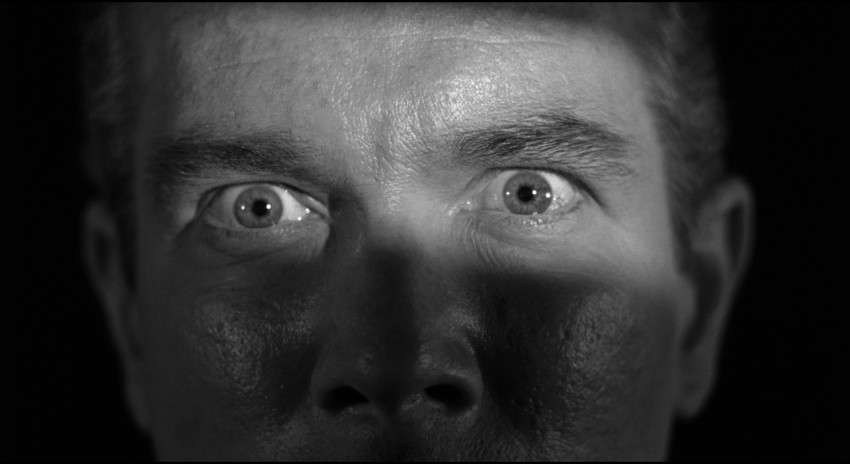
Whatever one might say about the content, the dialogue or the makeup of the movie, it is actually quite well filmed. Director of photography is Meredith Nicholson, who had also shot all Richard Cunha’s other films. The cinematography in Cunha’s films was always competent, but in Frankenstein’s Daughter it is even stylish on a few occasions, and the lighting is unusually good for a no-budget film of this sort. It’s difficult to say what was different with this movie – maybe Nicholson was simply in a particularly good mood. Not that the cinematography itself is particularly outstanding, but it is solid.
None of the actors involved in Frankenstein’s Daughter were Oscar material, and the acting ranges from decent to bad. Both Sandra Knight and Sally Todd come out with dignity intact, partly because their characters are slightly better written than usually in these kind of movies. There’s actually something for them to work with. Donald Murphy doesn’t leave much of an impression, but takes his role seriously and manages to be appropriately creepy. Felix Locher as Dr. Morton is just as amateurish is he was in all of his roles, and it’s a wonder he kept getting cast in role after role despite having little talent for acting. John Ashley as Trudy’s boyfriend does little else than mope around, doing his best Elvis impersonation, but at least he is better than Harold Lloyd Jr, who seems to be in the piece as some kind of comic relief. Wolfe Barzell who plays the resident Fritz was a seasoned character actor often called upon for quirky roles, and he does his schtick on autopilot.
Frankenstein’s Daughter is one of a myriad of low-budget teen/monster/sci-fi movies churned out of Hollywood in the late 50s, produced solely for the sake of making a quick buck at the drive-in market. As such, it has nothing in particular to distinguish it from the deluge of similar films. It is, like most of them, a bad movie from any which point you choose to look at it. However, it is not nearly among the worst of the bunch, in fact it is the best of Richard Cunha’s three SF pictures – which is not high praise as such. It’s script is incoherent and confusing, the dialogue is rotten and the characters flat and inconsistent. However, it does move the audience along and probably provided sufficient entertainment for the teen crowds. Cunha’s direction is workmanlike but working, and the cinematopraphy competent. In many ways, this is the epitomy of the late 50s teen/monster/sci-fi film, and as good an introduction to the subgenre as any.
Reception & Legacy

Frankenstein’s Daughter was released in December, 1958 in the US on a double bill with Cunha’s Missile to the Moon (review). Producers Richard Cunha and Marc Frederic had already made their money back by selling the two $65,000 films to Astor Pictures for $80,000 apiece, and they probably made their money back for Astor as well.
Like Missile to the Moon, Frankenstein’s Daughter got few reviews in the trade press, but Bill Warren has been able to list a few comments from newspapers at the time. The New York Times opined that it was a toss-up which of the two films on the double bill was “the cheaper, duller piece of claptrap”. The New York Herald-Tribune thought Frankenstein’s Daughter was “a little better, although much more confusing”. The Los Angeles Examiner called the film “a dismal clinker” and a “farrago”, according to Warren.
Thouroughly obscure, Phil Hardy doesn’t include the movie in his Encyclopedia of Science Fiction Movies. Bill Warren writes in Keep Watching the Skies: “Frankenstein’s Daughter is one of the worst films ever made. Richard Cunha’s direction is dismal, with no imagination of inventiveness discernable. The movie is ponderous, slow, repetitious, meandering.”

Today, Frankenstein’s Daughter has racked up a wee bit of cult movie fame with over 1,300 audience votes on IMDb, and no less than 42 external reviews on the site. And while many modern reviewers agree that the film is certainly not a good movie, few are as dismissive of it as Bill Warren. Kevin Lyons at EOFFTV Reviews says: “Frankenstein’s Daughter is a decidedly minor effort […] and exists really just to prop up a double bill for drive-in bookings. It’s barely distinguishable from any of the plentiful drive-in fodder of the time”. Richard Scheib at Moria gives it 1/5 stars: “In most regards, Frankenstein’s Daughter is a typical cheapie that was being produced in this era and is about average for a Z-budget film of the day.”
Glenn Erickson at Trailers from Hell even has a few pretty nice things to say about the picture, reviewing a 2021 remaster: “This terrific remastering reveals the film’s basic professionalism, especially as concerns some of the actors. Donald Murphy’s Mad Doctor is a genuinely nasty piece of work, a dastard who makes Peter Cushing’s cruel Hammer medico seem benign. The leading lady Sandra Knight carries the show with her sensitive performance, and the ‘special guest female victim’ Sally Todd comes off honorably as well. Frankenstein’s Daughter may not be for the carriage trade but it’s nowhere near the bottom of the barrel . . . even with a pretty sad excuse for a monster.”
As far as “the worst Frankenstein movie ever made”, at least IMDb users don’t agree. Of the 154 films with the name Frankenstein in the title, Frankenstein’s Daughter is nowhere near the bottom of the barrel when it comes to user ratings. As of writing, it is rated as the 31st lousiest Frankenstein movie with a user rating of 4.9/10. Sitting at the very bottom is Frankenstein Island (1981) with a 2.0/10 rating, and Frankenstein’s Daughter rates considerably higher than Jesse James Meets Frankenstein’s Daughter (1966), Dracula vs. Frankenstein (1971) and Frankenstein General Hospital (1988), to name a few of the best-known clunkers.
Cast & Crew

Richard Cunha is best, and really only, known for his four cheap horror/SF movies produced for Astor in 1958. He started his career as an aerial photographer for the US Air Force during WWII, and then was involved in making newsreels, documentaries and military training films at Hal Roach Studios. After this he started working in television, eventually becoming director of photography. When a small studio in Hollywood was closing down, he and editor friend Arthur Jacobs took it over and formed Screencraft, and used the studios to do commercials and industrial films, as an editing facility and rented it out. A friend pushed them to get into filmmaking proper, seeing as they already had a studio and a company, and that is how their first collaboration, Giant from the Unknown (1958), came about. After making its co-feature, She Demons (1958, review), Jacobs got the opportunity to work for TV procuder Jack Wrather in production and distribution, and wound up working for different TV companies until 1975, when he set up an independent distribution company. He also produced a small handful of sexploitation films.
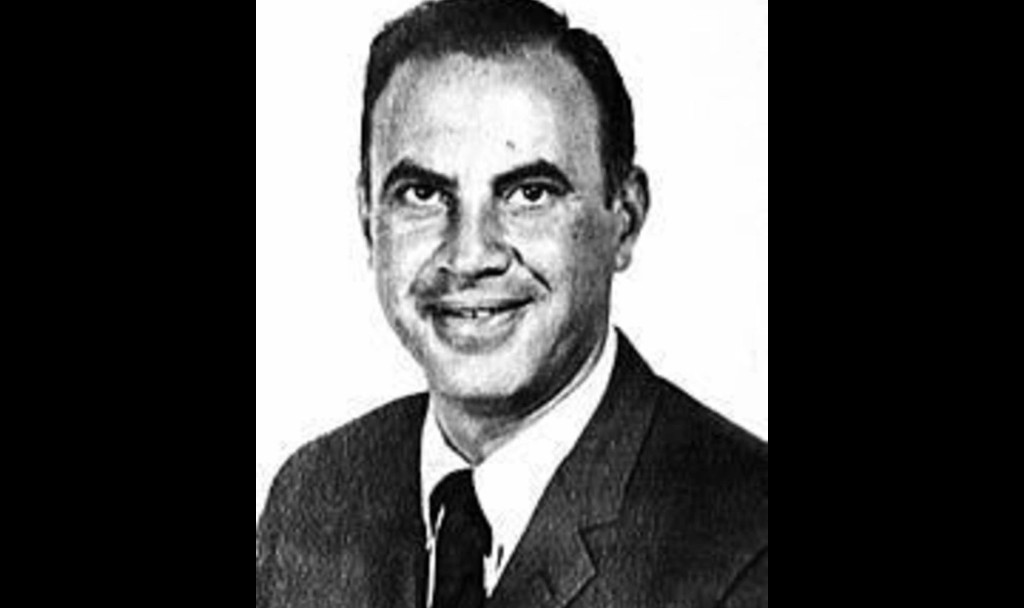
After Jacobs’ departure, Screenart was dissolved and Cunha founded Layton Film Productions with investor Marc Frederic. In 1958 they announced they were going to produce 10 films over the following 24 months, although in reality they only made three: the SF/horror films Frankenstein’s Daughter (1958), Missile to the Moon (1958, review) and Girl in Room 13 (1960), all distributed by Astor, like his first two movies. After completing these movies, Cunha returned to his work as a director of photography on TV and a small number of films, as well as making commercials, which he continued to do until the early 80s. After this, he opened a video rental shop.
H.E. Barrie, of whom there is little information available, wrote or co-wrote all Richard Cunha’s films, except Giant from the Unknown.
None of the actors involved in Frankenstein’s Daughter had what you’d call stellar careers.
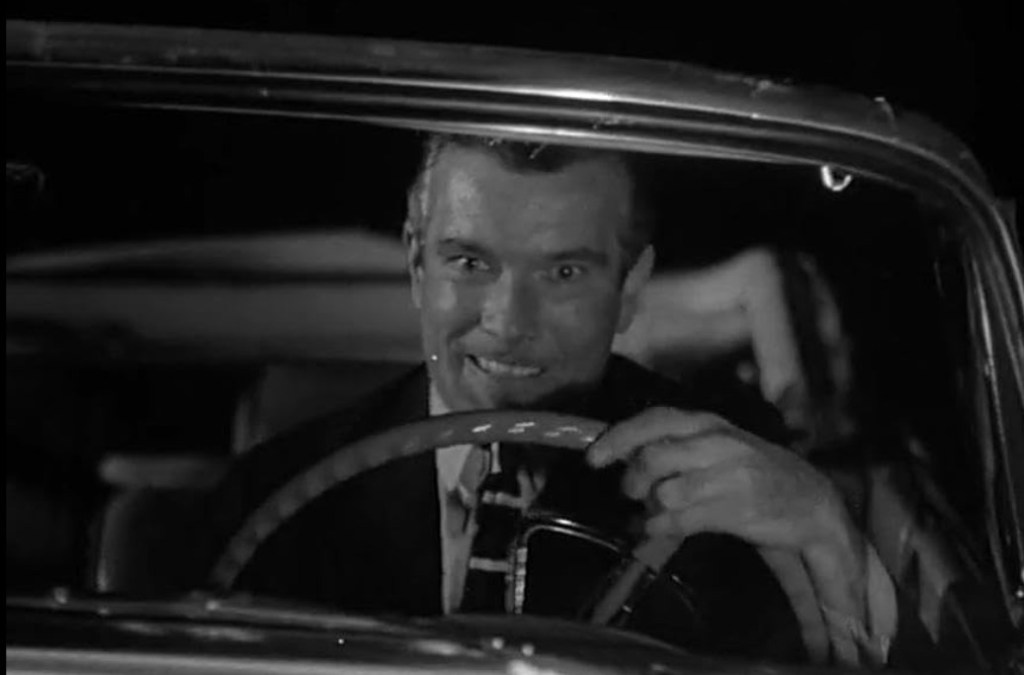
Dr. Frankenstein was probably the meatiest movie role Donald Murphy was ever offered. Primarily active in Hollywood from the early 50s to the mid-60s, Murphy was a handsome, if bland, supporting player in B-movies and TV shows. Genre friends primarily remember him for Frankenstein’s Daugher (1958), and aficionados of old, forgotten westerns may recognise him as Virgil Earp, brother of Wyatt, in Masterson of Kansas (1954). He also played Beverly Garland’s disappeared husband in the Bomba the Jungle Boy film Killer Leopard (1954). Murphy left Hollywood in the 60s to become an interior designer.

Sandra Knight, who plays the female lead, is something of a minor scream queen, best known for her four horror films in the 50s and 60s. Knight was a versatile artist who had performed on stage since childhood, singing and playing steel guitar. Spotted at a talent show, she got the lead in a stage play, which in turn led to the female lead in the crime drama Thunder Road (1958), opposite Robert Mitchum – her first film appearance. While the film was moderately successful, Knight’s career didn’t quite take off. She played the lead in the no-budget horror/SF film Frankenstein’s Daughter (1958), and then spent the rest of the 50s and early 60s doing guest spots on TV. Her film career was rekindled in the early 60s thanks to Roger Corman, who cast her in co-leads or supporting parts in three of his horror films: Tower of London (1962), The Terror (1963) and Blood Bath (1966). However, this was as far as her Hollywood career went.

Outside of her acting, Knight studied philosophy, painting and writing, and for a time tried to pursue a career as an artist. In 1962 she married her co-star in The Terror, Jack Nicholson, but they divorced in 1968. During the 60s she also became a “teacher” of a Christian new age mumbo jumbo thing that was sort of a fad in Hollywood in the era. She has resided in Hawaii for several decades and been active in the Island’s art scene. According to her IMDb bio, she has written several screenplays, but none of the titles mentioned are existent in IMDb’s database, so they have been either unproduced or are really obscure.
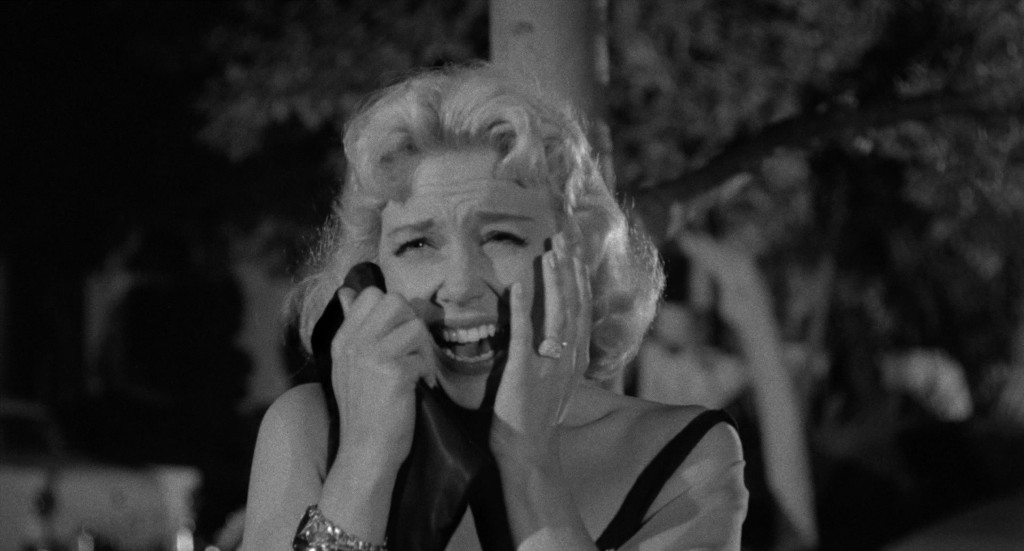
Frankenstein‘s Daughter co-star Sally Todd is likewise best known for her low-budget horror output. Todd entered the acting business, like so many other young girls, through the modelling business, and moved from Tucson to Los Angeles in 1952. Here she modelled for fashion, swimsuits and men’s magazines, and got uncredited bit-parts here and there in film and TV, but also a minor recurring role on The Bob Cummings Show (1955–1957). Her career received a slight boost after she appeared as Miss February in Playboy in 1957. As a result she was cast in a substantial role in Boris Petroff’s no-budget monster clunker The Unearthly (1957, review), starring John Carradine, Allison Hayes and Tor Johnson – and the monster from Frankenstein’s Daughter, Harry Wilson. From Boris Petroff it was onwards to Roger Corman, who cast her as one of the titular beauties in The Saga of the Viking Women and Their Voyage to the Waters of the Great Sea Serpent (1957) – in which appeared another Frankenstein monster, Gary Conway, known from Herman Cohen’s Teenage Frankenstein movies. And on from Petroff and Corman, she landed in the arms of yet another low-budget cult legend, Richard Cunha, and scored a co-lead – really, the title role – in Frankenstein’s Daughter (1958). Sally Todd appeared in a couple of more low-budget films and a few TV shows, but called it quits on her acting career in 1961.

Despite having a rather minor role as Sandra Knight’s moping boyfriend Johnny, John Ashley was first-billed on Frankenstein’s Daughter (1958). Ashley’s was a classic Hollywood story. He visited Los Angeles on holiday, and immediately got picked up for small parts. As a struggling actor, he was picking up his girlfriend at the offices of AIP, and the casting agent took him in for an audition, which is how he wound up with the villainous co-lead in Dragstrip Girl (1957). AIP immediately liked Ashley’s looks – he had a comely resemblence to Elvis Presley, and the fact that he could sing and even act, and signed him to a four-film contract. He auditioned for the lead in Herman Cohen’s I Was a Teenage Werewolf (1957, review), but lost out to Michael Landon. He subsequently appeared in four more films for AIP, all of them in leading roles, playing teenage delinquents in most of them. He had a cameo in How to Make a Monster (1958, review) as a singer, in his own words “his first sympathetic role”.

AIP exec James Nicholson liked Ashley – as did his daughters – and offered to renew his contract. However, when Nicholson’s colleague Sam Arkoff refused to move the shooting schedule of Hot Rod Gang (1958) with one day, so that Ashley could star in a TV play, Ashley soured and refused to renew. His first role off AIP was as a support in Frankenstein’s Daughter (1958), another rare sympathetic role (or semi-sympathetic, at least). In the years to come he did a couple of movies and TV work, and had a supporting role in the Paul Newman classic Hud (1963), before he mended fences with AIP and accepted a co-lead in the influential Beach Party (1963) movie. He then appeared in three more Beach Party movies in the following two years, often playing star Frankie Avalon’s best friend Johnny – a character who was always present but seldom had much to do. In 1967 he starred in Larry Buchanan’s infamous TV movie The Eye Creatures.
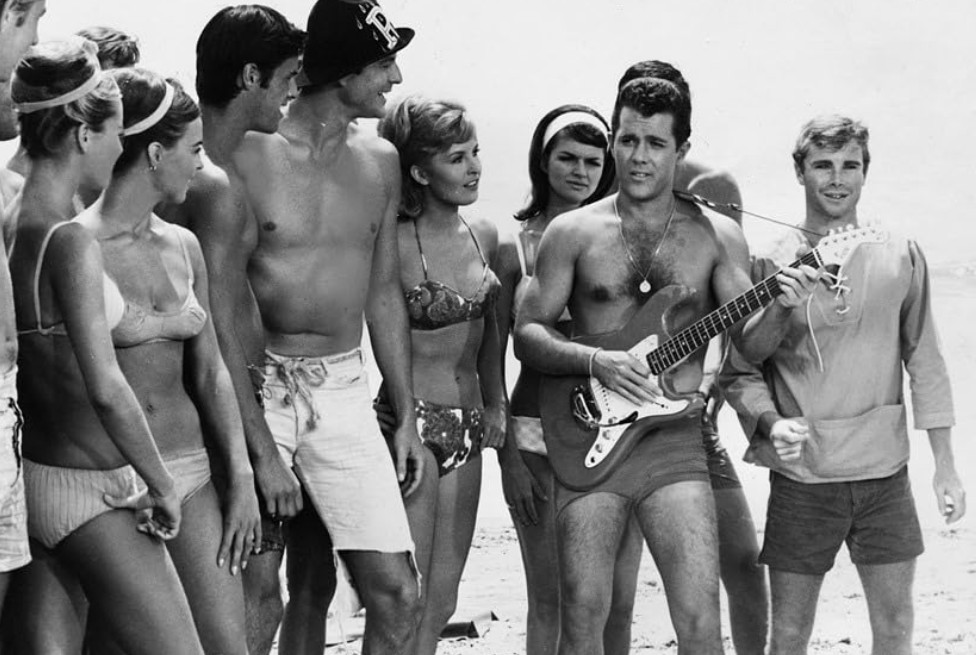
A new era in John Ashley’s career opened up in 1968 when he was invited to the Philippines to star in Eddie Romero’s SF/horror movie Brides of Blood. Taking a liking to both the Philippines and Romero, Ashley began a fruitful collaboration, starring in 11 films for Romero, most of the horror movies. In 1971 he and Romero founded their own production company, and Ashley went on to produce 9 Filipino films. Roger Corman co-financed some of these movies through his distribution company New World Films, for US release, and several of them did well at the box office. By the early 70s, Corman was looking at Jesús Franco’s small, European exploitation film 99 Women (1969), with pretty girls abused by the staff of a remote prison, staging an escape attempt. Corman sought to make a spin-off, with more nudity and violence, and wanted to film it it in Puerto Rico, where he had had success with shooting a handful of other movies. However, John Ashley convinced him to shoot in the Philippines as well, and became an executive producer for what was to become The Big Doll House (1971). The movie, starring Judith Brown, Roberta Collins and Pam Grier, had a budget of around $125,000, and made a profit of $4 million worldwide. Corman did not look a gift horse in the mouth, swallowed any scruples he might have had about “going overboard with the sex and the violence” and made more women in prison films in the Philippines. Ashley wasn’t involved with all of them, but he did produce the perhaps most famous of them, Black Mama, White Mama (1973), co-written by Jonathan Demme and starring Pam Grier and Margaret Markow. Ashley’s last production in the Philippines was none other than Apocalypse Now (1979), which Francis Ford Coppola chose to film in that country. With their knowledge of the country, it’s film business, and their experience working with Hollywood casts and crews, Romero and Ashley were natural choices as associate producers for the movie.

By the 80s, Ashley no longer felt the Philippines was a suitable place for making films – the power abuses by dictator Ferdinand Marcos was stirring up unrest in the country and a crippling recession also hit the film industry. Upon returning to the US, Ashley continued his career as a producer, particularly in TV. His greatest claim to fame is probably his work as a producer on the globally successful TV show The A-Team, which ran for 97 episodes between 1983 and 1987. His successful career as a TV producer lasted until 1998, when he died of a heart attack while producing the action film Scarred City. He also produced several seasons of Walker, Texas Ranger.

Felix Locher had no designs to become an actor at his mature age of 73, when he visited his son, actor Jon Hall on the set of Hell Ship Mutiny in 1957. However, the director convinced him to play the part of the elderly Tahitan cheif. He caught the bug, and for the next 12 years appeared in close to 40 films or TV shows. Born in Switzerland, the septagenarian’s accent typecast him in “ethnic” roles. Locher played his fair share of Latinos, Germans, Frenchmen, Greek, South Sea natives and he played a Native American in at least three films, including Sitting Bull!. In Curse of the Faceless Man (1958, review), he played the mild-mannered archaeologist Dr. Emanuel, and in Frankenstein’s Daughter the well-meaning researcher who doesn’t realise that he has the literal Dr. Frankenstein employed as his assistant. He also appeared in the Star Trek episode “The Deadly Years”, in which he played a member of a science team caused to age rapidly.

Polish-born Wolfe Barzell, who plays the local Fritz in Frankenstein’s Daughter (1958), was primarily a stage actor who had a respectable career in Viennese and Polish theatre before moving to the US in the early 30s, escaping the rising fascism and antisemitism in Europe. He continued his stage work in the US, had a stint on Broadway, and was active in New York’s Yiddish theatre scene. In the early 50s he relocated to Hollywood, where he became a steady character actor in both film and TV, often cast in small roles as stingy or quarrelsome characters, not seldom with a comedic twist. He played a clown in Edward Dmytryk’s remake of The Blue Angel (1959, with Swedish May Britt replacing Greta Garbo), a priest in the Natalie Wood/Steve McQueen romcom Love with the Proper Stranger (1963) and an Israeli delegate who gets disintegrated by the Joker in Batman: The Movie (1966).

Harold Lloyd Jr, son of the legendary silent era comedian, had a difficult time for much of his adult life. Struggling with his homosexuality, he was an alcoholic by the age of 20, and had a propensity for choosing violent partners, which often left him battered and bruised when returning home to his understanding and caring father. Harold Sr supported his son in his attempts at breaking into showbiz, attempts that were only marginally successful. He had a reasonable career for a while as a cabaret singer, but both his attempts as a career as a recording artist and as an actor fell flat. He appeared in no more than nine films between 1950 and 1964, mostly in supporting roles in B-movies, although he had a couple of leads. In 1965 he suffered a massive stroke, from which he never fully recovered. He died in 1971, only 40 years of age. Lloyd appeared in two science fiction movies: Frankenstein’s Daughter (1958) and Mutiny on Outer Space (1964).
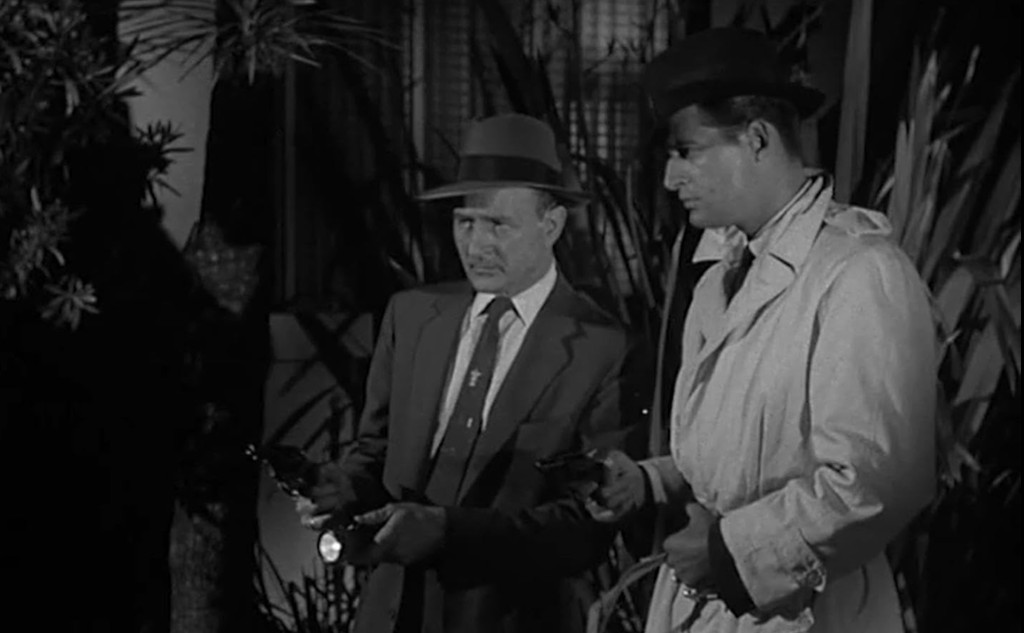
Frankenstein’s Daughter also features appearances by a few very familiar faces from 50s science fiction movies in bit parts, like John Zaremba and Robert Dix. George Barrows, the famous ape suit actor (and my favourite 50s monster, Ro-Man), also appears in a tiny part, one of his surprisingly many non-ape roles.

The band playing in Dr. Morton’s backyard isn’t going to be familiar to anyone watching the film today, unless you really know your So-Cal retro lounge scene – or are a Sinatra nerd. However, in the late 40s and early 50s the Page Cavanaugh Trio was one of the hottest tickets among the jazz crowd. In 1947, the band placed 5th in Billboard’s annual Disk Jockey Poll in the category “Small Bands”, just behind such luminaries as Nat King Cole and Benny Goodman. Founded by pianist and singer Page Cavanaugh and two friends in the US entertainment corps during WWII, the Page Cavanagh Trio used the line-up popularised by Nat King Cole: piano-bass-guitar, but with the difference that all the members sang. The trio also stood out because of the way they sang – in a sort of whispered unison, a style which was quite novel at the time. A highly skilled pianist with a soft voice, as well as a creative arranger and composer, Cavanaugh had a number of moderate hits during his heyday. The biggest one was called “The Three Bears”, a somewhat bizarre jive retelling of the story of Goldilocks and the three bears.
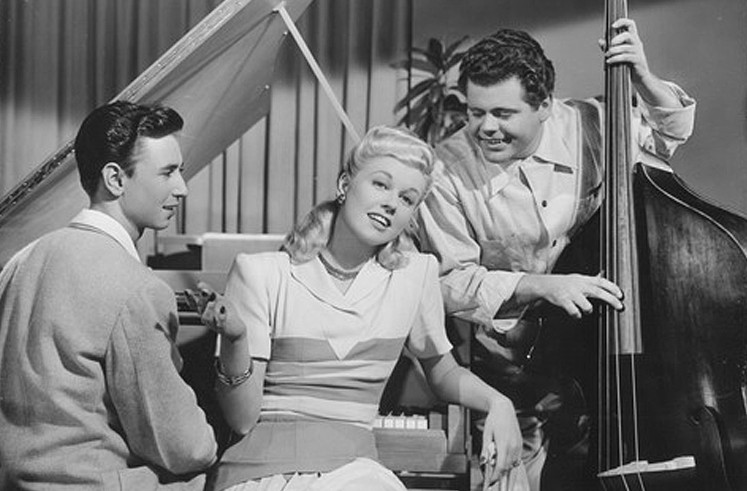
During 1946–1947, the Page Cavanaugh Trio found themselves playing as backing artists for Frank Sinatra both on record, in concert and in Sinatra’s TV show. In 1948, they appeared in three movies, including the musical comedy A Song is Born, Doris Day’s debut, where the thry appeared on equal footing with Benny Goodman and Louis Armstrong.
However, with the emergence of rock and roll in the early 50s, Cavanaugh wasn’t able to compete, and by the end of the decade he was struggling, “playing in bowling allies”, in his own words. A chance to appear in a movie, not matter how small, in order to pay the bills and perhaps get a bit of traction with the young rock and roll crowd, must have seemed like an opportunity. This was the age when songs from movies regularly became best-selling hits on the music market, as had happened just a couple of months before this came out, with the title song from The Blob (1958, review). Alas, neither “Daddy-Bird” nor “Special Date” made any great ripples, and its greatest achievement must be its inclusion on the 1985 album “The Golden Turkey Album: The Best Songs From The Worst Movies”, which, incidentally, also included “Beware of the Blob”. However, despite some struggles in the 50s, Cavanaugh got back on his feet as a popular nightclub and lounge artist in Southern California, and had a long-time show in Las Vegas. He released seven solo albums between 1956 and 2006.

Composer Nicholas Carras has the distinction of having composed the soundtrack of an impressive number of really bad films – including all three of Richard Cunha’s science fiction movies, as well as clunkers like Jungle Hell (1956, review), Dr. Sex (1964), Girl in Gold Boots (1968), Astro-Zombies (1968), Ten Violent Women (1982) and Mission: Killfast (1991). Carras was a “working composer”, composing and arranging music for theatre, revues, film, TV and for music libraries, etc.
Cinematographer Meredith Nicholson became a top cinematographer in television, acting as director of photography on shows like The Fugitive, Batman, Get Smart and Mork & Mindy. He was nominated for an Emmy for his work on The Fugitive. Art director Don Ament was one of the many people who got their start in Hollywood at American International Pictures – his first film as art director was Alex Gordon’s Girls in Prison (1956). He also worked on The She-Creature (1956), Voodoo Woman (1957, review), Invasion of the Saucer Men (1957, review), Frankenstein’s Daughter (1958), The Atomic Submarine (1959), Valley of the Dragons (1961), The Underwater City (1962) and The Three Stooges in Orbit (1962). Special effects creator Ira Anderson Jr got his start in no-budget films like Curse of the Faceless Man (1958, review), Missile to the Moon (1958) and Frankenstein’s Daughter (1958), but later worked on such big movies as Mel Brooks‘ Silent Movie (1976), the underwater thriller The Deep (1977) and Damien: Omen II (1978).
Janne Wass
Frankenstein’s Daughter. 1958, USA. Directed by Richard Cunha. Written by H.E. Barrie. Starring: Sandra Knight, Donald Murphy, Sally Todd, John Ashley, Felix Locher, Harold Lloyd Jr, Wolfe Barzell, Harry Wilson. Music: Nicholas Carras. Cinematography: Meredith Nicholson. Editing: Everett Dodd. Art direction: Don Ament. Makeup: Harry Thomas. Sound mixer: Robert Post. Special effects: Ira Anderson Jr. Produced by George Foley & Marc Frederic.

 Scifist.
Leave a reply to M – Cancel reply