
The Amazing Colossal Man is back! However, in this 1958 sequel his greatest adversaries are the tight shooting budget, the lacklustre script, the indifferent acting, and the fact that not even director Bert I. Gordon seemed to care. 3/10

War of the Colossal Beast. 1958, USA. Directed by Bert I. Gordon. Written by George Worthing Yates & Bert I Gordon. Starring: Sally Fraser, Roger Pace, Duncan Parkin, Russ Bender, Rico Alariz. Produced by Bert I. Gordon. IMDb: 3.9/10. Letterboxd: 2.4/5. Rotten Tomatoes: N/A. Metacritic: N/A.
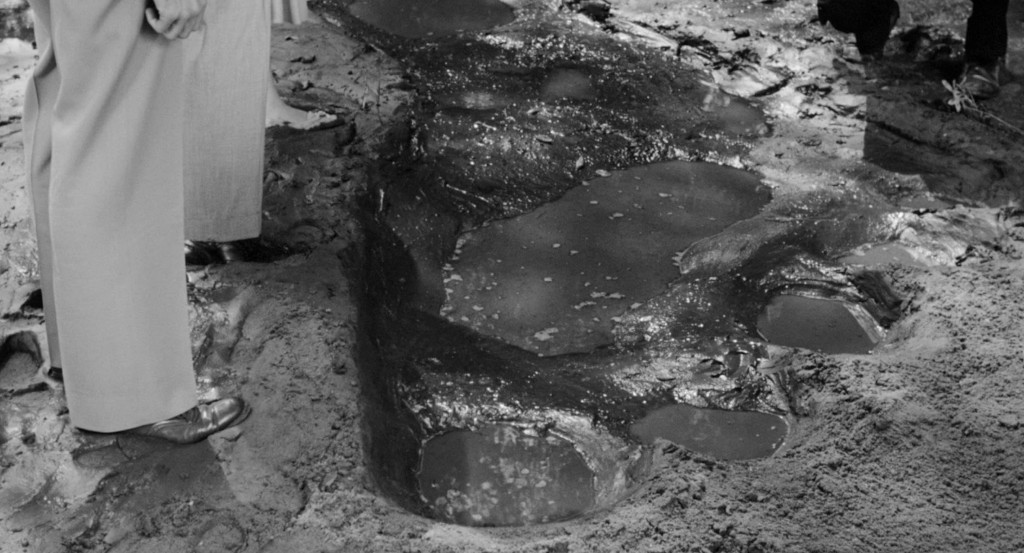
Outside a small Mexican town, young Miguel (Robert Hernandez) flees some unseen menace in a grocery truck, skids off the road in a muddy pool, and exits the vehicle screaming. The truck’s owner, John Swanson (George Becwar) reports the truck stolen to local police officer Luis Murillo (Rico Alanis). Murillo brings Swanson to the hospital next door, where Miguel lies in a catatonic state. Inspecting the place where Miguel was found, Murillo and Swanson find that the truck tracks end abruptly, as if the truck had been lifted up by a giant. When news of this reaches the US, Joyce Manning’s (Sally Fraser) interest is piqued. This sounds awfully like the work of her brother, Lt. Col. Glenn Manning, or the “Amazing Colossal Man”, presumed dead after being bazooka’d by the military and fallen down the Hoover Dam. However, as his body was never found, Joyce has always suspected he is still alive.

So begins War of the Colossal Beast (1958), the sequel to American International Pictures’ smash hit The Amazing Colossal Man (1957, review). Like the original movie, it was produced and directed by “Mr. BIG”, Bert I. Gordon, with special effects by Gordon and his wife Flora. None of the principal cast from the first film return in the sequel. The titular menace, Glenn Manning, was played with bravado by Glenn Langan in the original movie, but is replaced here by Duncan “Dean” Parkin (from Gordon’s The Cyclops [1957, review]). One assumes that Gordon also approached Cathy Downs, who played Manning’s wife in the original, as the role of Manning’s sister (here played by Sally Fraser) is essentially the same character.

Picking up from The Amazing Colossal Man’s ending, where Lt. Col. Glenn Manning was shot and presumably killed in Nevada, War of the Colossal Beast now sees the Amazing Colossal Man popping up in Mexico. Manning’s sister Joyce travels across the boarder to the small town, along with US army major Mark Baird (Roger Pace) to investigate the possibility of Manning still being alive and at large. Again inspecting the site of the truck’s disappearance, Joyce, Mark and Murillo find a giant footprint that was, amazingly, left unnoticed the last time around. They follow the trail toward the mountains, where they find another lost truck, but as night falls, they head back to town. Later in the evening, Joyce decides to once again inspect the site, and Mark tags along. Now they find a collection of trucks, all used to transport groceries, and one even marked with Glenn’s giant thumb print. They deduce that Manning has grabbed the trucks in order to provide food for himself.
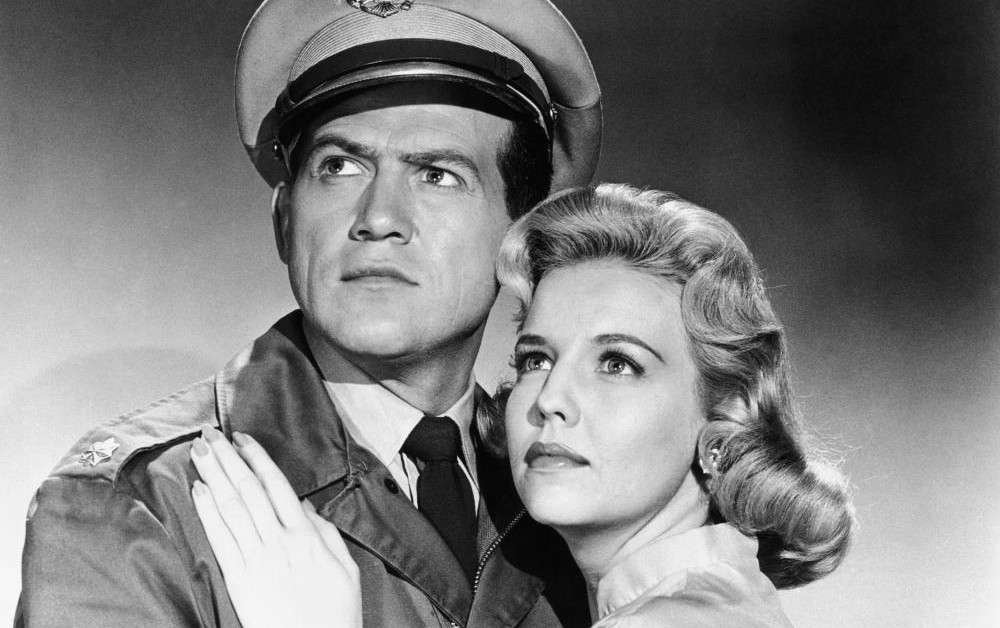
Back at the village, Dr. Carmichael (Russ Bender), Joyce, Mark and Murillo decide to trap Manning by filling a truck with bread dosed with a sleeping drug. It works, and Manning shows up, horribly deformed, with one side of his face almost a gaping skull. It is conjectured this is from injuries he sustained in his fall from the Hoover Dam. Manning now seems a mindless brute who has lost the capacity of speech, now communicating only in grunts and moans.
Manning goes for the bait and is incapacitated, and flown (off-screen) to Los Angeles. However, once there, he is stuck in limbo at the airport, as no government agency is willing to take responsibility for him. Finally, it is decided to keep him at an airplane hangar, where he is tied down to a giant straw mattress while Dr. Charmichael and his team try to jolt his memory and bring him back to sanity. However, he breaks his ropes and goes for a growling stroll at the airport, before again being incapacitated, this time with gas grenades.

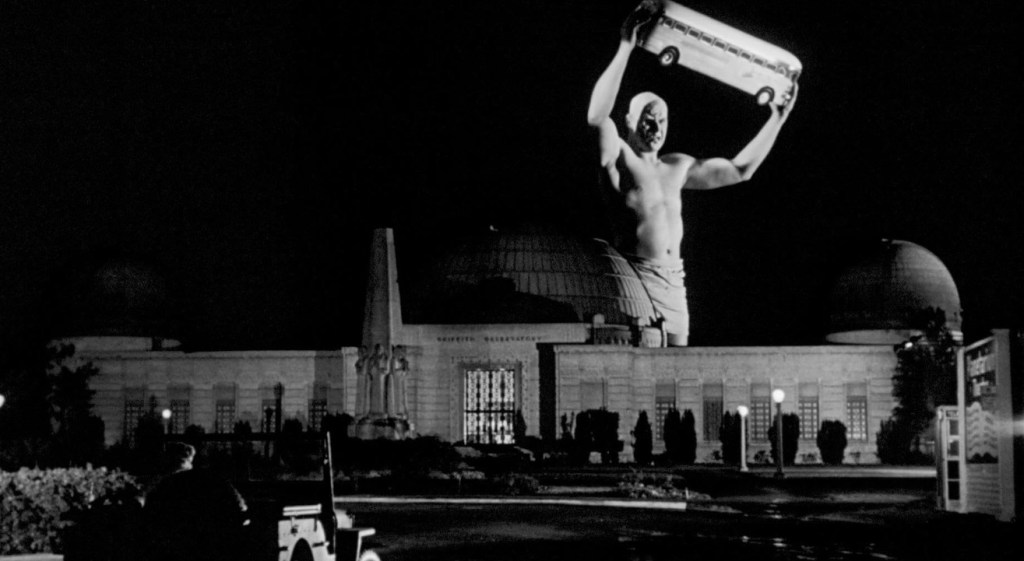
The haggle over responsibility continues, while Charmichael and Joyce try to cure Manning’s amnesia — unfortunately to no avail. It is decided that Manning will be relocated to a desert island for the safety of himself and the rest of the world. Joyce reluctantly agrees that this may be the best option. However, no chains can hold the Colossal Beast, and during the night before his transfer, Manning once again breaks loose and kills Dr. Charmichael, apparently without any of the guards noticing, and is now on the loose somewhere in Los Angeles. News bulletins go out, warning people that the Colossal Beast is on the loose, but nobody has seen him. Until finally, he is spotted at the Griffith Park Observatory, where he picks up a bus full of kids on a school trip.

This is when the army and Joyce turn up, ready to blast him to death. However, they can’t shoot as long as he hoists the school bus over his head. Joyce confronts him, and tells him to put the bus down, and finally, he seems to remember, as he gently puts down the kids and says “Joyce…”, before grabbing a high-voltage power line and electrocuting himself — in colour.
Background & Analysis

Oddly enough, very few Hollywood science fiction films in the 50s were sequels. War of the Colossal Beast is one of a handful of sequels, and it wasn’t even marketed as one. It would seem that even Bert I. Gordon, although he drained the well of gigantism in numerous films, wasn’t very keen on making a sequel. Even more odd is that the movie was originally intended to be marketed as a sequel. It’s working title was either “Return of the Amazing Colossal Man” or “Revenge of the Amazing Colossal Man”, depending on the source. However, American International Pictures changed the title and removed all references to The Amazing Colossal Man in their ad campaign.
I have been able to glean very little information on the origins of this movie, which indicates that it was a straightforward cash-grab instigated by AIP exec Sam Arkoff. Possibly Arkoff gave Bert I. Gordon free rains with the reasonably good (by Gordon standards) Attack of the Puppet People (1958, review), as long as he also delivered a sequel to The Amazing Colossal Man as part of a double bill.
For those not in the loop, a short recap: Bert I. Gordon emerged in the mid-50s as an independent writer, director, producer and special effects creator, almost exclusively making films involving giant lizards, insects or people. Gordon’s trademark was his hugely ambitious, but woefully shoddy low-budget special effects, which he often created in his garage with his wife Flora, who was also instrumental to his productions in many other ways. He made his debut in 1955 with the cringe-inducing King Dinosaur (1955, review), and in 1957 kicked off his loosely-knit “trilogy” involving a bald, diaper-wearing giant man with The Cyclops (review).
The Cyclops is really a stand-alone film set in the Mexican jungle, where a wife searches for her missing husband, only to find that the area’s natural radiation has turned him into a bald, mindless giant with a horrificly disfigured face. The giant in that movie was played by stagehand Duncan “Dean” Parkin, and the striking and memorable makeup was created by Jack Young. The film was supposed to be an RKO production, but ended up being independently produced. It was produced pretty soon after King Dinosaur, but because the deal with RKO fell through, it took until 1957 before it was released. By that time, Gordon was already well into the production of his first film for AIP, The Amazing Colossal Man. While the production values were only marginally better than in The Cyclops, a flawed but oddly compelling script by Mark Hanna and a strong performance by Glenn Langan in the central role made the film a surprise hit for AIP, and the movie casts a long shadow in the history of B-cinema. Many consider it Gordon’s finest movie.

The Amazing Colossal Man follows Lt. Col. Glenn Manning, whose selfless bravery causes him to get caught in a nuclear bomb test, with the result that he starts growing indefinitely. His wife and military scientists struggle, both with Manning’s mental swings during his hopeless growth, and with finding a cure. Ultimately, it is revealed that Manning’s heart doesn’t grow at the same rate as the rest of his body. In a sketchy bit of scientific explanation, we are told that this discrepancy will lead to Manning first losing his mind completely, and ultimately to his death. Quite so: Manning eventually goes all Neanderthal and rampages through cardboard cutouts of Las Vegas. Meanwhile the scientists have found a cure, but it is two-staged. First, they must inject him with a serum that will arrest his growth. This is done in a dramatic scene with a giant syringe. Then Manning would have to undergo another treatment in order to shrink back to normal size. However, before the scientists get the opportunity to shrink him, Manning goes ape on top of the Hoover dam, forcing the army to fire rockets at him, after which he topples into the river below, presumably to his death. Because Manning in this film looks almost identical to the giant in The Cyclops (sans the disfigured face), and the plots share many similarities, The Cyclops is often considered a sort of “prequel” to The Amazing Colossal Man, even though the stories are not linked in any way.
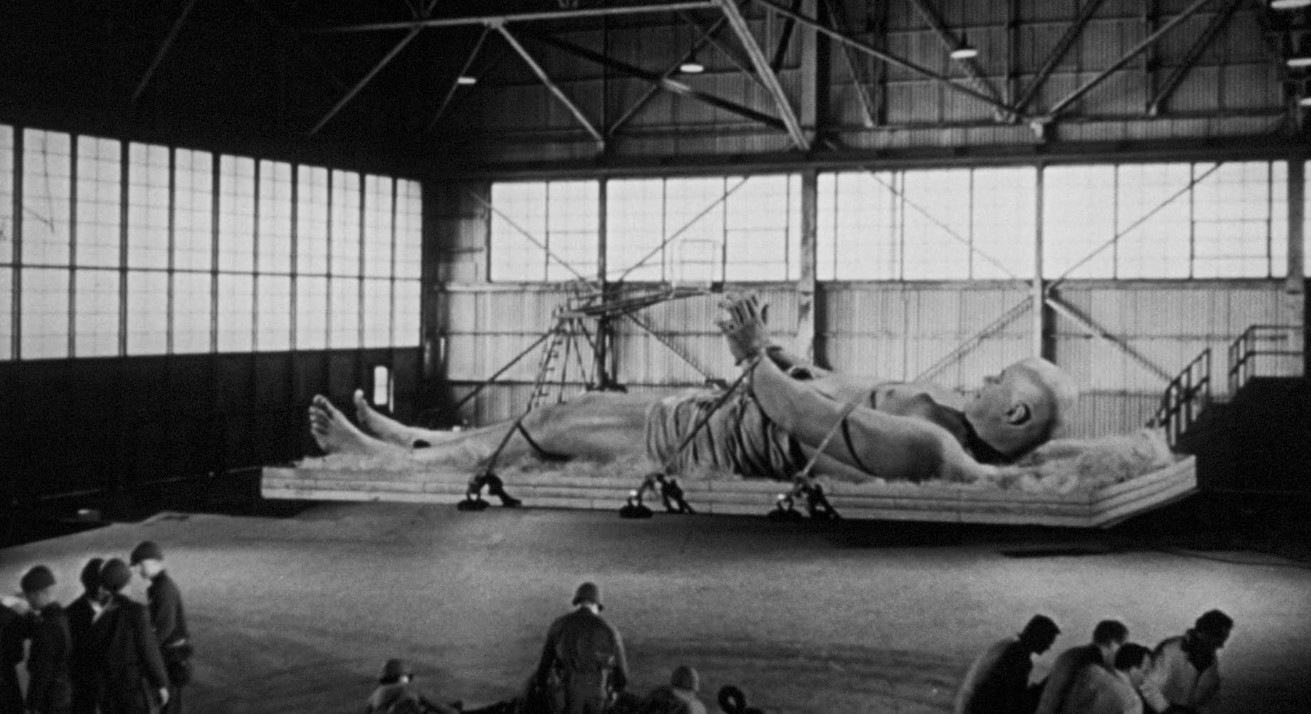
Enter War of the Colossal Beast. Because of his involvement in a number of quality films, such as Them! (1954, review) and Earth vs. the Flying Saucers (1956, review) I may have previously overestimated screenwriter George Worthing Yates‘ capabilities as a writer. Having recently watched two of his films where he has been the primary screenwriter (The Flame Barrier [1958, review] and this one) I must sadly revise my previously high opinion of Yates’ writing (granted, here he works from a story treatment by Bert Gordon, which is seldom a good starting point). Apparently, Bert I. Gordon had little enthusiasm for the movie, and must have delivered the thinnest of plot outline for Yates to work on, and kept time-consuming special effects shots to a minimum. Yates, for his part, has been unable to breathe any life into the proceedings. Much of the film consists of talking heads, often having rather pointless discussions that don’t move the story forward. Much time is spent on news bulletins and broadcasters explaining things that the audience already knows. Yates buys time by having the protagonists examine the spot where the truck disappeared not once, but twice, thus adding an extra five minutes to the film’s running time. Likewise, Mark and Joyce search the Mexican mountains twice before ultimately finding Manning, again adding five minutes to the proceedings. The colossal man doesn’t really do anything until the last ten minutes of the 69-minute film. It takes him 20 minutes to even appear, and not counting a short stroll around the air field, he spends most of the movie tied to a gigantic straw bed in the hangar. The segment which contains most action is a 6-minute flashback, editing together the best shots from The Amazing Colossal Man. Even when Manning escapes at the end, the action is limited to him standing behind the observatory and picking up a bus — in a night shot, which makes the job of creating the special effects a lot easier.

Gordon and Yates seem to have forgotten what happened in the last film. Dr. Carmichael explains that there is no cure for Manning, even though we were clearly told in The Amazing Colossal Man that the scientists had found a way to shrink him back to normal size. The fatal heart condition that was supposed to kill him in a matter of days has evaporated. It is also clearly stated in the original movie that Manning has no living relatives. Now he suddenly has a sister.
These nitpickings aside, a bigger problem for the movie is credibility — so much of the movie hinges on the fact that nobody notices a 60-foot giant that goes around grunting and moaning incessantly, and has a habit of picking up food trucks from the roads. We are told that Manning has drifted with the river from Nevada to Mexico after the end of the original movie. Even if this was geographically possible, it takes a lot of suspension of disbelief to buy the notion that nobody would have noticed a 60-foot man floating by. In Mexico, the protagonists find a whole junkyard full of trucks that Manning has picked up — without a single witness. Most incredible of all is that at the end of the movie Manning disappears from the LAX airport and turns up again at the Griffith Park observatory. This means he has walked across the entire city of Los Angeles and Hollywood without a single soul noticing it. Even in a film like this, some manner of credibility is usually maintained. Granted, The Amazing Colossal Man suffered from this same credibility problem, albeit on a somewhat smaller scale.
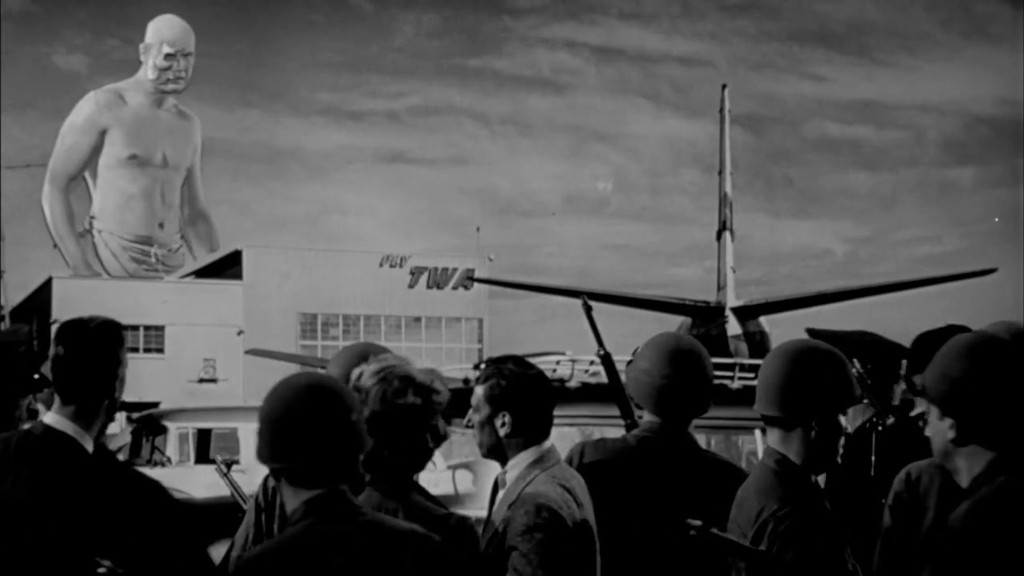
But most of all, the movie falls on its own dullness, and the fact that nobody involved seemed to give a damn. For a movie about a colossal man, it’s remarkably small-scale. As one reviewer pointed out, the colossal man himself probably has more coverage in the 6-minute flashback than in the rest of the movie, and when he is on screen, he is mostly lying on the floor of the hangar, and shot, by the looks of it, against a blown-up photograph of the hangar in the background. The characters are all completely devoid of personality. Sally Fraser tries her best as Joyce, but stumbles on her inane dialogue. This is the second film I’ve seen with Fraser: the first was Roger Corman’s It Conquered the World (1956, review), in which she struggled to keep an even pace with her three co-stars Lee Van Cleef, Peter Graves and Beverly Garland, who all put in fantastic performances in the movie. In my review of the movie I wrote: “Unfortunately, the strong acting from [the other three actors] only highlights Sally Fraser’s inadequacies”. In War of the Colossal Beast, Fraser also seems to be floundering, as if she had a hard time tapping into the right emotional channel for the dramatic scenes, giving her character an oddly disattached air. Roger Pace, a no-name actor with very little experience — an odd choice for leading man — fails to display any sort of emotion whatsoever. Duncan Parkin, a stage hand with no acting credentials, apart from his turn as the monster in The Cyclops, is a sad replacement for Glenn Langan. And by turning Glenn Manning into a hulking monster, the script derives the character of the emotional punch that he had in the previous film. Rico Alariz as the Mexican police officer is the only actor here that gets our approval.
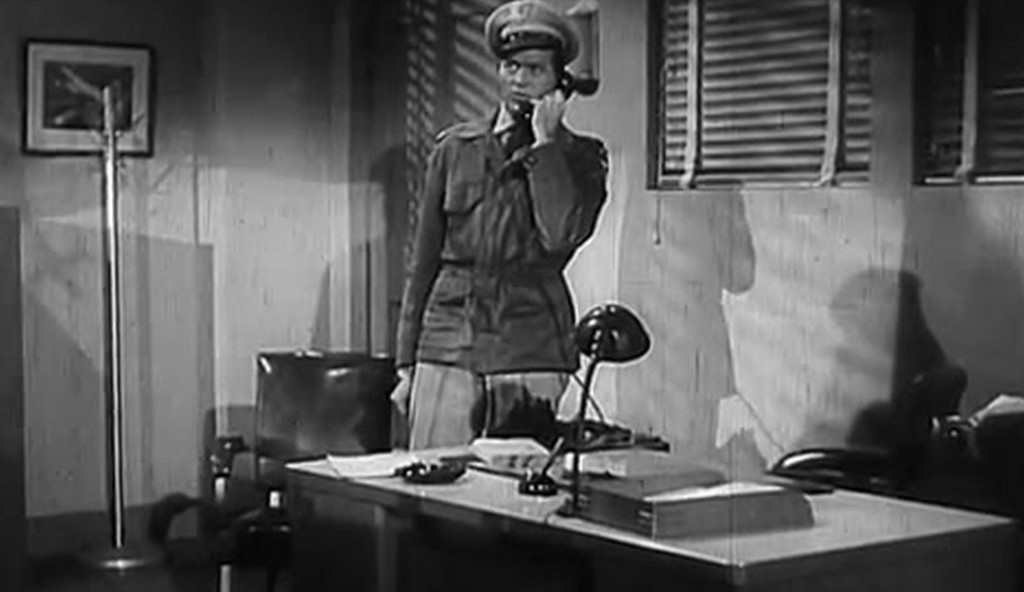
If the visual effects in War of the Colossal Beast seem slightly better than in The Amazing Colossal Man, then it’s only because they are fewer and less ambitious. This time around, the colossal man almost never interacts with other actors, and there are far fewer shots in which he is superimposed over the background footage (in those that are in the movie, he is still overexposed or even translucent, or has thick matte lines). The finale is shot as a night scene, which aids Gordon, as he can make the background behind Parkin black, and stick him in front of a matte of the observatory, from where he doesn’t move during the entire scene.

The one good effect of the film is Jack Young’s gruesome makeup for Duncan Parkin. The reason Parkin was chosen for the role when, presumably, Glenn Langan declined, was probably that Young already had the mold for his makeup from The Cyclops. By using the same makeup, Gordon could save both time and effort, and disguise the fact that Glenn Manning was played by another actor. The downside of the makeup is that it is rather rigid, and thus restricts Parkin’s ability to act with it, but considering Parkin was a stagehand and not an actor, this is not necessarily a bad thing. The makeup is rather gruesome for its time, and quite a tricky one to execute, since it is a retractive and not addative makeup, meaning it it is supposed to look like Manning’s skin and flesh have been peeled off his face. As one critic noted, even Lon Chaney seldom attempted this kind of makeup. Especially impressive is Manning’s hollow eye socket — a good change from the The Cyclops makeup, which instead featured a large, bulging eye, which came off with an unintended comic effect.
The music by AIP’s resident composer Albert Glasser is competent, as usual, but does sound like a greatest hits track of his previous movies.
Release & reception
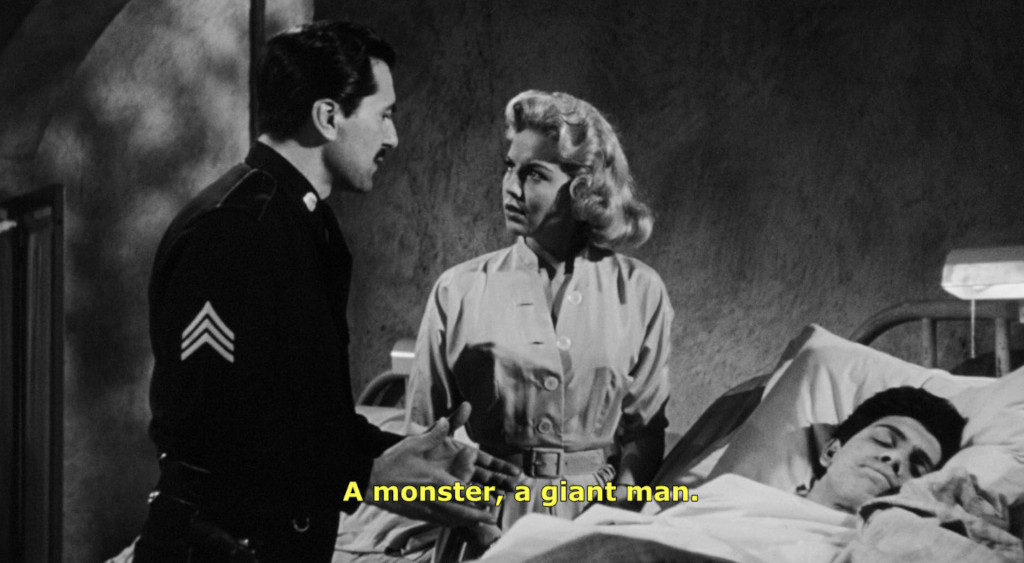
War of the Colossal Beast was released in the beginning of April, 1958, as a double bill with Gordon’s own Attack of the Puppet People, and brought AIP a good profit. The film received largely indifferent or bad reviews in the trade press. Jack Moffitt at The Hollywood Reporter called it “a pretty fair low budget boogie tale”, and opined that “In spite of the hoke, Dean Parkin creates a few moments of pathos as the monster”. Harrison’s Reports noted that the film had enough shock elements to satisfy the intended audience and that the two presented movies “shape up as a fairly effective exploitation double-bill”.
On the negative side, “Powr” at Variety said that “invention seems to have been largely exhausted in [The Amazing Colossal Man]”, and that “Word of mouth will not be enthusiastic”. The Monthly Film Bulletin wrote: “The trick photography of these Further Adventures of the Amazing Colossal Man is ludicrously unconvincing, and in any case, the idea has lost its pristine impact. The dialogue strikes an oddly hieratic note, the charm school heroine reacts to every plot development with a winsome smile, while the rest of the players apparently prefer not to react at all.”

In his book Keep Watching the Skies, Bill Warren called War of the Colossal Beast “terrible in almost every […] way”, “dull”, “drearily talky”, and said that “few films have been as desultory as War of the Colossal Beast”. TV Guide called the movie “a silly sequel”, which “is not as good as the original (which wasn’t all that good anyway), and its special effects are just as unspectacular”.
DVD Savant Glenn Erickson says: “The publicity for this sequel promises a grand-scale confrontation between the ill-fated Colonel Glenn Manning and an entire army. What Gordon gives us is a laughably small-scale gigantism drama that takes forever to get going and then ends before anything is allowed to happen. In a way, that’s not bad filmmaking for a 50s monster show with no pretensions — it’s all fluff and filler.” Richard Scheib at Moria in his 2/5 star review echoes Erickson’s sentiment: “. The Amazing Colossal Man stood out above the rest of Bert I. Gordon’s cheap films and showed a modest degree of imagination. The same could not be said for War of the Colossal Beast, which is only sequel making by the numbers. Certainly, Colossal Beast is competently made as B science-fiction movies of this era go, has okay actors, is passably scripted, while Gordon’s direction is pedestrian but adequate. It is also a boring film.”

However, the film has its defenders, even if they are fairly few in numbers. Mitch Lovell at The Video Vacuum gives War of the Colossal Beast 3.5/5 stars, writing: “Most sequels pale next to the original, but War of the Colossal Beast is just about on par with The Amazing Colossal Man“. And Derek Winnert in his 2/4 star review says: “Not much worse than The Amazing Colossal Man, it is another low-budget, sometimes daft but very amusing and appealing Fifties horror outing. Its cheap, wobbly special effects and equally wobbly performances simply add to its low-rent attraction.”
Cast & Crew
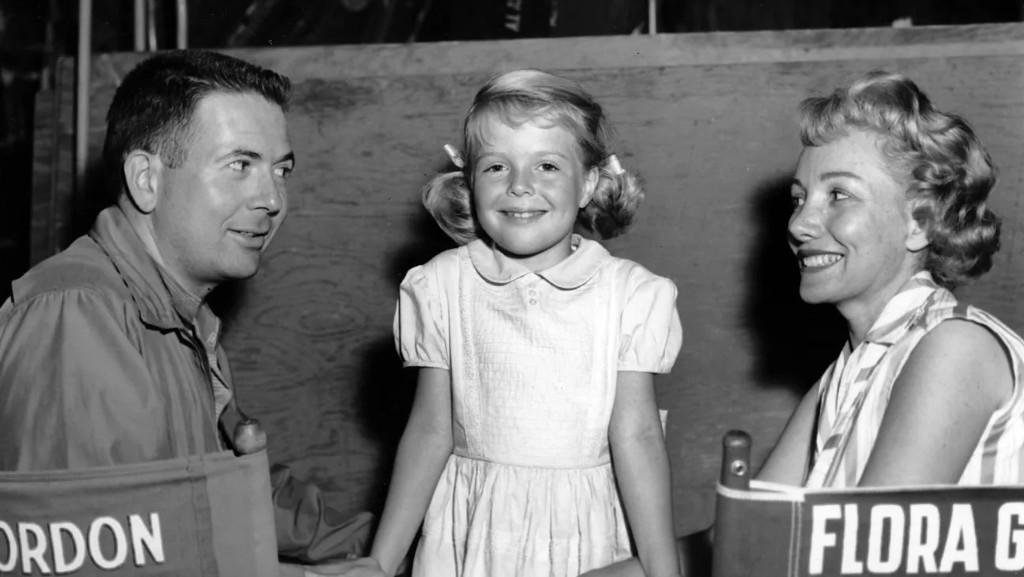
I have written at length about Bert and Flora Gordon elsewhere, so if you’re interested in learning more, you can, for example, head over to my review of Beginning of the End. In short, Bert I. Gordon and his wife Flora Gordon were a two-person all-round production crew, with Bert often co-writing, producing and directing his low-budget films, with a great deal of help from Flora. Flora has been described as an all-round production manager, doing everything from catering to production administration and generally keeping people happy on set. Bert is best known for his garden-variety special effects, often done in his own garage. Here, Flora was also a crucial collaborator, even if she often went uncredited. Bert Gordon specialised in all things giant, making good on his initials B.I.G. He was active as a producer and director all the way up to the late 80s, even making a comeback in 2015, but is probably best known for his string of black-and-white low-budget science fiction movies produced from the mid- to late 50s, starting with King Dinosaur (review) in 1955 and culminating in The Amazing Colossal Man (review) and its sequel War of the Colossal Beast, both made in 1958.
Flora Gordon worked on all of her husband’s movies between 1955 and their divorce in 1979. After that she struck out on her own (as Flora Lang) as a production manager on a handful of feature and TV movies, and worked as the unit production manager on the successful soap opera Dynasty between 1981 and 1985. She was one of the founding members of the Women’s Committee at the Directors Guild of America.
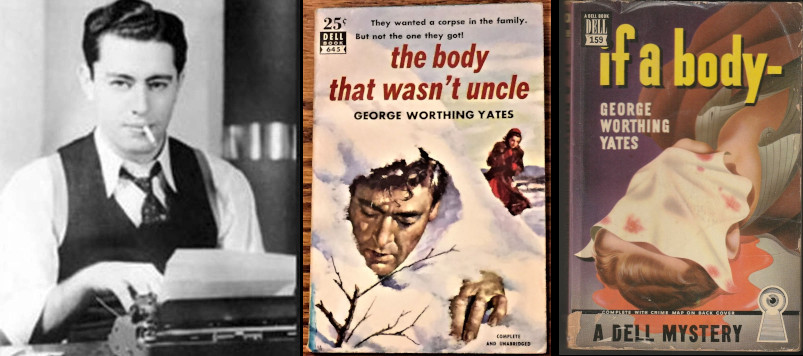
Born in 1901, screenwriter George Worthing Yates seems to have been writing short stories and treatments as early as the twenties, when his one of his westerns were adapted into film. From 1938 to 1954 he contributed to about a dozen screenplays, mostly B westerns, but also crime dramas and adventure films. In the thirties and forties he released a handful of mystery novels, sometimes working under pseudonym with another author. He found his stride with the first draft of the giant ant film Them! (1954, review), and after that worked almost exclusively in science fiction. He did a draft for George Pal’s and Byron Haskin’s semi-flop Conquest of Space (1955, review), but not much more than a few basic ideas of his were used for the finished film. He then contributed to such films as It Came from Beneath the Sea (1955, review) and Earth vs. the Flying Saucers (1956), The Amazing Colossal Man (1957, review), Attack of the Puppet People (1958, review), The Flame Barrier (1958, review), War of the Colossal Beast (1958), Space Master X-7 (1958, review), Frankenstein 1970 (1958, review) and Earth vs. the Spider (1958, review), making him perhaps the most prolific sci-fi screenwriter of the late fifties.

There’s not much to say about the film’s star, Duncan “Dean” Parkin, as very little has been written about him that is readily available on the internet, or indeed in any of my source literature. Parkin was not an actor, and he only ever appeared in two films, playing essentially the same bald, diaper-wearing giant with a misshapen face: Bert Gordon’s The Cyclops (1957) and War of the Colossal Beast (1958). Supposedly he was a stagehand whose parents were friends with makeup designer Jack Young’s parents, and that that’s why he got the first role, according to one account.
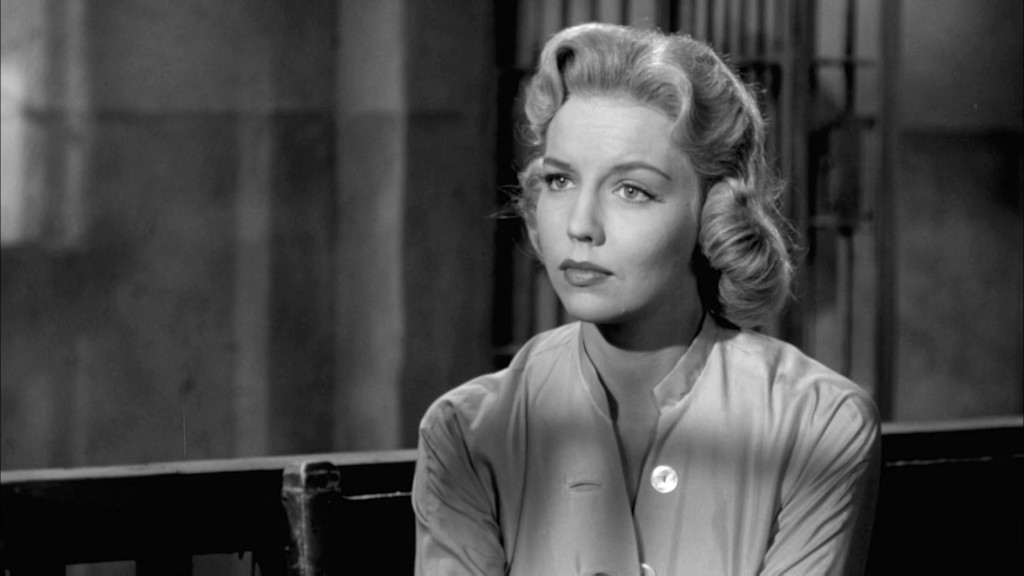
Sally Fraser, in the female lead, was a bit of a science fiction staple in the second half of the 50s. Like many young actresses of the era, she was spotted by an agent more for her looks than for her acting talent. She spent the majority of her 10-year acting career (1952-1962) doing guest spots in TV shows and bit-parts in movies. However, low-budget science fiction gave her rare opportunities to play leads. Her firsting SF outing was in a co-starring role opposite Peter Graves, Lee Van Cleef and Beverly Garland in Roger Corman’s It Conquered the World (1957), a company in which she was unfortunately out-acted. She then appeared in Richard Cunha’s Giant from the Unknown (1958), followed by Bert I. Gordon’s War of the Colossal Beast (1958) and Earth vs. the Spider (1958). In the early 60s, she left the movies and worked for a short time on stage, before retiring from showbiz.

Rico Alariz was a Mexican-born actor who worked in Hollywood between 1950 and 1992, primarily in television – he appeared in close to 100 films or TV shows, mostly as guest actor or in bit-parts, often playing Mexican bandits and henchmen, Spaniards or Native Americans.
Russ Bender, here in an unusually large role as Dr. Carmichael, appeared in small roles in a number of science fiction movies, beginning with an uncredited role as — again — Dr. Carmichae in The War of the Worlds (1953, review). Most likely his character’s name in War of the Colossal Beast (1958) was a tongue-in-cheek nof to his previous movie. He often appeared as military men, doctors and other authority figures, in films like It Conquered the World (1956, review), Invasion of the Saucer Men (1957), The Amazing Colossal Man (1957), Panic in Year Zero! (1962), The Satan Bug (1965), Space Probe Taurus (1965) and The Navy vs. the Night Monsters (1966).
The cast also includes 50s SF bit-part staples like John MacNamara and Roy Gordon. Warren Frost is best known for his recurring role as Dr. Will Hayward in Twin Peaks (1989-1991).

Composer Albert Glasser worked himself up the Holloywood ladder from copyist, stock music arranger and orchestrator to credited composer. His first on-screen credit as composer was for the Curt Siodmak adaptation The Monster Maker (1944, review), about which he said “What the hell? If I didn’t want it, they had ten guys waiting. I wanted credit.” With his ability to work fast (and therefore cheap), he became a sought-after composer for B-movies. His IMDb bio states: “He scored a staggering 135 movies between 1944 and 1962, not counting at least 35 features for which he received no credit. In addition to scoring 300 television shows and 450 radio programs, he arranged and conducted for noted American operetta composer Rudolf Friml and orchestrated for Ferde Grofé Sr.” Glasser composed 15 science fiction movies, including The Neanderthal Man (1953, review), The Amazing Colossal Man (1957, review), Attack of the Puppet People (1958, review), Teenage Caveman (1958, review), Earth vs. the Spider (1958) and The Cremators (1972). He was also musical director for Rocketship X-M (1950, review).
Sound editor Josef von Stroheim was none other than the son of demon director Erich von Stroheim. He went on to win a couple of Emmys for his work in TV.
Janne Wass
War of the Colossal Beast. 1958, USA. Directed by Bert I. Gordon. Written by George Worthing Yates & Bert I Gordon. Starring: Sally Fraser, Roger Pace, Duncan Parkin, Russ Bender, Rico Alariz, George Becwar, Robert Hernandez, Charles Stewart, June Jocelyn, John MacNamara, Loretta Nicholson, Raymond Winston, Jack Kosslyn, George Navarro, Bob Garnet, Stan Chambers, Roy Gordon. Music: Albert Glasser. Cinematography: Jack Marta. Editing: Ronald Sinclair. Art direction: Walter Keller. Makeup: Jack Young. Sound editor: Josef von Stroheim. Special & visual effects: Bert I. Gordon, Flora Gordon. Produced by Bert I. Gordon for Carmel Productions & American International Pictures.


 Scifist.
Leave a reply to tonycrnk Cancel reply