

Teens track down a giant spider that comes back to haunt their small town in Bert I. Gordon’s 1958 schlocker. Mr. B.I.G. has never bee associated with quality, but this is one of his least bad movies. 4/10
Earth vs. the Spider. 1958, USA. Directed by Bert I. Gordon. Written by Gordon, George Worthing Yates & Laszlo Görög. Starring: Ed Kemmer, Eugene Persson, June Kenney, Gene Roth. Produced by Bert I. Gordon. IMDb: 4.7/10. Letterboxd: 2.6/5. Rotten Tomatoes: N/A. Metacritic: N/A.

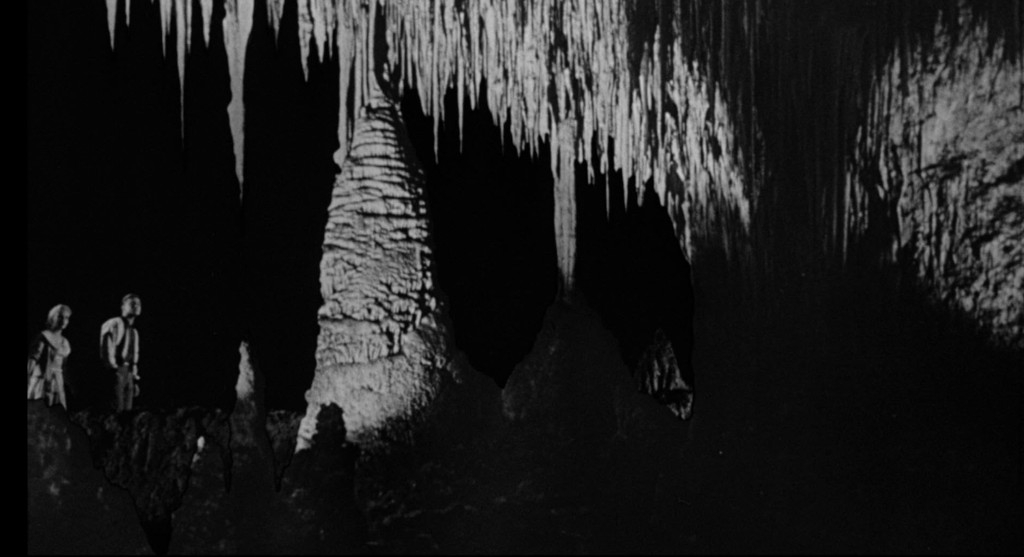
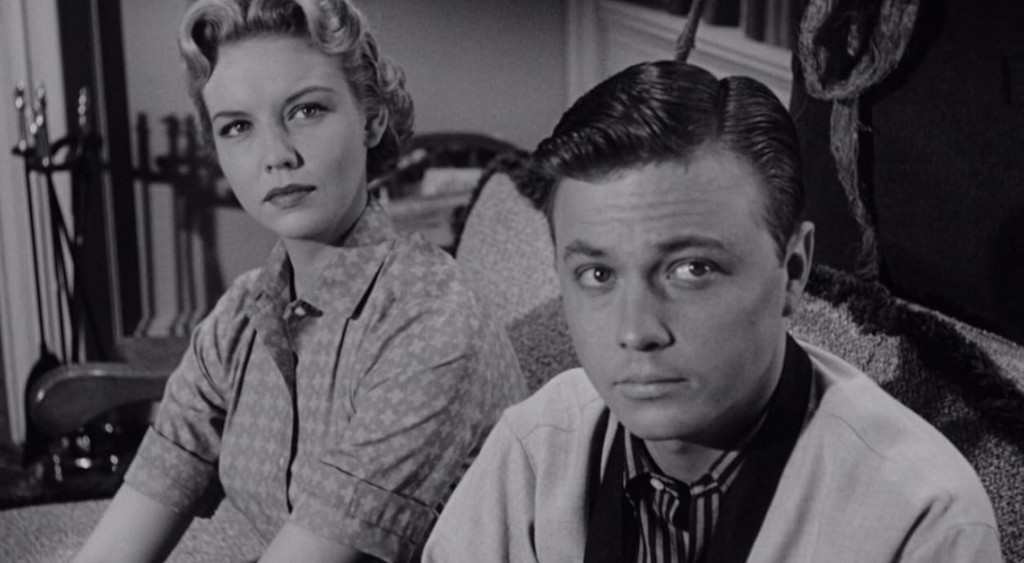
Jack Flynn (Merritt Stone) is riding his car back from the city to the small town of River Falls with a bracelet he has bought his daughter Carol for her birthday. However, on the deserted road, something smashes into his car. The next morning, Carol (June Kenney) and her boyfriend Mike (Eugene Persson) worry about Jack’s disappearance and ride out to investigate. They find his pickup truck crashed and empty by the roadside, and figure he might have gone into a nearby cave to keep warm. Descending ever-deeper into the massive network of caverns, Carol and Mike find the box with the bracelet and a happy birthday note to Carol, confirming Jack has entered the cave. But they get the fright of their lives as they encounter an enormous bird spider, and are lucky to get out alive.
All spider senses are tingling at the onset of Earth vs. the Spider, or simply The Spider, a low-budget movie from the one and only Mr. B.I.G., or Bert I. Gordon. Released in the fall of 1958, the movie was distributed by (who else?) American International Pictures, and was the last Bert Gordon movie released by AIP in over a decade to come.
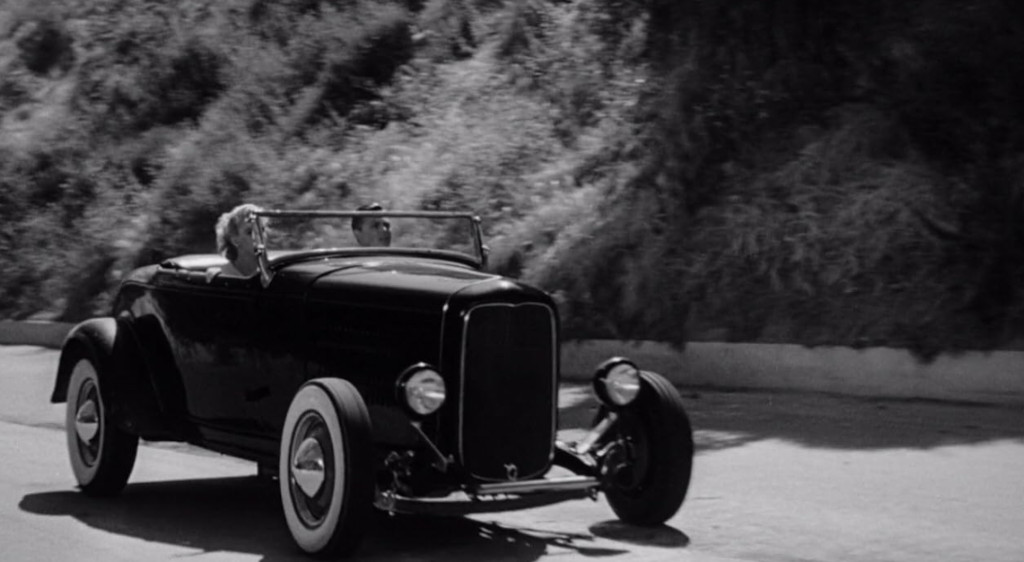
Back in River Falls, the teenagers have a hard time convincing local sheriff Cagle (Gene Roth) of the existence of a giant spider. However, high school science teacher, Prof. Kingman (Ed Kemmer) takes them on their word and convinces Cagle to send for a truckful of DDT and take a team out to look for Jack in the caves. Cagle is bemused, but does as the professor wishes. At the cave, sadly, they find Jack’s body – mummified and drained of all fluids. This, says Kingman, is proof of the spider. But Cagle still isn’t taking his word on it, until the team find a large spider web that the kids encountered earlier, and with it – the spider. Exterminators bombard the spider with DDT, but it manages to take out one of the deputies before it succumbs to the poison. Cagle orders the carcass to be taken into town for study, and it is placed – of all places – in the high school gymnasium.

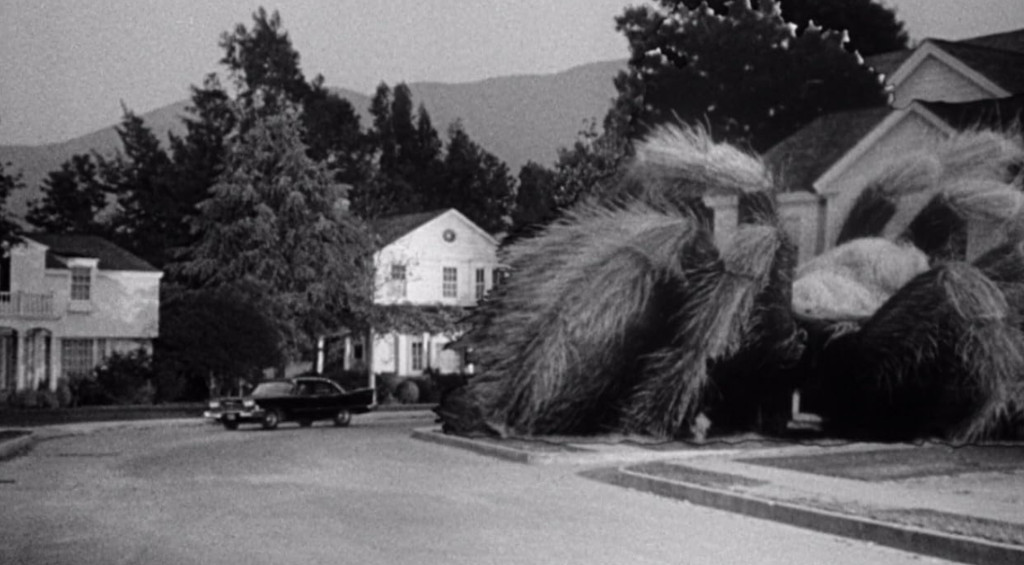
Despite orders to stay out, the high school band, with Mike’s friend Joe (Troy Patterson) sneak into the gymnasium to practice a rock and roll piece for the upcoming ball, and the school’s drama group follow to brush up on their dance moves. But the spider is of the old school, and no fan of rock music. Turns out the DDT only put it to sleep, and now it awakes because of the racket and calls for a good ol’ polka. The spider breaks out and starts its rampage on the town, and, as is prone to happen in these films, knocks out the long-range telephone communications, so there’s no chance to call for backup. It’s on the townsfolk to stop the unstoppable menace.

When the spider starts nibbling at the Kingman home, threatening his wife and child (Sally Fraser), Kingman is able to lure it back to its cave, and calls for the sheriff to put together a demolition team and seal the entrance to the cave. However, they soon learn that Mike and Carol have entered the cave in order to search for the bracelet, as Carol lost it during their earlier escapades. The question now is: who will get to the kids first? The rescuers or the spider?
Background & Analysis
By now, we have reviewed a good half-dozen films by Bert Gordon here on Scifist, and like most 50s B-movie lovers, we have a certain affection for these often ill-scripted, badly directed low-budget movies, most often involving amateurishly matted giants, lilliputians or oversized bugs and critters. While it’s a stretch to say that he ever made a good movie, there are those that are better than others, and Earth vs. the Spider from 1958 is generally considered one of his more accomplished ones. The film’s working title was Earth vs. the Spider, but when 20th Century Fox’s The Fly (1958, review) became a massive hit, AIP decided to rename the film simply as The Spider, which was the title it bore in all PR material. However, AIP was too cheap to change the title credits, which still read Earth vs. the Spider, which is why that is the title to which we usually refer today.
As usual, Gordon himself came up with the story of the film, produced, directed and created the special effects – with constant backup from his wife Flora. It was made for his own Santa Rosa Productions, and was made for American International Pictures for a budget of around $150,000, a tad higher than the studio’s normal budgets. The screenplay was written by science fiction specialist George Worthing Yates – who had already penned other films for Gordon – and Lazslo Görög, who had previously penned a The Mole People (1956, review) and The Land Unknown (1957, review) for Universal. The film was partly shot at the B-movie favourite location, Bronson Canyon, and at the entrance to the Bronson Caverns, and Griffith Park. The outdoor scenes of River Falls were filmed on Universal’s backlot set – I can clearly recognise sets from The Monolith Monsters (1958, review), released the same year. It was not, however, filmed at Carlsbad Caverns, as some reviewers claim, but used blown-up photographs of the caves into which the actors were dropped.
The movie came in at the tail end Hollywood’s giant monster craze, one to which Gordon himself had been a primary contributor – and it would remain his last giant critter movie until Empire of the Ants in 1977. The giant monster fad was really ignited by the re-release of King Kong (1933, review) in 1952, which in turn inspired The Beast from 20,000 Fathoms (1953, review), which in turn inspired the giant ant movie Them! (1954, review) – made on a substantial budget by Warner. Universal followed suit with Tarantula (1955, review), to which Earth vs. the Spider owes an obvious debt, and studios big and small started churning out B-movies concering gigantic lizards, octopuses, slugs, wasps, mantises, scorpions, spiders and robots, and of course Japan followed suit with all the varied monsters that turned up in the wake of Godzilla. Bert I. Gordon himself dealt with dinosaurs and grasshoppers before turning his sights at giant humans with The Cyclops (1957, review) and The Amazing Colossal Man (1957, review), creating something of a mini-fad of its own.
However, the major studios’ interest in giant critter movies faded almost as quickly as it began. Them! remained the only big bug film that got anywhere near an A-list budget, and the genre was soon passed to the realm of the low-budget B-movie, along with the rest of the science fiction genre. By 1958, no-one made big budget science fiction films, hardly even mid-budget ditto. However, the studios had realised that super-low-budget science fiction and monster movies made a good profit in the drive-in circuit. With American International Pictures as the guiding light, by 1958 production companies squeezed out as many horror and sci-fi B-movies they were capable of producing, hoping to cash in as much as possible before audiences got tired of the whole thing.
This was a golden opportunity for filmmakers like Roger Corman and Bert Gordon. Nobody cared much about the quality of the product, as long as the film had a monster, a sellable title and a poster that caught people’s attention.

All that being said, Earth vs. the Spider is actually one of Gordon’s more accomplished films. One reason for this is an unusually streamlined and on-point script. This is a film about a giant spider, and that is all it is about. The movie never veers off in pointless subplots, there’s no scheming bad guys, no tedious character drama or bolted-on romance. One of the script’s major flaws is that it never explains – or indeed even speculates about – where the giant spider has come from, why it is in the cave, and why it has grown so large. But in a way, this is also a boon. So many of these kind of films are dragged down by endless scenes in which this or that egghead gives a ludicrous explanation for why and how this or that monster exists, and people in lab coats stand around arguing how this or that monster should be destroyed – and it always bogs the movie down. No such thing in Earth vs. the Spider. It’s a plot that is economical and effective in its simplicity. Dad’s killed, teenagers look for him, find spider. Rescue party goes looking for dad, fight and catch spider. Spider breaks loose, rampages town, gets chased into cave, attacks teenagers, gets electrocuted. The end. That’s really all there is to it.
That’s not to say that this is a good script. It is derivative, completely devoid of originality and quite repetitive. To keep the plot going, the screenwriters need the characters to enter the cave not once or twice, but thrice. The lost bracelet is an extremely contrived plot twist to get Mike and Carol to put themselves in harm’s way again. The spider just randomly attacking Art Kingman’s house is not only contrived, its pointless. While the idea is to provide some personal stake for Kingman and an emotional punch, it falls flat because we have hardly met his wife and kid during the entire movie: there’s no reason for us to care what happens to them. The musical number in the middle of the film is just as ill-fitting as it always is in these movies (the song is not bad, though). And so on.

The dialogue is bad, but it is better than in the worst of Gordon’s films. It is mainly aimed at moving the plot along. The parts that do stand out are the disussions between the teens, written in a magnificently terrible faux-teen lingo, as if teens in the 50s would have constantly walked around talking in some kind of jazzy secret code.
It’s difficult to say who was mainly responsible for the script. Both George Worthing Yates and Lazslo Görög had both proved in the past that thay were capable of writing equally terrible films. A fun fact is that this was the third science fiction movie that Görög wrote, and all three take place to a large extent in caves. Yates had a pencheant for inserting a barrage of techno and science babble into his movies. This can be seen to some extent in Earth vs. the Spider as well, but it is not nearly as prevalent as in many other of his films.
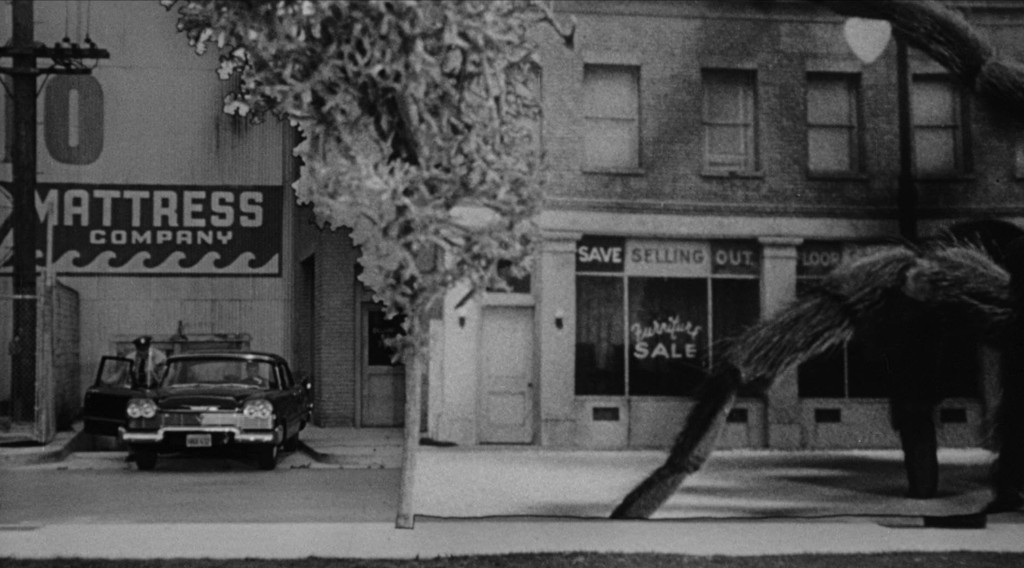
Many reviewers have latched on to the sub-par visual effects of Earth vs. the Spider. However, the effects are actually a lot better than the ones in many of Gordon’s earlier movies. Gordon has practiced and refined his technique over the years. Sure, there are still shots in which parts of the spider’s appendages are translucent, places in which the arachnid seems to hover above the ground and walk around with obvious matte lines. The split screens are also obvious, the miniature houses tilt, and it is clear as day that the actors are not walking through the Carlsbad Caves, but among cut-out photographs of the caverns. But there’s never the egregious scenes of a half-transparent spider showing the background through its entire body, and by this time Gordon had also refined his technique, so the matte lines here are less egregious than in previous movies. For the most part the effects are decent enough not to completely yank the viewer out of the movie.

Gordon is famous for his sub-par special effects, partly caused by the fact that he did his matte shots with an in-camera bipack process that he developed himself, and did much of the post-production in his own garage. Any slight misalignment of the two film strips would cause thick matte lines, and badly exposed travelling matte effects would often turn up translucent in the final movie. Also, instead of using miniatures or matte paintings, Gordon would often simply blow up photographs and glue them onto cardboard or plywood, which he would then film as such, giving buildings, or stalagtites for that matter, a phony flattened look. In later films, Gordon often chose to have his giant people walking behind such cut-outs, rather then matte them into the shots in front of the buildings, in an attempt to mimimize the translucency that inevitabely crept into his flawed travelling matte shots when he tried to shoot the actors against a black background and mis-matched the lighting. An extreme example of his use of photo prints is when his giant grasshoppers invade Chicago in Beginning of the End (1957, review). Here, Gordon often didn’t even bother to attempt matte shots, but simply poured the grasshoppers onto large blow-ups of photographs of Chicago buildings and shorelines and filmed them as such. The effect works reasonably well until the grasshoppers start walking out onto the sky.
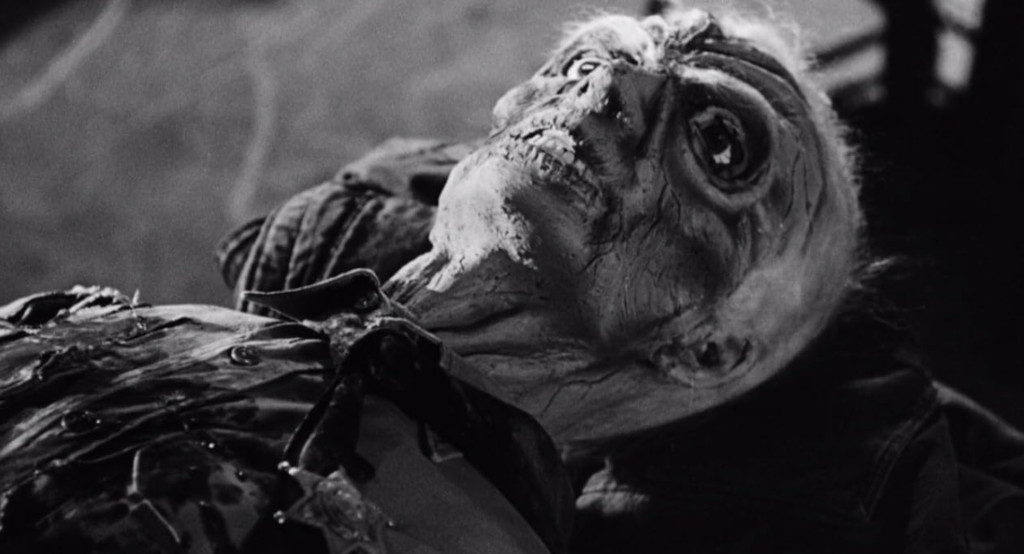
By any normal standards, the effects in Earth vs. the Spider are quite bad. However, by the standards of a Bert Gordon film, they are an improvement over much of his work, and in some instances actually work rather well. As far as practical effects go, we have two major props in the movie. The first is a single, hairy spider leg seen in a number of shots, in particular when the spider is in storage in the gymnasium. The other is the dried-up mummies of the spider’s victims. These were both made by AIP:s special effects guru Paul Blaisdell. The leg was a hinged wooden construction covered in broom straw, and operated with a string, which worked without a hitch, according to Randy Palmer’s biography. For the dried-upp mummies, Blaisdell used his usual technique of creating a dummy based on models of himself out of latex and foam rubber. The same dummy was used for both victims, just with a change of wardrobe.
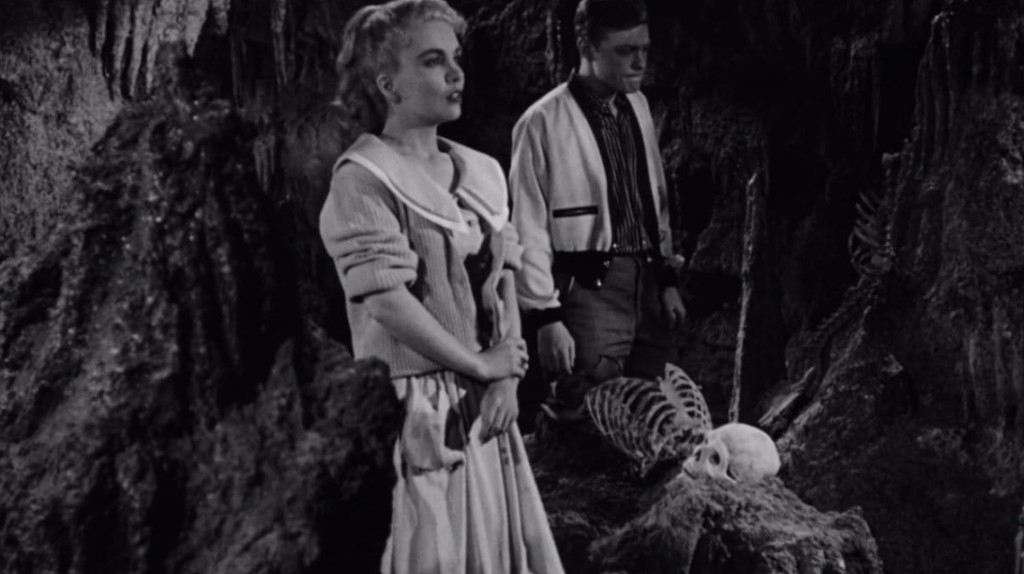
Earth vs. the Spider is a typical film for its time. It was one of the several hundreds of low-budget SF/monster movies that were being produced by Hollywood studios and independets producers during the last years of the 50s and the first years of the 60s – aimed almost solely for the drive-in market. It displays all the usual characteristics of this group of movies: a hastily written script, extensive filming around Griffith Park and Bronson Canyon, struggling character actors and young hopefuls either phoning in their performances or overcompensating for a lack of experience, cheap and hardly convincing special effects, bad dialogue and perfunctory direction to match the short shooting schedule. The further toward the 60s Hollywood moved, a picture like this became ever more a copy of a copy of a copy, seldom bringing new ideas to the table. Earth vs. the Spider is a servicable programmer for friends of B-movie monsters, but little more than that.
Reception & Legacy

Earth vs. the Spider opened in September, 1958, on a double bill with Ed Nelson’s super-cheap The Brain Eaters (review), and the pair probably did decent business at the drive-in. As mentioned above, the movie was retitled The Spider in all marketing material, despite still bearing the original title in the film’s title sequence.
Trade magazines gave the picture modestly positive reviews – in fact among the most positive Gordon ever received in his career – and didn’t seem to be bothered at all by the shoddy special effects. The Film Bulletin wrote that “The Spider expertly pulls out all the stops in the special effects department”, while Varity wrote: “It is characterized by well done special effects, a reasonably credible plot, and will be a good feature for the exploitation market”. Harrison’s Reports called the movie “a fair enough picture of its kind, even if it follows a formula pattern”. Jack Moffitt said the film was “a better-than-average film shocker”. Even British Monthly Film Bulletin, often critical towards these kind of movies, gave the film their middle 2/3 rating, writing: “The success of any routine, low-budget “monster” thriller, with no other aspirations, lies almost entirely with the trick work, which here is variable; acting and general production values are adequately imaginative and frightening.”

In The Encyclopedia of Science Fiction Movies Phil Hardy calls Earth vs. the Spider a “cheapskate version of Tarantula” and notes that Gordon was “a director whose posters were invariably better than the films they advertised”. In Keep Watching the Skies!, Bill Warren does note that this is one of Gordon’s better films it “is so simply conceived it verges on elegance, in the mathematical sense of the word, but it is still silly and shoddy”. He continues: “While the film is generally mediocre, this singleness of purpose and the connection of all actions to the spider make the film especially coherent. […] But due to Gordon’s ineptitude, scenes are flat and dull. […] The settings are also dull […] The acting, too, is dull”.
Richard Scheib at Moria gives the movie 1/5 stars, writing: “As with most of Bert I. Gordon’s films, Earth vs the Spider is cheap and fairly awful. The title – Earth vs the Spider – sets up the promise of a grandiose conflict, is even suggestive of the entire world being taken on by a spider. However, what is delivered falls woefully flat of any such promise in actuality.” Glenn Erickson writes at Trailers from Hell that the script “has a dashed-off feel that matches the haphazard direction of Mr. B.I.G.”. However, Erickson also notes that the film does have a veneer of professionalism provided by decent sets, like Universal’s “Big Street” set and some fairly large cave sets, as well as unusually many extras for a Gordon film. Still, he notes, the effects are terrible, the plot bizarre, the dialogue bewildering and the acting dull. His bottom line: “technically and aesthetically, this a terrible film. I think you’ll enjoy it.”.
As of writing, Earth vs. the Spider has a 4.7/10 audience rating on IMDb – based on over 3,600 votes, which does make it one of the better known films we’ve reviewed here in a while. Its 2.6/5 rating on Letterboxd is also based on around 2,800 votes. It does not have enough entries for a critic consensus on Rotten Tomatoes.
The movie was featured on the third season of MST3K, which probably accounts for its “popularity”, and was the pick for a Christimas Day movie in 2021 and the New Years Day movie in 2022 on the long-running hosted horror movie show Svengoolie. In 2002 a clip from the movie was seen in Lilo & Stitch.
In 2001 effects wizard Stan Winston, Sam Arkoff’s son Lou and actress/producer Colleen Camp produced five TV movies under the banner “Creature Features” for Cinemax, all of them remakes – or really reimaginings – of old AIP horror/SF movies. One of these was Earth vs. the Spider, however the 2001 film only borrows the title. The plot has nothing in common with the original movie, and is rather a sort of mashup between Spiderman and David Cronenberg’s The Fly (1986). Dan Aykroyd was first-billed, but the main character, a nerdy nightwatchman who injects himself with an experimental spider serum, was played by TV actor and director Devon Gummersall. Despite largely negative reviews, the picture was nominated for a Saturn Award.
Cast & Crew

I have written at length about Bert and Flora Gordon elsewhere, so if you’re interested in learning more, you can, for example, head over to my review of Beginning of the End. In short, Bert I. Gordon and his wife Flora Gordon were a two-person all-round production crew, with Bert often co-writing, producing and directing his low-budget films, with a great deal of help from Flora. Flora has been described as an all-round production manager, doing everything from catering to production administration and generally keeping people happy on set. Bert is best known for his garden-variety special effects, often done in his own garage. Here, Flora was also a crucial collaborator, even if she often went uncredited. Bert Gordon specialised in all things giant, making good on his initials B.I.G. He was active as a producer and director all the way up to the late 80s, even making a comeback in 2015, but is probably best known for his string of black-and-white low-budget science fiction movies produced from the mid- to late 50s, starting with King Dinosaur (review) in 1955 and culminating in The Amazing Colossal Man (review) and its sequel War of the Colossal Beast (review), both made in 1958.
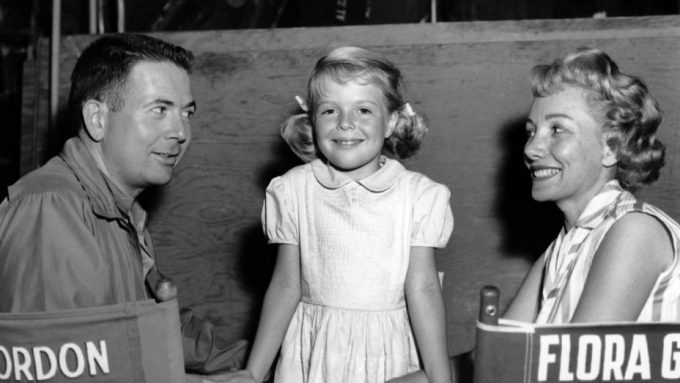
After Earth vs. the Spider, Gordon had made seven gigantism films in three years and took a hiatus from the genre he had become the poster boy for, and tried his hand at other genres, with varying results, often starring his daughter Susan. He made the family-friendly pirate movie The Boy and the Pirates (1960), co-starring Susan Gordon, the horror thriller Tormented (1960) with Susan and SF staple Richard Carlson, and the sword-and-magic film, aptly titled The Magic Sword (1962), starring Basil Rathbone, and with a cameo by Vampira actress Maila Nurmi. However, he returned to his house bible, H.G. Wells‘ The Food of the Gods, in his clumsy attempt at a teenage counter-culture movie Village of the Giants in 1965, co-starring Ron Howard and Beau Bridges. And he took on the other part of Wells’ book in The Food of the Gods (1976), with Robert Lansing and Joan Collins.
Flora Gordon worked on all of her husband’s movies between 1955 and their divorce in 1979. After that she struck out on her own (as Flora Lang) as a production manager on a handful of feature and TV movies, and worked as the unit production manager on the successful soap opera Dynasty between 1981 and 1985. She was one of the founding members of the Women’s Committee at the Directors Guild of America.

Born in 1901, screenwriter George Worthing Yates seems to have been writing short stories and treatments as early as the twenties, when his one of his westerns were adapted into film. From 1938 to 1954 he contributed to about a dozen screenplays, mostly B westerns, but also crime dramas and adventure films. In the thirties and forties he released a handful of mystery novels, sometimes working under pseudonym with another author. He found his stride with the first draft of the giant ant film Them! (1954, review), and after that worked almost exclusively in science fiction. He did a draft for George Pal’s and Byron Haskin’s semi-flop Conquest of Space (1955, review), but not much more than a few basic ideas of his were used for the finished film. He then contributed to such films as It Came from Beneath the Sea (1955, review) and Earth vs. the Flying Saucers (1956, review), The Amazing Colossal Man (1957, review), Attack of the Puppet People (1958, review), The Flame Barrier (1958, review), War of the Colossal Beast (1958, review), Space Master X-7 (1958, review), Frankenstein 1970 (1958, review) and Earth vs. the Spider (1958), making him perhaps the most prolific sci-fi screenwriter of the late fifties.
Screenwriter László Görög was born László Guttmann in Austria-Hungary in 1903, and emigrated to the US in 1939. In his birth country, Görög worked as a journalist and a prolific writer of detective and crime novellas. It wasn’t until he arrived in Los Angeles, however, that he entered the movie business. Without a studio contract, Görög received commissions from various companies. His first produced screenplay was Tales of Manhattan (1942) for Fox, then he wrote The Affairs of Susan (1945) for Columbia, which earned him an Oscar nomination for best original story. However, film work seems to have run dry in 1947, and he has no credits before 1953, when he started writing for television. Görög mainly wrote for anthology shows and had a few film assignments as well. His science fiction movies include The Mole People (1957), The Land Unknown (1957, review) and Earth vs. the Spider (1958). He retired in 1963.
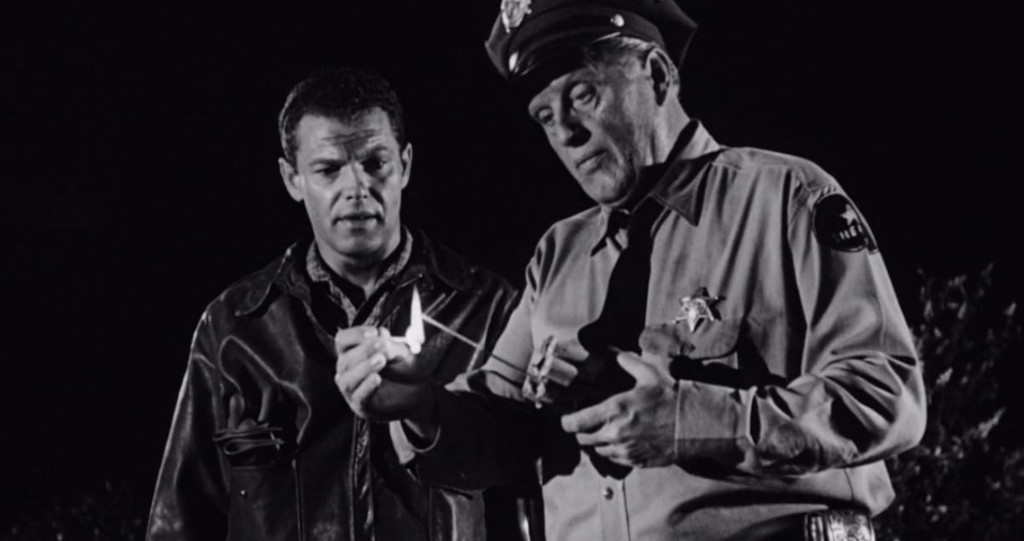
Lead actor Ed Kemmer was a busy TV actor, active between 1950 and 1953, perhaps best remembered for playing the lead role as Commander Buzz Corry in ABC’s hugely popular kiddie matinee show Space Patrol between 1950 and 1955. A few years later he continued his career as an astronaut in the lead of the Earth-bound daytime soap opera The Clear Horizons (1960-1962), set at Cape Canaveral. He spent most of the rest of his career doing guest spots or minor recurring roles in TV shows. In 1957-1958 he had a short stint as a leading man in B-movies, including Richard Cunha’s horror movie Giant from the Unknown (1958) and Bert I. Gordon’s Earth vs. the Spider (1958), both, incidentally featuring Sally Fraser. Kemmer only appeared in 13 movies, most of them in bit-parts.
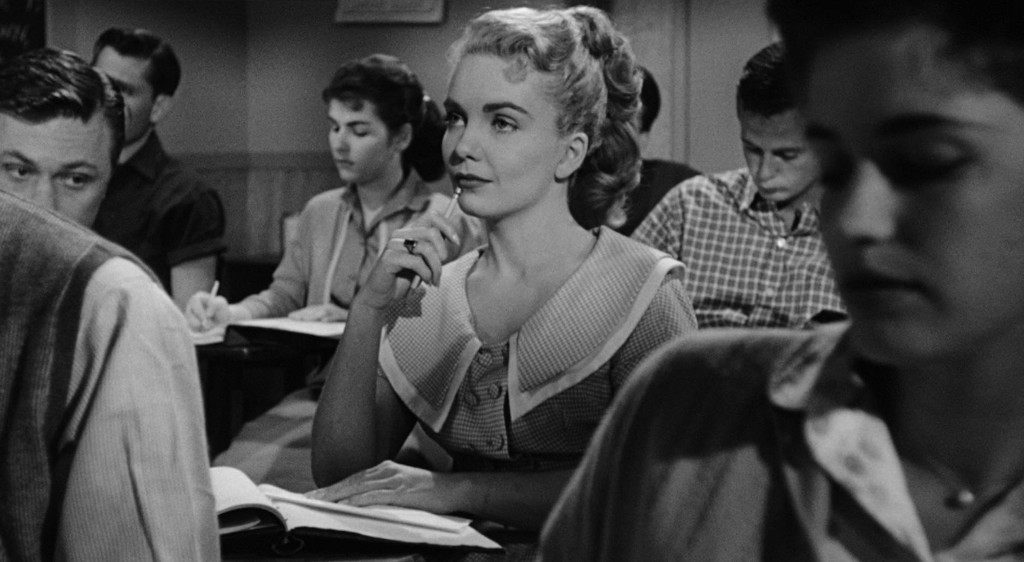
June Kenney’s mom set her on the path for showbiz in her childhood, curling her to dancing and singing lessons, and in her late teens, she moved to Hollywood in the early 50s, doing odd jobs, Playhouse theatre and a handful of small roles in movies and TV. It was Roger Corman who gave Kenney her breakthrough in 1957, by casting her in the lead of the teenage delincuency movie Teenage Doll. In 1957 and 1958 Kenney was a hot ticket in the teenage market, playing leads in half a dozen AIP movies, including Bert. I. Gordon’s Attack of the Puppet People (1958, review) and Earth vs. the Spider (1958). She continued in a few TV appearances and a couple more B-movies in the early 60s, before deciding enough was enough and took a job reading commercials in radio.

Eugene Persson started his career as a child actor at the age of 12 in 1946, mostly appearing in small movie roles, and appeared as one of the Kettle kids in a couple of Ma and Pa Kettle movies in the early 50s, after which he appeared primarily in guest spots on TV. Earth vs. the Spider (1958) was his first movie role as an adult. He had a bit-part in The Party Crashers (1958) and another co-lead in Bloodlust! (1961), again teaming up with June Kenney. This was his last film, as he decided to go into stage producing. Persson became a very successful theater producer, producing plays in Los Angeles, New York and London. His most lasting legacy is the musical You’re a Good Man, Charlie Brown (1967), based on the popular Peanuts comic strip. The original Broadway production ran for over 1,600 performances. Persson also produced the 1999 Broadway revival, which was awarded with two Tonys.
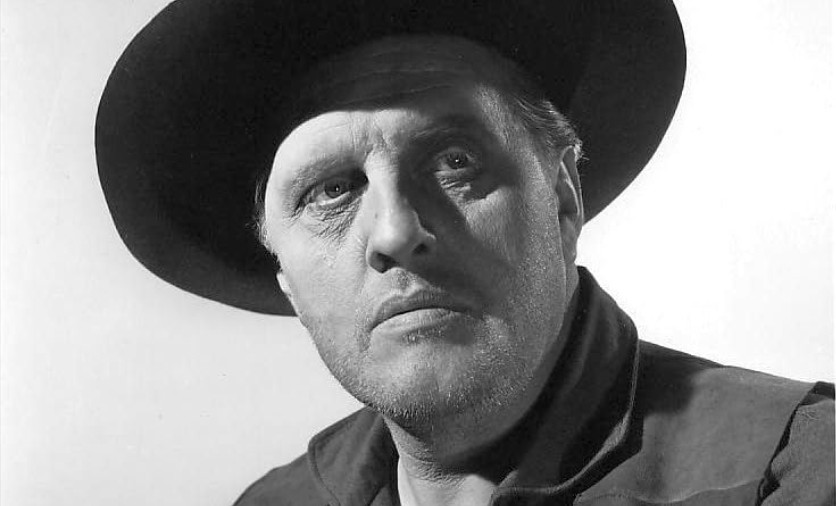
Gene Roth‘s burly appearance and menacing look made him perfect for villains, henchmen and the occasional stern authority figure, often playing sheriffs. He appeared in over 250 movies or TV serials between 1922 and 1967, including playing the main villains in a small handful of Columbia movie serials in the early 50s. He was also recogniseable for appearing as a foil for the Three Stooges in a number of movies. Roth’s perhaps most prominent role came in Bert I. Gordon’s Earth vs. the Spider (1958, where he played the sheriff, which he also did in Attack of the Giant Leeches (1959). He appeared as the main Nazi henchman Igor in She Demons (1958, review), in which he has a lengthy fisticuff with lead actor Tod Griffin. He appeared in minor roles in a number of other SF movies, including Red Planet Mars (1952, review), Red Snow (1952, review) and Twice Told Tales (1963).
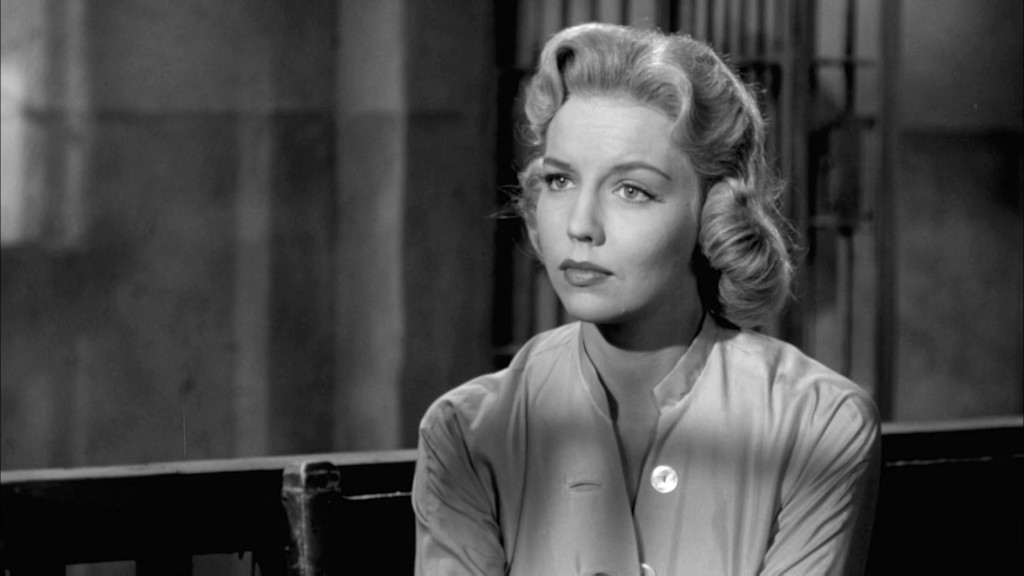
Sally Fraser, who has a small part as Ed Kemmer’s wife in Earth vs. the Spider, was a bit of a science fiction staple in the second half of the 50s. Like many young actresses of the era, she was spotted by an agent more for her looks than for her acting talent. She spent the majority of her 10-year acting career (1952-1962) doing guest spots in TV shows and bit-parts in movies. However, low-budget science fiction gave her rare opportunities to play leads. Her firsting SF outing was in a co-starring role opposite Peter Graves, Lee Van Cleef and Beverly Garland in Roger Corman’s It Conquered the World (1957), a company in which she was unfortunately out-acted. She then appeared in Richard Cunha’s Giant from the Unknown (1958), followed by Bert I. Gordon’s War of the Colossal Beast (1958) and Earth vs. the Spider (1958). In the early 60s, she left the movies and worked for a short time on stage, before retiring from showbiz.
In a small role, we also see Jack Kosslyn, who played one of the miniature people in Gordon’s Attack of the Puppet People.

Earth vs. the Spider is also populated by the usual set of overgrown teenagers. Joe, whose hot rod Carol and Mike borrow throughout the film, is played by Troy Patterson, who was 35 at the time of filming. Patterson had small roles in two dozen B-movies during the 50s and early 60s, including Attack of the Puppet People (1958) and Bloodlust! (1961).
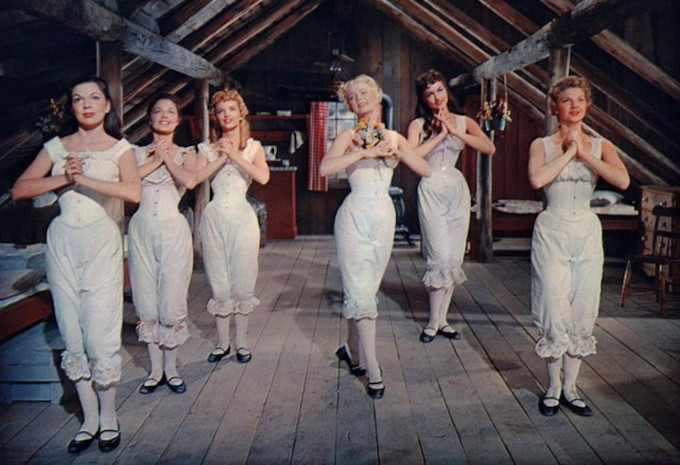
Nancy Kilgas, 28 at the time of making Earth vs. the Spider, had a background in dance, and was often cast in roles that took advantage of her talents. She is perhaps best known as one of the titular dancing and singing brides in Stanley Donen’s musical Seven Brides for Seven Brothers (1954), and as Aphrodite in its follow-up Athena (1954). She also danced her way through Fred Zinnemann’s Oklahoma (1955), AIP’s Shake, Rattle and Roll! (1956) and Donen’s Funny Face (1957). Non-dancing bit-parts included Gorilla at Large (1954), The Man of a Thousand Faces (1957), High School Hell Cats (1958) and the vampire western Curse of the Undead (1959).

The high school band waking up the spider in Earth vs. the Spider contained a couple of interesting names. Pianist Dick D’Agostin was a dancer and rock musician who turned up in a couple of dancing movie roles in the 50s, and wrote about dance for teen magazines. His band Dick D’Agostin and the Swingers had a couple of minor hits in the late 50s, but hit the big time as Eddie Cochran’s touring band. D’Agostin himself worked as a session musician for numerous big stars, including Bobby Vee, Sam Cooke and Ritchie Valens. Some sources claim that Dick D’Agostin and the Swingers is the band that performed in Earth vs. the Spider, but that is not the case.
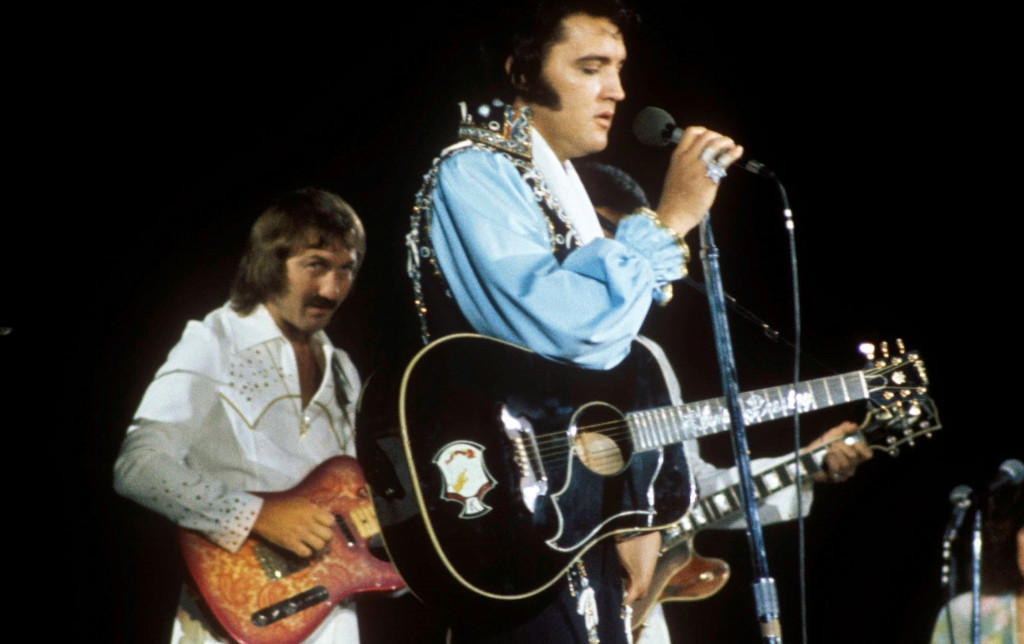
If Dick D’Agostin played with all the Elvis Presley imitators, then guitarist James Burton got to work with the man himself, as the bandleader for Elvis between 1969 and the King’s death in 1977. Burton is a revered session musician, and an inductee in the Rock and Roll Hall of Fame and a whole array of other hall of fames. He was ranked in 2023 by Rolling Stone magazine as the 24th best guitarist in history. Aside from Elvis, he worked with artists like Ricky Nelson, Johnny Cash, Emmylou Harris, Jerry Lee Lewis, Elvis Costello, Joni Mitchell, The Byrds, Frank Sinatra, Nancy Sinatra and Townes Van Zandt. Burton was also one of the session musicians that recorded several records by The Monkees. As late as 2023, Burton played a “James Burton & Friends” concert at the London Palladium, with friends such as James May, Elvis Costello and Ronnie Wood.
Janne Wass
Earth vs. the Spider. 1958, USA. Directed by Bert I. Gordon. Written by Gordon, George Worthing Yates & Laszlo Görög. Starring: Ed Kemmer, Eugene Persson, June Kenney, Gene Roth, Sally Fraser, Hal Torey, June Jocelyn, Mickey Finn, Troy Patterson, Skip Young, Hank Patterson, Jack Kosslyn, Nancy Kilgas, Dick D’Agostin, James Burton. Music: Albert Glasser. Cinematography: Jack Marta. Editing: Ronald Sinclair. Set decoration: William Calvert. Makeup: Allen Snyder. Sound: Al Overton. Special effects: Bert & Flora Gordon, Paul & Jackie Blaisdell. Produced by Bert I. Gordon for Santa Rosa Productions & American International Pictures.
 Scifist.
Leave a comment